
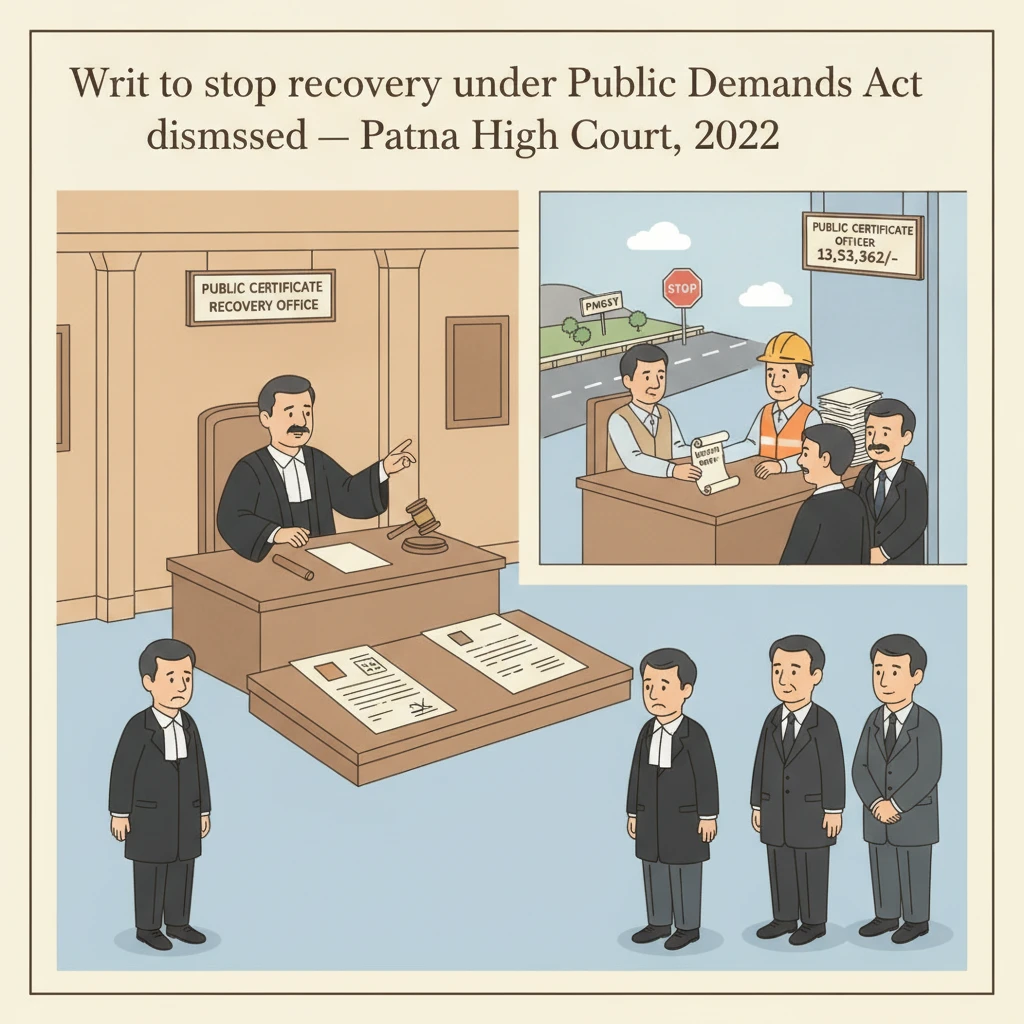
The Patna High Court held that the Certificate Officer had jurisdiction to proceed because the contract itself allowed such recovery.
The Court refused to examine disputed contract facts in writ jurisdiction and directed the contractor to use the statutory objection process.
The writ petition was dismissed, leaving the contractor free to contest liability before the Certificate Officer.
Case Background
The case arose from a road work contract under the Pradhan Mantri Gram Sadak Yojana (PMGSY). The petitioner was the contractor engaged by the Rural Works Department, Government of Bihar.
The contract contained a clause in the Standard Bidding Document (SBD), specifically Clause 53.1(ii), which stated that if the contract was terminated for fundamental breach, the employer could assess the cost of rectifying defects. Any balance amount still unrecovered after adjustment from security deposit, performance security, and other dues payable from the State or public sector works would be recovered as arrears of land revenue, i.e., as a “public demand”.
According to the State, the petitioner failed to complete the contracted road work. The agreement was rescinded for fundamental breach of contract. The security deposit and performance security were forfeited under Clause 53 of the SBD, and a balance liability of Rs. 13,53,362/- remained towards “risk and cost”.
By office letter dated 18-03-2021 bearing Memo No. 510 (Annexure-J to the counter affidavit), the Executive Engineer informed the petitioner about this liability and warned that, if the amount was not deposited, action would be taken under the Bihar and Orissa Public Demands Recovery Act, 1914 (the Act).
As the amount was not paid, Certificate Case No. 3 of 2021-2022 was initiated before the District Certificate Officer, Bhagalpur. On 14-07-2021, a notice under Section 7 of the Act was issued to the petitioner for recovery of Rs. 13,53,362/- as a public demand.
Instead of filing an objection under Section 9 of the Act before the Certificate Officer, the petitioner approached the Patna High Court under its civil writ jurisdiction (CWJC No. 15650 of 2021). He sought quashing of the entire certificate proceedings and the Section 7 notice, and an order restraining the authorities from proceeding with recovery.
What the Court Examined and Decided
The Division Bench of the Patna High Court, comprising Hon’ble Mr. Justice Chakradhari Sharan Singh and Hon’ble Mr. Justice Madhuresh Prasad (author of the judgment), examined whether the certificate proceedings were without jurisdiction and liable to be quashed at the threshold.
The petitioner’s primary argument was that the amount of Rs. 13,53,362/- did not qualify as a “public demand” under Section 3(6) of the Act. Therefore, he contended, the Certificate Officer had no jurisdiction to entertain the requisition or to issue the notice under Section 7.
Section 3(6) defines “public demand” as any arrear or money mentioned or referred to in Schedule I, including the interest legally chargeable up to the date of signing the certificate. The Court, therefore, turned to Schedule I of the Act, which lists the kinds of dues recoverable as public demand.
The petitioner relied specifically on Clause 9 of Schedule I, which covers “any money payable to a servant of the Government or any local authority, in respect of which the person liable to pay the same has agreed, by a written instrument, that it shall be recoverable as a public demand.”
On this basis, the petitioner argued that unless a written agreement specifically authorized recovery as a public demand, the amount could not fall within the definition. He claimed that the conditions under the contract for invoking the Act were not satisfied.
He further argued that Clause 32 of the General Conditions of Contract (GCC), which deals with defect liability period and routine maintenance of PMGSY roads for five years, applied only after completion of works. Since, according to him, the road work had not been completed, any “defect liability” amount quantified under Clause 53.1(ii) of the SBD could not be treated as a public demand. Thus, the entire certificate case was described as without jurisdiction.
It was, however, not in dispute that the contract contained a specific agreement in Clause 53.1(ii) of the SBD that any money payable which remained unrecovered would be recoverable as a public demand.
When the Bench asked why the petitioner had not approached the Certificate Officer with an objection under Section 9 of the Act, counsel replied that the Certificate Officer had already “signed the certificate” under Section 6. Once such satisfaction under Section 6 was recorded, he argued, it would be futile to file an objection under Section 9. He treated the Section 6 satisfaction as final and relied on the Supreme Court judgment in S.R. Bommai v. Union of India, (1994) 3 SCC 1, to support the idea that once satisfaction is recorded, courts should not go behind it.
On the other hand, the State contended that Clause 53.1(ii) of the SBD clearly enabled such recovery. The clause provided that:
- If the contract is terminated for fundamental breach, the Engineer shall assess the cost of having the defects corrected.
- If the total amount due to the employer exceeds any payment due to the contractor, the difference shall be recovered from the security deposit and performance security.
- Any amount still remaining unrecovered shall be recovered from other dues payable to the contractor from the State Government or any other State or public sector works.
- If even then some amount remained unpaid, it would be recovered as arrears of land revenue.
The State pointed out that the petitioner had not completed the work in time, his application for extension of time was irrelevant once the contract was rescinded, and his liability was already fixed under departmental norms. Therefore, recovery as a public demand was fully justified under the contract terms.
The Court framed the central issue as whether the existence of Clause 53.1(ii) and the factual background around rescinding the contract could be treated as matters going to the “jurisdiction” of the Certificate Officer, or merely as questions on the merits of the claim.
The Bench held that whether Clause 53.1(ii) applied in the particular factual circumstances, and how Clause 53 should be interpreted, were all questions of fact and contract interpretation. These are matters for the Certificate Officer to examine, not for the High Court to decide in a writ petition.
The Court emphasized that the agreement clearly contained a written clause authorizing recovery of unrecovered dues as arrears of land revenue. Therefore, the basic jurisdictional condition under the Act—existence of a written instrument for such recovery—was satisfied. On this basis, the Court rejected the argument that the certificate proceedings were wholly without jurisdiction.
The Court noted that if there had been no such clause in the written contract, the petitioner could then have argued that the Certificate Officer lacked jurisdiction. But here, such a clause did exist and was undisputed.
To address the argument about “jurisdiction”, the Court relied on the Supreme Court’s judgment in Nusli Neville Wadia v. Ivory Properties, (2020) 6 SCC 557, which endorsed the earlier judgment in Kamalakar Eknath Salunkhe v. Baburav Vishunu Javalkar, (2015) 7 SCC 321. Referring to paragraph 16 of Kamalakar Eknath Salunkhe, the Court explained that “jurisdiction” is used in a narrow sense—power to entertain the matter by virtue of value, place and subject matter.
The Court observed that Clause 53.1(ii) did not take away the inherent jurisdiction of the Certificate Officer. At most, it could be seen as a contractual condition regulating what kind of amounts may be recovered as public demand. Such conditions may affect whether a particular demand is ultimately recoverable, but they do not extinguish the authority of the Certificate Officer to examine and decide the issue.
The Bench then turned to Section 6 of the Act. It held that the satisfaction of the Certificate Officer under Section 6—that the demand is recoverable and not barred by limitation—is only a preliminary satisfaction to sign and file the certificate. It is not a final or conclusive finding.
Under the statutory scheme, the debtor can file a petition denying liability under Section 9. After hearing both sides and recording evidence if necessary, the Certificate Officer, under Section 10, must determine whether the debtor is liable for the whole or any part of the amount. The Certificate Officer can then set aside, modify or vary the certificate accordingly.
Therefore, the Court held, the petitioner’s argument that the Section 6 satisfaction is final and cannot be questioned is “misconceived and erroneous”. The jurisdiction of the Certificate Officer under Section 10 is wide enough to examine disputes about the amount and its recoverability.
The Bench also rejected the petitioner’s reliance on S.R. Bommai. That case dealt with the President’s satisfaction under Article 356(1) of the Constitution for imposing President’s Rule, which has the grave consequence of dissolving an elected State Legislature. The Court held that the context of constitutional judicial review in S.R. Bommai could not be compared with routine monetary recovery under the Public Demands Recovery Act. The Act itself provides a detailed mechanism for objection and adjudication, making the analogy inappropriate.
Finally, the Court held that issues regarding the quantification of the demand, whether the work was completed or not, and whether the contract conditions were fulfilled, are purely contractual disputes in the realm of private law, without any public law element. Such disputes should be raised before the Certificate Officer under Sections 9 and 10 of the Act and not in a writ petition.
To avoid prejudicing the petitioner’s case in future proceedings, the Court clarified that nothing in its judgment should be treated as an observation on the merits of the petitioner’s liability. All factual disputes and objections regarding the amount and its recoverability were expressly left open to be decided by the Certificate Officer, if the petitioner chooses to file a petition denying liability.
On this reasoning, the Patna High Court dismissed the writ petition.
Why This Judgment Matters
This judgment is significant for contractors and others facing recovery of dues by the State through the Bihar and Orissa Public Demands Recovery Act, 1914.
First, the Patna High Court confirmed that when a written contract expressly authorizes recovery of dues as “arrears of land revenue” or “public demand”, the Certificate Officer has jurisdiction to start certificate proceedings. The High Court will not normally interfere at the threshold on the ground of “lack of jurisdiction”.
Second, the Court made it clear that preliminary satisfaction of the Certificate Officer under Section 6 is not final. A debtor is not helpless once a certificate is signed. He or she can file an objection under Section 9 and seek a full adjudication under Section 10, where the Certificate Officer can even set aside the entire demand.
Third, the judgment draws a line between public law and private law disputes. Issues about whether the work was completed, whether time extension should have been granted, or whether department norms were correctly applied are contractual disputes. These are to be addressed in the statutory process or appropriate civil forums, not by invoking writ jurisdiction unless there is a clear public law element or patent illegality.
For readers who are contractors or suppliers to the government, the message is clear: if your agreement allows recovery as a public demand, and a certificate case is started, you should promptly use the in-built objection mechanism before the Certificate Officer rather than expecting the High Court to quash the proceedings outright.
Legal Issues and Answers
Issue: Does the existence of a clause in the contract authorizing recovery of dues as arrears of land revenue give the Certificate Officer jurisdiction to initiate proceedings under the Bihar and Orissa Public Demands Recovery Act, 1914?
Answer: Yes. Since Clause 53.1(ii) of the contract expressly permitted recovery as a public demand, the Certificate Officer had jurisdiction to issue the certificate and notice.
Issue: Is the preliminary satisfaction of the Certificate Officer under Section 6 of the Act final and immune from challenge, making an objection under Section 9 futile?
Answer: No. Section 6 satisfaction is only preliminary. The debtor may file an objection under Section 9, and under Section 10 the Certificate Officer can set aside, modify or vary the certificate after hearing.
Issue: Should the High Court, in writ jurisdiction, decide disputed factual and contractual questions about quantification of dues and enforceability of contract clauses in such recovery cases?
Answer: No. These are private law and contractual issues best decided by the Certificate Officer under the Act’s statutory scheme; the High Court declined to exercise writ jurisdiction over them.
Cases Cited by the Court
- Nusli Neville Wadia v. Ivory Properties and others, (2020) 6 SCC 557.
- Kamalakar Eknath Salunkhe v. Baburav Vishunu Javalkar and others, (2015) 7 SCC 321.
- S.R. Bommai & others v. Union of India & others, (1994) 3 SCC 1 (referred by petitioner and distinguished).
Case Details
Case Number: Civil Writ Jurisdiction Case No. 15650 of 2021
Case Title: Shiv Ranjan Kumar v. The State of Bihar & Ors.
Citation: 2022 (2) PLJR 495
Court: High Court of Judicature at Patna
Coram: Hon’ble Mr. Justice Chakradhari Sharan Singh and Hon’ble Mr. Justice Madhuresh Prasad
Date of Judgment: 21-03-2022
For the Petitioner: Mr. Prabhat Ranjan, Advocate
For the Respondents (State of Bihar and others): Mr. Kameshwar Pd. Gupta, GP-10 with Mr. Satyavart, AC to GP-10
Nature of the Case: Writ petition challenging certificate proceedings and notice under Section 7 of the Bihar and Orissa Public Demands Recovery Act, 1914.
Statute Involved: Bihar and Orissa Public Demands Recovery Act, 1914 (particularly Sections 3(6), 6, 7, 9 and 10); Contract clauses including Clause 32 of General Conditions of Contract and Clause 53 (including 53.1(ii)) of the Standard Bidding Document for PMGSY works.
Link to Judgment: Click here to read the full judgment of the Patna High Court
If you found this explanation helpful and wish to stay informed about
how legal developments may affect your rights in Bihar,
you may consider following Samvida Law Associates for more updates.







