

Case Background
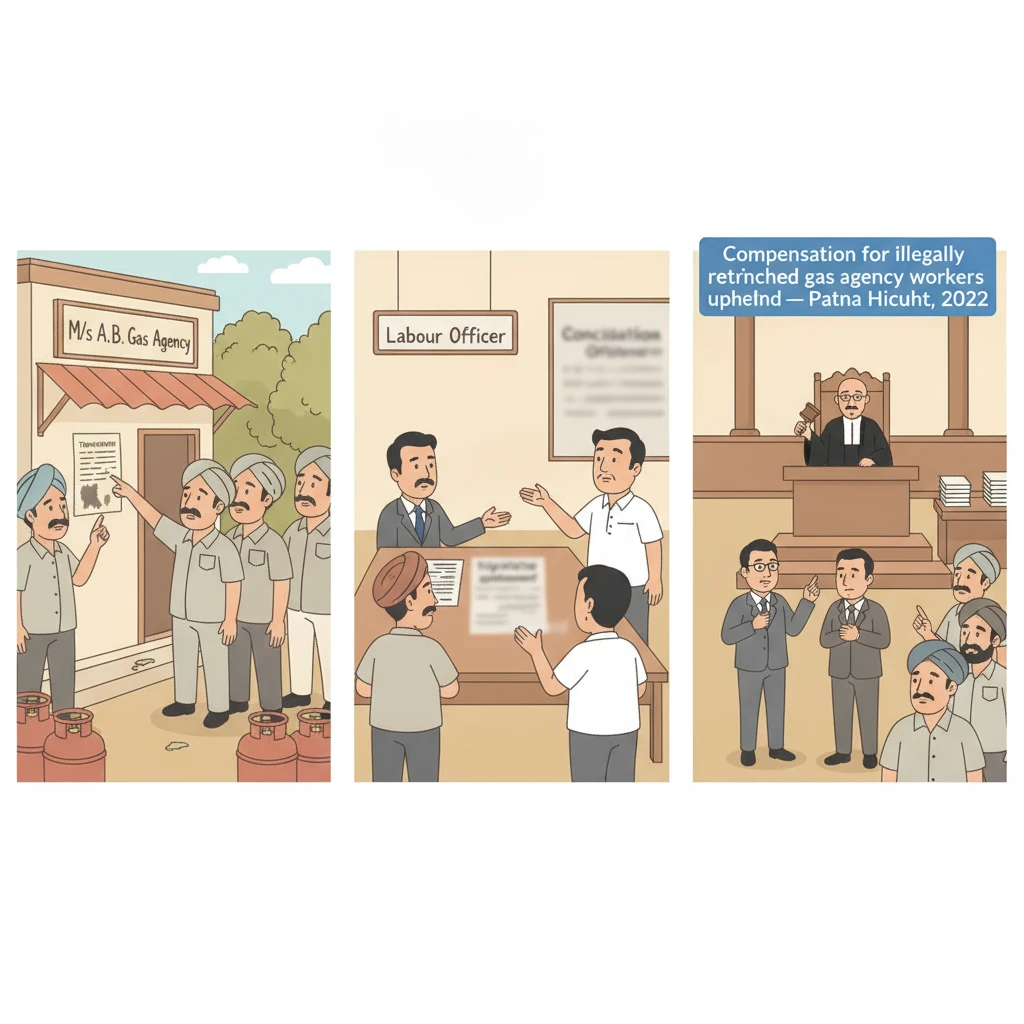
The dispute arose from the retrenchment of seven workers of a domestic gas agency, M/s A.B. Gas Agency at Aurangabad, Bihar. The workers claimed they had joined between 1983 and 1993 and served continuously until 17.12.1994.
According to the workers, the agency remained closed from 15.12.1994 to 16.12.1994. When they reported for duty on 17.12.1994, they allegedly found a termination letter pasted on the outer wall of the gas agency. They said they were not given one month’s notice or wages in lieu of notice as required by Section 25F of the Industrial Disputes Act, 1947.
The workers also complained that they had earlier raised grievances about non-payment of minimum wages, absence of service cards and attendance registers, and denial of legal benefits under labour laws. These complaints led to conciliation proceedings before the Labour Department and a tripartite settlement. However, before the settlement could be implemented, the workers were terminated.
The dispute was referred for adjudication to the Labour Court/Industrial Tribunal in Reference Case No. 1 of 1997 under Section 10(1)(c) of the Industrial Disputes Act, 1947. The terms of reference were whether the termination of the seven workmen was justified and, if not, what relief they were entitled to.
The Tribunal passed an award in favour of the workmen, holding that their termination violated Section 25F of the Industrial Disputes Act, 1947, and directing payment of full back wages from 17.12.1994 till the date of payment. However, it did not order their reinstatement.
The employer challenged this award in the Patna High Court through Civil Writ Jurisdiction Case No. 18188 of 2015. On 05.08.2019, the learned Single Judge held that the gas agency had already been closed and therefore reinstatement was not possible. The Single Judge modified the award and directed the employer to pay Rs. 75,000 by way of compensation to each of the seven workmen. The Executing Munsif, Aurangabad, was directed to proceed with execution.
Both sides were unhappy with this outcome. The employer and the heirs of the former proprietor filed Letters Patent Appeal No. 1128 of 2019. The workmen filed Letters Patent Appeal No. 1291 of 2019. These two appeals were heard together and decided by a Division Bench of the Patna High Court on 26.04.2022.
What the Court Examined and Decided
The Division Bench first noted that the two appeals represented cross-challenges: one by the employer (and the legal heirs of the proprietor) and the other by the workmen. The core question before the Bench was whether the Single Judge was right in modifying the Tribunal’s award and fixing lump-sum compensation of Rs. 75,000 for each workman.
The workers’ case before the Tribunal was that they had worked continuously for more than one year and were abruptly terminated without following the procedure under Section 25F of the Industrial Disputes Act, 1947. They claimed they remained unemployed thereafter.
The employer took several stands before the Tribunal. First, it questioned the very jurisdiction of the Industrial Disputes Act, arguing that the dispute should have been raised under the Shops and Establishments Act, 1948. Second, it alleged that the workers had never submitted any formal charter of demands regarding wages and benefits.
The employer also accused the workers of serious misconduct: issuing gas refills without cash memos, issuing domestic gas consumer cards without authorization, using fake and false receipts, and remaining irregular in attendance. It claimed that the workers were ad-hoc employees whose performance was unsatisfactory, and their services were dispensed with on that basis.
The Tribunal, however, found that the employer’s participation in conciliation proceedings and the resulting tripartite agreement itself showed that the workers’ demands were known to the employer. More importantly, it found no evidence that the mandatory conditions under Section 25F had been fulfilled. No notice of retrenchment or payment in lieu of notice was proved. The Tribunal also accepted that the workers had worked continuously for more than one year, which the employer could not dispute.
The Tribunal rejected the employer’s contention that, where services are terminated for misconduct, compliance with Section 25F is unnecessary. It therefore held the termination illegal and directed payment of full back wages from 17.12.1994 until the date of payment.
However, while deciding the issue of relief, the Tribunal explicitly recorded that the workers had failed to prove that they were not gainfully employed during the intervening period. On that ground, it did not order their reinstatement. The award was thus limited to back wages.
When the award came before the Single Judge in C.W.J.C. No. 18188 of 2015, the Court observed that the gas agency had been closed. The employer asserted that the agency had effectively stopped functioning and was formally wound up in January 2009, with one partner having died and the other resigned. Taking note of the closure, the Single Judge held that reinstatement was not possible and converted the relief into lump-sum compensation of Rs. 75,000 per workman.
The workmen, in their appeal (L.P.A. No. 1291 of 2019), attacked this modification on two main grounds. First, they argued that the Tribunal had never directed reinstatement, so there was no need for the Single Judge to interfere on that basis. The award was only for back wages. Second, they contended that the figure of Rs. 75,000 per worker was arbitrary, with no calculation based on salary, length of service, or other relevant factors. They argued that, if the Court wanted to alter the relief, it should either have done a proper calculation itself or remitted the matter to the Tribunal.
The employer, in its own appeal (L.P.A. No. 1128 of 2019), took a different line. It argued that even the modified compensation was unjustified because the Tribunal’s award of back wages was wrong to begin with. It maintained that the workers’ claim of non-employment was a mere bald statement and had not been proved. It also relied on inspection and adverse advisory from HPCL (the licensor supplying LPG) regarding deficiencies in the agency’s functioning and alleged misconduct of the workers, and said neither the Tribunal nor the Single Judge properly considered this.
Both sides referred to various Supreme Court judgments. The employer cited J.K. Synthetics Ltd. v. K.P. Agrawal and other decisions where the Supreme Court had clarified that back wages are not an automatic result of illegal termination and that various factors, including length of service and quality of work, must be considered. The discussion in those cases emphasised that courts should not always grant full back wages, and that discipline in workplaces must be maintained.
The workmen relied on Anoop Sharma v. Executive Engineer, Public Health Division No. 1, Panipat, and also on the Constitution Bench judgment in Syed Yakoob v. K.S. Radhakrishnan, to argue that the writ court cannot act as an appellate court and reappreciate evidence. They contended that once the Tribunal had found non-compliance with Section 25F and granted back wages, the Single Judge should not have modified the award without any legal error being shown.
The Division Bench also considered the later Supreme Court decision in Deepali Gundu Surwase v. Kranti Junior Adhyapak Mahavidyalaya, where the law on back wages was summarised. The Supreme Court had held that reinstatement with continuity of service and back wages is normally the rule in cases of wrongful termination, though the quantum of back wages can be adjusted after considering factors like length of service, nature of misconduct, and financial condition of the employer. It also clarified that observations in J.K. Synthetics regarding denial of continuity of service on reinstatement do not state good law.
Another judgment brought into focus was Salim Ali Centre for Ornithology & Natural History v. Dr. Mathew K. Sebastian, where the Supreme Court held that a workman claiming back wages must at least assert on oath that he was not gainfully employed; once that is done, the burden shifts to the employer to show otherwise, and the principle of “no work no pay” is not applied in such situations of illegal termination.
Applying these principles, the Division Bench first held that the employer had failed before the Tribunal to establish compliance with Section 25F. It also failed to prove that the workers were validly removed on grounds of misconduct in accordance with procedures under the Industrial Disputes Act, 1947.
Therefore, the Tribunal was right in holding that the termination was bad in law and in directing payment of back wages.
The Bench then considered the question of reinstatement. It noted that, although there was no explicit mention of closure of the gas agency before the Tribunal, the Tribunal still did not grant reinstatement, apparently because the workers could not prove they were not gainfully employed. The Division Bench observed that this could also indicate that the Tribunal was aware that the company no longer existed when it passed the award, and that back wages were meant to cover the period up to closure.
For the Division Bench, the central question became how to deal with the Single Judge’s lump-sum figure of Rs. 75,000 per worker. Both parties criticised this figure as being without any clear basis, and a salary chart had since been produced that could, in theory, help calculate precise back wages up to the closure date of 09.01.2009.
However, the Bench pointed out that there was no clear, sworn assertion by the workers before the Tribunal that they were not gainfully employed during the entire period after termination. At the same time, the employer also could not conclusively prove that they were employed elsewhere. In such a situation, the Court felt that a strict mathematical computation of full back wages up to January 2009, based on salary charts, might not be appropriate.
Balancing these considerations, and keeping in mind that the gas agency had long since been wound up and its management had passed to others, the Division Bench chose a practical route. Even though it acknowledged that the Single Judge had fixed Rs. 75,000 without an explicit calculation, the Bench held that justice would best be served by retaining that amount rather than reopening the entire computation exercise.
Accordingly, the Division Bench affirmed the Single Judge’s direction that the employer must pay Rs. 75,000 to each of the seven terminated workers as compensation and back wages. It also directed that execution of this order be expedited by the concerned court.
Both Letters Patent Appeals were thus disposed of, leaving the compensation figure untouched and clearing the way for the workers to finally receive payment after a long litigation spanning from termination in 1994 to the judgment in April 2022.
Why This Judgment Matters
This judgment of the Patna High Court matters for workers and small employers alike across Bihar and similar settings.
First, it confirms that if an employer terminates workers without following Section 25F of the Industrial Disputes Act, 1947, the termination is legally bad. Even small establishments like gas agencies must follow this law when retrenching workers who have completed more than one year of continuous service.
Second, the case shows that courts can grant monetary compensation even when a business has closed and reinstatement is no longer possible. The workers here did not get their jobs back, but they did get some financial relief.
Third, it shows the importance of workers clearly stating, preferably on oath, whether they were employed or not after termination. That statement affects how back wages are calculated and how much compensation they may finally receive.
Finally, the judgment reflects a practical balancing approach. Instead of reopening all calculations after many years, the Court preferred to uphold a lump-sum amount that it considered fair in the circumstances, so that the workers receive some justice without further delay.
Legal Issues and Answers
Issue: Was the termination of the seven gas agency workers in 1994 valid when no notice or retrenchment compensation under Section 25F of the Industrial Disputes Act, 1947, was shown?
Answer: No. The Court accepted the Tribunal’s finding that Section 25F was not complied with, making the termination bad in law.
Issue: Was the learned Single Judge justified in modifying the Tribunal’s award of back wages into lump-sum compensation of Rs. 75,000 per worker, and should that figure stand?
Answer: Yes. Although the amount lacked a clear calculation basis, the Division Bench held that, given the illegal termination, closure of the agency, and lack of clear evidence on gainful employment, retaining the Rs. 75,000 compensation per worker would best serve justice.
Issue: Were the workers entitled to reinstatement with full back wages?
Answer: No reinstatement was ordered. The Tribunal itself had not granted reinstatement, and the agency had long been closed. The High Court confined the relief to monetary compensation.
Cases Cited by the Court
- J.K. Synthetics Ltd. v. K.P. Agrawal & Anr., 2007 (2) SCC 433
- U.P. State Brassware Corporation Ltd. v. Udai Narain Pandey, 2006 (1) SCC 479
- Allahabad Jal Sansthan v. Daya Shankar, 2005 (5) SCC 124
- Kendriya Vidyalaya Sangathan v. S.C. Sharma, 2005 (2) SCC 363
- Anoop Sharma v. Executive Engineer, Public Health Division No. 1, Panipat (Haryana), 2010 (5) SCC 497
- Syed Yakoob v. K.S. Radhakrishnan, 1964 (5) SCR 64
- Deepali Gundu Surwase v. Kranti Junior Adhyapak Mahavidyalaya (D.Ed.), AIR 2014 (Supp) 121
- Hindustan Tin Works Private Limited v. Employees of Hindustan Tin Works Private Limited, AIR 1979 SC 75 (referred to)
- Salim Ali Centre for Ornithology & Natural History, Coimbatore & Anr. v. Dr. Mathew K. Sebastian, 2022 SCC OnLine SC 451
Case Details
Case Number: Letters Patent Appeal No. 1128 of 2019 and Letters Patent Appeal No. 1291 of 2019, arising out of C.W.J.C. No. 18188 of 2015
Case Title (LPA 1128/2019): Mira Daruka & Ors. v. The State of Bihar & Ors.
Case Title (LPA 1291/2019): Bijoy Kumar Singh @ Vijay Singh & Ors. v. The State of Bihar & Ors.
Coram: Hon’ble Mr. Justice Ashutosh Kumar and Hon’ble Mr. Justice Anjani Kumar Sharan
Citation: 2022 (3) PLJR 217
Advocates (LPA 1128 of 2019):
- For the appellants (employer/legal heirs): Mr. Nandlal Kumar Singh, Advocate; Mr. Manish Kumar, Advocate; Mr. Rajeev Nayan, Advocate
- For the workmen: Mr. Alok Kumar Sinha, Advocate; Mr. Sushil Kumar Singh, Advocate
- For the State: Mr. Rohitabh Das, AC to AAG-10; Mr. Ajay Kumar Rastogi, AAG-10
Advocates (LPA 1291 of 2019):
- For the appellants (workmen): Mr. Alok Kumar Sinha, Advocate; Mr. Sushil Kumar Singh, Advocate
- For the respondents (employer/legal heirs): Mr. Nandlal Kumar Singh, Advocate; Mr. Manish Kumar, Advocate; Mr. Rajeev Nayan, Advocate
- For the State: Mr. Rohitabh Das, AC to AAG-10
Nature of the Case: Letters Patent Appeals against a Single Judge order in a writ petition challenging an Industrial Tribunal award under the Industrial Disputes Act, 1947.
Date of Judgment: 26.04.2022
Court: High Court of Judicature at Patna
Link to Judgment: Click here to view the official Patna High Court judgment
If you found this explanation helpful and wish to stay informed about how legal developments may affect your rights in Bihar, you may consider following Samvida Law Associates for more updates.







