

Case Background
The Patna High Court heard two writ petitions together: Civil Writ Jurisdiction Case No. 9720 of 2021 and Civil Writ Jurisdiction Case No. 9762 of 2021. Both petitions arose from East Champaran district, Motihari.
In both cases, the petitioners claimed to be small shopkeepers who had earlier been carrying on business in a particular locality in Motihari. They said they had been displaced from their shops because of actions taken by the authorities.
The petitioners approached the High Court under its civil writ jurisdiction. They sought a direction to State authorities, particularly the District Magistrate and officials of the Nagar Parishad, Motihari, to allot shops or spaces to them in Bhagat Singh Market under Motihari Municipal Corporation.
They based their claim on an earlier order of the Patna High Court dated 11.02.2021, passed in CWJC No. 10351 of 2013 (Ranjan Kumar Sinha & Ors v. State of Bihar & Ors). In that earlier case, the Court had considered the plight of small entrepreneurs who were being displaced in the course of anti-encroachment proceedings.
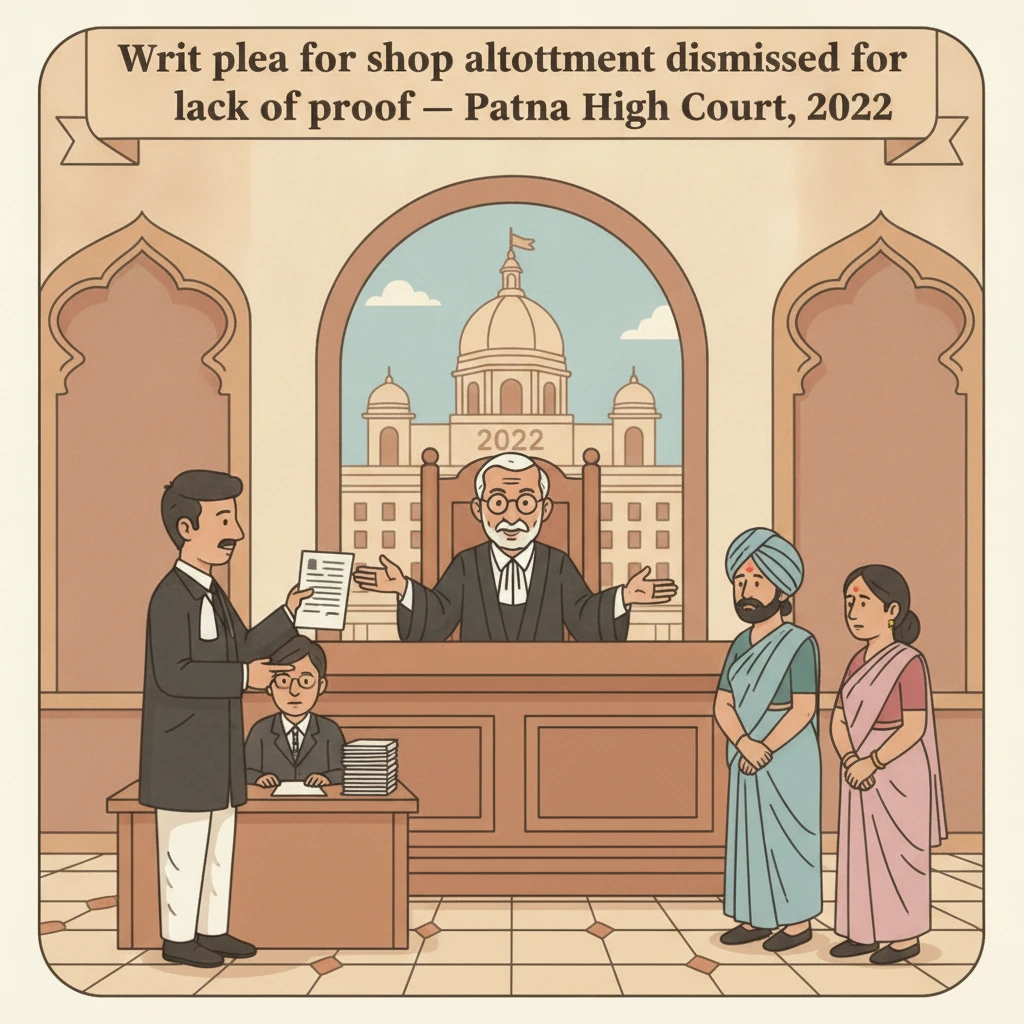
Because both writ petitions relied on the same earlier judgment and sought the same type of relief, the Patna High Court, with consent of the parties, heard them together and decided them by a common oral judgment dated 23.02.2022.
What the Court Examined and Decided
The Division Bench of the Patna High Court, consisting of Hon’ble Mr Justice Chakradhari Sharan Singh and Hon’ble Mr Justice Madhuresh Prasad, first noted that the relief sought in both petitions was identical. The petitioners wanted a direction to the authorities to allot them shop space in Bhagat Singh Market, Motihari.
The key basis of their claim was the earlier order of the Patna High Court dated 11.02.2021 in CWJC No. 10351 of 2013 (Ranjan Kumar Sinha & Ors v. State of Bihar & Ors). The petitioners argued that, just like in that case, they too were small shopkeepers who had suffered due to action taken by the authorities, and therefore they should also get alternative shops.
The Bench therefore first reproduced and examined the operative part of the earlier order in the case of Ranjan Kumar Sinha. In that earlier matter, the Court had said:
“The Court hope and trust that the District Magistrate, Motihari shall explore the possibility of allotment of suitable place to the petitioners so that the petitioners and their family may not be affected adversely. Necessary decision in this regard may be taken by the respondent District Magistrate within a period of six months from the date of receipt/production of a copy of this order.”
The Division Bench then examined the factual background in the earlier case. As recorded in the present judgment, the earlier order had been passed in a specific situation. In that case, the Court was dealing with small entrepreneurs who were being displaced because of proceedings for removal of encroachment.
In other words, the earlier direction of the Court, where it expressed “hope and trust” that the District Magistrate would explore alternative allotment, was linked to a clear factual situation. The petitioners in that case were actually facing removal of encroachment, and their existing shops were affected by that official action.
Having clarified the context of the earlier order, the Court then turned to the present petitioners’ claims. The petitioners’ counsel submitted that they too had shops in the same locality and had been displaced due to actions of the authorities. They therefore argued that they should receive the same benefit as those in the Ranjan Kumar Sinha case, namely consideration for allotment of shop or space in Bhagat Singh Market.
The Bench carefully examined whether the present petitioners had shown that they were truly in the same situation as those earlier petitioners.
The Court noted that the petitioners’ counsel made an important admission. He accepted that no proceeding for removal of encroachment from public land had been initiated against these petitioners. This meant that, unlike in the earlier case, there was no recorded anti-encroachment proceeding directed against them.
Further, the Court recorded that the present petitioners had not been able to show that they were running their shops in the specific locality which had been cleared during anti-encroachment action. Thus, they could not connect themselves, with evidence, to the area and proceedings which had generated the earlier Court order.
The Bench then gave its key reasoning. It held that the petitioners had “miserably failed” to make out a case that they were similarly or identically situated with those who were before the Court in the case of Ranjan Kumar Sinha. This finding is crucial.
Under Indian constitutional law, a person can sometimes seek similar relief if they show that they are in the same factual and legal position as persons in an earlier case. But here, the Court found that the basic facts were not proved. There was no anti-encroachment proceeding against these petitioners. There was no established connection between their alleged shops and the locality from which encroachments were removed.
Because of this, the Court was not willing to extend the benefit of the earlier order to the present petitioners. The earlier order was not a general scheme for allotment of shops to anyone who claimed to be a small businessman in the area. It was a specific, fact-based direction relating to petitioners who faced displacement in an identified anti-encroachment drive.
The language of the earlier order is also important. The Court had expressed “hope and trust” that the District Magistrate would explore the possibility of allotting suitable places to the petitioners in that case. It was not a blanket order for all similarly placed persons, let alone for persons who could not even show they were similarly placed.
On these grounds, the Bench concluded that the present writ petitions were without merit. In paragraph 7 of the judgment, the Court stated clearly that the writ applications were “devoid of any merit” and therefore dismissed them.
The dismissal means that no direction has been given to the authorities to allot shops or spaces in Bhagat Singh Market to the petitioners. The Court has not ordered any further enquiry or given any time-bound direction to consider the petitioners’ cases, unlike what it did in the earlier Ranjan Kumar Sinha case.
The judgment thus closes the matter at the High Court level, at least on the basis of the claims made in these two writ petitions. Any future attempt by the petitioners would require fresh proceedings, based on proper factual material, but this judgment itself does not provide them any relief.
Why This Judgment Matters
This judgment is significant for small shopkeepers and street vendors who are affected by municipal or district actions, especially anti-encroachment drives.
It shows that simply pointing to an earlier order of the Patna High Court, passed in favour of other shopkeepers, is not enough. A person must show that they are actually in the same situation as those earlier petitioners.
Here, the petitioners could not prove that anti-encroachment proceedings had been started against them, or that their shops were in the cleared locality. Because of this gap, the Court refused to direct the authorities to give them alternative shops.
For affected citizens, the message is clear. If they claim that government action has displaced them and that they deserve rehabilitation or alternative space, they must gather and present concrete evidence. This could include notices of encroachment, demolition records, or other official documents showing that their shops were removed in a particular action.
The judgment also underlines that earlier Court directions often apply to specific parties and circumstances. They cannot be used as a general policy document by others who do not share the same factual background.
Legal Issues and Answers
-
Issue: Were the petitioners entitled to a direction from the Patna High Court to allot them shops or spaces in Bhagat Singh Market, Motihari, on the basis of the earlier order in CWJC No. 10351 of 2013 (Ranjan Kumar Sinha & Ors v. State of Bihar & Ors)?
Answer: No. The Court held that the petitioners failed to prove that they were similarly or identically situated to those in the earlier case, particularly because no anti-encroachment proceedings had been initiated against them and they could not show that their shops were in the locality cleared by such action. Therefore, the writ petitions were dismissed as devoid of merit.
Cases Cited by the Court
- The Court expressly referred to and relied upon its earlier order dated 11.02.2021 in CWJC No. 10351 of 2013, titled Ranjan Kumar Sinha & Ors v. State of Bihar & Ors.
Case Details
Case Numbers: Civil Writ Jurisdiction Case No. 9720 of 2021; Civil Writ Jurisdiction Case No. 9762 of 2021
Case Titles: Ramayan Thakur v. The State of Bihar & Ors; Abrarul Haque Ansari @ Md Abrarul Haque Ansari v. The State of Bihar & Ors
Citation: 2022 (1) PLJR 730
Court: High Court of Judicature at Patna
Coram: Hon’ble Mr Justice Chakradhari Sharan Singh and Hon’ble Mr Justice Madhuresh Prasad
Date of Judgment: 23-02-2022
Advocates: For the petitioners (in both cases): Mr Binod Kumar Mishra, Advocate. For the respondents in CWJC No. 9720 of 2021: Mr Ravish Chandra, AC to SC VI. For the respondents in CWJC No. 9762 of 2021: Mr Zaki Haider, AC to SC IX.
Respondents: The State of Bihar; The District Magistrate, East Champaran, Motihari; Chairman, Nagar Parishad, Motihari; S.D.O. Sadar, Motihari, East Champaran.
Nature of the Case: Writ petitions under civil writ jurisdiction seeking direction for allotment of shop/space in Bhagat Singh Market, Motihari, allegedly as alternative arrangement after displacement.
Link to the Judgment: Click here to view the official Patna High Court judgment
If you found this explanation helpful and wish to stay informed about
how legal developments may affect your rights in Bihar,
you may consider following Samvida Law Associates for more updates.







