
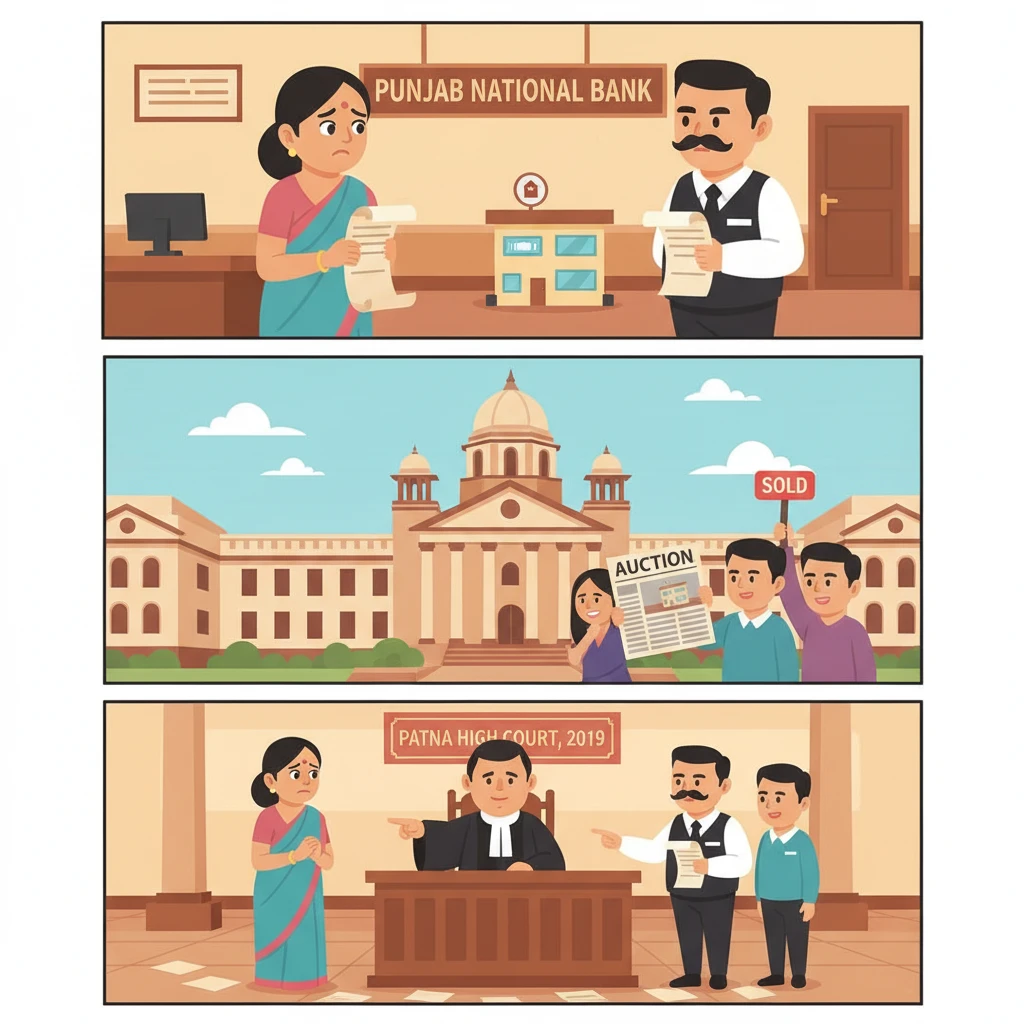
Case Background
The petitioner started a private registered firm named “NEERCO” in 2006. To run this business, she took a cash-credit loan from Punjab National Bank (PNB). For this loan she mortgaged her residential flat, Flat No. 115, Rajdhani Palace, C.P. Thakur Lane, Shivpuri, Patna.
When the business failed, the cash-credit account turned into a Non-Performing Asset (NPA) in 2009. PNB then issued a demand notice under Section 13(2) of the Securitization and Reconstruction of Financial Assets and Enforcement of Security Interest Act, 2002 (SARFAESI Act, 2002).
The petitioner challenged that first notice before the Patna High Court in CWJC No. 5536 of 2009. The Court did not grant her relief and observed that she could approach the Banking Ombudsman if she so wished.
Thereafter, she made certain payments and the bank did not immediately proceed further under Section 13(4) of the SARFAESI Act, 2002. However, she again defaulted, and the dues remained unpaid.
On 08.06.2011 PNB issued a fresh demand notice under Section 13(2), calling upon her to pay Rs. 13,17,068.75. The petitioner filed a written objection dated 01.08.2011 (Annexure-3), raising several points. She complained that the detailed statement of account had not been supplied along with the notice. She asked for the account statement so that she could submit a “meaningful proposal” for compromise settlement in line with Reserve Bank of India guidelines.
According to her, the bank did not reply to this objection. On 08.12.2011 PNB took symbolic possession of the mortgaged flat under Section 13(4) of the Act, and a possession notice was published in a newspaper on 13.12.2011.
Subsequently, on 04.09.2012, the bank published a sale notice in newspapers, inviting tenders for public auction of the flat. The petitioner then approached the Debts Recovery Tribunal (DRT), Patna, by filing a Securitization Application under Section 17 of the SARFAESI Act, 2002, on 24.09.2012, challenging the sale notice dated 04.09.2012.
In the DRT proceedings, the petitioner claimed that the bank had not dealt with her objection under Section 13(3A) and had gone ahead with further measures under Section 13(4). She also alleged that the bank avoided filing reply in the DRT and took repeated adjournments after appearing on 09.10.2012.
Meanwhile, on 29.10.2012, while the Securitization Application was pending, PNB put the flat to public auction. The auction was confirmed on the same day, and a sale deed dated 22.11.2012 was prepared in favour of respondent no. 5, the auction purchaser. These developments were not brought before the DRT at that time.
On 18.02.2013 the DRT took note of the petitioner’s main contention that her objection under Section 13(2) had not been disposed of under Section 13(3A). The Tribunal, understanding that the bank claimed the objection was already considered, directed that if the representation had not been disposed of, it must be decided within 15 days and the reply be communicated to the petitioner. It also ordered that if the representation had already been disposed of, there would be no interim order and the bank would be free to proceed, but status quo should be maintained till the order was complied with.
Following this DRT order, the petitioner again submitted her objection on 20.02.2013. The bank then issued a detailed reply dated 25.02.2013 (Annexure-R/1), stating that the Section 13(2) notice was correct as per the account and the loan agreement, that there was no requirement to attach the statement of account with the notice, and that it was ready to release the mortgaged flat if she paid the total dues along with up-to-date interest and cost.
Despite this opportunity, the petitioner did not pay. On 20.05.2013, the bank executed and registered a sale deed in favour of respondent no. 5. The present writ application (CWJC No. 11495 of 2013) was filed later, on 17.06.2013, by which time the sale deed was already registered.
During the pendency of the writ, the bank took physical possession of the flat and handed it over to the auction purchaser in the presence of a Magistrate. On 24.06.2014, the High Court recorded this fact and passed an interim order directing that respondent no. 5 shall keep the premises under his lock and key, not place his furniture or belongings there, and keep the flat vacant in the meantime.
What the Court Examined and Decided
The petitioner attacked the entire SARFAESI process mainly on the ground that the bank had not complied with Section 13(3A) of the SARFAESI Act, 2002 and Rule 3A of the Security Interest (Enforcement) Rules, 2002. She argued that without deciding her objection dated 01.08.2011 and without supplying the statement of account, PNB could not lawfully take possession or auction the mortgaged flat.
She also accused the bank of misleading both the DRT and the High Court. In particular, she pointed to the counter affidavit filed by the bank’s Chief Manager (Branch), which stated that the bank had complied with Section 13(3A) “within the stipulated period” before taking possession. Another paragraph claimed that in compliance with the DRT’s order the petitioner had submitted objection on 20.02.2013 and the bank had replied on 25.02.2013 “within the stipulated period”.
The petitioner relied on Supreme Court and High Court decisions, especially Mardia Chemicals Ltd. v. Union of India (AIR 2004 SC 2371), where the Supreme Court held that the secured creditor must communicate reasons for non-acceptance of a borrower’s objections to a Section 13(2) notice. She also cited decisions of the Andhra Pradesh High Court (M/s Venshiv Pharma Chemical (P) Ltd. v. State Bank of India) and the Madras High Court (Padmavathy v. The Authorized Officer and others).
On the other side, PNB defended its actions. It argued that it had eventually considered the petitioner’s objections and, through the letter dated 25.02.2013, offered her a chance to redeem the mortgage by paying all dues. Despite this, she did not clear the loan. The bank’s counsel also relied on the Supreme Court judgment in ITC Limited v. Blue Coast Hotel Pvt. Ltd. (AIR 2018 SC 3063) to submit that Section 13(3A) is only directory and that, in any event, the Court should not grant discretionary relief under Article 226 when the borrower has not acted bona fide.
The auction purchaser, respondent no. 5, stated that he had paid the entire auction price, got the sale deed registered (he mentioned the date as 13.05.2013), and obtained possession. He argued that when the sale deed was registered no writ was pending in the High Court and the sale should not now be disturbed.
Justice Rajeev Ranjan Prasad first noted that the petitioner admitted default in repayment of the cash-credit loan. Therefore, issuance of the Section 13(2) demand notice was lawful.
The Court accepted that the bank had taken symbolic possession on 08.12.2011 and published the possession notice on 13.12.2011 without first dealing with the petitioner’s objection dated 01.08.2011. This meant that the bank had not, at that time, complied with Section 13(3A). However, the Court closely examined what the petitioner did in response.
It found that she never challenged the possession notice dated 08.12.2011/13.12.2011. Under Section 17(1) of the SARFAESI Act, 2002, a borrower can file an application before the DRT within 45 days from any measure taken under Section 13(4), including constructive or symbolic possession. Each such measure creates a separate cause of action.
Referring to the Supreme Court decision in M/s Hindon Forge Pvt. Ltd. & Anr. v. State of Uttar Pradesh (AIR 2018 SC 5382), the Court emphasised that a borrower can approach the DRT even before actual physical possession is taken. In this case, the first measure under Section 13(4) was symbolic possession on 08.12.2011. The petitioner did not challenge this within time. She chose to approach the DRT only after the sale notice was published on 04.09.2012.
The High Court noted that the DRT was aware of the ongoing sale process because the application under Section 17 was filed specifically against the sale notice. Though the bank took adjournments, the petitioner also did not secure any interim order to stay the sale. The auction was conducted during pendency of that application, but later, following the DRT’s order dated 18.02.2013, the bank considered her renewed objection and issued the letter dated 25.02.2013.
In that letter, the bank rejected her objections but clearly stated that it would release the flat if she paid the total dues with interest and costs. The petitioner received this letter but did not take any steps to pay.
The Court observed that almost three months later, on 20.05.2013, the bank executed the registered sale deed in favour of respondent no. 5. The writ petition was filed after that, on 17.06.2013. From June 2013 to June 2014 no interim orders were passed, and there was no indication that the petitioner pushed for an urgent hearing of her stay application. During this time she continued to occupy the flat.
On this factual background, the Court formed a clear view that the petitioner’s conduct showed she was trying to delay and obstruct the sale rather than genuinely clear the dues.
While analysing the legal effect of non-compliance with Section 13(3A), the Court discussed Mardia Chemicals (supra) and ITC Limited (supra). It noted that in ITC Limited, the Supreme Court had considered previous rulings including Mardia Chemicals, Transcore v. Union of India and Keshav Lal Khemchand & Sons Pvt. Ltd. v. Union of India, where Section 13(3A) was treated as mandatory. At the same time, the Supreme Court held that a court exercising discretionary writ jurisdiction could refuse relief if, in the facts, the debtor had been given sufficient opportunities to pay but did not avail them.
In particular, the Supreme Court in ITC Limited held that failure to furnish a reply to the borrower’s representation is “not of much significance” where the creditor has in fact considered the representation and given enough time and opportunity to repay, yet the debtor still defaults. In such cases the borrower is not entitled to equitable relief under Article 226.
Applying this approach, Justice Prasad held that although PNB had initially failed to consider the petitioner’s objection before taking symbolic possession, it later did consider and reject her objection pursuant to the DRT’s order, and it also offered her a clear last chance on 25.02.2013 to redeem the property by paying all dues. She did not act on this offer.
Therefore, the Court held that the mere initial breach of Section 13(3A) was not enough, in these circumstances, to set aside the entire SARFAESI action and undo the completed auction sale, particularly when public money was involved and relief under Article 226 is discretionary.
At the same time, the Court took serious note of the false statements made by the bank’s Chief Manager in the counter affidavit, where he had wrongly claimed that the objection had been considered before action under Section 13(4). When the Court called for the records, it became clear that this was not correct. The Court described these statements as “false and baseless” and made “with total irresponsibility” without looking into the records.
For this, the Court imposed a cost of Rs. 15,000 on the deponent of the counter affidavit (the Chief Manager), to be deposited with the Member Secretary, Bihar State Legal Services Authority, Patna, within eight weeks, and a receipt to be filed in the Registry.
Finally, the Court dismissed the writ application, subject to this cost on the bank officer. No relief was granted to the petitioner regarding the auction sale or possession of the flat.
Why This Judgment Matters
This judgment is important for small borrowers and home-owners whose property is mortgaged to banks. It shows that if a borrower does not challenge each step of SARFAESI action in time, courts may treat their rights as waived.
Here, the Patna High Court acknowledged that the bank had initially violated Section 13(3A) by not deciding the borrower’s objection before taking symbolic possession. But the Court still refused to undo the sale because the borrower had not challenged possession on time, had ignored a clear chance to pay dues, and filed the writ only after the sale deed was executed.
The decision also sends a message to banks and their officers. Even though the Court protected the auction sale, it punished the bank officer who made false statements in the counter affidavit by imposing personal costs. This underlines that banks must be truthful and careful in court pleadings, especially in SARFAESI matters.
For people facing SARFAESI action in Bihar and beyond, the judgment highlights three practical points: respond promptly to each bank step, use DRT remedies within limitation, and, if the bank offers a genuine last chance to redeem property, act on it quickly. Courts are unlikely to interfere later if these opportunities are allowed to pass.
Legal Issues and Answers
-
Issue: Can a borrower get an auction sale under SARFAESI quashed because the bank did not initially decide her objection under Section 13(3A) before taking symbolic possession?
Answer: No. The Patna High Court held that in this case the borrower had not challenged the possession notice within time, had later been given a chance to redeem the property by paying dues, and had not availed that chance. In these circumstances the Court refused to exercise its discretionary writ jurisdiction to set aside the bank’s action or the sale. -
Issue: Does failure to supply account statements and to comply with Section 13(3A) automatically invalidate all subsequent SARFAESI measures?
Answer: No automatic invalidation. The Court, relying on the approach in ITC Limited v. Blue Coast Hotel Pvt. Ltd., held that where the borrower is given sufficient opportunity later to know the reasons and to repay, and yet does not pay, the court may decline relief under Article 226, especially when public money recovery is involved. -
Issue: How did the Court deal with false statements made by the bank officer in the counter affidavit about compliance with Section 13(3A)?
Answer: The Court found those statements to be false and baseless and imposed personal costs of Rs. 15,000 on the deponent (the Chief Manager) to be deposited with the Bihar State Legal Services Authority.
Cases Cited by the Court
- Mardia Chemicals Ltd. v. Union of India, AIR 2004 SC 2371.
- ITC Limited v. Blue Coast Hotel Pvt. Ltd., AIR 2018 SC 3063.
- Transcore v. Union of India, (2008) 1 SCC 125 : AIR 2007 SC 712.
- Keshav Lal Khemchand and Sons Pvt. Ltd. v. Union of India, (2015) 4 SCC 770 : AIR 2015 SC 1168.
- M/s Hindon Forge Pvt. Ltd. & Anr. v. State of Uttar Pradesh, AIR 2018 SC 5382.
- M/s Venshiv Pharma Chemical (P) Ltd. v. State Bank of India (Andhra Pradesh High Court).
- Padmavathy v. The Authorized Officer and others (Madras High Court).
Case Details
Case Number: Civil Writ Jurisdiction Case No. 11495 of 2013
Case Title: Swarn Lata v. The Punjab National Bank & Ors.
Citation: 2019 (2) PLJR 1033
Coram: Hon’ble Mr. Justice Rajeev Ranjan Prasad
Advocates:
- For the petitioner: Mr. Onkar Nath, Advocate
- For the State: Mr. Prabhat Kishore, AC to SC-13
- For Punjab National Bank: Mr. Niraj Kumar Sinha, Advocate
- For respondent no. 5 (auction purchaser): Mr. Dhaneshwar Pd. Gupta, Advocate
Nature of the Case: Writ petition under Article 226 of the Constitution of India challenging measures taken under Sections 13(2) and 13(4) of the SARFAESI Act, 2002 and related auction sale.
Final Outcome: Writ petition dismissed; auction sale and SARFAESI measures not interfered with; cost of Rs. 15,000 imposed personally on the deponent of the bank’s counter affidavit.
Link to Judgment: Patna High Court Judgment in CWJC No. 11495 of 2013
If you found this explanation helpful and wish to stay informed about how legal developments may affect your rights in Bihar, you may consider following Samvida Law Associates for more updates.







