
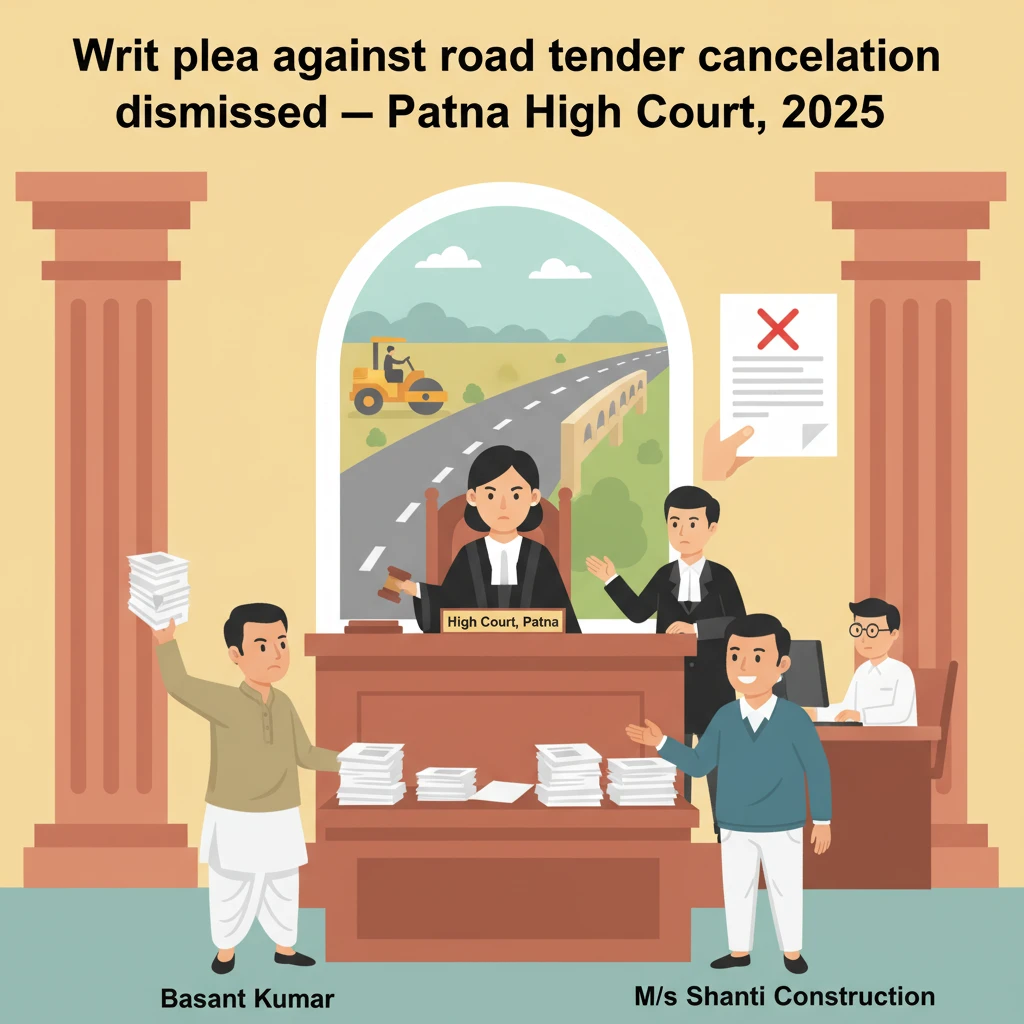
Case Background
The case arose out of a major tender floated by the Rural Works Department, Government of Bihar, under the Mukhya Mantri Gramin Sadak Unnayan Yojana (MMGSUY).
Notice Inviting Tender (NIT) No. RRRSMP-15/2024-25 dated 27.02.2025 was issued for “Initial Rectification, Minor Improvement, Surface Renewal, Construction of Bridge/Drainage/Protection Work including Operation and Management” for rural road strengthening and management. The dispute in this writ case related specifically to Package No. RRRSMP/24-25 Sasaram-1/11, with a total contract value of Rs. 3520.452 lakhs.
Altogether ten bidders, including the petitioner, participated. A Five-Member Technical Bid Evaluation Committee, chaired by the Engineer-in-Chief, met on 06.05.2025 and, by Memo No. 1643 dated 08.05.2025, declared seven bidders, including M/s Shanti Construction, technically responsive, and three non-responsive. Bidders were allowed five working days to raise objections.
The petitioner, a Class-I registered contractor under the Bihar Contractors Registration Rules, 2007, filed objections on 16.05.2025 against three technically qualified bidders, primarily challenging the bid capacity of M/s Shanti Construction.
The Committee reconvened on 10.06.2025 and, through Memo No. 2220 dated 12.06.2025, reiterated its earlier decision. Dissatisfied, the petitioner again objected on 13.06.2025, specifically pointing out that Shanti Construction’s bid capacity, after accounting for works already allotted in Aurangabad Division, was insufficient.
On this basis, a report was called from the jurisdictional Executive Engineer. By report dated 26.06.2025, the Executive Engineer categorically stated that M/s Shanti Construction did not have the required bid capacity. Despite this, the Technical Bid Evaluation Committee, by Memo No. 2469 dated 30.06.2025, again declared Shanti Construction’s bid technically responsive, without recording reasons for disagreeing with the Executive Engineer.
The Committee then issued another decision on 01.07.2025 vide Memo No. 2477, reiterating the same conclusion, on the very day the earlier decision was uploaded, and without any new material or expiry of the objection period.
On 05.07.2025, the financial bids were opened. M/s Shanti Construction was found to be the lowest bidder (L-1), quoting 5.77% below the estimated rate; the petitioner was L-2, quoting 5.05% below the estimated rate.
Subsequently, the Committee again examined the bid capacity of Shanti Construction. In a meeting on 12.07.2025 it was found that, after adjusting already allotted works under Tender ID 139610 and Tender ID 139568, Shanti Construction did not have sufficient bid capacity for the present work of Rs. 3714.50482 lakhs. Because the financial bids had already been opened, all bidders were now aware of the L-1 rates, and confidentiality was held to be compromised.
On this basis, the Committee decided to recommend cancellation of the entire tender and re-advertisement. This decision was communicated through Memo No. 2611 dated 14.07.2025.
The petitioner, by communication dated 16.07.2025, expressed willingness to execute the work at the L-1 rate quoted by Shanti Construction and requested that the work be awarded to him as the second lowest bidder. Instead, the department proceeded to implement the cancellation and issued Short Notice Inviting Tender No. RRRSMP-15/2025-26 dated 22.07.2025 (uploaded on 26.07.2025), re-advertising the same work on the same terms and conditions.
The petitioner then approached the Patna High Court by way of this writ petition, seeking quashing of Memo Nos. 2469, 2477 and 2611, as well as the fresh Short NIT dated 22.07.2025, and a direction to award the work to him at the L-1 rate.
What the Court Examined and Decided
The Patna High Court, speaking through Hon’ble Mr. Justice Alok Kumar Sinha (for the Bench with Hon’ble the Chief Justice), carefully traced the entire tender process and examined each major grievance raised by the petitioner.
The core complaints were:
(i) that the Technical Bid Evaluation Committee acted arbitrarily and without reasons in declaring M/s Shanti Construction technically responsive despite the adverse report of the Executive Engineer about inadequate bid capacity;
(ii) that the reiteration of that decision on 01.07.2025, without any change in circumstances, was unsustainable;
(iii) that the Committee had no authority to re-evaluate technical eligibility after opening financial bids, and its decision on 14.07.2025 was coram non judice; and
(iv) that, once L-1 was found disqualified, the department was bound to move to L-2 (the petitioner), especially as he was ready to work at L-1 rates.
On the other hand, the State contended that all actions were taken strictly within the framework of the Standard Bidding Document (SBD) and the NIT, particularly Clause 33, which allows the Engineer-in-Chief to cancel the bidding process at any time before award of contract without assigning reasons.
The State pointed out that objections were repeatedly considered, reports were called from the Executive Engineer, and the Committee met several times (06.05.2025, 10.06.2025, 27.06.2025, 01.07.2025, and 12.07.2025) to review technical issues. Ultimately, when it became clear that L-1 lacked bid capacity and confidentiality of rates had been compromised, the only fair course was to cancel and re-tender.
The Court framed five issues and answered them one by one.
On the first issue, the Court accepted that the Executive Engineer’s report dated 26.06.2025 clearly showed that Shanti Construction’s bid capacity was short of the requirement. The Committee’s decision dated 30.06.2025 (Memo No. 2469), declaring Shanti Construction’s bid responsive without recording reasons for rejecting that report, was described as reflecting “a degree of arbitrariness and non-application of mind”.
However, the Court also emphasised that the subsequent cancellation of the entire tender, once the lack of bid capacity and breach of confidentiality were acknowledged, worked as a “corrective measure”. The Court drew on Supreme Court precedents such as Michigan Rubber (India) Ltd. v. State of Karnataka, Afcons Infrastructure Ltd. v. Nagpur Metro Rail Corporation Ltd., and Montecarlo Ltd. v. NTPC Ltd., which hold that tendering authorities are best placed to judge technical capacity, and courts should interfere only in cases of clear mala fides or extreme arbitrariness.
Thus, while criticising the Committee’s earlier approach, the Court held that the ultimate decision to cancel and re-tender neutralised any earlier defect and did not show mala fides.
On the second issue, regarding the 01.07.2025 decision (Memo No. 2477), the Court again pointed out that reiterating the earlier decision on the very day it was uploaded, without new facts or reasons and despite the existing adverse report, did not represent ideal administrative behaviour. The Court treated this as a “procedural lapse”.
Yet, it reasoned that because the respondents soon after reassessed bid capacity, recognised the problem, and cancelled the tender entirely, this lapse became “harmless” in the larger picture. The important point for the Court was that the department ultimately acknowledged and corrected the mistake, rather than pushing through award of the work to an ineligible bidder.
On the third issue, the Court considered whether cancellation of the tender under Memo No. 2611 dated 14.07.2025, based on insufficient bid capacity of L-1 and breach of confidentiality, was valid under Clause 33 of the NIT. That clause specifically empowers the Engineer-in-Chief to accept or reject any bid and to cancel the bidding process and reject all bids at any time prior to award of the contract without assigning any reason.
The Court noted two concrete reasons behind the cancellation:
(i) recalculation showed that, after adjustment for already awarded works, Shanti Construction did not have the required bid capacity for the tendered work; and
(ii) financial bids had already been opened, so all bidders knew the L-1 rates, meaning confidentiality and fairness of the earlier tender could not be preserved if the remaining bidders were now considered.
The Court held these were rational, objective grounds that fell squarely within Clause 33 and Supreme Court guidance in Afcons and Michigan Rubber. Cancellation and re-tendering in such a situation was described as “a lawful and prudent exercise of administrative discretion”.
On the fourth issue, the Court addressed the petitioner’s claim that, as L-2 willing to work at L-1’s rate, he should get the contract. The Court first noted that the petitioner had not even framed a specific prayer in the writ petition seeking an order to award the contract to him.
More fundamentally, the Court held that no bidder acquires an automatic right to be awarded a government contract simply because another bidder is disqualified. Clause 33 of the NIT allowed cancellation; there was no provision requiring the department to move down to L-2. The Court relied on the Supreme Court’s decision in W.B. State Electricity Board v. Patel Engineering Co. Ltd., which states that the authority is not obliged to award the contract to any bidder at their quoted price.
The Court also cited the recent judgment in Prakash Asphaltings And Toll Highways (India) Ltd. v. Mandeepa Enterprises & Others, where the Supreme Court stressed the sanctity of tender conditions and held that financial bids cannot be altered or “rescued” by later adjustments, even if this could benefit public revenue. Applying that logic, the Court held that the petitioner’s later offer to match L-1 rates, after opening of bids, was legally impermissible. Public interest cannot be reduced to getting the cheapest rates by ignoring the tender rules.
Therefore, the petitioner had no enforceable legal right to demand award of the contract as L-2.
On the fifth issue, regarding the scope of writ jurisdiction under Article 226 in tender matters, the Court reiterated settled principles from Jagdish Mandal v. State of Orissa, Tata Cellular v. Union of India, and Michigan Rubber. Judicial review is meant to keep administrative action free from mala fides, arbitrariness, and irrationality, not to re-evaluate commercial decisions or substitute the Court’s view for that of technical experts.
In this case, the Court found that the respondents had carried out multiple rounds of technical and financial scrutiny, obtained reports, and finally exercised the power under Clause 33 to cancel and re-tender. The process showed “application of mind and administrative prudence”, and there was no indication of bias or bad faith.
In conclusion, the Court held that although there were earlier lapses in recording reasons and responding to the Executive Engineer’s report, the final step of cancelling and re-advertising the tender was valid, fair, and within the department’s authority. The petitioner, as a disappointed L-2 bidder, could not use Article 226 to press a private commercial interest over the integrity of the public tender process.
Accordingly, the writ petition was dismissed, with liberty to the respondents to proceed with re-tendering in accordance with law. There was no order as to costs, and all pending interlocutory applications were treated as disposed of.
Why This Judgment Matters
This judgment is important for contractors and government departments alike.
For contractors, it clarifies that being L-2, or even being ready to match L-1’s rate, does not create a legal right to get the work if the tender is cancelled. Once bid rates are opened and confidentiality is broken, the authority can scrap the entire tender and start afresh, instead of shifting the contract down the line.
For the administration, the Patna High Court affirms that a tender can be cancelled before award whenever there is a genuine concern about bid capacity or breach of confidentiality, so long as the decision is honest and in public interest. Even if there were mistakes earlier in evaluation, taking a corrective step like cancellation and re-tendering will usually be upheld.
The judgment also reinforces that courts will interfere in tender decisions only when there is clear mala fide, bias, or gross arbitrariness. Routine disputes about who should be L-1 or L-2, or minor procedural lapses later cured by corrective action, will not generally lead to quashing of the tender process.
Legal Issues and Answers
-
Issue: Was the Technical Bid Evaluation Committee’s decision declaring M/s Shanti Construction technically responsive, despite the Executive Engineer’s adverse report on bid capacity, arbitrary?
Answer: Yes, the decision of 30.06.2025 lacked reasons and reflected arbitrariness, but the subsequent cancellation of the entire tender and re-tendering acted as a corrective measure, curing the defect. -
Issue: Was cancellation of the tender by Memo No. 2611 dated 14.07.2025, after finding L-1’s bid capacity insufficient and confidentiality breached, valid under Clause 33 of the NIT?
Answer: Yes, the Court held the cancellation was a lawful and prudent exercise of discretion under Clause 33, grounded on objective reasons and consistent with Supreme Court precedents. -
Issue: Did the petitioner, as L-2 willing to work at L-1 rates, have any legal right to demand award of the contract?
Answer: No, the Court held there is no enforceable right for L-2 to get the contract; tender conditions and Clause 33 permit cancellation, and later offers to match L-1 rates cannot override the tender rules.
Cases Cited by the Court
- Michigan Rubber (India) Ltd. v. State of Karnataka, (2012) 8 SCC 216
- Afcons Infrastructure Ltd. v. Nagpur Metro Rail Corporation Ltd., (2016) 16 SCC 818
- Montecarlo Ltd. v. NTPC Ltd., (2016) 15 SCC 272
- W.B. State Electricity Board v. Patel Engineering Co. Ltd. and Others, (2001) 2 SCC 451
- Prakash Asphaltings And Toll Highways (India) Ltd. v. Mandeepa Enterprises & Others, Civil Appeal No. 11418 of 2025
- Jagdish Mandal v. State of Orissa and Others, (2007) 14 SCC 517
- Tata Cellular v. Union of India, (1994) 6 SCC 651
Case Details
Case Number: Civil Writ Jurisdiction Case No. 11886 of 2025
Case Title: Basant Kumar v. The State of Bihar & Others
Citation: 2025(4) PLJR 653
Court: High Court of Judicature at Patna
Coram: Hon’ble the Chief Justice; Hon’ble Mr. Justice Alok Kumar Sinha
Date of Judgment: 09.10.2025
CAV Date: 24.09.2025
Advocates for Petitioner: Mr. Prabhat Ranjan, Advocate; Mr. Ansh Prasad, Advocate; Mr. Shubham Prakash, Advocate
Advocates for Respondents: Mr. P.K. Shahi, Advocate General; Mr. Vikas Kumar, Advocate
Respondent Authorities: State of Bihar through Additional Chief Secretary, Rural Works Department, and other officers including Engineer-in-Chief, Chief Engineer-2 (Gaya), Superintending Engineer (Work Circle Sasaram), Nodal Officer MMGSUY, and Executive Engineer (Works Division Sasaram-1)
Nature of Case: Writ petition under Article 226 of the Constitution of India challenging technical evaluation decisions, cancellation of tender, and re-tendering in a public works contract
Link to Judgment: View full Patna High Court judgment
If you found this explanation helpful and wish to stay informed about how legal developments may affect your rights in Bihar, you may consider following Samvida Law Associates for more updates.







