

Case Background
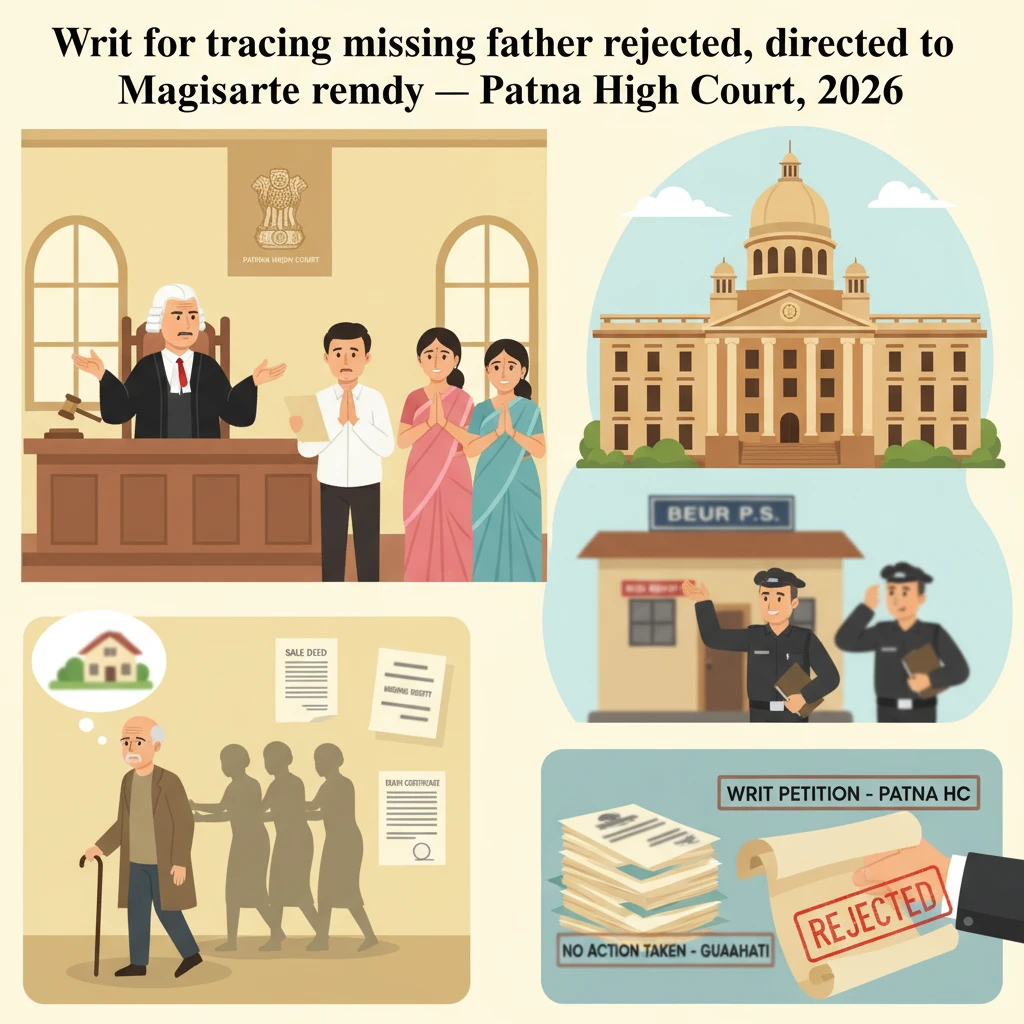
The criminal writ petition was filed by a son, an Assistant Engineer under suspension, before the Patna High Court. He sought directions to the police authorities to trace his father, Suraj Prasad Singh, who was stated to be missing since 19.03.2013.
According to the petition, on 19.03.2013 the petitioner’s wife lodged a missing report at Beur Police Station, Patna. She informed the officer‑in‑charge that her father‑in‑law, aged about 85 years, had gone missing.
In that missing report, she expressed suspicion that three women – later arrayed as respondent nos. 8, 9 and 10 – had abducted the missing man. These women are the petitioner’s sisters. The suspicion, as set out in the petition, was that they had taken him away with an intention to get a sale deed registered in respect of his house and thereby grab his property.
The writ petition further alleged that these three sisters had earlier given a false affidavit before the registration office at Purnia, claiming that the petitioner himself had died on 12.04.2010. This affidavit, according to the petitioner, was used when some of his property at Purnia was being alienated.
The petitioner claimed that despite repeated requests to the officer‑in‑charge of Beur Police Station and higher police officers, no FIR was registered and his father was not recovered. He also asserted, on the basis of information obtained under the Right to Information Act, that no police official from Beur Police Station had gone to Guwahati to search for the missing person, where some inquiry was apparently expected.
Finding no progress from the police, the petitioner approached the Patna High Court through this criminal writ petition. At the time of judgment, the matter was still at the admission stage, meaning the Court was first deciding whether the writ petition itself should be entertained.
What the Court Examined and Decided
The petition was heard by Hon’ble Mr. Justice Jitendra Kumar. The Court heard submissions from the petitioner’s counsel and from the learned APP appearing for the State of Bihar.
Counsel for the petitioner argued that the police had failed both to trace the missing father and to register an FIR despite a clear complaint and serious suspicion of abduction for property‑related reasons. Because of this inaction, it was submitted, the petitioner had been forced to invoke the writ jurisdiction of the Patna High Court as he had no other effective remedy.
The State’s counsel strongly opposed this view and challenged the maintainability of the petition. He submitted that the case, as pleaded, was essentially a “missing person” matter. While the petitioner suspected that his sisters had abducted the father for grabbing property, there was no clear plea, either in the missing report or the writ petition, that the father was being illegally confined by any State authority or any private person.
In the State’s view, at best this was a case where an FIR ought to be lodged and a proper investigation conducted, not one where a writ like habeas corpus should be issued. For that purpose, the petitioner had an efficacious alternative remedy: moving the jurisdictional Judicial Magistrate under Section 156(3) of the Code of Criminal Procedure (Cr.PC) / Section 175(3) Bharatiya Nagarik Suraksha Sanhita (B.N.S.S.), read with Section 97 Cr.PC / Section 100 B.N.S.S.
The Court first examined the factual averments. It noted that the father of the petitioner had indeed been missing since 19.03.2013 and that the petitioner suspected his sisters of having abducted him to grab his property. However, the Court emphasized that there was no “clear case of illegal confinement” by any State authority or individual emerging from the record.
The Court identified the petitioner’s real grievance as the failure of the police to register an FIR and to recover the missing person. It then turned to the legal framework to determine whether a writ petition was the appropriate route.
The Court explained that an effective alternative remedy was available before the jurisdictional Judicial Magistrate. Section 156(3) Cr.PC (equivalent to Section 175(3) B.N.S.S.) empowers a Magistrate who is competent under Section 190 Cr.PC to order investigation. This provision, read with Section 97 Cr.PC / Section 100 B.N.S.S., is wide enough to authorize the Magistrate to direct the officer‑in‑charge of the concerned police station to take all necessary steps for proper investigation and to monitor the same.
The judgment then quoted Section 156(3) Cr.PC and Section 97 Cr.PC / Section 100 B.N.S.S., which allow a Magistrate to order investigation and to issue a search warrant where there is reason to believe that a person is confined under circumstances amounting to an offence.
To reinforce this view, the Court relied on the Supreme Court judgment in Sakiri Vasu v. State of U.P., (2008) 2 SCC 409. In that case, the Supreme Court held that if an FIR is not being registered or properly investigated, the aggrieved person should first approach higher police authorities under Section 154(3) and Section 36 Cr.PC, and if that fails, file an application under Section 156(3) Cr.PC before the Magistrate. The Supreme Court clarified that Section 156(3) is wide enough to imply powers to direct registration of FIR, proper investigation, and even monitoring of investigation, and that High Courts should discourage people from directly filing writ petitions or Section 482 applications in such situations.
The Patna High Court then examined the scope of Section 97 Cr.PC / Section 100 B.N.S.S. It noted that these provisions empower District Magistrates, Sub‑Divisional Magistrates or first‑class Magistrates to issue search warrants for persons confined under circumstances amounting to an offence. If such a person is found, he or she must be immediately produced before a Magistrate for appropriate orders. The Court observed that search and recovery of a victim is part of investigation and that Magistrates can even monitor the steps taken by the police for such search and recovery.
The Court next referred to a series of decisions from different High Courts, including:
Showkat Ahmad Mir v. Nighat Begum (High Court of Jammu and Kashmir and Ladakh, CRM(M) No. 240 of 2022), Jaishree v. State of U.P., 2024 SCC OnLine All 162 (Allahabad High Court), Selvaraj v. State, 2018 SCC OnLine Mad 14215 (Madras High Court), Mamonikakoty v. State of Assam, 2021 SCC OnLine Gau 2584 (Gauhati High Court), Jaymati Sahu v. State of Chhattisgarh, 2022 SCC OnLine Chh 737 (Chhattisgarh High Court), Nimananda Biswal v. State of Odisha, 2023 SCC OnLine Ori 5628 (Orissa High Court), Simmi Bai v. State, 2025 SCC OnLine MP 893 (Madhya Pradesh High Court), and Babita v. State of Rajasthan, 2025 SCC OnLine Raj 5227 (Rajasthan High Court).
Across these judgments, the common principle is that for a writ of habeas corpus, there must be a prima facie case of illegal or unlawful detention. Missing person cases, where there is no allegation or material of illegal confinement, are not suitable for habeas corpus. Instead, such cases should be handled as regular criminal cases under the Penal Code and the Code of Criminal Procedure, through investigation by police and supervision by Magistrates.
The Patna High Court noted that constitutional courts across the country have repeatedly held that habeas corpus is not meant to be a general tool for tracing missing persons or supervising ordinary investigation. Therefore, the High Court’s extraordinary jurisdiction under Article 226 of the Constitution should not be invoked for such purposes.
Having discussed the alternative remedies under criminal law, the Court then addressed the broader question: when should High Courts exercise writ jurisdiction despite such remedies? For this, the Court relied on Supreme Court decisions in Godrej Sara Lee Ltd. v. Excise and Taxation Officer‑cum‑Assessing Authority, (2023) SCC OnLine SC 95, Whirlpool Corporation v. Registrar of Trade Marks, Mumbai, (1998) 8 SCC 1, and Radha Krishan Industries v. State of Himachal Pradesh, (2021) 6 SCC 771.
These judgments make it clear that:
Article 226 powers are plenary, and availability of an alternative remedy does not remove the High Court’s jurisdiction. However, as a matter of policy and judicial discipline, High Courts normally decline to entertain writ petitions where an effective alternative remedy exists.
Exceptions arise when a writ is filed for enforcement of fundamental rights, where there is violation of natural justice, where the order or proceedings are wholly without jurisdiction, or where the validity of a statute is challenged.
The concepts of “maintainability” and “entertainability” are distinct. Even if a petition is technically maintainable, the High Court may still refuse to entertain it, especially when statutory remedies are adequate.
Applying these principles, the Patna High Court noted that the petitioner was essentially seeking registration of an FIR and recovery of a missing person, for which the law has provided a detailed and effective mechanism through the Magistrate’s powers under Sections 156(3) and 97 Cr.PC / corresponding B.N.S.S. provisions. There was no plea of violation of fundamental rights in the strict constitutional sense, no allegation that any court order was without jurisdiction, and no challenge to any statute.
The Court also found that the petitioner had not pleaded any exceptional circumstances that would justify bypassing the statutory route and directly invoking the High Court’s writ jurisdiction. In these circumstances, the Court held that it would be “desirable” for the petitioner to move an appropriate application before the jurisdictional Judicial Magistrate.
Ultimately, the Patna High Court dismissed the criminal writ petition. However, it did so with liberty to the petitioner to file a proper application under Section 156(3) Cr.PC / Section 175(3) B.N.S.S. before the Judicial Magistrate for lodging an FIR and ensuring proper investigation, including efforts to recover the missing father. The Court clarified that if such an application is filed, the concerned Magistrate is duty‑bound to pass orders in accordance with law.
Why This Judgment Matters
This decision is important for families in Bihar and elsewhere who are facing the trauma of a missing relative and feel that the police are not doing enough. It explains that the first and most effective legal path is not directly to the High Court, but to the local Judicial Magistrate using Section 156(3) Cr.PC / Section 175(3) B.N.S.S.
The judgment also reinforces that habeas corpus, or similar writ remedies under Article 226, are not routine tools for supervising missing person investigations. Without clear material suggesting illegal detention, High Courts are likely to refuse such petitions and send parties back to the statutory remedies.
For lawyers and laypersons, this ruling from the Patna High Court clarifies how the criminal justice system is expected to function in missing person cases: complaint to police, approach to higher police officers if needed, and then application to the Magistrate if the police fail to act. It highlights the Magistrate’s strong powers to order investigation, issue search warrants, and monitor police action, rather than relying on extraordinary writs.
Legal Issues and Answers
- Issue: Can the Patna High Court, in its writ jurisdiction, be directly approached to order police to trace a missing person and register an FIR when there is no clear allegation of illegal detention?
Answer: No. The Court held that in the absence of a clear case of illegal confinement, and given the availability of an efficacious alternative remedy before the Judicial Magistrate under Section 156(3) Cr.PC / Section 175(3) B.N.S.S. read with Section 97 Cr.PC / Section 100 B.N.S.S., the writ petition should not be entertained. - Issue: What is the proper remedy when police do not register an FIR or conduct proper investigation in a missing person matter?
Answer: The aggrieved person should first approach higher police authorities under Section 154(3) and Section 36 Cr.PC, and if still aggrieved, file an application under Section 156(3) Cr.PC / Section 175(3) B.N.S.S. before the jurisdictional Magistrate, who can direct registration of FIR, proper investigation, search and recovery under Section 97 Cr.PC / Section 100 B.N.S.S., and monitor the investigation.
Cases Cited by the Court
- Sakiri Vasu v. State of U.P., (2008) 2 SCC 409
- Showkat Ahmad Mir v. Nighat Begum, CRM(M) No. 240 of 2022 (High Court of Jammu and Kashmir and Ladakh)
- Jaishree v. State of U.P., 2024 SCC OnLine All 162 (Allahabad High Court)
- Selvaraj v. State, 2018 SCC OnLine Mad 14215 (Madras High Court)
- Mamonikakoty v. State of Assam, 2021 SCC OnLine Gau 2584 (Gauhati High Court)
- Jaymati Sahu v. State of Chhattisgarh, 2022 SCC OnLine Chh 737 (Chhattisgarh High Court)
- Nimananda Biswal v. State of Odisha, 2023 SCC OnLine Ori 5628 (Orissa High Court)
- Simmi Bai v. State, 2025 SCC OnLine MP 893 (Madhya Pradesh High Court)
- Babita v. State of Rajasthan, 2025 SCC OnLine Raj 5227 (Rajasthan High Court)
- Godrej Sara Lee Ltd. v. Excise and Taxation Officer‑cum‑Assessing Authority and Others, 2023 SCC OnLine SC 95
- Whirlpool Corporation v. Registrar of Trade Marks, Mumbai and Others, (1998) 8 SCC 1
- Radha Krishan Industries v. State of Himachal Pradesh and Others, (2021) 6 SCC 771
Case Details
Case Number: Criminal Writ Jurisdiction Case No. 1419 of 2019
Case Title: Binit Kumar v. State of Bihar and Others
Citation: 2026 (2) PLJR 472
Coram: Hon’ble Mr. Justice Jitendra Kumar
Advocates: Mr. Prakash Tiwari, Advocate for the petitioner; Mr. Sheo Shankar Prasad, APP for the State
Nature of the Case: Criminal writ petition seeking directions to police authorities to trace a missing person and to ensure lodging of FIR and proper investigation
Link to Judgment: Patna High Court official judgment
If you found this explanation helpful and wish to stay informed about how legal developments may affect your rights in Bihar, you may consider following Samvida Law Associates for more updates.







