
Case Background
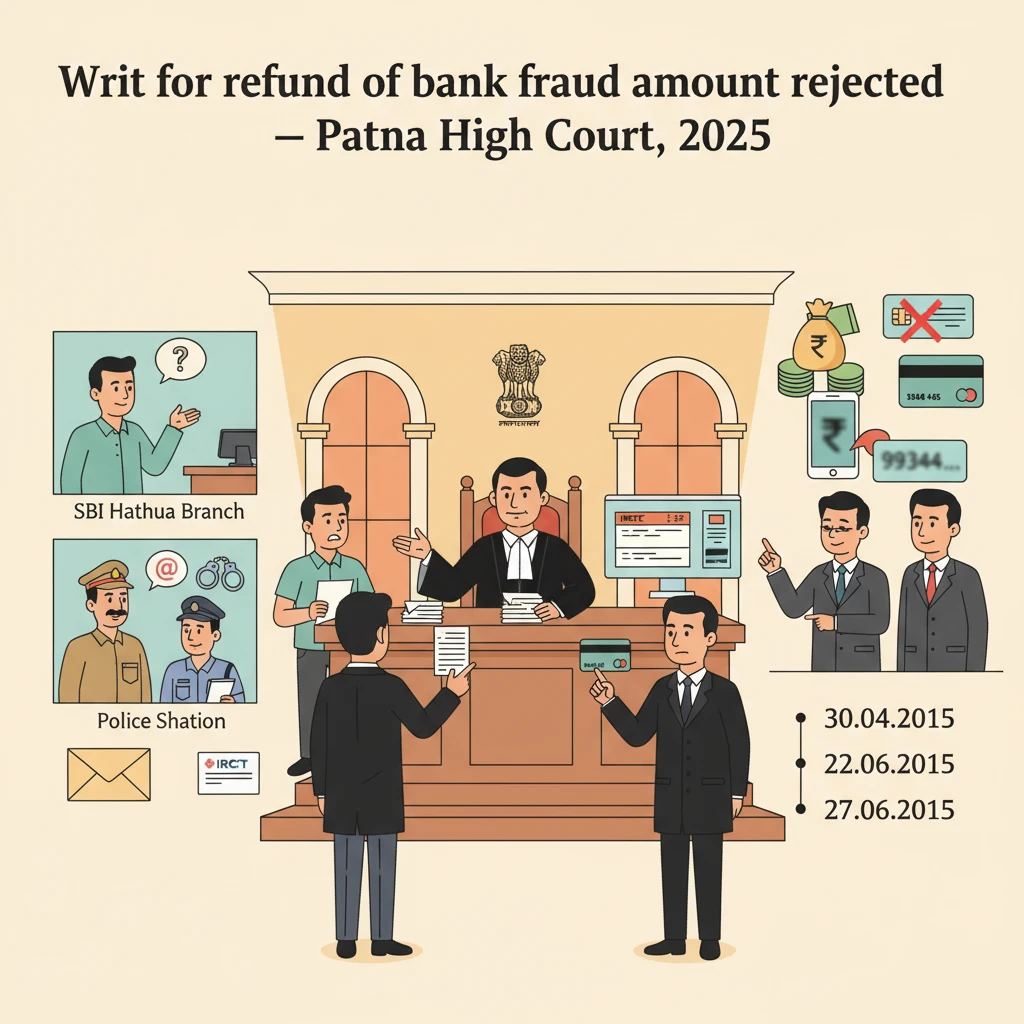
The petitioner maintained a savings bank account bearing number 11453719697 with the Hathua Branch of State Bank of India in Gopalganj district.
He visited the branch to get his passbook updated. On checking the entries, he discovered that a total sum of Rs. 11,28,283/- had been withdrawn from his account and credited to Indian Railway Catering and Tourism Corporation (IRCTC) on different dates between 30.04.2015 and 22.06.2015.
According to the petitioner, he had never given any authorization or instruction to State Bank of India to transfer any amount from his account to IRCTC. On noticing these debits, he immediately approached the Branch Manager of SBI, Hathua, and questioned the unauthorized withdrawals.
The Branch Manager allegedly expressed ignorance and helplessness. Feeling aggrieved, the petitioner lodged a First Information Report, registered as Hathua P.S. Case No. 106 of 2015, alleging fraud in relation to the withdrawals.
The petitioner also wrote letters to the Reserve Bank of India and IRCTC about the disputed transfers. IRCTC, in response, informed that they had provided transaction details to the bank. The petitioner further addressed a letter to the Chairperson of State Bank of India seeking refund of the entire amount of Rs. 11,28,283/- along with interest.
When no remedial action came from the bank’s side, the petitioner filed this writ petition before the Patna High Court seeking a direction (mandamus) to the respondents, particularly SBI, to credit back the said amount with interest to his savings account, alleging that the money had been illegally withdrawn without his authorization.
What the Court Examined and Decided
The Patna High Court examined the pleadings and affidavits filed by all sides: the petitioner, State Bank of India (respondent bank), and IRCTC (respondent nos. 6 and 7).
Bank’s version of the transactions
State Bank of India filed a counter affidavit giving details and its stand on the disputed withdrawals. According to SBI, as per the petitioner’s own annexures, about 295 transactions were carried out from the petitioner’s account over a span of 53 days.
The bank stated that these transactions were made using the petitioner’s debit card. The petitioner had also opted for SMS alert facility on mobile number 9934402334, and during all the disputed transactions, SMS messages were sent to this number.
SBI further pointed out that the petitioner used the ATM card for his own personal withdrawals in addition to the disputed transactions linked to IRCTC. The bank clarified that all the transactions questioned by the petitioner were not done at the branch counter or from any SBI ATM. Instead, they were done from a personal computer for online ticket booking on IRCTC.
According to SBI, for completing such online IRCTC ticket bookings, the following details are required and entered:
- Petitioner’s personal login and password on IRCTC
- Debit/ATM card number
- CVV number printed on the back of the card
- Validity period of the card
- One Time Password (OTP) sent to the registered mobile number at the time of final payment
The bank stressed that these particulars are known only to the cardholder and that the transaction would be completed only when the OTP sent to the registered mobile is entered correctly.
SBI found it surprising that about 293 transactions in 53 days could take place without the petitioner’s knowledge, despite SMS alerts being active. The bank claimed it had no definite knowledge of who actually used the card and that once the ATM card is issued, it is the responsibility of the individual account holder to protect the card and maintain secrecy of its details.
The bank informed the Court that the ATM card had already been blocked and that an FIR (Hathua P.S. Case No. 106/2015 dated 22.06.2015) had been lodged by the petitioner, which was under investigation. SBI also took a preliminary legal stand that the writ prayer was not maintainable because the bank was only acting in its usual course of business and had no role in who purchased tickets from IRCTC.
IRCTC’s explanation on the booking process
IRCTC (respondent nos. 6 and 7) also filed a counter affidavit explaining how online ticket booking works on its platform.
IRCTC stated that any user must first register on its website. For registration, a unique user name, a unique mobile number, and an address are required. An OTP (verification code) is sent to the mobile number given during registration. The address is not verified at this stage.
At registration, bank or card details are not asked. Only at the time of actual booking of tickets, after the user logs in with the user ID and password and fills in journey details, the system directs the user to a payment page where bank/card details are entered. The system then communicates with the bank for authentication and clearance.
IRCTC clarified that card numbers used for payments are not stored in its database, and therefore IRCTC is not aware of or in control of the card number through which payment is made. It emphasized that the responsibility for safe handling of debit cards for online transactions lies with the user and the issuing bank, and IRCTC is not involved in that part.
IRCTC further stated that after receiving the complaint from the petitioner concerning unauthorized withdrawal of Rs. 11,28,283/- for 292 transactions, it checked all details and emailed the transaction details to SBI on 27.06.2015. All associated user IDs were deactivated. However, by the time the complaint reached IRCTC, all the journeys under those e-tickets had already been completed or had expired.
The disputed e-tickets were booked using an SBI debit card bearing ATM Card No. 6220180294500007736, as confirmed by SBI’s concerned department. IRCTC concluded that the issue was strictly between the user and his card issuing bank and that IRCTC had no role in the actual debit process.
Petitioner’s allegations of fraud and bank connivance
The petitioner filed a detailed rejoinder to contest the stands of SBI and IRCTC. He asserted that once the fraudulent transactions were discovered, he found that the then Branch Manager of SBI, Hathua Branch, Mr. Naveen Prakash, had been transferred to Madhubani district.
After lodging the FIR (Hathua P.S. Case No. 106/15 dated 22.06.2015), the cyber cell investigated the matter and identified one Rahul Jha, who allegedly operated the IRCTC login user ID and did ticketing through IRCTC, and who also belonged to Madhubani district.
According to the petitioner, this coincidence raised strong suspicion of involvement of the then Branch Manager in connivance with Rahul Jha. The petitioner claimed that Rahul Jha had been in custody since 16.09.2016 and alleged that the entire fraud was carried out in collusion with the bank manager.
The petitioner alleged that the then Branch Manager misused his knowledge that the account was not being operated by the petitioner for a long period. After the petitioner’s retirement, his retiral benefits were credited into this account, which he had reserved for the marriage of his two daughters and a son, and therefore he did not frequently operate it.
He further alleged that the Branch Manager had destroyed, deleted, or altered information in the bank’s computer system relating to his account and that this amounted to wrongful handling of computer resources, making the bank liable for compensation under Section 43 of the Information Technology Act, 2008.
The petitioner also pointed to alleged anomalies in his account profile printout, such as recording “Madhubani district” in place of Gopalganj and the mention of a landline number which he claimed he never had or provided. These, according to the petitioner, created further suspicion of manipulation of his account profile by bank officials in order to facilitate the fraudulent transactions.
Bank’s objection on maintainability and alternative remedy
In an additional counter affidavit, SBI again raised a preliminary objection that the writ petition was not maintainable. It relied on the Information Technology Act, 2000, particularly:
- Section 43-A, relating to compensation for failure to protect data
- Section 46(1), under which the Central Government notified the Secretary of the Department of Information Technology of each State as the Adjudicating Officer (Notification No. GSR 240(E) dated 25.03.2003)
- Section 57, providing for an Appellate Tribunal against decisions of the Adjudicating Authority
- Section 62, providing an appeal to the High Court from the order of the Appellate Tribunal
On this basis, the bank argued that the petitioner had an effective statutory remedy before the Adjudicating Authority under the I.T. Act, followed by appeal to the Appellate Tribunal and, if needed, to the High Court, and therefore a writ petition under Article 226 directly before the High Court was not proper.
Court’s reliance on Supreme Court precedent
The Court noted the submissions and the multiple, conflicting factual allegations made by the parties regarding:
- Who actually used the debit card
- How the card and account details supposedly leaked
- Alleged collusion of bank staff and the person identified by cyber cell
- Accuracy or manipulation of account profile details
Learned counsel for the respondent bank placed reliance on paragraph 18 of the Supreme Court judgment reported in AIR 1976 SC 386, D.L.F. Housing Construction (P) Ltd. v. Delhi Municipal Corporation and others. In that decision, the Supreme Court held that where basic facts are disputed and complicated questions of law and fact, depending on evidence, are involved, the writ court is not the proper forum. In such cases, the High Court should dismiss the writ petition on that preliminary ground, leaving the parties to seek their remedy by a regular suit.
Quoting the principle from that case, the Patna High Court emphasized that without firm and adequate factual foundation, it would be hazardous to make findings in writ jurisdiction.
High Court’s conclusion
Applying the Supreme Court’s guidance, the Patna High Court held that the controversy here involved highly disputed and complicated questions of fact and law. These issues required detailed evidence, examination of records, and perhaps witness testimonies, which cannot be satisfactorily dealt with in a writ proceeding.
The Court specifically noted that such matters must be decided by a court or forum having original jurisdiction, not by the High Court in its writ jurisdiction.
Therefore, the Court declined to go into the merits of the petitioner’s allegations or to determine responsibility for the alleged fraudulent transactions.
Instead, the Court dismissed the writ petition while expressly granting liberty to the petitioner to move or choose an appropriate forum for redressal of his grievance, such as the statutory mechanisms under the Information Technology Act or by regular civil proceedings, as may be advised.
All interlocutory applications stood disposed of as a consequence of the dismissal.
Why This Judgment Matters
This judgment is important because it clarifies that the Patna High Court will not decide complex banking fraud and cyber fraud disputes under writ jurisdiction when the facts are heavily disputed.
In cases where money has been debited through online transactions, and there are allegations of fraud, misuse of debit card, or collusion of bank staff, detailed evidence is necessary. The High Court has indicated that such questions must be examined before the proper original forum, not through a writ petition.
For account holders, this decision signals that if they suffer large unauthorized withdrawals involving online platforms, simply filing a writ may not be enough. They may have to:
- Pursue criminal investigation through FIR and cyber cell
- Use remedies under the Information Technology Act before the Adjudicating Authority
- Consider filing a regular civil suit for compensation and recovery
For banks and service providers like IRCTC, the judgment reinforces that their role and responsibility in such disputes will be tested in a full-fledged fact-finding process, not in a summary writ proceeding.
Legal Issues and Answers
-
Issue: Can the Patna High Court, in writ jurisdiction, order State Bank of India and other respondents to refund alleged fraudulent withdrawals when there are serious disputes on facts and allegations of collusion requiring evidence?
Answer: No. The Court held that where basic facts are disputed and complicated questions of law and fact, depending on evidence, arise, writ jurisdiction is not the proper forum. The petitioner must seek remedy before an appropriate original forum. -
Issue: Is the writ petition maintainable when alternative statutory remedies exist under the Information Technology Act, 2000, for data protection failures and compensation?
Answer: The Court accepted the bank’s contention that such matters should go before the adjudicatory mechanisms under the I.T. Act or a regular civil court, and on that basis, dismissed the writ petition while giving liberty to the petitioner to approach the appropriate forum.
Cases Cited by the Court
- AIR 1976 Supreme Court 386, D.L.F. Housing Construction (P) Ltd. v. Delhi Municipal Corporation and others – relied upon to hold that writ jurisdiction is not suitable where basic facts are in serious dispute and complicated factual questions require evidence.
Case Details
Case Number: Civil Writ Jurisdiction Case No. 11423 of 2015
Case Title: Surendra Nath Pandey v. The State Bank of India & Others
Court: High Court of Judicature at Patna
Coram: Hon’ble Justice Smt. G. Anupama Chakravarthy
Date of Judgment: 10-01-2025
Citation: 2025 (2) PLJR 553
Advocates:
- For the petitioner: Mr. Alok Kumar @ Alok Kr Shahi, Advocate
- For the respondent bank (State Bank of India): Mr. Rakesh Kumar Singh, Advocate
- For the respondent IRCTC: M/s R.K. Agrawal and Sanjeev Kumar, Advocates
- For other respondents: Not specifically mentioned
Nature of the case: Writ petition (Civil) seeking mandamus for refund of alleged unauthorized online withdrawals from savings bank account
Link to the Judgment: Click here to read the full judgment
If you found this explanation helpful and wish to stay informed about
how legal developments may affect your rights in Bihar,
you may consider following Samvida Law Associates for more updates.







