
Case Background
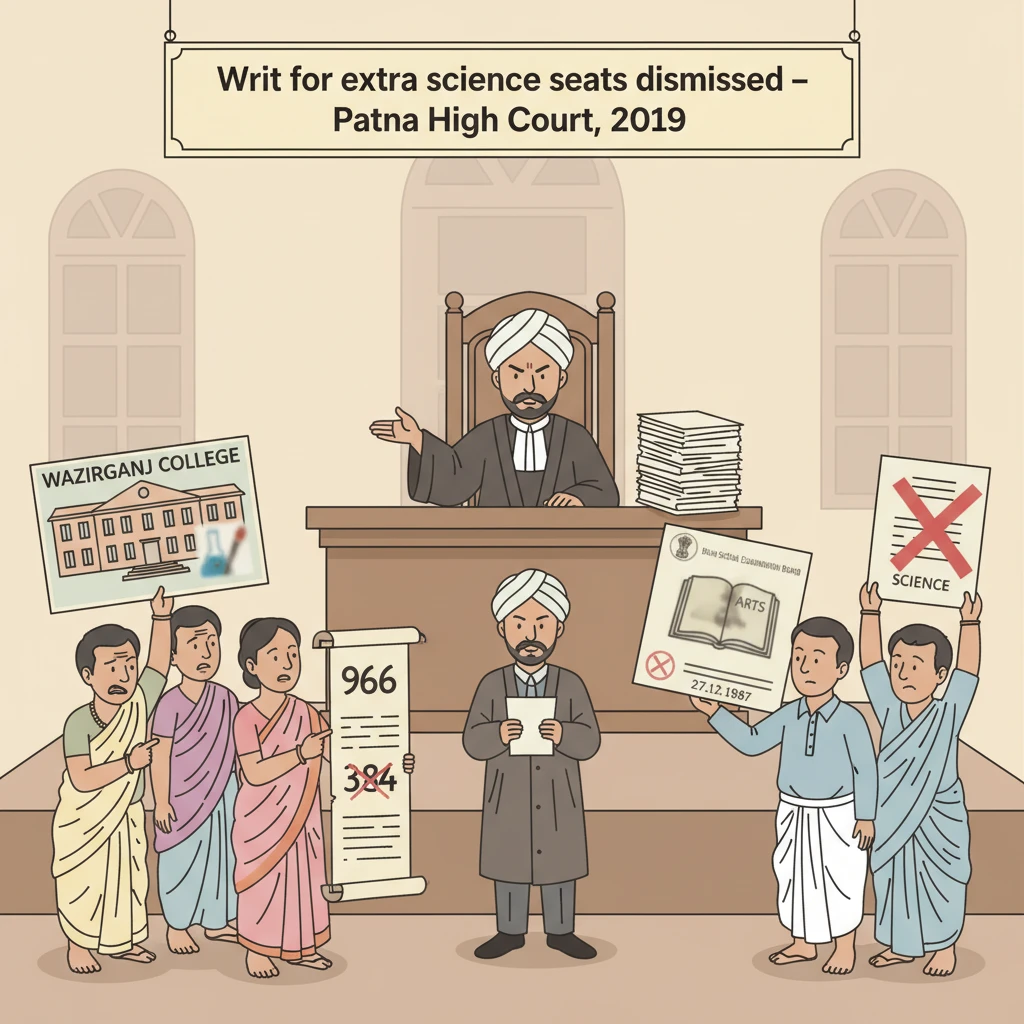
The case arose from a writ petition filed by Wazirganj College, Gaya, before the Patna High Court. The college approached the Court in Civil Writ Jurisdiction Case No. 22582 of 2018.
The college described itself as an affiliated degree college imparting education in both Science and Arts streams. It claimed to have 40 classrooms and other facilities. It also stated that the Bihar School Examination Board had inspected the college, and the District Education Officer, Gaya, had submitted an inspection report dated 02.01.2013.
For the Intermediate Session 2017–19, the college admitted 966 students in Class XI Science. According to the college, there were not enough colleges or schools in the area, so local students depended heavily on it.
The Bihar School Examination Board accepted the Class XI results and fees for all 966 students. However, when the time came for the Intermediate examination, the Board allowed only 384 students to appear, and that too after applying its policy decisions. Feeling aggrieved, the college filed this writ petition.
The college requested two main directions: first, to consider and decide its application for extension of seats in the Science stream for the 2017–19 Intermediate session; and second, to allow registration of all its Science stream students for the upcoming Intermediate examination.
On 15.01.2019, the Court granted the college an opportunity to place on record the order of recognition of the college in the Science stream by filing a supplementary affidavit. Despite this opportunity, no such order granting recognition, affiliation, or even permission to admit students in Intermediate Arts or Science was produced.
Instead, through the supplementary affidavit, the college mainly relied on past practice. It stated that its students had been regularly allowed to fill forms and appear in Intermediate examinations in both Science and Arts streams for several years and that the Board had accepted such forms and fees.
What the Court Examined and Decided
The Court first looked at the documents placed on record. It found that there was no order showing that the college had recognition, affiliation, or permission from either the State Government or the Bihar School Examination Board to run Intermediate classes in Arts or Science.
The college’s case relied heavily on the claim that, over the years, the Board had accepted forms and fees of its students and allowed them to appear in Intermediate examinations. The college argued that for Session 2016–18, its intake in Arts and Science had even been increased, registration forms accepted, and students allowed to sit in the exam. On this basis, it insisted that for 2017–19 also, the Board should follow the same pattern, especially since it had already accepted registration and examination fees.
The college also pointed out that, for the current session, the Board had given permission to 384 extra candidates of the Arts stream to appear in the 2019 Intermediate examination. It argued that denying a similar extension in the Science stream was against past precedent and would ruin the future of innocent students.
On the other side, the Bihar School Examination Board produced clear material showing the limits of any past approval. The State Government, by Memo No. 1150 dated 27.12.1987, had approved the college only in the Arts faculty at Intermediate level and only for two academic sessions, without financial liability. Even this limited approval did not extend to the Science stream.
The Board’s counsel also referred to proceedings of the Board’s meeting held on 19.12.2018. In that meeting, it was decided not to accept admission, registration or examination forms of students of schools and colleges which did not have affiliation or recognition from the State Government or the Bihar School Examination Board.
However, keeping the interest of students in mind, the Board also took a compassionate decision. It resolved that where institutions had affiliation in one or two streams but not in a particular stream, and students had already filled admission, registration or examination forms, such students would be allowed to appear from any other +2 recognised institution.
Further, following an earlier policy decision, the Board resolved that institutions having affiliation in one or two faculties would be allowed the same “basic strength” in the unaffiliated faculty as well. On this basis, 384 students in the Science stream belonging to the petitioner college were allowed to appear in the 2019 Intermediate examination, though not as a matter of right.
After hearing both sides, the Court reached some firm findings. It held that the college had no affiliation, recognition or permission for admitting students in Class XI and XII Intermediate level courses, either in Arts or in Science, from the State Government or the Bihar School Examination Board.
The Court concluded that the college had illegally inducted students in both streams at the Intermediate level and thereby duped innocent students. It noted that despite being given a specific opportunity to produce any recognition or affiliation order, the college had failed to do so.
The college’s main legal argument was that because its students had been allowed to appear in earlier years without proper affiliation, the same benefit should be extended in the current year as well. The Court categorically rejected this argument. It held that illegal precedents cannot become a rule and that an illegality cannot be perpetuated.
The Court emphasized the legal principle that “there is no equality in illegality.” It stated that merely because something wrong had been allowed in the past could not create a legal right to demand that the wrong be repeated.
Interestingly, the Court also examined the role of the Board’s officials. It found that respondent no. 5 (the Additional Secretary, Senior Secondary-cum-Nodal Officer, OFSS) had been accommodative and sympathetic towards the students. He had allowed 384 candidates of the college to appear in the Science stream of the 2019 Intermediate examination, even though such permission was “neither warranted nor legal.”
The Court observed that allowing any candidate to appear from the college was admittedly illegal because the institution had no recognition or affiliation. Still, the Court consciously decided not to cancel the candidature of those 384 students. It did so keeping in mind their future and noting that they had no complicity in the college’s wrongdoing.
The Court further held that the college had failed to show any legal right to seek a direction (mandamus) to the Board. Without recognition or affiliation at the Intermediate level, the college could not demand that its students be permitted to appear as college candidates in extra seats of the Science stream.
The Court stressed that issuing such a direction would amount to passing an illegal order, which the Court is bound not to do. Therefore, it refused to interfere with the Board’s decision beyond the limited, already granted relief for 384 students.
In the end, the writ petition was dismissed as being without merit. No costs were imposed on the college. However, the Court issued important directions to protect students and maintain accountability.
First, the State Government and the Bihar School Examination Board were directed to widely publicise that the college neither possesses recognition nor affiliation from either authority. The purpose was to ensure that innocent children are not misled or duped by the college in future.
Second, the respondents were directed to take appropriate action not only against the college but also against those officials of the Board who, after an enquiry, are found to have illegally permitted students of the college to appear in Intermediate examinations year after year without the college having recognition, affiliation or permission to admit students.
The Court ordered that an action taken report be submitted before it immediately upon the completion of eight weeks from the date of the judgment, i.e., 01.03.2019.
Why This Judgment Matters
This judgment has strong practical implications for students, parents and educational institutions in Bihar.
First, it makes clear that no college or school can claim a right to send students to Board examinations at Intermediate level without proper recognition or affiliation. Past laxity by authorities does not create any legal right.
Second, the decision protects students by directing the Government and Board to publicise the status of unrecognised institutions. This helps families verify whether a college actually has permission to run Intermediate courses before taking admission.
Third, the Court balanced legality with compassion. While refusing to extend illegality, it protected the 384 students already allowed to appear, recognising that they were innocent and had no role in the misconduct.
Finally, the judgment puts responsibility on officials who allowed such irregularities in the past. By ordering an enquiry and action against them, it sends a message that both private institutions and public functionaries can be held accountable.
Legal Issues and Answers
Issue: Can an unrecognised and unaffiliated college claim a right to have all its Intermediate Science students registered and allowed to appear in the Board examination, based on past practice?
Answer: No. The Patna High Court held that the college had no recognition or affiliation and therefore no legal right to seek such a direction. Past illegal permissions cannot be relied upon; “there is no equality in illegality.”
Issue: Should the Court cancel the candidature of students already allowed by the Board to appear from such an illegal college?
Answer: No. Although permitting them was illegal, the Court, considering the future of innocent students and their lack of complicity, chose not to cancel the candidature of 384 Science stream students already allowed for the 2019 Intermediate examination.
Issue: What steps should be taken to prevent further harm to students and fix responsibility for past irregularities?
Answer: The Court directed the State Government and Bihar School Examination Board to widely publicise the college’s lack of recognition or affiliation, and to take appropriate action against the college and responsible Board officials, with an action taken report to be filed within eight weeks.
Cases Cited by the Court
- The judgment does not mention or rely on any specific earlier decided case by name or citation. It only refers to the general legal principle that “there is no equality in illegality.”
Case Details
Case Number: Civil Writ Jurisdiction Case No. 22582 of 2018
Case Title: Wazirganj College, Wazirganj Gaya through its officiating Principal Geeta Pd. Singh v. The State of Bihar & Ors.
Citation: 2019 (3) PLJR 338
Court: High Court of Judicature at Patna
Coram: Hon’ble Mr. Justice Mohit Kumar Shah
Date of Judgment: 01.03.2019
Nature of Case: Writ petition under civil writ jurisdiction challenging refusal to extend seats and allow registration of Intermediate Science stream students for the 2017–19 session.
Advocates for Petitioner: Mr. P.K. Shahi, Senior Advocate; Mr. Shama Sinha, Advocate
Advocates for State (Respondent): Mr. Madanjeet Kumar, Government Pleader 20
Advocates for Bihar School Examination Board: Mr. Satyabir Bharti, Advocate; Mr. Gyan Shankar, Advocate
Link to Judgment: Full text of Patna High Court judgment
If you found this explanation helpful and wish to stay informed about
how legal developments may affect your rights in Bihar,
you may consider following Samvida Law Associates for more updates.







