

Case Background
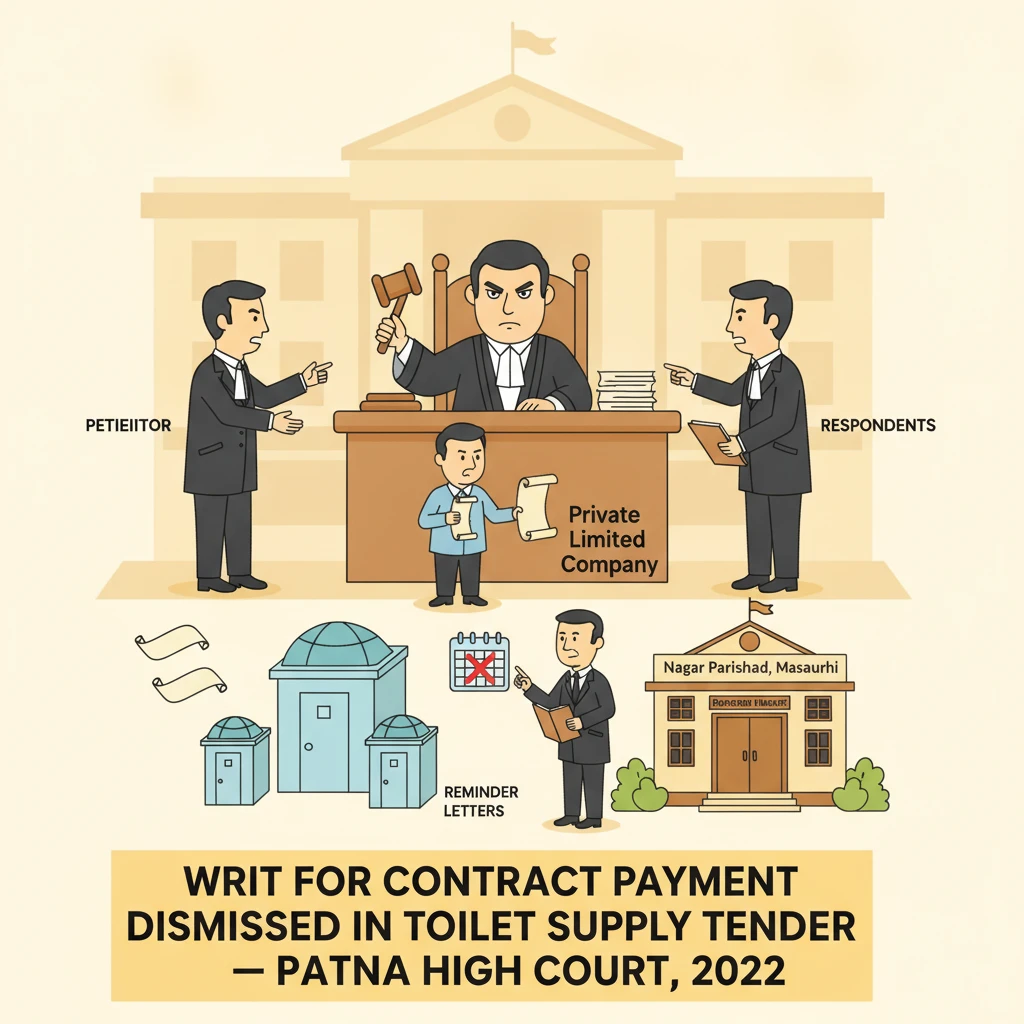
The case arose from a government tender floated by Nagar Parishad, Masaurhi, in Patna district. The tender was for the supply of portable toilet single seaters with bio-digester and mobile toilet six-seater units with bio-digester.
A private limited company, the writ petitioner, submitted its bid. Its bid was accepted, and it was found to be the lowest bidder. On 16.05.2018, the Nagar Parishad issued a work order in its favour.
As per the work order and the notice inviting tender (N.I.T.), the petitioner had to supply 70 portable toilet single seater units with bio-digester and 5 mobile toilet six-seater units with bio-digester. Both Clause 12 of the N.I.T. and Clause 2 of the work order clearly fixed a time limit of 30 days from the date of the work order for completing the supply.
Clause 6 of the work order stated that payment would be made only after completion of the supply and submission of bills.
The petitioner, however, did not complete the supply within 30 days. In fact, even by the time of the writ hearing, the full quantity had not been supplied. According to the petitioner’s own case, it supplied only 34 out of 70 single seater units and only 2 out of 5 six-seater mobile toilet units.
Because of this delay and shortfall, the Nagar Parishad issued reminders to the petitioner’s Managing Director on 31.08.2018 and 22.10.2018 asking for supply of the remaining articles. In both letters, the Nagar Parishad pointed out that the petitioner had failed to meet the 30-day supply period.
Despite these communications, the supply was never completed. Later, the petitioner approached the Patna High Court under Article 226 of the Constitution of India.
Through the writ petition, the company sought a direction to the Nagar Parishad to pay the “admitted dues” for the articles already supplied. It also asked for a direction compelling the Nagar Parishad to accept the remaining items allegedly ready for supply.
What the Court Examined and Decided
The Patna High Court, hearing the matter online due to COVID-19 restrictions, considered pleadings from both sides. A counter affidavit had been filed on behalf of Nagar Parishad, Masaurhi (respondent nos. 4 and 5), and the petitioner had filed a rejoinder.
The core question before the Court was whether it should, in a writ petition, compel the Nagar Parishad to pay for the partial supply and to accept the remaining items despite the admitted delays and disputes.
First, the Court looked closely at the nature of the arrangement between the parties. It noted that the case arose purely from a contract—the tender, the work order dated 16.05.2018, and the obligations flowing from them.
The contract terms were not in dispute. The tender documents and work order clearly required the petitioner to supply all 70 single seater toilets and 5 six-seater mobile toilets within 30 days. The payment clause (Clause 6) also clearly said that payment would be made only after completion of supplies and submission of bills.
On the factual side, the Court recorded that it was an admitted fact that the petitioner did not supply the articles within the prescribed period. Even by the date of the writ hearing, the entire supply had not been made available to the Nagar Parishad.
According to the petitioner’s own showing, only 34 single seater toilets and 2 six-seater mobile toilets had been supplied. This meant that a large part of the contracted work remained incomplete long after the 30-day period and even after follow-up reminders.
In its counter affidavit, the Nagar Parishad took a firm stand against the petitioner’s claim. It pointed to Clause 12 of the N.I.T. and said that the petitioner itself had violated the terms and conditions by not supplying within time. It further asserted that none of the supplied articles had been made functional till that date.
On this basis, the Nagar Parishad disputed any liability to pay, as the petitioner had failed to perform its primary contractual obligation of timely and complete supply.
In the rejoinder affidavit, the petitioner did not effectively meet these factual objections. It did not dispute the key points raised in the counter affidavit. Instead, it mainly argued that since the Nagar Parishad had accepted part of the supply, it was under an obligation to make payment for that part.
The Court then turned to the nature of the relief sought. The petitioner wanted the Court, using its writ jurisdiction under Article 226, to:
- direct the Nagar Parishad to pay the bills for the supplied items; and
- direct the Nagar Parishad to accept the remaining items under the work order.
The Bench, speaking through Hon’ble Mr. Justice Chakradhari Sharan Singh, examined whether such relief was appropriate in writ proceedings.
The Court emphasised that the dispute arose out of a purely contractual arrangement between a private company and a local body. The petitioner’s interest was described as “purely private and monetary in nature”.
Importantly, the Court noted that the Nagar Parishad had not admitted the petitioner’s claims. On the contrary, it was actively disputing the claim by pointing out breach of contractual terms by the petitioner. This made the claim a contested money claim, not an undisputed liability.
The Court also referred to the work order condition that bills were to be submitted only after supply of the items. It treated as significant the admitted position that the petitioner had not supplied all the articles and that the contract condition for completion had not been met.
In view of these facts, the Court concluded that there was no exceptional circumstance that would justify interference under Article 226. It said that it was “not inclined to interfere in the matter” because it was “purely contractual in nature”.
The High Court underlined that writ jurisdiction is not meant to resolve such private commercial disputes over performance and payment, especially where factual issues are disputed and need evidence. For that purpose, normal civil or other appropriate forums are available.
On this reasoning, the Court held that the writ application had no merit. The petition was accordingly dismissed.
However, the Court did not close the door entirely on the petitioner. It explicitly granted liberty to the petitioner to approach the “appropriate forum, in accordance with law, to establish its claim, if permissible.”
This means that, while the High Court refused to entertain the dispute as a writ, the company remains free to file a civil suit or take any other remedy provided under law before the proper forum, where evidence can be led and disputed facts can be examined in detail.
Why This Judgment Matters
This judgment is important for contractors, suppliers and service providers who deal with government bodies, especially local bodies like Nagar Parishads.
The Patna High Court made it clear that when a dispute is purely about a commercial contract—such as delayed supply, incomplete work, or disagreement over payment—writ petitions under Article 226 are usually not the correct route.
Where the government authority disputes the contractor’s claim and alleges breach of contract, the court will normally not use writ powers to order payment. Instead, the party must go to the civil court or another appropriate forum to prove its case.
For small and medium contractors, this decision serves as a reminder to:
- adhere strictly to timelines and terms of tenders and work orders,
- understand that partial performance may not guarantee payment, especially if time is of the essence, and
- know that contractual disputes often need to be fought in civil courts, not through writ petitions.
The judgment also reassures government bodies that, when they reasonably dispute a contractor’s performance, they cannot usually be forced to pay through writ proceedings alone.
Legal Issues and Answers
Issue: Can the Patna High Court in writ jurisdiction under Article 226 direct a Nagar Parishad to pay and accept supplies under a disputed work order arising from a tender?
Answer: No. The Court held that the dispute was purely contractual, the petitioner’s interest was private and monetary, and the claims were disputed by the Nagar Parishad. There were no exceptional circumstances warranting interference under Article 226.
Issue: Does acceptance of part supply by a Nagar Parishad automatically create an enforceable writ claim for payment when overall contractual obligations remain unfulfilled?
Answer: No. The Court noted that the work order required full supply and only then submission of bills for payment. Since the petitioner had not supplied all articles and its performance was disputed, no such writ relief could be granted.
Cases Cited by the Court
- No prior judicial decisions are expressly cited or relied upon in the text of this judgment.
Case Details
Case Number: Civil Writ Jurisdiction Case No. 2124 of 2021
Case Title: Anshila Services Pvt. Ltd. v. The State of Bihar & Ors.
Citation: 2022 (1) PLJR 773
Coram: Hon’ble Mr. Justice Chakradhari Sharan Singh; Hon’ble Mr. Justice Madhuresh Prasad
Advocates: For the petitioner – Mr. Ravindra Kumar, Advocate; For the respondents – Mr. Rajiv Roy, GP-1
Nature of the Case: Writ petition under Article 226 of the Constitution of India seeking directions for payment of alleged dues and acceptance of goods under a government supply contract.
Link to Full Judgment: Patna High Court Judgment in CWJC No. 2124 of 2021
If you found this explanation helpful and wish to stay informed about
how legal developments may affect your rights in Bihar,
you may consider following Samvida Law Associates for more updates.







