
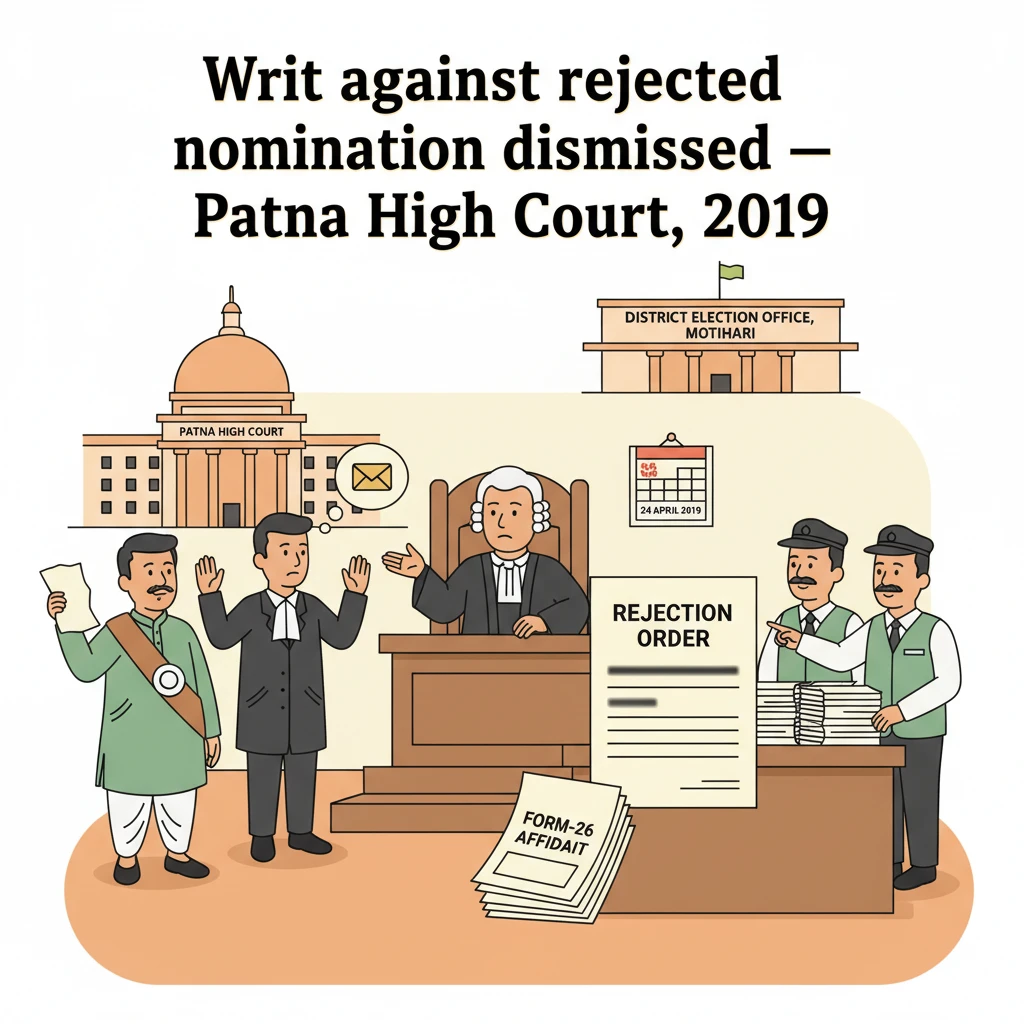
Case Background
The case arose out of the 2019 Parliamentary elections for the 04-Sheohar constituency in Bihar.
The election schedule was notified on 16.04.2019. The period for filing nomination papers was fixed from 16.04.2019 to 23.04.2019.
The petitioner, an independent candidate, filed his nomination paper on 20.04.2019 to contest from 04-Sheohar Parliamentary Constituency. During preliminary scrutiny on the same day, the Returning Officer prepared a check-list of documents and pointed out defects in the petitioner’s nomination and supporting affidavit in Form-26.
The check-list was handed over to the petitioner vide memo no. 36 dated 20.04.2019. He was granted time up to 3:00 p.m. on the last date for filing nominations to file a fresh affidavit and remove the defects.
According to the petitioner, he submitted a fresh nomination paper along with a corrected Form-26 affidavit on 22.04.2019, within the permitted period. He claimed that no further notice of defect was served on him.
The scrutiny of nominations was fixed on 24.04.2019. On that day, the Returning Officer passed the impugned order contained in memo no. 125 dated 24.04.2019, by which the petitioner’s nomination was rejected on the ground that his affidavit in Form-26 still contained blanks and defects.
Feeling aggrieved, the petitioner approached the Patna High Court under Article 226 of the Constitution in Civil Writ Jurisdiction Case No. 9829 of 2019.
What the Court Examined and Decided
The petitioner sought several reliefs. He asked the Court to quash the Returning Officer’s order dated 24.04.2019 rejecting his nomination as illegal, mala fide and arbitrary. He also sought directions to accept his nomination, include his name in the list of valid candidates, and allot him an election symbol.
His core argument was that the defect pointed out in his Form-26 affidavit was not of a “substantial character” under Section 36(4) of the Representation of the People Act, 1951. In his view, any error was curable and did not amount to suppression of information. He contended that rejection of his nomination on such a ground was without jurisdiction.
He further argued that, since he had submitted a fresh affidavit on 22.04.2019 within the time allowed, the Returning Officer’s statement that the fresh affidavit was filed on 24.04.2019 was factually wrong and mala fide. If the affidavit had truly been filed only on 24.04.2019, it would be beyond the last date of nomination, making scrutiny itself impossible. On this logic, he claimed that the impugned order was void on its face.
The petitioner tried to overcome the constitutional bar in Article 329(b), which limits court interference in election matters. He relied heavily on the Supreme Court’s judgment in Mohinder Singh Gill v. Chief Election Commissioner, and its detailed discussion in Election Commission of India v. Ashok Kumar. He argued that his case fell in the “exceptional” category where a High Court could intervene even during an election, because the Returning Officer’s action allegedly thwarted the election process instead of facilitating it.
On the other hand, counsel for the Election Commission of India opposed the writ petition.
The respondents stressed that during preliminary scrutiny on 20.04.2019, the petitioner was clearly informed of the defects in his Form-26 affidavit and given a checklist specifying those defects. He was also granted time, up to 3:00 p.m. on the last date of nomination, to file a proper fresh affidavit. Despite this opportunity, the defects were not cured.
The Election Commission’s counsel drew attention to an email sent by the petitioner himself on 24.04.2019 (Annexure-3 to the writ petition). In that email, the petitioner sought more time for removal of defects. The Court noted that this email strongly suggested that as on 24.04.2019, the affidavit remained defective, and thus undermined the petitioner’s claim that a correct affidavit had already been filed on 22.04.2019.
The respondents pointed out that there was no documentary proof to support the petitioner’s assertion of filing a fresh affidavit on 22.04.2019. The pleading in the writ petition was a bare statement without any acknowledgment, receipt, or copy to back it up.
The Election Commission also relied on Clause 6.10(x) of the “Handbook for Returning Officer” (February 2019). This clause requires mandatory rejection of a nomination paper “if columns were left blank in the affidavit and fresh affidavit not filed in spite of notice.” On this basis, the respondents argued that the Returning Officer had no discretion; if the affidavit remained incomplete despite notice and time, the nomination had to be rejected.
Legally, the respondents relied on the landmark Supreme Court decision in N.P. Ponnuswami v. Returning Officer, which holds that issues affecting the validity of an election, including rejection of nominations, should ordinarily be raised only through an election petition after the election is over, and not through writ proceedings under Article 226 at an intermediate stage. They argued that the petitioner had not shown any later Supreme Court ruling weakening this principle in the context of nomination rejection.
After hearing both sides, the Patna High Court framed its approach in two stages: first, whether it should exercise its extraordinary writ jurisdiction at all, given Article 329(b); and second, whether the Returning Officer’s decision suffered from arbitrariness or illegality.
On the factual dispute about when and how the fresh affidavit was filed, the Court found that this could not be satisfactorily resolved in writ proceedings. The petitioner claimed to have filed a fresh affidavit on 22.04.2019; the Returning Officer’s order recorded that it was filed on 24.04.2019; and the petitioner’s own email of 24.04.2019 sought more time to remove defects. In the absence of any supporting document from the petitioner, the Court was unwilling to accept his version in a summary writ proceeding.
Because of this unresolved factual controversy, the Court declined to hold that the Returning Officer’s order was null and void on its face.
On the question of arbitrariness, the Court examined the Supreme Court’s decisions in Mohinder Singh Gill and Ashok Kumar, but held that the petitioner’s case did not fall within the limited exceptions where court intervention during elections is allowed. The scenario contemplated in those cases involved obviously arbitrary steps that would stop an election or distort it, such as accepting nominations from only one party. In contrast, the present dispute involved failure to cure defects in an affidavit despite notice and time.
The Court then turned to the nature of the defect itself. Here, it placed strong reliance on the Supreme Court judgment in Resurgence India v. Election Commission of India. That decision recognised the voter’s fundamental “right to know” full details about a candidate’s criminal antecedents, assets, liabilities and educational qualifications, flowing from Article 19(1)(a) of the Constitution.
In Resurgence India, the Supreme Court held that a candidate’s affidavit that leaves columns blank defeats this right. It emphasised that the Returning Officer has a duty to ensure that all required information is fully furnished, and that if a candidate does not fill the blanks even after being reminded, the nomination paper is fit to be rejected. The candidate at least must write “NIL”, “Not applicable” or “Not known”; leaving blanks is not acceptable.
Applying these principles, the Patna High Court noted that in the present case certain columns in the petitioner’s affidavit had been left blank. In particular, objection no. 5(ii)(gha) related to criminal antecedents, and required a brief description of the offences in criminal cases involving the petitioner. In two out of three cases, those columns were not filled at all.
The Court held that such omissions were defects of a “substantial character”, not minor or technical. Because important information about alleged criminal cases was missing, the core purpose of Form-26—informing voters about a candidate’s criminal background—was frustrated.
The Court observed that, in view of the Handbook for Returning Officer and the law declared in Resurgence India, the Returning Officer’s action in rejecting the nomination could not be called arbitrary or mala fide. Instead, it was in line with the legal requirement that incomplete affidavits with blank columns should lead to rejection, especially when the candidate had been given an opportunity to correct them.
The Court also took into account the stage of the election process. By the time the writ was heard on 30.04.2019, ballot papers were stated to have already been printed and the polling date of 12.05.2019 was less than two weeks away. Allowing the writ and directing acceptance of the petitioner’s nomination at such a late stage would, in the Court’s view, impede, delay, and interrupt the election process, contrary to the caution in Ashok Kumar.
Further, this was not a case where immediate court intervention was necessary to preserve evidence or prevent loss of material, a situation noted in Ashok Kumar as a possible narrow ground for pre-election judicial interference. Here, the petitioner’s grievance could still be effectively examined later.
In conclusion, the Court held that Article 329(b) of the Constitution barred the writ remedy in these circumstances. It pointed out that the petitioner had an adequate alternative remedy: to file an election petition after the election, challenging the outcome and raising all his grievances about the rejection of his nomination.
On these grounds, the Patna High Court dismissed the writ petition, refusing to set aside the Returning Officer’s order or to direct acceptance of the petitioner’s nomination.
Why This Judgment Matters
This judgment sends a clear message to anyone planning to contest elections: filling Form-26 fully and correctly is not a formality. Leaving columns blank, especially about criminal cases, can lead to outright rejection of nomination.
The decision also shows that the Patna High Court will be very slow to interfere with the election process once it has started. Even if a candidate feels wronged by the Returning Officer, the normal route is to challenge the election later through an election petition, not through a rushed writ petition.
For voters, the case reinforces their right to know the full criminal background of candidates. Courts are insisting that this information must be given honestly and completely, and that election officials have a duty to reject incomplete affidavits.
Legal Issues and Answers
Issue: Can the Patna High Court, in a writ petition, set aside rejection of a nomination paper during an ongoing election on the allegation that the Returning Officer wrongly treated the Form-26 affidavit as defective?
Answer: No. The Court held that Article 329(b) bars such interference, especially when there are disputed facts and the candidate has an effective remedy by way of an election petition after the election.
Issue: Are blanks in the Form-26 affidavit regarding criminal cases a minor defect or a substantial defect justifying rejection of nomination?
Answer: The Court held that leaving such columns blank is a substantial defect, as it defeats the voter’s right to know and attracts mandatory rejection under the law and the Returning Officer’s Handbook.
Issue: Was the Returning Officer’s action in rejecting the petitioner’s nomination arbitrary or mala fide so as to justify writ interference under the exceptions recognised in Mohinder Singh Gill and Ashok Kumar?
Answer: The Court found no arbitrariness or mala fides. The rejection was in line with binding guidelines and Supreme Court precedent, and therefore did not fall within the limited exceptions permitting pre-election judicial review.
Cases Cited by the Court
- N.P. Ponnuswami v. The Returning Officer, Namakkal Constituency, Namakkal, Salem District and Others, AIR 1952 SC 64.
- Mohinder Singh Gill v. The Chief Election Commissioner, New Delhi, AIR 1978 SC 851.
- Election Commission of India through Secretary v. Ashok Kumar and Others, AIR 2000 SC 2977.
- Resurgence India v. Election Commission of India and Another, (2014) 14 SCC 189.
Case Details
Case Number: Civil Writ Jurisdiction Case No. 9829 of 2019
Case Title: Angesh Kumar v. The Election Commission of India & Ors.
Citation: 2019 (3) PLJR 118
Coram: Hon’ble Mr. Justice Vikash Jain
Advocates:
- For the petitioner: Mr. Purnendu Singh, Advocate
- For respondent no. 1 (Election Commission of India): Mr. Siddhartha Prasad, Advocate
- For respondent no. 3 (Returning Officer-cum-District Magistrate, Motihari): Mr. Prashant Pratap, GP-2
Nature of the case: Writ petition under Article 226 challenging rejection of nomination paper in Parliamentary election
Date of judgment: 30.04.2019
Link to judgment: Click here to read the full judgment of the Patna High Court
If you found this explanation helpful and wish to stay informed about
how legal developments may affect your rights in Bihar,
you may consider following Samvida Law Associates for more updates.







