

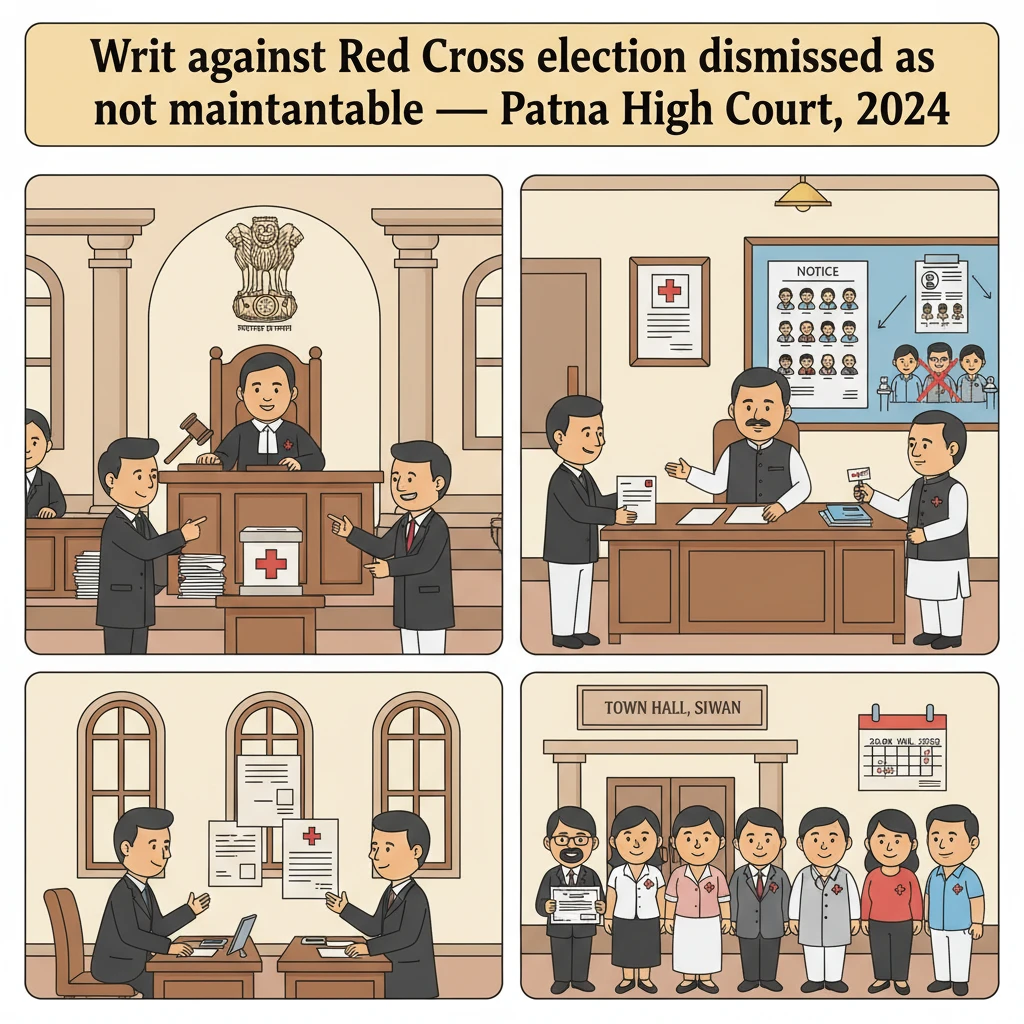
Case Background
The petitioner described himself as Secretary of the Indian Red Cross Society, Siwan District Branch. He approached the Patna High Court under its civil writ jurisdiction challenging an order dated 12.09.2023 passed by respondent no. 6, the Deputy Development Commissioner, Siwan, who was also Vice-President of the Siwan District Branch.
Earlier, respondent no. 5, the District Magistrate, Siwan, cum President of the Siwan District Branch, had issued letter no. 1447 dated 29.07.2023. By this letter, he informed the petitioner that an Annual General Meeting (AGM) for election of the Management Committee members would be held on 20.08.2023 at 11:00 a.m. in Town Hall, Siwan.
According to the petitioner, there were 1440 members of the Siwan Branch who were eligible to vote. Forty-three candidates filed their nomination papers to contest for posts of members of the Management Committee. In the AGM held on 20.08.2023, the members decided to elect 15 members for the Management Committee out of these 43 candidates.
Ballot papers were used for voting. After counting, 15 candidates were shown as having secured the highest votes and were declared elected as Management Committee members. The petitioner stated that respondent no. 5 declared these 15 successful candidates and that individual certificates were issued to each of them on 20.08.2023.
Later, on 23.08.2023, the District Magistrate, Siwan (respondent no. 1) issued letter no. 172. Referring to this, the petitioner wrote to respondent no. 5 on 12.09.2023 requesting that the election process be completed by 25.09.2023 for the posts of Chairman, Secretary, Vice-Chairman and Treasurer of the Management Committee.
However, on the same date, 12.09.2023, respondent no. 5 passed an order based on a complaint made by one Ashok Kumar Gupta and others. Acting in pursuance of a decision of respondent no. 4, the Secretary of the Bihar State Branch, this order set aside the election result of 20.08.2023. The order also declared all 43 candidates as members of the Management Committee instead of only 15. Respondent no. 6 then issued memo no. 548-II dated 12.09.2023 implementing this decision.
Aggrieved, the petitioner demanded documents including the election proceeding register from respondent no. 5 and wrote to respondent no. 4, with copies to respondents no. 1 and 2, by letter dated 14.09.2023. He asserted that setting aside the election of the 15 candidates after more than 22 days, at the instance of defeated candidates, and declaring all 43 as Management Committee members was against the law and the Rules of the Society. He requested reconsideration of the decision.
When this did not happen, the petitioner filed the present writ petition seeking to quash the order dated 12.09.2023 and to uphold the election result of 20.08.2023.
What the Court Examined and Decided
The Patna High Court, presided over by Hon’ble Mr. Justice Rajesh Kumar Verma, began by framing the “moot question” in the case: whether the Indian Red Cross Society is a “State” or its instrumentality within the meaning of Article 12 of the Constitution of India.
This question was crucial because a writ petition under Article 226 generally lies against the State or authorities that fall within Article 12, or at least against bodies performing public duties. If the Society did not qualify, the writ petition would not be maintainable, and the Court would not get into the merits of the election dispute.
The petitioner’s counsel argued that the functioning of the Indian Red Cross Society is governed by the Indian Red Cross Society Act, 1920, as amended, and Rules made under Section 5 of that Act for State and Union Territory branches. According to him, under Section 3 of the Act the Management Committee must have a minimum of 10 and maximum of 30 members, and any number within this range can be decided by the general body in the AGM.
On this basis, he submitted that declaring all 43 candidates as Management Committee members was illegal because it exceeded the statutory cap of 30. He also contended that neither the Collector nor district authorities had power under the Act and Rules to cancel the election of Management Committee members. In his view, only the State Branch could approve or disapprove the election. He asserted that the Red Cross Society should be treated as “State” under Article 12, making the writ petition maintainable.
To support these points, the petitioner relied on several decisions. He cited a Punjab and Haryana High Court judgment in J.N. Gahlaut and others vs. Indian Red Cross Society, Haryana State Branch and others, and quoted paragraphs 10 and 11, to argue that writ petitions could be entertained against the Society at least on grounds of violation of service rules and natural justice. He also referred to a judgment of the Madhya Pradesh High Court in New Balaji Chemist vs. Indian Red Cross Society (M.P. State Branch) and another, where the maintainability of a writ petition in relation to contractual matters with the Society had been argued. Additionally, he pointed to an order of the Patna High Court in Deepak Kumar vs. State of Bihar and others (CWJC No. 9954 of 2022) to buttress his stand that Red Cross actions could be tested under writ jurisdiction.
On the other side, counsel for respondent nos. 7 to 14 filed a detailed counter affidavit and raised a preliminary objection that the Indian Red Cross Society is neither a State nor its instrumentality under Article 12. They also challenged the petitioner’s locus standi, stating that he had wrongly represented himself as Secretary of the Siwan District Branch even though, after reconstitution of the Management Committee, a new Secretary was to be appointed.
The respondents’ counsel placed reliance on the Constitution Bench decision in Ajay Hasia vs. Khalid Mujib Sehravardi (AIR 1987 SC 487) where the Supreme Court laid down several tests to determine whether a body is an instrumentality or agency of the State, such as whether the entire share capital is held by Government, whether it receives almost entire financial assistance from the State, whether it enjoys State-conferred monopoly, depth of State control, the nature of its functions, and whether a government department has been transferred to it.
Further reliance was placed on K.K. Saksena vs. International Commission on Irrigation and Drainage, (2015) 4 SCC 670, where the Supreme Court examined whether a non-governmental international organisation performing technical and voluntary functions could be called “State” under Article 12. The Court in that case held that such bodies, even if performing important functions, are not necessarily performing public duties comparable to sovereign functions of the State.
The respondents also relied on decisions directly concerning the Red Cross Society. They cited the Gujarat High Court decision in Manoj Abraham Kahar vs. Indian Red Cross Society & Ors, 2017 GLH (1) 156, where it was held that Red Cross Societies function as impartial voluntary organisations, largely funded by donations from the public, without financial assistance or pervasive control from Government. In that case, the Court held that their functions are not in the nature of public duty and therefore writ petitions against them are not maintainable.
Similarly, reliance was placed on the Jammu and Kashmir High Court decision in Gh. Rasool Bhat vs. Indian Red Cross Society & Ors, 2010 (4) JKL 223. That judgment applied the normal Article 12 tests and concluded that the Society receives no government funding, has no statutory duties imposed on it, is governed by its own constitution, and that the presence of constitutional functionaries as honorary presidents does not make it a State instrumentality. Hence, it is not amenable to writ jurisdiction.
The respondents further referred to a decision of the Patna High Court in Bipin Kumar Singh vs. State Bank of India (CWJC No. 19201 of 2021). In that case, the Court held that disputes relating to elections within bodies governed by bye-laws often raise disputed questions of fact and should ordinarily be resolved by mechanisms provided in those bye-laws or by civil suits, and that writ jurisdiction is misconceived in such matters.
On the factual side, respondents argued that the entire election process for electing only 15 members was itself contrary to Chapter VI Rule 1 C 2 of the Indian Red Cross Society Rules, which provide only for a minimum of 10 Management Committee members, not a fixed ceiling of 15. They pointed out that the earlier Management Committee of the Siwan District Branch had 27 members. According to them, holding an election restricted to 15 members, without a prior AGM resolution fixing that number, was an improper exercise engineered by the petitioner.
They also stated that the AGM and voting were marked by “utter chaos and confusion.” Initially, all 43 candidates were announced to be nominated or elected as Management Committee members. Objections were raised before the Deputy Development Commissioner and the District Magistrate. Both authorities examined the situation and respondent no. 6 then issued memo no. 548-II on 12.09.2023 nominating all 43 candidates to the Managing Committee. The respondents claimed that this decision actually aligned with the Rules, and that the petitioner, not being Secretary anymore, had no locus to challenge it.
After considering these rival submissions and authorities, the Patna High Court concluded that the Indian Red Cross Society is not a State or instrumentality of the State, and that its functions are “not in the nature of public duty” but those of an “impartial voluntary organization.” The Court adopted the reasoning of the earlier High Court decisions cited by the respondents, which had examined the structure, funding and control of the Society and found that it did not meet the tests for being treated as “State” under Article 12.
On this basis, in paragraph 21 of the judgment, the Court held that the writ petition was not maintainable. Since the preliminary objection succeeded, the Court considered it inappropriate to delve into the merits of the election dispute or comment on the legality of the order dated 12.09.2023. The Court specifically noted that any such comments might prejudice the petitioner if he chose to approach a civil court or any other appropriate forum.
Finally, the Court dismissed the writ petition, while clearly leaving open to the petitioner the option of pursuing other remedies as may be available in law.
Why This Judgment Matters
This judgment is significant for members and office-bearers of Red Cross branches in Bihar who may be dissatisfied with internal elections or decisions of their Managing Committees.
The Patna High Court has made it clear that the Indian Red Cross Society, including its State and District branches, is treated as a voluntary organisation and not as “State” under Article 12. Because of this, internal disputes about elections, appointments or management decisions cannot normally be brought directly before the High Court through writ petitions.
Instead, aggrieved members will have to use remedies available under the Society’s own Rules, or file civil suits in competent civil courts. The Court has also signalled that it will avoid getting into factual questions arising from election processes within such voluntary bodies when writ jurisdiction itself is not made out.
Legal Issues and Answers
- Issue: Is the Indian Red Cross Society, including its Bihar State and Siwan District branches, a “State” or instrumentality of the State within the meaning of Article 12 of the Constitution, so that its actions in relation to internal elections can be challenged through a writ petition?
Answer: No. The Court held that the Society’s functions are not in the nature of public duty; it is an impartial voluntary organisation, and therefore a writ petition against it in this context is not maintainable. - Issue: Should the Patna High Court interfere with and set aside the order dated 12.09.2023 by which the election of 15 Management Committee members was cancelled and all 43 candidates were declared members?
Answer: The Court declined to examine this issue on merits once it found the writ petition not maintainable, and expressly refrained from commenting on the correctness of the impugned order.
Cases Cited by the Court
- Ajay Hasia vs. Khalid Mujib Sehravardi, AIR 1987 SC 487.
- K.K. Saksena vs. International Commission on Irrigation and Drainage, (2015) 4 SCC 670.
- Manoj Abraham Kahar vs. Indian Red Cross Society & Ors, 2017 GLH (1) 156.
- Gh. Rasool Bhat vs. Indian Red Cross Society & Ors, 2010 (4) JKL 223.
- Bipin Kumar Singh vs. State Bank of India, CWJC No. 19201 of 2021 (Patna High Court).
- J.N. Gahlaut and others vs. Indian Red Cross Society, Haryana State Branch and others, 2002 SCC OnLine P & H 1265.
- New Balaji Chemist (M/s) vs. Indian Red Cross Society (M.P. State Branch) & Anr, I.L.R. [2018] M.P. 894.
- Deepak Kumar vs. State of Bihar and others, CWJC No. 9954 of 2022 (Patna High Court order dated 11.12.2023).
Case Details
Case Number: Civil Writ Jurisdiction Case No. 14779 of 2023
Case Title: Ratnesh Prasad Singh vs. The State of Bihar through the District Magistrate, Siwan & Ors.
Citation: 2024 (4) PLJR 68
Court: High Court of Judicature at Patna
Coram: Hon’ble Mr. Justice Rajesh Kumar Verma
Date of Judgment: 23.08.2024
Nature of the Case: Civil writ petition under Article 226 of the Constitution of India challenging orders relating to election of Management Committee of Indian Red Cross Society, Siwan District Branch.
Advocates:
For the petitioner: Mr. Prabhakar Singh, Advocate; Ms. Rano Neha Kumari, Advocate.
For the State: Mr. Ajay Behari Sinha, Government Advocate 8; Mr. Upendra Kumar Singh, Assistant Counsel to GA 8.
For respondent nos. 7 to 14: Mr. Amit Srivastava, Senior Advocate; Mr. Sumit Shekhar Pandey, Advocate; Mr. Prashant Kumar, Advocate; Mr. Mayank Madan, Advocate.
Link to Judgment: Click here to access the full judgment of the Patna High Court
If you found this explanation helpful and wish to stay informed about how legal developments may affect your rights in Bihar, you may consider following Samvida Law Associates for more updates.







