

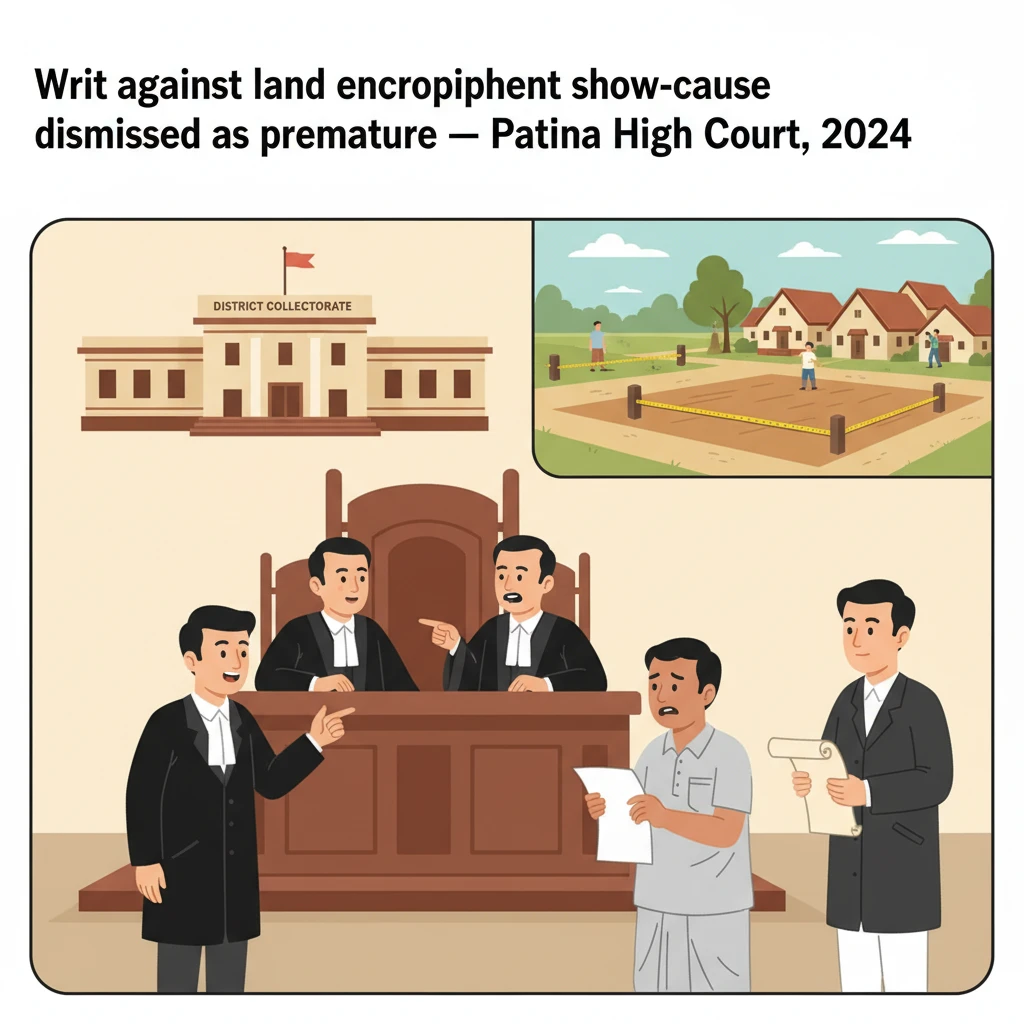
Case Background
The case arose from proceedings under the Bihar Public Land Encroachment Act, 1956. The Circle Officer, Rafiganj, started Case No. 18/17-18 alleging encroachment over government land.
On 27.08.2018, the Circle Officer issued a notice under Section 6(2) of the Act. By this notice he directed the petitioner to remove alleged encroachment from land under Thana No. 735, Khata No. 90, Plot No. 914, having an area of 1170 square feet, on or before 20.10.2018. This notice is referred to in the judgment as Annexure-4.
Instead of filing a detailed reply before the Circle Officer and participating in the proceedings under the 1956 Act, the petitioner approached the Patna High Court under its civil writ jurisdiction in CWJC No. 24522 of 2018.
He sought several directions from the Court. First, he asked for quashing of the notice dated 27.08.2018. Second, he wanted a mandamus for fresh measurement of the disputed land in his and others’ presence. Third, he asked that he be allowed to engage a private Amin at the time of such measurement. Fourth, he requested that earlier measurements, allegedly done in his absence, be kept in abeyance till fresh measurement. He also sought any other suitable relief.
What the Court Examined and Decided
The Division Bench of Hon’ble Mr. Justice P. B. Bajanthri and Hon’ble Mr. Justice Alok Kumar Pandey heard the writ petition. The oral judgment was delivered on 29.02.2024 by Justice P. B. Bajanthri.
The Bench first looked at the exact reliefs prayed for. From these it became clear that the core challenge was to the show-cause notice dated 27.08.2018 issued under Section 6(2) of the Bihar Public Land Encroachment Act, 1956.
The Court then examined whether a writ petition under Article 226 could be entertained at this stage, when only a show-cause notice had been issued and the authority had not yet passed any final order.
The judges noted a settled principle: writ courts generally do not interfere at the “show-cause” stage. An exception exists only in limited situations, such as when:
(a) the authority issuing the notice is clearly incompetent; or
(b) the notice is clearly in violation of statutory rules.
The Bench recorded that the petitioner had not shown that the Circle Officer, Rafiganj lacked power under the Bihar Public Land Encroachment Act, 1956 to issue such a notice. Nor did the petitioner point out how the notice violated any particular statutory rule.
Because these essential grounds were missing, the Court held that no case was made out for entertaining the writ petition. In simple words, the High Court said it could not step in when the petitioner still had an opportunity to explain his case before the Circle Officer.
To support this conclusion, the Bench relied on two decisions of the Hon’ble Supreme Court:
First, Union of India and Another v. Kunisetty Satyanarayana, reported in (2006) 12 Supreme Court Cases 28. In that case, the Supreme Court held that writ jurisdiction should not ordinarily be invoked against a mere show-cause notice or charge-sheet, except where the notice is wholly without jurisdiction or patently illegal.
Second, Secretary, Ministry of Defence and Others v. Prabhash Chandra Mirdha, reported in (2012) 11 Supreme Court Cases 565. The Supreme Court again reaffirmed that courts should avoid interfering at the initial stage of departmental or quasi-judicial proceedings unless serious jurisdictional or legal errors are shown on the face of the record.
Applying these precedents, the Patna High Court concluded that the present petition was premature. There was no final decision against the petitioner which could be challenged. The proceeding before the Circle Officer was still open, and the petitioner had not yet given his detailed reply.
Accordingly, in paragraph 4 of the judgment, the Court disposed of the writ petition as premature.
However, the Bench also ensured that the petitioner was not left without remedy. It specifically recorded that disposal of the writ would not prevent the petitioner from filing a detailed explanation before the Circle Officer in response to the show-cause notice dated 27.08.2018.
The Court fixed a time frame. The petitioner has been allowed 15 days from the date of receipt of the High Court’s judgment or order to submit his explanation. After receiving this explanation, the concerned authority has been directed to proceed in accordance with law.
The authority must take a decision and communicate it to the petitioner within two months from the date it receives the explanation. This gives a clear outer limit for the local authority to act, protecting the petitioner from indefinite uncertainty.
The Court then addressed the status of the interim order earlier granted in the writ petition. During the pendency of the case, there had been an interim protection order dated 26.02.2019. Once the main writ was disposed of, the Bench clarified that this interim order merged with the final order and therefore ceased to operate.
For this conclusion, the Court relied on the Supreme Court judgment in Kalabharati Advertising v. Hemant Vimalnath Narichania and Others, reported in (2010) 9 Supreme Court Cases 437. The principle drawn from that case is that interim orders do not survive after final disposal of the main case unless specifically preserved.
In the later part of the judgment, the Bench referred to a very recent Supreme Court decision: HYDHA MUSLIM WELFARE MASJID-E HIDAYA AND MADARASA v. N. Dinakaran and Others, decided on 26.02.2024 in SLA (C) No(s). 4375/2024.
The High Court reproduced key observations of the Supreme Court in that case relating to disputed illegal encroachments. The Supreme Court had recorded, for instance, that:
- the petitioner there was admittedly not the owner of the subject property,
- the land vested in the Chennai Metropolitan Development Authority free from all encumbrances,
- the petitioner was an unauthorized occupant,
- no building plan sanction had been applied for,
- construction had been raised in a totally illegal manner, and
- the illegal construction continued despite notices issued by the authority on 09.12.2020.
The Patna High Court stated that these “ingredients” are to be examined in cases of disputed illegal encroachments. In the present case too, the concerned authority (here, the Circle Officer or other competent officer under the 1956 Act) has been directed to keep these considerations in mind while finalising the matter.
Thus, though the High Court did not decide whether the petitioner in this case was actually an encroacher, it reminded the revenue authorities that, while deciding such disputes, they must carefully look into factors like ownership, vesting of land in the State or authority, presence or absence of building plan sanction, and the conduct of the person in occupation after receiving notices.
By doing so, the Court attempted to guide local authorities on how to approach encroachment cases in a legally sound and factual manner.
Why This Judgment Matters
This judgment is important for anyone who receives a show-cause notice under the Bihar Public Land Encroachment Act, 1956, or similar laws. It makes clear that rushing to the Patna High Court at the notice stage is usually not the right step.
The Court has underlined that a person should first reply in detail to the authority that issued the notice. Only after a final, adverse order is passed—and if there are legal grounds—can a challenge before the High Court be considered.
For government officers, the judgment reinforces that they have the power to proceed against alleged encroachers, but they must examine key aspects such as ownership, vesting of land, legality of construction and response to notices, in line with the recent Supreme Court guidance.
Practically, the ruling also shows that the High Court can fix timelines for authorities to decide encroachment proceedings, which can help prevent unnecessary delay and prolonged uncertainty for affected citizens.
Legal Issues and Answers
- Issue: Can the Patna High Court, in writ jurisdiction, quash a show-cause notice issued under Section 6(2) of the Bihar Public Land Encroachment Act, 1956, when no final order has been passed?
Answer: No. The Court held that a writ petition against a show-cause notice is not maintainable unless the notice is issued by an incompetent authority or in violation of statutory rules, which was not shown in this case. The petition was therefore dismissed as premature. - Issue: What is the effect of interim orders after the writ petition is finally disposed of?
Answer: The Court clarified that the interim order dated 26.02.2019 merged with the final order and stood ceased, following the Supreme Court’s decision in Kalabharati Advertising v. Hemant Vimalnath Narichania and Others. - Issue: How should authorities approach allegations of illegal encroachment while deciding proceedings under the Bihar Public Land Encroachment Act, 1956?
Answer: The Court directed that authorities should examine factors identified by the Supreme Court in HYDHA MUSLIM WELFARE MASJID-E HIDAYA AND MADARASA v. N. Dinakaran and Others, such as ownership, vesting of land in the public authority, status of occupation, sanction of building plans and response to prior notices.
Cases Cited by the Court
- Union of India and Another v. Kunisetty Satyanarayana, (2006) 12 SCC 28.
- Secretary, Ministry of Defence and Others v. Prabhash Chandra Mirdha, (2012) 11 SCC 565.
- Kalabharati Advertising v. Hemant Vimalnath Narichania and Others, (2010) 9 SCC 437.
- HYDHA MUSLIM WELFARE MASJID-E HIDAYA AND MADARASA v. N. Dinakaran and Others, decided on 26.02.2024 in SLA (C) No(s). 4375/2024.
Case Details
Case Number: Civil Writ Jurisdiction Case No. 24522 of 2018
Case Title: Md. Muzaffar Alam v. The State of Bihar & Others
Court: High Court of Judicature at Patna
Coram: Hon’ble Mr. Justice P. B. Bajanthri and Hon’ble Mr. Justice Alok Kumar Pandey
Date of Judgment: 29.02.2024
Citation: 2024(2) PLJR 225
Advocates: Mr. Nagendra Kumar Singh, Advocate for the petitioner; Mr. Rishi Raj Sinha, SC-15 for the State
Nature of the Case: Writ petition under civil writ jurisdiction challenging a show-cause notice issued under Section 6(2) of the Bihar Public Land Encroachment Act, 1956
Link to the Judgment: Click here to read the full judgment of the Patna High Court
If you found this explanation helpful and wish to stay informed about
how legal developments may affect your rights in Bihar,
you may consider following Samvida Law Associates for more updates.







