

Case Background
The case arose from a dispute over land situated in District Darbhanga. The petitioner stated that she was the title holder and in possession of land bearing Thana No. 501, Khata No. 27, Plot No. 218, having an area of 9 katha, situated at Mauza Behat, District Darbhanga.
A jamabandi (record of rights) bearing Jamabandi No. 278 had been created in her favour. According to her, this jamabandi was long standing and had been opened on the basis of a registered sale deed.
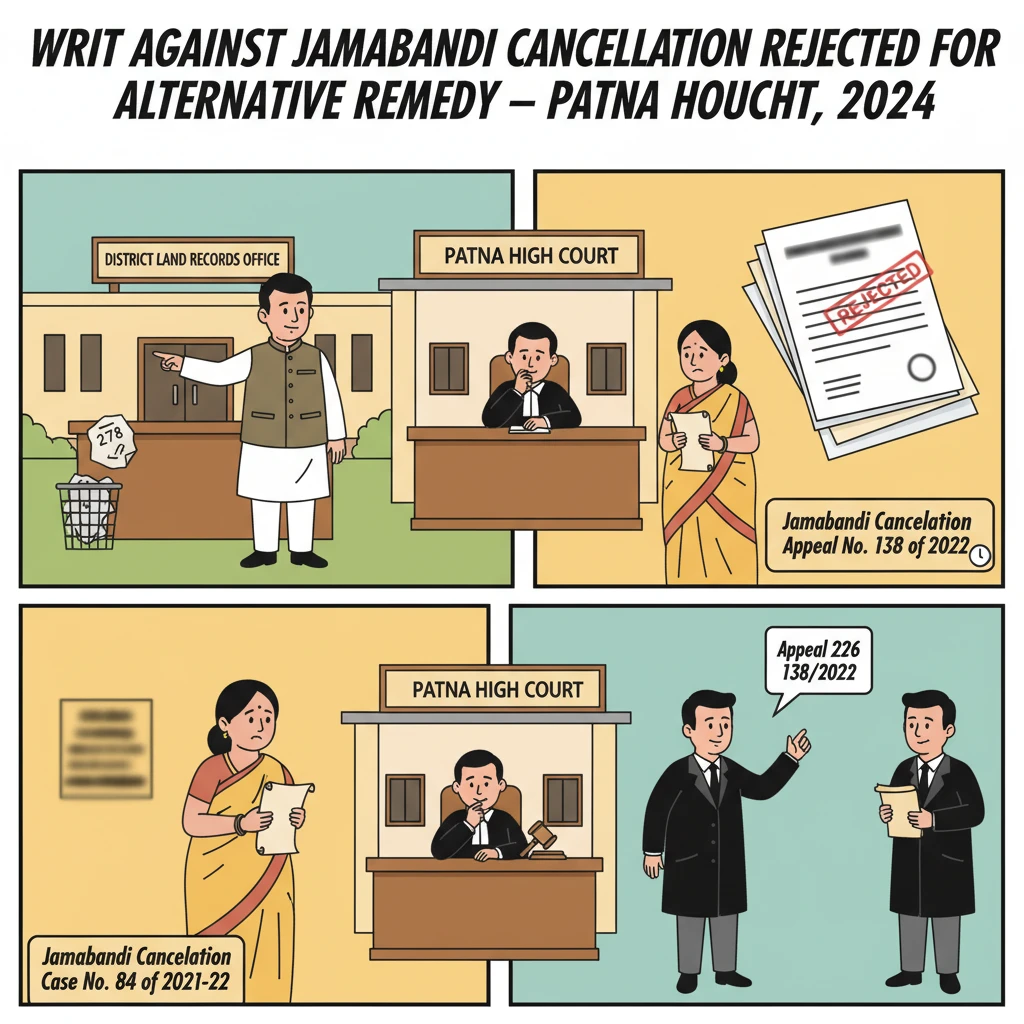
Later, proceedings were initiated before the Additional Collector, Darbhanga, in Jamabandi Cancellation Case No. 84 of 2021-22. Exercising powers under Section 9 of the Bihar Land Mutation Act, 2011, the Additional Collector passed an order dated 28.06.2022 cancelling Jamabandi No. 278.
Feeling aggrieved, the petitioner challenged this cancellation. She preferred a statutory appeal before the Collector, Darbhanga, under Section 9(6) of the Bihar Land Mutation Act, 2011. This appeal was registered as Jamabandi Cancellation Appeal No. 138 of 2022 on 26.07.2022 and remained pending for adjudication.
While the appeal was still pending, the petitioner also approached the Patna High Court under Article 226 of the Constitution of India by filing Civil Writ Jurisdiction Case No. 14881 of 2023. In the writ petition she questioned the legality of the cancellation order passed by the Additional Collector and sought restoration of her jamabandi.
What the Court Examined and Decided
The writ petition came up before Hon’ble Mr. Justice Prabhat Kumar Singh of the Patna High Court on 06.02.2024. The Court heard learned counsel for the petitioner and learned counsel for the State.
The petitioner sought three main reliefs in the writ petition. First, she asked for setting aside the order dated 28.06.2022 passed by the Additional Collector, Darbhanga, in Jamabandi Cancellation Case No. 84 of 2021-22. She asserted that the Additional Collector had wrongly exercised power under Section 9 of the Bihar Land Mutation Act, 2011, to cancel Jamabandi No. 278.
Second, she requested a direction to the respondents to restore Jamabandi No. 278 in her name, claiming that she was in possession of the land as the title holder. Third, she sought any other relief to which she might be legally entitled.
On merits, learned counsel for the petitioner submitted that the Additional Collector had exceeded his jurisdiction. He argued that under Section 9 of the Bihar Land Mutation Act, 2011, read with the Bihar Land Mutation Rules, 2012, the Additional Collector could cancel a jamabandi only if it was created in violation of law or in contravention of executive instructions.
According to the petitioner, this power was meant to correct illegal or irregular mutations, not to disturb long standing jamabandi entries supported by registered sale deeds. She claimed that the jamabandi in her favour was validly created on the basis of such a registered sale deed and, therefore, could not be cancelled through mutation proceedings.
To support this contention, the petitioner relied upon a judgment of a Division Bench of the Patna High Court in the case of The State of Bihar through the Collector, Siwan and others versus Harendra Nath Tiwari, reported in 2015 (1) PLJR 606. She cited this judgment to emphasise the limited scope of powers under the Bihar Land Mutation Act, 2011.
On the other side, learned counsel for the State pointed out an important procedural fact. He submitted that the petitioner had already availed the statutory appellate remedy provided under the Bihar Land Mutation Act, 2011. Specifically, she had filed an appeal under Section 9(6) before the Collector, Darbhanga, on 26.07.2022, which was registered as Jamabandi Cancellation Appeal No. 138 of 2022.
The State informed the Court that this appeal was still pending before the Collector for adjudication. Thus, the State argued that the writ petition was not maintainable because the petitioner was simultaneously pursuing two remedies for the same grievance: one before the statutory appellate authority and another before the High Court under Article 226.
After hearing both sides, the Patna High Court focused on the question of maintainability of the writ petition. The Court noted, as a matter of fact, that it was not in dispute that the petitioner had already filed Jamabandi Cancellation Appeal No. 138 of 2022 before the Collector, Darbhanga, under Section 9(6) of the Bihar Land Mutation Act, 2011, and that the appeal was still pending.
The Court then referred to the settled legal position on multiple remedies. It observed that pursuing more than one remedy for the same relief before different forums makes a writ petition under Article 226 not maintainable. When a statute provides for an appeal to a higher authority, and the aggrieved person actually files such an appeal, the High Court normally does not entertain a writ petition on the same subject during the pendency of that appeal.
The reasoning is that the person has not exhausted the alternative remedy given by law. The statutory forum, here the Collector, should first decide the dispute. Only thereafter, if still aggrieved and if grounds exist, the party may approach the High Court.
Applying this principle, the Court held that the present writ petition could not be entertained. Since the petitioner had already invoked the remedy of appeal under Section 9(6) and that appeal was awaiting decision, the writ petition was considered not maintainable.
Instead of examining the merits of the cancellation order or the arguments about the scope of Section 9, the Court chose to respect the statutory scheme. It directed the petitioner to pursue the pending appeal before the Collector, Darbhanga, in accordance with law.
To ensure that the petitioner was not left without timely relief, the Court also issued a direction to the appellate authority. The Collector, Darbhanga (Respondent No. 2), was directed to dispose of Jamabandi Cancellation Appeal No. 138 of 2022 in accordance with law, after hearing the parties, preferably within a period of three months from the date of receipt or production of a copy of the High Court’s order.
With these observations and directions, the writ application was disposed of. The High Court thus did not pronounce on the validity of the jamabandi cancellation itself. Instead, it left that question open for the Collector to decide in the pending appeal, while clarifying that the petitioner must first take that route.
Why This Judgment Matters
This judgment is significant for landholders and lawyers dealing with mutation and jamabandi disputes in Bihar. It underlines that when the Bihar Land Mutation Act, 2011, provides for an appeal against an order of the mutation authority, that remedy must be used fully before moving the Patna High Court under Article 226.
People whose jamabandi has been cancelled or modified by the Additional Collector cannot expect the High Court to step in immediately if a statutory appeal lies and has already been filed. The High Court will ordinarily insist that the appeal be pursued, and will discourage parallel proceedings.
Practically, this decision reminds citizens to check whether an appeal or revision is available under the statute and to approach that forum in time. It also assures them that if they have already filed such an appeal, the High Court can direct the authority to decide it within a reasonable period instead of directly deciding the dispute.
The judgment reinforces the idea that the remedy under the Bihar Land Mutation Act, 2011, is not just formal but must be effectively used. For land disputes involving jamabandi cancellation, the Collector, as appellate authority, has an important role and must give a hearing and decide within a set time when directed by the Court.
Legal Issues and Answers
Issue: Can the Patna High Court entertain a writ petition challenging cancellation of a jamabandi when a statutory appeal under Section 9(6) of the Bihar Land Mutation Act, 2011, against the same order is already pending before the Collector?
Answer: No. The Court held that pursuing multiple remedies for the same relief before different forums renders the writ petition not maintainable. Since the petitioner had already filed a statutory appeal, she must pursue that remedy, and the High Court declined to interfere under Article 226.
Cases Cited by the Court
- The petitioner relied on a Division Bench judgment of the Patna High Court in The State of Bihar through the Collector, Siwan and others versus Harendra Nath Tiwari, reported in 2015 (1) PLJR 606. The present judgment records this reliance but turns on the question of alternative remedy rather than on detailed discussion of that case.
Case Details
Case Number: Civil Writ Jurisdiction Case No. 14881 of 2023
Case Title: Rambha Singh v. The State of Bihar and others
Coram: Hon’ble Mr. Justice Prabhat Kumar Singh
Citation: 2024 (1) PLJR 865
Advocates:
- For the Petitioner: Mr. Jitendra Prasad Singh, Advocate; Mr. Rajeev Kumar, Advocate
- For the State: Md. Khurshid Alam, AAG-12; Ms. Nutan Sahay, AC to AAG-12
Nature of the Case: Writ petition under Article 226 of the Constitution of India challenging an order of jamabandi cancellation passed under Section 9 of the Bihar Land Mutation Act, 2011.
Link to Judgment: Patna High Court Judgment in CWJC No. 14881 of 2023
If you found this explanation helpful and wish to stay informed about
how legal developments may affect your rights in Bihar,
you may consider following Samvida Law Associates for more updates.







