
Case Background
The petitioner was working as a Clerk in the office of the Labour Superintendent, Nalanda at Biharsharif in 2016.
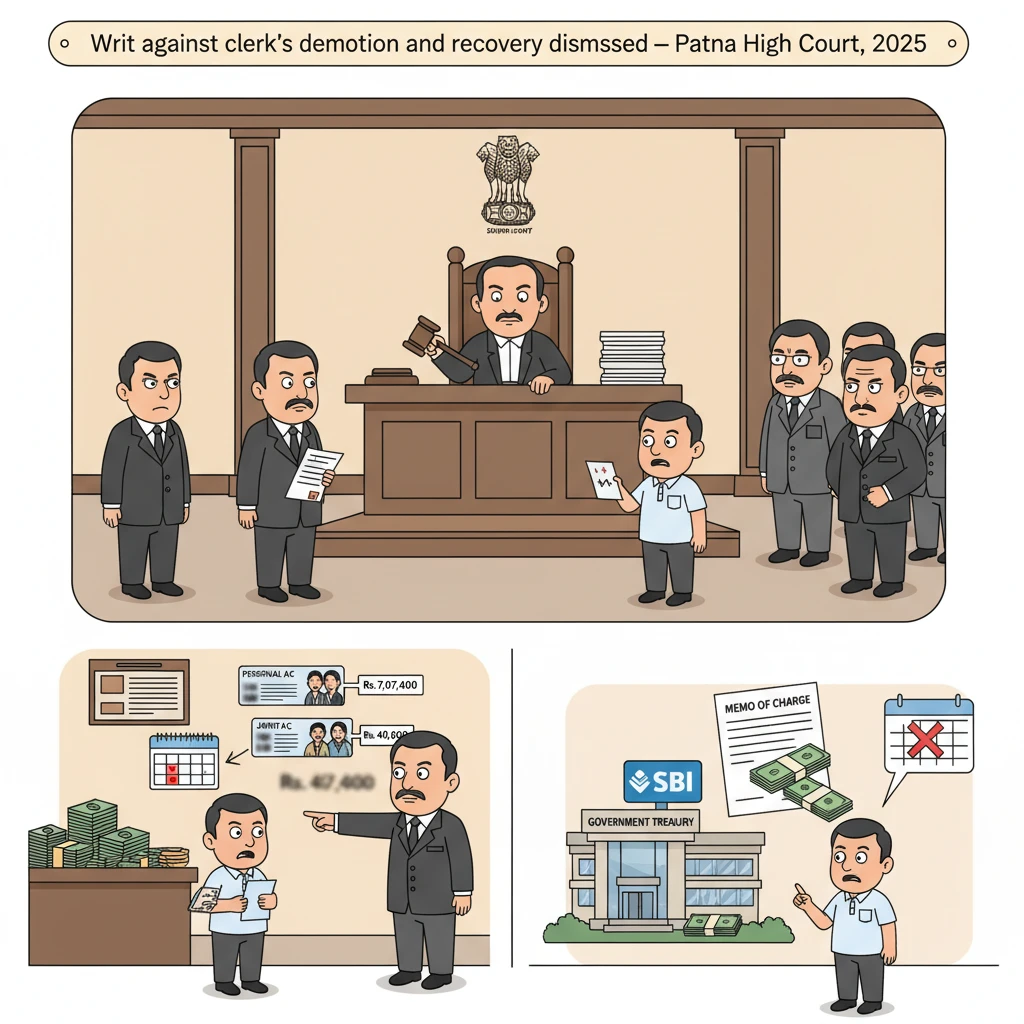
During this posting, money was collected in the office towards registration and renewal fees for building construction labourers under the Bihar Building & Other Construction Workers Welfare Board (BOCW).
This money was supposed to be deposited in the Government Treasury or in the official departmental account. Instead, it was later found that the amount was deposited in the petitioner’s personal bank account and partly in a joint account with his wife.
The petitioner was subsequently transferred to the office of the Labour Superintendent, Lakhisarai, where he joined on 27.10.2016.
The amount kept in his and his wife’s accounts was eventually deposited in the Government Treasury on 14.11.2017 and 06.12.2017 through bank drafts prepared by the State Bank of India, after directions from the Labour Superintendent.
Following detection of this conduct, a departmental proceeding was initiated against the petitioner. A memo of charge was issued, and the petitioner submitted a detailed reply.
An enquiry was conducted, material witnesses were examined, and the presenting officer supported the charges. The Enquiry Officer held that the charges were proved.
Based on the enquiry report, and after issuing a second show-cause notice and considering the petitioner’s response, the Labour Commissioner passed an office order in Memo No. 3020 dated 09.07.2019.
By this order, the petitioner was demoted to the minimum pay scale of Clerk and a direction was issued to recover 16% interest over the amount of registration/renewal fee that had been kept in his and his wife’s accounts.
The petitioner filed an appeal before the Additional Principal Secretary, Labour Department. This appeal was rejected by order contained in Memo No. 3997 dated 23.09.2019, thereby affirming the punishment.
Aggrieved, the petitioner approached the Patna High Court under its civil writ jurisdiction, challenging both the original punishment order and the appellate order.
What the Court Examined and Decided
The Patna High Court examined whether there was any legal flaw in the departmental enquiry, the findings of guilt, or the punishment imposed, which would justify interference under Articles 226/227 of the Constitution of India.
The petitioner’s main defence was that the period during which the money could not be deposited in the treasury coincided with demonetisation.
He argued that, to save the government money during that disturbed period, he bonafidely deposited the labourers’ registration and renewal fees in his own account and in the joint account with his wife.
According to him, the then Labour Superintendent, Ganesh Prasad (also referred to in the record as Ganesh Jha), was not interested in signing the rokar bahi and bank slips needed to deposit the amount in the Government Treasury.
The petitioner claimed that the money was lying in the office, and due to non-cooperation of the Labour Superintendent he was left with no option but to park the funds temporarily in his and his wife’s accounts.
He further submitted that the moment a new Labour Superintendent, Niraj Nayan, joined on 08.07.2016, the amount was later deposited in the Government Treasury on 14.11.2017 and 06.12.2017.
He argued that, had he intended to siphon off the money, he would not have deposited it in his own and his wife’s accounts, which would be easy to trace.
The petitioner also emphasised that ultimately no loss was caused to the public exchequer, as the full amount was deposited in the treasury.
On this basis, he contended that the punishment of demotion to the minimum pay scale of Clerk was too harsh and disproportionate to the misconduct.
He further expressed readiness to deposit the interest accrued on the amount during the period it remained in his and his wife’s accounts, and complained that records relating to alleged tampering were not produced despite his demand.
According to him, the finding of tampering by the Inquiry Officer was unsupported, and he pointed out that the Labour Officer, Ms. Sneha Shiwani, had allegedly stated in her deposition that she had never made any complaint.
The State, on the other hand, strongly opposed the writ petition.
The State submitted that the facts themselves clearly disclosed serious financial irregularity. It was an admitted position that the petitioner had deposited government money in his personal bank account and in his joint bank account with his wife.
This amount remained in those accounts for about 8–9 months and was deposited in the Government Treasury only after strict directions from the newly posted Labour Superintendent.
The State argued that if the petitioner was genuinely concerned only with the safety of the amount, he would have ensured its immediate deposit in the treasury, rather than keeping it in personal accounts.
Such conduct was described as “temporary embezzlement” and a grave misconduct involving lack of financial integrity.
The State also argued that during the enquiry, witnesses, including the Labour Inspector Smt. Sneha Shiwani, supported the charges.
According to the State, the departmental proceeding was properly conducted, the petitioner was given due opportunity to defend himself, and the punishment imposed was proportionate to the seriousness of the proved charges.
The Court perused the records and found that the core facts were admitted and the charges were proved to the following extent:
While posted at the office of the Labour Superintendent, Nalanda, in 2016, an amount of Rs. 7,07,400/- collected as registration and renewal fees for labourers under BOCW was deposited in the petitioner’s personal bank account and retained there for 8–9 months.
Out of this total, Rs. 40,000/- was deposited in the joint account of the petitioner with his wife, Pancha Devi.
On the strict directions of the Labour Superintendent, the amount was later deposited in the Government Treasury on 14.11.2017 and 06.12.2017 through bank drafts from the State Bank of India.
In addition, there was a separate charge of tampering with records, which the petitioner denied. Nonetheless, after enquiry, all charges were held proved by the Enquiry Officer.
Upon receipt of the enquiry report, a second show-cause notice was given to the petitioner, his reply was considered, and then the punishment order was passed. This was affirmed in departmental appeal.
The High Court then turned to the legal limits of its power in judicial review of departmental proceedings.
Referring to the Supreme Court judgment in Union of India & Ors. v. P. Gunasekaran, (2015) 2 SCC 610, the Court noted that under Articles 226/227, the High Court cannot act as an appellate authority over departmental findings.
The Court reproduced the guidelines from P. Gunasekaran, clarifying that in judicial review the High Court can only examine whether:
- the enquiry was conducted by a competent authority;
- the prescribed procedure was followed;
- principles of natural justice were violated or not;
- the authorities considered extraneous or irrelevant material;
- the conclusions were so arbitrary and capricious that no reasonable person could reach them; or
- admissible evidence was wrongly excluded or inadmissible evidence wrongly relied upon, or findings were based on no evidence.
The Court also referred to the Supreme Court decision in Bharti Airtel Limited v. A.S. Raghavendra, (2024) 6 SCC 418, and earlier precedents such as State of Andhra Pradesh v. S. Sree Rama Rao, State of Andhra Pradesh v. Chitra Venkata Rao, and State Bank of Patiala v. S.K. Sharma.
From these, the Court reiterated that:
- Re-appreciation of evidence by the High Court is not the norm.
- Interference is justified only where there is a higher level of infirmity in the tribunal or departmental order.
- Minor deficiencies in procedure that do not cause real prejudice do not warrant judicial intervention if the findings are based on legal evidence.
- As to punishment, the High Court cannot interfere merely on proportionality grounds unless the punishment shocks the conscience of the Court.
Applying these principles, the Patna High Court held that there was no illegality in the conduct of the enquiry or in the decision-making process.
The explanation given by the petitioner—that he deposited the money in his and his wife’s accounts to “save” the government money due to alleged non-cooperation of the then Labour Superintendent—was found to be unsubstantiated.
The Court observed that this explanation was only an oral plea, unsupported by any documentary proof or convincing witness testimony, and had been rightly rejected in the departmental proceedings.
The Court noted that, even if one assumes there was no intention of permanent embezzlement, the act of placing government money in personal accounts for 8–9 months without disclosure to higher authorities clearly reflected lack of integrity and absence of bonafides.
The Court emphasised that the petitioner did not disclose, during this long interregnum, to any higher authority that government funds were lying in his personal and joint accounts.
This conduct, in the Court’s view, strongly indicated that the explanation of good faith could not be accepted.
The Court further held that the petitioner had failed to point out any infirmity in the departmental process or in the orders of the disciplinary authority and appellate authority.
On the question of punishment, the Court held that the penalty of demotion to the minimum pay scale of Clerk, coupled with recovery of 16% interest on the amount for the period it remained in his and his wife’s accounts, did not shock the conscience of the Court.
Therefore, under the settled law, the High Court could not interfere with the quantum of punishment.
In conclusion, the Court found no reason or occasion to interfere with the impugned orders and dismissed the writ petition. No order as to costs was made.
Why This Judgment Matters
This judgment is important for government employees, especially those handling public money such as fees, taxes, or welfare contributions.
The Patna High Court has made it clear that even “temporary” use of government money in personal bank accounts is treated as serious financial misconduct.
Even where the entire amount is later deposited in the Government Treasury and no direct financial loss is finally caused, the act itself can show lack of integrity and justify strict punishment.
The judgment also underscores that in service matters, High Courts will not easily interfere with departmental findings or reduce punishment unless there is clear illegality in the process or the penalty is shockingly disproportionate.
For lower-level staff, the decision is a warning that convenience, pressure from superiors, or alleged administrative hurdles are not valid grounds to divert government funds into personal accounts.
For departments and disciplinary authorities, the judgment confirms that where enquiries are properly conducted and supported by evidence, their punishments are likely to be upheld in writ proceedings.
Legal Issues and Answers
- Issue: Whether the petitioner’s act of depositing government registration/renewal fees for labourers into his and his wife’s bank accounts, instead of the Government Treasury, justified departmental punishment and whether the High Court should interfere with such punishment in writ jurisdiction.
Answer: Yes, the act was a serious misconduct showing lack of integrity, and since the departmental enquiry was lawful and the punishment was not shockingly disproportionate, the Patna High Court refused to interfere and dismissed the writ petition. - Issue: Whether the High Court could re-appreciate evidence and reconsider factual findings of the departmental enquiry against the petitioner.
Answer: No, relying on Supreme Court precedents, the Court held that in judicial review under Articles 226/227 it can only examine the decision-making process, not re-evaluate evidence or substitute its own view on facts where the enquiry is lawful and supported by legal evidence. - Issue: Whether the punishment of demotion to minimum clerk pay and recovery of 16% interest was disproportionate.
Answer: The Court held that the punishment did not shock its conscience, and therefore it would not interfere with the quantum of punishment.
Cases Cited by the Court
- Union of India & Ors. v. P. Gunasekaran, (2015) 2 SCC 610
- Bharti Airtel Limited v. A.S. Raghavendra, (2024) 6 SCC 418
- State of Andhra Pradesh & Ors. v. S. Sree Rama Rao, AIR 1963 SC 1723
- State of Andhra Pradesh & Ors. v. Chitra Venkata Rao, (1975) 2 SCC 557
- State Bank of Patiala & Ors. v. S.K. Sharma, (1996) 3 SCC 364
Case Details
Case Number: Civil Writ Jurisdiction Case No. 1490 of 2020
Case Title: Sitaram Prasad v. The State of Bihar & Ors.
Court: High Court of Judicature at Patna
Coram: Hon’ble Mr. Justice Harish Kumar
Date of Judgment: 16.06.2025
Citation: 2025(3) PLJR 155
Advocates:
- For the Petitioner: Mr. Salahuddin Khan, Advocate; Mr. Chandra Bhushan Das, Advocate
- For the Respondents (State): Mr. Sushil Kumar Singh, AC to AAG-10
Nature of the Case: Writ petition under civil writ jurisdiction challenging departmental punishment and appellate orders in a disciplinary proceeding.
Impugned Orders:
- Memo No. 3020 dated 09.07.2019 (Labour Commissioner, Labour Department, Government of Bihar, Patna) — demotion to minimum pay scale of Clerk and recovery of 16% interest over government fee amount kept in petitioner’s and his wife’s accounts.
- Memo No. 3997 dated 23.09.2019 (Additional Principal Secretary, Labour Department, Government of Bihar, Patna) — dismissal of appeal and affirmation of punishment.
Final Outcome: Writ petition dismissed; no order as to costs.
link to judgement; https://patnahighcourt.gov.in/viewjudgment/MTUjMTQ5MCMyMDIwIzEjTg==-UcI9UOCTvNs=
If you found this explanation helpful and wish to stay informed about
how legal developments may affect your rights in Bihar,
you may consider following Samvida Law Associates for more updates.







