

Case Background
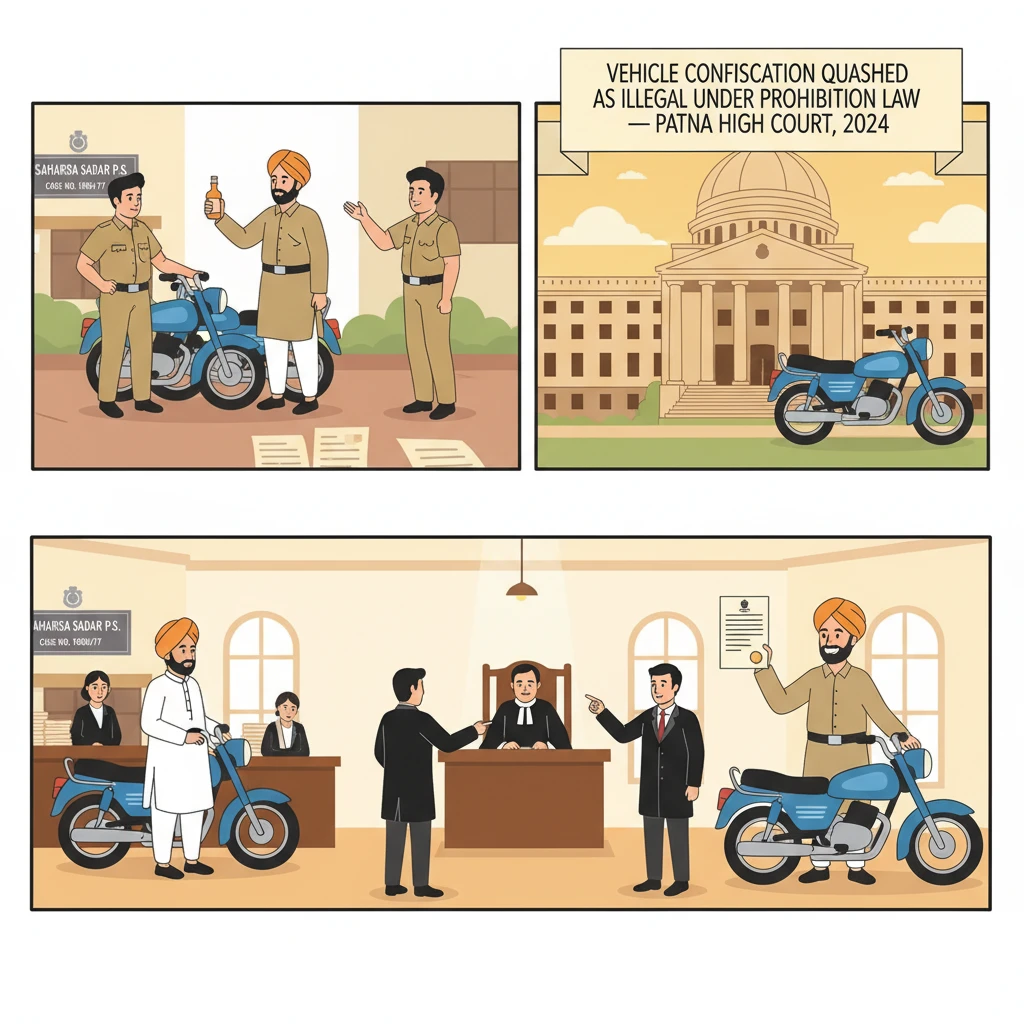
The petitioner is the registered owner of a motorcycle bearing registration number BR19K 5509. On 26.09.2017, while he was riding this motorcycle, the police stopped him on suspicion.
On search, the police claimed to have recovered 180 ml of Indian Made Foreign Liquor from the pant of the petitioner. The alleged liquor and the motorcycle were both seized. An FIR was registered as Saharsa Sadar P.S. Case No. 1006 of 2017 against the petitioner.
After the FIR, confiscation proceedings were started by the Collector-cum-District Magistrate, Saharsa, as Confiscation Case No. 102 of 2018-19. Initially, following an order of the Patna High Court dated 18.01.2019 in C.W.J.C. No. 1231 of 2019, the motorcycle was released provisionally in favour of the petitioner.
Later, however, by order dated 14.08.2021 in the same confiscation case, the Collector confiscated the motorcycle and directed that it be auctioned.
The petitioner challenged this confiscation and auction order before the Excise Commissioner, Patna, in Excise Appeal Case No. 822 of 2021. On 14.12.2021, the Appellate Authority dismissed the appeal and upheld the Collector’s order.
The petitioner then filed Excise Revision No. 16 of 2022 before the Additional Chief Secretary, Patna. In revision, the authority did not set aside the confiscation proceedings. Instead, the revisional order directed that the motorcycle could be released only on payment of 50% of its insurance value as non-refundable penalty.
Aggrieved by all three orders – confiscation, appellate and revisional – the petitioner approached the Patna High Court by filing Civil Writ Jurisdiction Case No. 4040 of 2023.
What the Court Examined and Decided
The Patna High Court, through a Division Bench, examined two core questions. First, whether the motorcycle could legally be seized and confiscated in the facts of the case. Second, whether the petitioner could be forced to pay 50% of the insurance value of the motorcycle for its release, or whether he was instead entitled to return of the vehicle with compensation.
The petitioner argued that he is the registered owner of the motorcycle and that the seizure and confiscation were arbitrary. He stressed that, as per the FIR itself, the alleged 180 ml of liquor was recovered from his pant, that is, from his person, and not from the motorcycle. Therefore, he contended, the motorcycle was not used for transporting the liquor and could not be legally confiscated.
He further stated that, in fact, no liquor was recovered from his possession at all and that he had been falsely implicated by the police. He also asserted that the motorcycle was actually seized from his house, not from the spot of alleged recovery. On this basis, he claimed that the vehicle was not liable to seizure or confiscation under the Bihar Prohibition and Excise Act, 2016, and that he deserved return of the vehicle along with compensation for violation of his constitutional rights and for expenses incurred on the forced litigation.
The State, on the other hand, defended the actions of its officials. The State’s counsel submitted that the vehicle was liable to confiscation under the Bihar Prohibition and Excise Act, 2016 in the facts and circumstances of the case. It was argued that there was no illegality in the orders passed by the Collector, the Appellate Authority and the Revisional Authority, and therefore the petitioner was not entitled to any relief.
Before answering these rival contentions, the Patna High Court carefully examined the relevant provisions of the Bihar Prohibition and Excise Act, 2016 and the Bihar Prohibition and Excise Rules, 2021.
The Court first looked at Section 56 of the Act as it existed prior to the 2022 amendment. This provision is relevant because the alleged offence took place on 26.09.2017. Under Section 56(b), any animal, vehicle, vessel or other conveyance used for carrying any intoxicant or liquor is liable for confiscation.
Next, the Court examined Section 57B, inserted in 2022, which allows the Collector to release any vehicle used for committing an offence under the Act on payment of penalty, with this provision applying even to pending confiscation proceedings. However, the Court noted that Section 57B itself assumes that the vehicle has been used for committing an offence under the Act.
The Court then turned to Section 58. This section lays down the procedure for confiscation by the District Collector. The seizing officer must promptly report the seizure to the Collector. On being satisfied that an offence under the Act has been committed, the Collector may order confiscation, but only after giving the person concerned a reasonable opportunity of being heard.
Section 61 was noted for providing that, once an order of confiscation under Section 58 becomes final, the property vests in the State Government free from any encumbrance.
The Bench also reviewed Sections 92 and 93 of the Act. Section 92 provides for departmental appeals against final orders passed by excise authorities, including appeals from the Collector to the Excise Commissioner, and from the Excise Commissioner to the State Government. Section 93 vests revisional power in the State Government to examine the correctness and legality of orders passed by excise officers.
The Court further considered Section 95, under which the Bihar Government framed the Bihar Prohibition and Excise Rules, 2021. Rule 12A, inserted in 2022, provides the mechanism for release of seized vehicles and conveyances on payment of penalty. Under Rule 12A(2), while imposing penalty, the Collector or authorised officer must consider the quantity of intoxicant recovered, the involvement of the vehicle owner, and the insured value of the vehicle. The penalty must not be less than 10% of the insured value, and not more than Rs. 5 lakhs. The rule also states that such penalty is non-refundable, regardless of the outcome of any criminal trial.
After setting out this legal framework, the Patna High Court distilled the central requirement: a vehicle can be seized and confiscated under the Bihar Prohibition and Excise Act, 2016 only when it has been used for carrying or transporting intoxicant or liquor. The Court held that use of the vehicle in transport of illicit liquor or intoxicant is a sine qua non – an absolutely necessary condition – for seizure and confiscation.
To clarify the meaning of the word “use” in this context, the Court referred to two decisions of the Kerala High Court. In Wilson C.C. v. State of Kerala [2022 LiveLaw (Ker) 627], a small quantity of LSD stamp was recovered from the wallet in the pocket of a person driving a vehicle. The Kerala High Court held that, in such circumstances, it could not be said that the vehicle was used for conveying the contraband, and therefore the vehicle was not subject to confiscation.
Similarly, in Thausif Ahammad Bengre v. State of Kerala [MANU/KE/0426/2018], 40 grams of ganja was recovered from the possession of a driver. The Kerala High Court held that it was fallacious to contend that the vehicle was used for carrying the contraband.
The Patna High Court also noted a Government letter dated 07.02.2020 (Letter No. 13/HC-06-55/2020-670) issued by the Additional Chief Secretary, Home Department-cum-Prohibition, Excise and Registration Department, Bihar. Addressed to all District Collectors, Police Officers and Excise Officers, this letter records that, as per directions of the Patna High Court, vehicles from which no liquor is recovered should not be confiscated. It further states that if a driver is found drunk but no liquor is recovered from the vehicle, only the driver is to be prosecuted under the Act and not the vehicle confiscated.
Applying these principles to the case at hand, the Bench highlighted a crucial fact: no liquor was recovered from the motorcycle itself. The only alleged recovery is 180 ml of liquor from the pant of the petitioner. In such a situation, the Court held that the motorcycle cannot be treated as having been used to carry illicit liquor recovered from the person of the petitioner.
The Court emphasised that the word “use” in Section 56(b) cannot be given a liberal or expansive meaning because it carries penal consequences. It must be interpreted strictly. Therefore, without proof that the motorcycle was used to transport liquor, there was no legal basis to seize or confiscate it.
Despite this, the confiscation authority had ordered confiscation and auction of the motorcycle. The Appellate Authority failed to correct this error and simply upheld the confiscation. The Revisional Authority also did not fully correct the injustice and instead directed release of the motorcycle only on payment of 50% of its insurance value as non-refundable penalty.
The Bench observed that the petitioner had been compelled to approach the High Court, incurring expenses on litigation. The Court described the case as a “classic illustration” of how people are being harassed by concerned State officials in the name of the Bihar Prohibition and Excise Act, 2016.
On this reasoning, the Patna High Court concluded that the impugned orders were arbitrary and violated Article 14 of the Constitution, which guarantees equality before the law. It also held that the petitioner’s constitutional right to property under Article 300A had been violated. Article 300A prohibits deprivation of property without authority of law.
The Court found that the Bihar Prohibition and Excise Act, 2016 did not authorise the seizure or confiscation of the vehicle in the facts and circumstances of this case. Therefore, the seizure and confiscation of the motorcycle were without authority of law.
As a result, the Court held that the confiscation order of the Collector, the appellate order of the Excise Commissioner, and the revisional order of the Additional Chief Secretary were all liable to be quashed. It also held that the petitioner, whose constitutional right to property had been violated, was entitled to adequate compensation, including for expenditure and harassment suffered due to forced litigations.
Accordingly, the Patna High Court quashed: (i) the order dated 11.04.2022 passed in Excise Revision No. 16 of 2022; (ii) the appellate order dated 14.12.2021 passed in Excise Appeal Case No. 822 of 2021; and (iii) the confiscation order dated 14.08.2021 passed in Confiscation Case No. 102/2018-19. The District Collector, Saharsa was directed to release the motorcycle forthwith.
The Court further directed that compensation of Rs. 1,00,000 (Rupees one lakh only) be paid to the petitioner. This amount is to be paid within ten days from the date of receipt of the Court’s order. With these directions, the writ petition was allowed.
Why This Judgment Matters
This judgment is important for vehicle owners in Bihar who may be caught up in cases under the Bihar Prohibition and Excise Act, 2016.
The Patna High Court has made it clear that a vehicle cannot be seized and confiscated merely because liquor is found on the person of a rider or driver. There must be clear use of the vehicle for transporting liquor or intoxicant.
The decision also reinforces that government officials must act strictly within the law. Confiscating a vehicle without legal authority is not only invalid but can also attract compensation for violation of constitutional rights.
For ordinary people, especially in prohibition-related cases, this ruling shows that they can challenge arbitrary seizures and seek both return of their property and compensation, if the authorities have overstepped their powers.
Legal Issues and Answers
Issue: Can a motorcycle be seized and confiscated under the Bihar Prohibition and Excise Act, 2016 when liquor is recovered only from the rider’s pant and not from the vehicle?
Answer: No. The Court held that, under Section 56(b), seizure and confiscation are permissible only when the vehicle is used for carrying or transporting liquor. As no liquor was recovered from the motorcycle, it could not be treated as used for carrying illicit liquor.
Issue: Was the petitioner bound to pay 50% of the insurance value of the motorcycle as non-refundable penalty for its release under Section 57B and Rule 12A?
Answer: No. Since the vehicle was not lawfully liable to seizure or confiscation in the first place, there was no basis to demand any penalty. The revisional order imposing 50% penalty was quashed.
Issue: Was the petitioner entitled to compensation for violation of his constitutional rights due to illegal seizure and confiscation?
Answer: Yes. The Court held that the arbitrary orders violated Article 14 and Article 300A of the Constitution and directed payment of Rs. 1,00,000 as compensation within ten days.
Cases Cited by the Court
- Wilson C.C. v. State of Kerala [2022 LiveLaw (Ker) 627] – relied on to explain that a vehicle is not liable to confiscation when contraband is recovered only from the person and not from the vehicle.
- Thausif Ahammad Bengre v. State of Kerala [MANU/KE/0426/2018] – relied on to hold that it is fallacious to treat a vehicle as used for carrying contraband when the recovery is from the driver’s person.
Case Details
Case Number: Civil Writ Jurisdiction Case No. 4040 of 2023
Case Title: Binit Kumar v. The State of Bihar & Ors.
Citation: 2024 (1) PLJR 905
Court: High Court of Judicature at Patna
Coram: Hon’ble Mr. Justice P. B. Bajanthri and Hon’ble Mr. Justice Jitendra Kumar
Date of Judgment: 30.01.2024
For the Petitioner: Mr. Diwakar Prasad Singh, Advocate
For the Respondents (State of Bihar and others): Mr. Vivek Prasad, GP-7; Ms. Supragya, AC to GP-7
Nature of the Case: Writ petition under civil writ jurisdiction challenging confiscation, appellate and revisional orders passed under the Bihar Prohibition and Excise Act, 2016.
Link to Judgment (Patna High Court official website): https://patnahighcourt.gov.in/viewjudgment/MTUjNDA0MCMyMDIzIzEjTg==-ArW0wU6iSB8=
If you found this explanation helpful and wish to stay informed about
how legal developments may affect your rights in Bihar,
you may consider following Samvida Law Associates for more updates.







