

Case Background
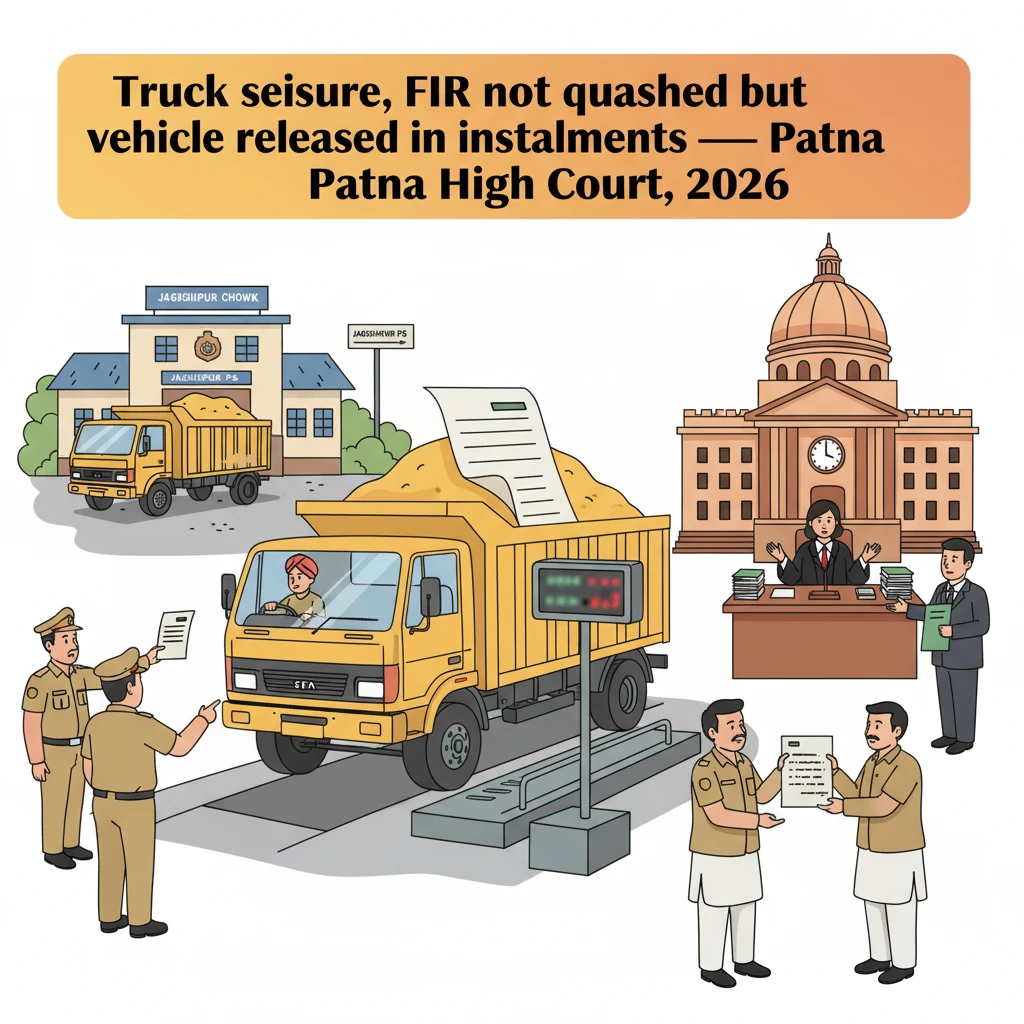
This case arose from seizure of a diesel TATA goods truck bearing registration number UP-51AT-0925 and chassis number MAT466388F5J12443. The petitioner is stated to be the owner of the truck and engaged in transportation business.
According to the petitioner, the Government of Bihar had issued a prepaid pass or challan for transport of yellow sand. The challan permitted transportation from 01.11.2024 at 06:38:21 p.m. till 02.11.2024 at 06:38:21 p.m.
On 02.11.2024, while the truck was carrying yellow sand, mining officials intercepted and seized the vehicle. Later, after about 18 days, Jagdishpur P.S. Case No. 127 of 2024 was registered on 20.11.2024 under Section 303(2) of the Bharatiya Nyaya Sanhita, Section 27 of the Mines and Minerals (Development and Regulation) Act, 1957 and Section 56(2) of the Bihar Mineral (Concession, Prevention of Illegal Mining, Transportation & Storage) Rules, 2019.
The petitioner filed a criminal writ before the Patna High Court seeking multiple reliefs. He asked for release of the seized truck, quashing of the FIR and related proceedings, and directions to enquire into the circumstances of lodging the FIR and seizure of the vehicle.
What the Court Examined and Decided
The single judge, Hon’ble Mr. Justice Arun Kumar Jha, considered the rival submissions of the petitioner and the State/Mining Department.
The petitioner’s stand was that he was a bona fide owner of the truck and was engaged in legitimate business. He stressed that the truck had a valid challan, and the transportation was within the permitted time. Therefore, according to him, no offence under the Bharatiya Nyaya Sanhita, MMDR Act or 2019 Rules was made out.
The petitioner attacked the seizure on several grounds. He claimed that the entire case of the authorities was based on a mere presumption that the vehicle was overloaded beyond the quantity mentioned in the challan. He alleged that the seizure memo was prepared without proper procedure and without weighing the sand at the time of seizure.
It was also argued that no independent witness was associated with the seizure, though this is a legal requirement. The petitioner further alleged that even a copy of the seizure memo was not supplied to the driver, a co-accused, which in his view cast serious doubt on the credibility of the seizure process.
The petitioner pointed out that there were no details about how and when the vehicle was weighed by the Mining Officer. According to him, before the seizure, no weighing of the loaded truck was done despite the existence of a valid sand challan.
Another important grievance was the delay. The truck had been seized on 02.11.2024 and kept under custody. Only after more than 18 days was the FIR lodged on 20.11.2024. The truck continued to lie in the Jagdishpur Police Station premises without proper shed, allegedly deteriorating with each passing day. On these grounds, he sought quashing of the FIR and immediate release of the truck.
The Department of Mines strongly disputed these claims. On its side, the department submitted that on 02.11.2024 at around 9:30 p.m., during an inspection of vehicles carrying minerals near Jagdishpur Chowk, the petitioner’s 12-wheel truck was intercepted.
When challan was demanded, the driver produced a challan issued on 01.11.2024 at 6:38 p.m., valid till 02.11.2024 at 6:38 p.m. The challan permitted transportation of 17.83 metric tonnes (equivalent to 445.75 cubic feet) of sand.
On physical inspection, the officials suspected overloading and took the truck to the nearest weighbridge. There, according to the department, the gross weight of the vehicle was found to be 35,020 kg. As per the registration certificate, the unladen weight of the truck was 11,250 kg. Deducting the permitted load of 17,830 kg and the unladen weight from the gross weight, the officials found an excess load of 5,940 kg of sand. A weighment slip was allegedly given to the driver, Ajit Singh, who signed it.
On this basis, the Mines Inspector seized the vehicle for overloading and handed it over to the Station House Officer, Jagdishpur, for safe custody. A letter bearing no. Camp-01 dated 02.11.2024, forming part of the FIR, recorded that the truck was seized for overloading and that the key was kept at the police station.
The department further clarified the delay in lodging the FIR. It relied on Rule 56 of the 2019 Rules, which permits the competent authority, such as the Mineral Development Officer, to compound the offence within 30 days. The Mines Department said it waited for the owner to come forward and deposit the compounding fee/penalty of Rs. 8,15,930/-. When the petitioner did not do so, the Mines Inspector sent a written statement to the SHO, Jagdishpur, to register a case, leading to Jagdishpur P.S. Case No. 127/2024 on 20.11.2024.
The department also disputed the allegation of non-compliance with procedure. It stressed that once the truck was found overloaded on physical verification, it was taken to a weighbridge, and the weighing process took place in the presence of the driver. His signature on the weighment slip, according to the department, showed that procedure was followed.
After hearing both sides, the Court identified the main grounds of challenge as: first, the claim that the truck was not overloaded and transportation was under a valid challan; and second, that there was an 18-day delay in lodging the FIR which should vitiate the proceedings.
The Court noted that it was undisputed that the truck was indeed transporting sand under a valid challan. However, the Court emphasised that seizure had been made under Rule 56(1) of the 2019 Rules, and penalty was provided under Rule 56(2). The Mines Department asserted that re-weighing of the vehicle on a weighbridge was carried out and showed overloading of about 6 metric tonnes.
The judge observed that this weighing was in line with Rule 60(2) of the 2019 Rules. In light of these materials, the Court held that the petitioner’s contention about absence of overloading and non-compliance with the re-weighment process was not acceptable at this stage.
On the issue of delay in lodging the FIR, the Court accepted the explanation of respondent no. 3. Since the offence was compoundable before the Mining Authorities, they had waited for the petitioner to get the case compounded. When he did not respond, the FIR was lodged. The Court held that even otherwise, delay alone could not be a ground for quashing an FIR.
Regarding the alleged procedural irregularities such as non-joining of independent witnesses or not supplying a copy of seizure memo, the Court held that even if some procedural safeguards were not strictly followed, this by itself would not make the FIR liable to be quashed. Such issues, the Court observed, could be raised before the trial court during the course of evidence.
In view of these findings, the Court concluded that the petitioner failed to make out any case for quashing Jagdishpur P.S. Case No. 127 of 2024. Therefore, the prayer for setting aside the FIR and related proceedings was rejected.
However, the Court separately considered the prayer for release of the truck. The Mines Department informed that a penalty of Rs. 8,15,930/- had been imposed under Rule 51(1)(b) read with Rule 56 of the 2019 Rules. The department stated that the petitioner could get the truck released by paying this penalty and also had a statutory remedy of appeal under Rule 67.
The Court noted that the truck had been lying seized since 02.11.2024 and that almost one year and three months had passed. Such long seizure affected the road-worthiness of the vehicle. Referring to the Supreme Court’s decision in Sunderbhai Ambalal Desai v. State of Gujarat, (2002) 10 SCC 283, the Court reiterated that there is no use in keeping seized vehicles at police stations for long periods. Courts should order release with suitable conditions, bonds and security.
Applying these principles, the Patna High Court directed that the truck be released on payment of the imposed penalty amount of Rs. 8,15,930/- but permitted payment in 15 monthly instalments.
The truck is to be released after the petitioner pays the first instalment of Rs. 60,000/- before the concerned authority on or before 30th March 2026. The remaining penalty is to be paid in 14 equal monthly instalments on or before the 30th of every month thereafter, subject to further satisfaction of the concerned court, if the petitioner is so inclined. With these directions, the writ petition was disposed of.
Why This Judgment Matters
This decision is particularly important for truck owners and transporters involved in sand and other mineral transport in Bihar.
First, the Patna High Court has made it clear that having a valid challan does not protect a vehicle from seizure if the load exceeds the quantity allowed in the challan. Overloading based on actual weighment can still invite action under the mining rules and criminal law.
Second, the judgment shows that delay in lodging an FIR by itself is normally not enough to get the case quashed, especially where the law allows compounding and the authority waits for the offender to come forward.
Third, even if there are complaints about minor procedural lapses during seizure, the High Court is unlikely to interfere at the FIR stage. Such objections are to be taken before the trial court during evidence.
At the same time, the Court has protected the economic interest of the vehicle owner by preventing long-term decay of the seized truck. By following the Supreme Court’s guidance in Sunderbhai Ambalal Desai, the Court has ensured that seized vehicles should be released on reasonable terms instead of being left to rot in police station premises.
Legal Issues and Answers
- Issue: Should Jagdishpur P.S. Case No. 127 of 2024 and related proceedings be quashed on the grounds of valid challan, alleged lack of overloading, procedural lapses and delay in lodging the FIR?
Answer: No. The Court held that there was material showing overloading based on weighbridge results in line with the 2019 Rules, and delay explained by the compounding process. Alleged procedural lapses did not justify quashing the FIR; such defences may be raised before the trial court. - Issue: Is the petitioner entitled to release of the seized truck despite the pending case and imposed penalty?
Answer: Yes, but subject to conditions. Recognising long seizure and potential loss of road-worthiness, the Court directed release of the truck on payment of the penalty amount of Rs. 8,15,930/- in 15 monthly instalments, starting with Rs. 60,000/- by 30 March 2026.
Cases Cited by the Court
- Sunderbhai Ambalal Desai v. State of Gujarat, (2002) 10 SCC 283 – relied upon for the principle that seized vehicles should not be kept in police stations for long and should be released or auctioned with adequate safeguards.
Case Details
Case Number: Criminal Writ Jurisdiction Case No. 300 of 2025; arising out of Jagdishpur P.S. Case No. 127 of 2024
Case Title: Manoj Ray @ Manoj Kumar Ray v. The State of Bihar & Others
Citation: 2026 (2) PLJR 440
Coram: Hon’ble Mr. Justice Arun Kumar Jha
Advocates: Ms. Chhaya Kirti, Advocate for the petitioner; Mr. Kameshwar Kumar, GP-17 for the State; Mr. Utsav Anand, Advocate for the Department of Mines
Nature of the Case: Criminal writ petition seeking quashing of FIR and release of seized vehicle arising out of alleged illegal mining/overloading of sand
Date of Judgment: 20.02.2026
Link to Judgment: Click here to access the full judgment of the Patna High Court
If you found this explanation helpful and wish to stay informed about how legal developments may affect your rights in Bihar, you may consider following Samvida Law Associates for more updates.







