
Case Background
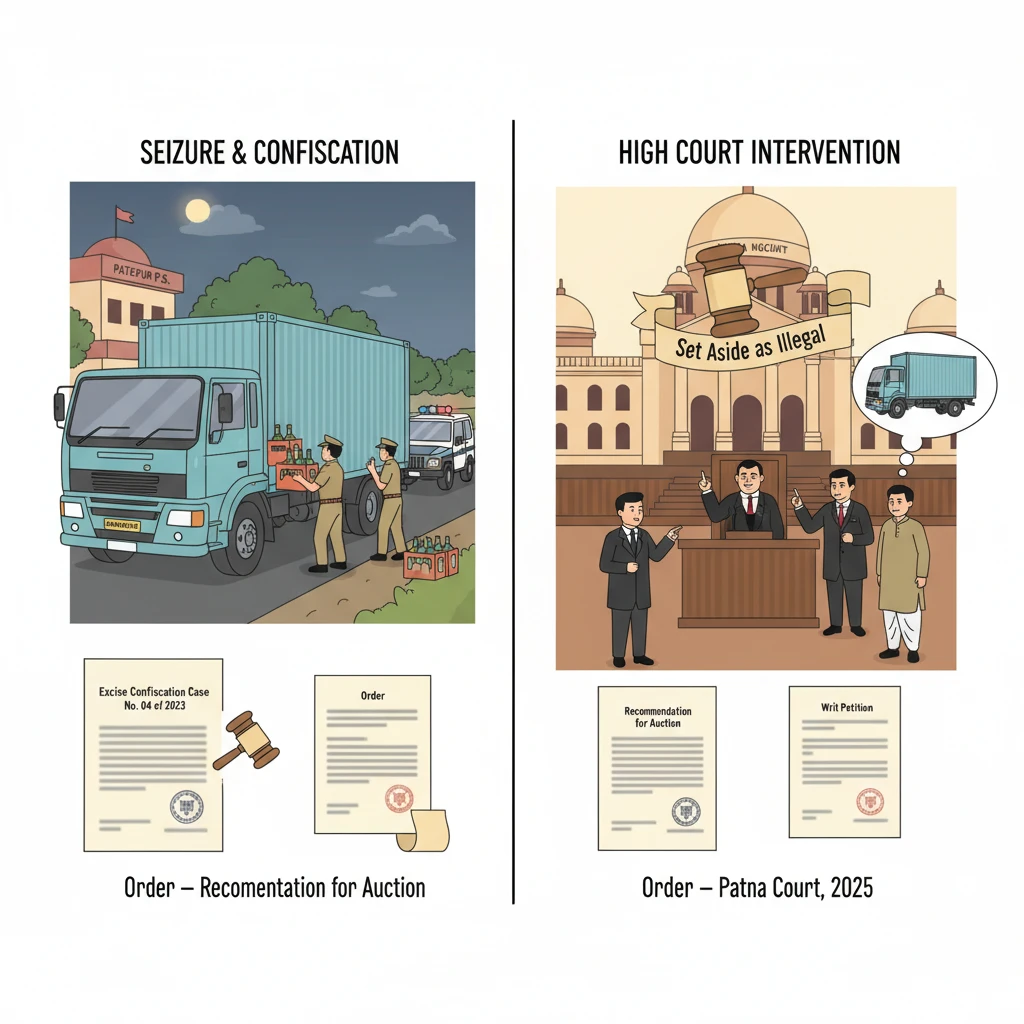
The petitioner is the registered owner of a container truck bearing Registration No. MH-04JU-0423. On 26.12.2022, this truck was seized in Bihar after recovery of 477 litres of Indian made foreign liquor from it.
On the same day, Patepur P.S. Case No. 346 of 2022 was registered under Sections 30(a), 32(2), 41(1) of the Bihar Prohibition and Excise Act, 2016 against the owner and other apprehended accused persons. The driver and cleaner of the vehicle were apprehended at the spot.
On 27.12.2022, the Station House Officer, Patepur Police Station, forwarded a proposal for confiscation of the seized vehicle vide Memo No. 1347/22. Based on this proposal, Excise Confiscation Case No. 04 of 2023 was initiated.
On 20.02.2023, the Additional Sub Divisional Officer, Mahua (respondent no. 5) passed an order in Excise Confiscation Case No. 04 of 2023 directing confiscation of the petitioner’s truck. A recommendation was also made to the Sub-Divisional Officer, Mahua, to initiate the process of auction of the confiscated vehicle.
According to the petitioner, no notice was served on him before or during the confiscation proceedings. He resides in Mumbai and had given the truck on rent to a private person (respondent no. 7). He claims that he came to know about the seizure only about three months later, when the agreement holder informed him.
On 28.09.2023, the petitioner submitted Form IV to the District Magistrate (respondent no. 3), but he was informed that his vehicle had already been forwarded for auction without notice to him. Thereafter, by order dated 29.09.2023, the Sub-Divisional Officer, Mahua, Vaishali, auctioned the vehicle and sold it to one Sandeep Kumar for Rs. 2.2 lakhs.
The petitioner then approached the Patna High Court under writ jurisdiction (Civil Writ Jurisdiction Case No. 18561 of 2023). He sought quashing of the confiscation order dated 20.02.2023, release of the vehicle if not yet auctioned, or payment of adequate compensation with interest from the date of confiscation, alleging breach of principles of natural justice.
What the Court Examined and Decided
The Patna High Court, speaking through Hon’ble Mr. Justice S. B. Pd. Singh, examined the entire statutory scheme of the Bihar Prohibition and Excise Act, 2016 and the Bihar Prohibition and Excise Rules, 2021, as well as the manner in which the authorities had acted in this particular case.
The petitioner argued that:
- He is the bona fide owner of the truck, which had been hired by a transport company and operated by a driver and cleaner.
- He was never served any notice about the confiscation proceedings, contrary to the mandatory requirement of giving a reasonable opportunity of being heard.
- The authorities did not properly verify his name and address from the District Transport Officer.
- A notice was only published in a local newspaper in Bihar, though he lives in Mumbai and the vehicle had a national permit; this was termed a mere formality, not real notice.
- The vehicle was auctioned at a throwaway price of Rs. 2.2 lakhs, whereas the insurance value on 29.09.2023 was Rs. 9,47,893/-, and on the date of seizure (26.12.2022) it was Rs. 21 lakhs.
The State, through its counsel, submitted that:
- The vehicle was confiscated and auctioned under collective confiscation and auction proceedings, as per departmental Letter No. 633 dated 25.01.2023 issued by the then Additional Secretary, Prohibition, Excise & Registration Department.
- The petitioner did not act promptly and failed to file Form IV in time under Rule 12A of the Bihar Prohibition and Excise Rules, 2021 to seek release of his vehicle on payment of penalty.
Before addressing these rival submissions, the Court analysed several key provisions of the Bihar Prohibition and Excise Act, 2016:
Section 47 makes a person having control or use of a conveyance liable for punishment if he knowingly permits it to be used for committing an offence under the Act. Section 57B, inserted in 2022, allows the Collector to release seized vehicles used for offences under the Act upon payment of penalty, and applies to all pending confiscation proceedings.
Section 58 sets out the procedure for confiscation:
- The seizing officer must report to the District Collector without delay.
- If the Collector is satisfied that an offence has been committed, he may order confiscation.
- Critically, under Section 58(3), the Collector must give a reasonable opportunity of being heard to the person concerned before passing an order of confiscation.
Section 61 states that once a confiscation order under Section 58 becomes final, the property vests in the State Government free from encumbrances. Sections 92 and 93 provide for departmental appeals and revisions against orders passed under the Act. Section 95 empowers the State Government to frame rules, under which the Bihar Prohibition and Excise Rules, 2021 were made.
Rule 12A (inserted in 2022) deals with release of seized vehicles on payment of penalty. It requires the owner to move Form IV before the Collector or authorised officer, who may release the vehicle upon payment of a penalty calculated with reference to the quantity of liquor seized, the involvement of the owner, and the insured value of the vehicle. The penalty cannot be less than 10% of the insured value and not more than Rs. 5 lakhs. The Explanation to Rule 12A states that this mechanism applies to all pending or ongoing confiscation/auction cases, and on payment of penalty, confiscation/auction proceedings may be dropped and the vehicle released.
The Court drew certain important conclusions from this legislative framework:
- No vehicle can be seized or confiscated under the Act unless it has been used in the commission of an offence, typically the transport of illicit liquor under Section 30.
- Mere use of a vehicle for transport of liquor is not sufficient for confiscation; the involvement or connivance of the owner is an essential prerequisite for confiscation or for imposing any penalty.
- Section 58(3) mandates that the owner or person concerned must be given a reasonable opportunity of being heard before confiscation.
- Rule 12A(2) explicitly requires the authority to have due regard to the involvement of the vehicle owner while imposing penalty.
The Court also referred to a government letter dated 07.02.2020 (Letter No. 13/HC-06-55/2020-670), issued by the Additional Chief Secretary, Home Department cum Prohibition, Excise and Registration Department, to all District Collectors, Police Officers and Excise Officers. In this letter, the Government clearly recorded, in line with directions of the Patna High Court, that:
- Vehicles from which no liquor has been recovered should not be confiscated.
- If a driver is found drunk but no liquor is recovered from the vehicle, only the driver is to be prosecuted under the Act, not the vehicle confiscated.
Applying these principles to the present case, the Court found:
- The petitioner is the registered owner of the vehicle from which 477 litres of liquor were recovered.
- There is no allegation on record of any direct or indirect involvement of the petitioner in the commission of the offence.
- Despite this, his vehicle was seized, confiscated, and then auctioned without proper notice and without giving him a hearing, in violation of Section 58(3).
- The authorities did not verify the petitioner’s name and address from the District Transport Officer. Instead, they issued a notice only through publication in a local Bihar newspaper, even though the petitioner resides in Mumbai and the vehicle had a national permit.
- The auction sale at Rs. 2.2 lakhs was grossly disproportionate when compared with the insured value of Rs. 9,47,893/- on 29.09.2023 and Rs. 21 lakhs on the date of seizure.
By order dated 19.03.2025 in this writ petition, the Court had already observed that the officials had erred in determining the valuation for auction and directed the Principal Secretary, Department of Registration and Excise, Patna, to register a criminal case against such officials. The Court further directed the State of Bihar to deposit Rs. 21 lakhs in the Registry of the Court within eight weeks.
The State challenged this interim order before the Supreme Court in Special Leave to Appeal (C) No. 12926/2025, but the Supreme Court rejected the SLP on 07.05.2025. In compliance with the High Court’s directions, the State filed a counter affidavit stating that a Demand Draft of Rs. 21,00,000/- (DD No. 634446 dated 12.05.2025, Punjab National Bank) had been issued in favour of the Registrar General, Patna High Court.
In the final judgment dated 01.09.2025, the Patna High Court held that both prerequisites for lawful seizure and confiscation under the Act were missing so far as the petitioner was concerned:
- While the vehicle was used to carry liquor, there was no material to show that the owner consented to or connived in this illegal use.
- Therefore, the twin conditions of use plus owner’s involvement were not satisfied.
On this basis, the Court concluded that the vehicle was not liable to be seized or confiscated under the Act. The confiscation order dated 20.02.2023 was found to be arbitrary, violative of Article 14 (equality before law) and infringing the petitioner’s constitutional right to property under Article 300A, which prohibits deprivation of property without authority of law.
Since the vehicle had already been auctioned, the Court could not order its physical return. Instead, it directed:
- The Registrar General, Patna High Court, to release the Rs. 21 lakh Demand Draft in favour of the petitioner.
- However, because 477 litres of Indian made foreign liquor had in fact been recovered from the vehicle, the petitioner must deposit the maximum penal amount of Rs. 5 lakhs before the concerned authority.
- Upon deposit of Rs. 5 lakhs and production of proof before the Registrar General, the petitioner would receive the Rs. 21 lakhs deposited by the State.
- Alternatively, the amount could be adjusted, so that Rs. 5 lakhs would go to the government and the petitioner would receive the remaining Rs. 16 lakhs from the amount deposited.
With these directions, the writ petition was disposed of.
Why This Judgment Matters
This judgment is significant for vehicle owners, transporters, and drivers whose vehicles are seized under the Bihar Prohibition and Excise Act, 2016.
The Patna High Court has made it clear that:
- Authorities cannot confiscate and auction vehicles behind the back of the real owner. A proper notice and hearing are mandatory.
- Mere use of a vehicle in transporting liquor is not enough to confiscate it. The owner’s knowledge, consent or connivance must be shown.
- Confiscation proceedings are subject to constitutional safeguards, including Article 14 and Article 300A.
- Auctioning vehicles at unreasonably low prices, without fair valuation, and without notice to the owner, can invite judicial interference and even directions for criminal action against officials.
For ordinary citizens and transporters, this means that if their vehicle is misused by a driver or a hirer without their knowledge, they cannot be mechanically deprived of their property. They have a right to be heard, to seek release on payment of penalty under Section 57B and Rule 12A, and to challenge arbitrary confiscation in the Patna High Court.
Legal Issues and Answers
-
Issue: Can the authorities confiscate and auction a vehicle under the Bihar Prohibition and Excise Act, 2016 without proving the owner’s involvement and without giving him a proper hearing?
Answer: No. The Court held that both use of the vehicle in transporting liquor and the owner’s consent or connivance must be present, and the owner must be given a reasonable opportunity of being heard under Section 58(3). In absence of these, confiscation and auction are illegal and arbitrary. -
Issue: What relief is appropriate when an illegally confiscated vehicle has already been auctioned?
Answer: The Court directed monetary compensation equivalent to the insured value (Rs. 21 lakhs) to be released to the owner, subject to deposit of the maximum statutory penalty of Rs. 5 lakhs on account of actual liquor recovery from the vehicle. -
Issue: Does such arbitrary confiscation violate constitutional rights?
Answer: Yes. The Court held that the impugned confiscation order violated Article 14 and Article 300A of the Constitution, as the Act did not authorise confiscation in the facts of this case and due process was ignored.
Cases Cited by the Court
- The judgment refers to “various judicial pronouncements” of the Patna High Court and to directions which led to Government Letter dated 07.02.2020, but it does not name or cite specific reported cases. No express case citations are provided in the text.
Case Details
Case Number: Civil Writ Jurisdiction Case No. 18561 of 2023
Case Title: Sharad Navnath Gange v. The State of Bihar & Ors.
Citation: 2025(4) PLJR 194
Coram: Hon’ble the Acting Chief Justice; Hon’ble Mr. Justice S. B. Pd. Singh (CAV Judgment per Hon’ble Mr. Justice S. B. Pd. Singh)
Advocates:
- For the Petitioner: Mr. Deo Prakash Singh
- For the Respondents: Mr. Madhaw Pd. Yadaw (GP 23)
Nature of the Case: Writ petition (Civil) challenging confiscation and auction of vehicle under the Bihar Prohibition and Excise Act, 2016
Date of Judgment: 01.09.2025
Link to the Judgment: Patna High Court Judgment Link
If you found this explanation helpful and wish to stay informed about
how legal developments may affect your rights in Bihar,
you may consider following Samvida Law Associates for more updates.







