
Case Background
This criminal miscellaneous application arose from Rajapakar P.S. Case No. 106 of 2020, District Vaishali, registered under Section 306 of the Indian Penal Code. The case relates to the suicide of the adult son of the informant.
According to the FIR, the deceased had married petitioner no. 1 about five years before the incident, as per Hindu customs. They had one child, a son aged about three years. Over time, there were frequent quarrels between the deceased and his wife on various issues. Because of these disputes, the deceased used to live in tension and petitioner no. 1 left the matrimonial home and started living at her parental house along with their child.
On 14.05.2020, the deceased was allegedly called to the house of petitioner no. 1 and her family members. A “hot discussion” took place there between the deceased and the petitioners. It is alleged that in the course of this heated exchange, the petitioners reprimanded and infuriated the deceased. Shortly thereafter, the deceased consumed poison and died.
A suicide note was found and seized during the inquest proceedings. The police registered the FIR for the offence of abetment of suicide and, after investigation, submitted Charge-Sheet No. 294 of 2024 dated 27.08.2024. On the basis of this, criminal proceedings were initiated before the competent court.
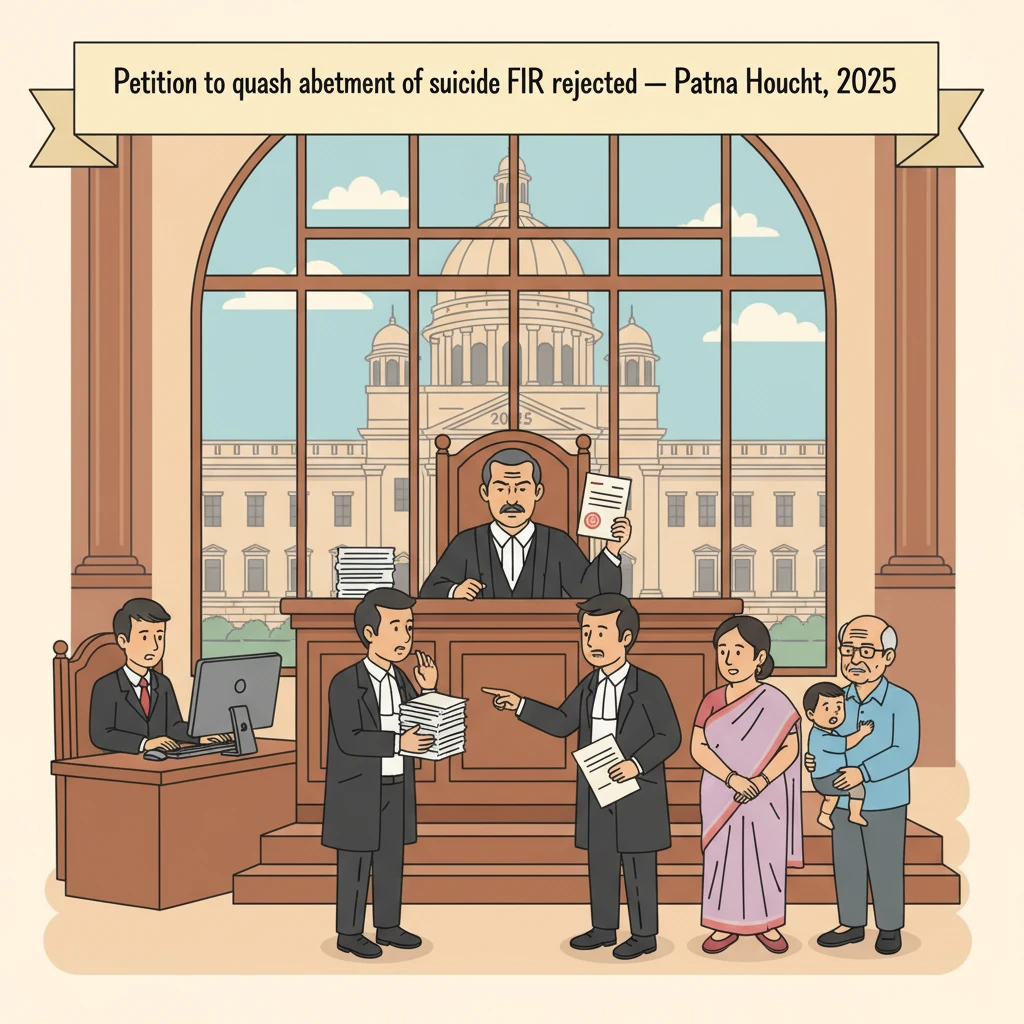
The present application was then filed before the Patna High Court, seeking quashing of the FIR, the charge sheet and all consequential court proceedings, invoking the supervisory note of the Superintendent of Police, Vaishali, and relying on Supreme Court precedents on Section 306 IPC.
What the Court Examined and Decided
The Patna High Court, presided over by Hon’ble Mr. Justice Purnendu Singh, heard arguments from both sides. Counsel for the petitioners argued that the basic legal ingredients of abetment of suicide were not made out from the FIR, the suicide note, or the surrounding material.
On behalf of the petitioners, it was submitted that petitioner no. 1 was the wife of the deceased and there was no prior complaint or criminal case lodged by the deceased against her or the other petitioners during his lifetime. Counsel stressed that the suicide note did not show that the petitioners had ever instigated, provoked or forced the deceased to commit suicide.
The petitioners’ counsel argued that for Section 306 IPC (abetment of suicide) to apply, there must be a link through Section 107 IPC, which defines “abetment”. He maintained that the elements of instigation, conspiracy or intentional aid were completely absent. Continuing the criminal proceedings, therefore, would amount to abuse of the process of the court.
To support this, the petitioners cited several Supreme Court judgments. They relied on:
Prabhat Kumar Mishra @ Prabhat Mishra vs. State of U.P. & Ors. (Criminal Appeal No. 1397 of 2024), and Mahendra Awase vs. State of Madhya Pradesh (Criminal Appeal No. 221 of 2025; SLP (Crl.) No. 11868 of 2023). In those cases, the Supreme Court held that, on a plain reading of the suicide note, the necessary element of abetment was not made out, and criminal proceedings under Section 306 IPC were interfered with.
The petitioners further placed reliance on M. Mohan vs. State represented by the Deputy Superintendent of Police, (2011) 3 SCC 626, which followed Ramesh Kumar vs. State of Chhattisgarh, (2001) 9 SCC 618. They drew specific attention to observations that “instigation” involves goading, provoking or encouraging the commission of an act, and that a mere word spoken in anger, without intention that suicide should follow, cannot amount to instigation.
The petitioners also highlighted wider comments of the Supreme Court in Mahendra Awase, where the Court cautioned that Section 306 IPC is often misused, that the threshold is high, and that police and trial courts must be careful not to treat every emotional exchange or heated conversation as instigation to suicide. They argued that their case was similar, as the deceased’s suicide was more a personal choice amid marital strain, and the criminal law should not be stretched to turn it into an offence by the in-laws.
On the other hand, the learned A.P.P. for the State relied heavily on the FIR and the suicide note. He argued that, when read together, they disclosed all necessary ingredients of abetment of suicide. In particular, he emphasised that the suicide note directly linked the deceased’s act of self-destruction to the conduct and relationship with petitioner no. 1 and others. At the stage of quashing, the State argued, the Court should not enter into detailed appreciation of evidence but should see whether a prima facie offence is made out. On this standard, the case clearly warranted trial and could not be thrown out.
The Court then carefully examined the contents of the FIR in detail. The FIR recorded that on 15.05.2020, the informant, father of the deceased, gave his statement before the police. He described the marriage of his son with petitioner no. 1, their child, the frequent disputes, and the fact that petitioner no. 1 had moved with the child to her parental home two months earlier.
The FIR further mentioned that on 14.05.2020, the deceased had gone to the village of his in-laws after a call from his maternal uncle-in-law. There a discussion took place before the local panchayat. It was alleged that petitioner no. 1’s relatives said the matter would be settled in court, and that they taunted and pressurised the deceased. The informant stated that, upset by these events, his son consumed poison and a suicide note was later recovered. The FIR named specific relatives, including the wife, her father and others, as those whose behaviour and threats allegedly pushed the deceased to end his life.
The Court then reproduced and read through the suicide note in full. In the note, written in Hindi, the deceased stated that he was writing with full sense, and that he felt his five-year married life had become burdensome. He acknowledged that suicide is wrong but claimed he had no way out. He clearly mentioned his wife, father-in-law and mother-in-law, stating that he blamed them for his situation.
The deceased wrote that he had one son and another child in the womb of his wife. He described that he had learnt three years earlier that his wife had a prior relationship or “uktaaj” connection with another person (named as maternal grandfather’s servant/relative). He said that after he tried to explain matters and even informed his in-laws, things seemed to have been sorted but then his wife and her relatives again started harassing him.
In the suicide note, the deceased alleged that his wife’s relatives had tried to falsely implicate him and his family over a previous incident involving a person called “nurse mistri” (described as an “eunuch” accused). He also mentioned that they had allegedly taken money in context of his marriage and had managed evidence in another case. He finally narrated that on 14.05.2020, when he called his wife on her mobile phone, a quarrel ensued, and he was called to the village of his in-laws. There he was allegedly threatened with death in front of others and felt humiliated and trapped.
The suicide note ends with the deceased stating that all responsibility for his death lies with his wife, her parents and certain named relatives. He records that his mother, father, brothers and sisters are innocent and should not be blamed.
The Court also noted the viscera report, which confirmed that the cause of death was consumption of Aluminium Phosphide (commercially known as Celphos), a highly poisonous substance used as a grain preservative.
After this factual scrutiny, the Court turned again to the law. It quoted Section 107 IPC defining abetment, listing the three ways in which a person abets: instigating, engaging in conspiracy, or intentionally aiding by act or illegal omission. It then set out Section 306 IPC, which punishes abetment of suicide. The Court referred to Supreme Court decisions in Chitresh Kumar Chopra v. State (Govt. of NCT of Delhi), (2009) 16 SCC 605, where “instigation” and “goading” were explained, and in S.S. Chheena v. Vijay Kumar Mahajan, (2010) 12 SCC 190, which emphasised that abetment involves a mental process of instigating or intentionally aiding, and that there must be clear mens rea and an active or direct act.
The Patna High Court recognised that different persons have different levels of tolerance and self-esteem, and that in matrimonial life, persistent cruelty or harassment can, in some circumstances, push a spouse to a “no option” situation. It observed that in matrimonial relationships, both spouses gradually become aware of each other’s tolerance threshold, and persistent harassment beyond that knowledge can drive one to fatal decisions.
Applying these principles to the case at hand, the Court held that, from the FIR and the suicide note, there were “sufficient materials” indicating that the deceased did not have a good relationship with his wife, petitioner no. 1. It specifically noted that petitioner no. 1 had “fallen in company of some other person with whom she was having illicit relationship,” and that this aspect appeared clearly from the suicide note and the FIR.
The Court also referred to a later claim reportedly made by the informant that the deceased’s income had stopped during the Covid-19 pandemic, which allegedly explained his distress. The Court held that this retraction did not wipe out the allegations in the suicide note. In the Court’s view, the suicide note was “sterling evidence” of what drove the deceased to end his life. The note and FIR taken together pointed towards cruelty and harassment by the wife and her relatives from the beginning of the marriage, culminating in suicide.
In paragraph 18, the Court concluded that petitioner no. 1 had subjected the deceased to cruelty from the beginning of the relationship, which ultimately resulted in his suicide. On this basis, it held that the ingredients of both Sections 107 and 306 IPC were attracted against the petitioners.
Consequently, the Court rejected the plea for quashing. It held that it was not inclined to interfere with the FIR or the ongoing criminal proceedings. The criminal miscellaneous application was dismissed, and the prosecution will now proceed in the trial court.
Why This Judgment Matters
This judgment is significant for families, especially in Bihar, because it shows when the Patna High Court will refuse to stop a criminal case in a suicide matter. If a suicide note and FIR clearly blame specific family members and describe cruelty or harassment, the Court may allow the trial to continue instead of shutting it down early.
The decision also reflects how courts read suicide notes in matrimonial disputes. Here, the Court treated the suicide note as a strong piece of evidence about why the deceased took the extreme step. The Court refused to accept later softening or retraction by the informant when those statements clashed with the original suicide note.
For ordinary readers, the message is that in-laws and spouses can face serious criminal allegations if their conduct is alleged to be cruel and persistent, and is linked directly to a suicide through a written note or other clear evidence. At the same time, the Court did not declare the petitioners guilty; it only said there is enough material for the trial court to examine the case.
This judgment thus reinforces that quashing of an FIR under Section 306 IPC is not easily granted when there is a detailed suicide note blaming particular individuals and narrating persistent marital problems. The full facts will now be tested at trial, where evidence can be cross-examined and weighed properly.
Legal Issues and Answers
-
Issue: Whether the FIR, charge sheet and criminal proceedings for abetment of suicide under Section 306 IPC arising from Rajapakar P.S. Case No. 106 of 2020 should be quashed at the pre-trial stage.
Answer: No. The Patna High Court held that the FIR and suicide note disclose sufficient material to attract Sections 107 and 306 IPC, and refused to quash the proceedings.
Cases Cited by the Court
- Prabhat Kumar Mishra @ Prabhat Mishra vs. State of U.P. & Ors., Criminal Appeal No. 1397 of 2024 (Supreme Court).
- Mahendra Awase vs. State of Madhya Pradesh, Criminal Appeal No. 221 of 2025; SLP (Crl.) No. 11868 of 2023 (Supreme Court).
- M. Mohan vs. State represented by the Deputy Superintendent of Police, (2011) 3 SCC 626 (Supreme Court).
- Ramesh Kumar vs. State of Chhattisgarh, (2001) 9 SCC 618 (Supreme Court).
- Chitresh Kumar Chopra v. State (Govt. of NCT of Delhi), (2009) 16 SCC 605 (Supreme Court).
- S.S. Chheena v. Vijay Kumar Mahajan, (2010) 12 SCC 190 (Supreme Court).
Case Details
Case Number: Criminal Miscellaneous No. 79977 of 2024
Arising Out Of: Rajapakar P.S. Case No. 106 of 2020, District Vaishali
Case Title: Radha Kumari & Ors. vs. The State of Bihar & Anr.
Citation: 2025(4) PLJR 123
Court: High Court of Judicature at Patna
Coram: Hon’ble Mr. Justice Purnendu Singh
Date of Judgment: 01-09-2025
Advocates:
- For the petitioners: Mr. Deo Prakash Singh, Advocate
- For the State/opposite parties: Mr. Rajendra Singh, A.P.P.
Nature of the Case: Criminal miscellaneous application seeking quashing of FIR, charge sheet and consequential proceedings under Section 306 IPC.
Link to Judgment: Patna High Court Judgment
If you found this explanation helpful and wish to stay informed about
how legal developments may affect your rights in Bihar,
you may consider following Samvida Law Associates for more updates.







