

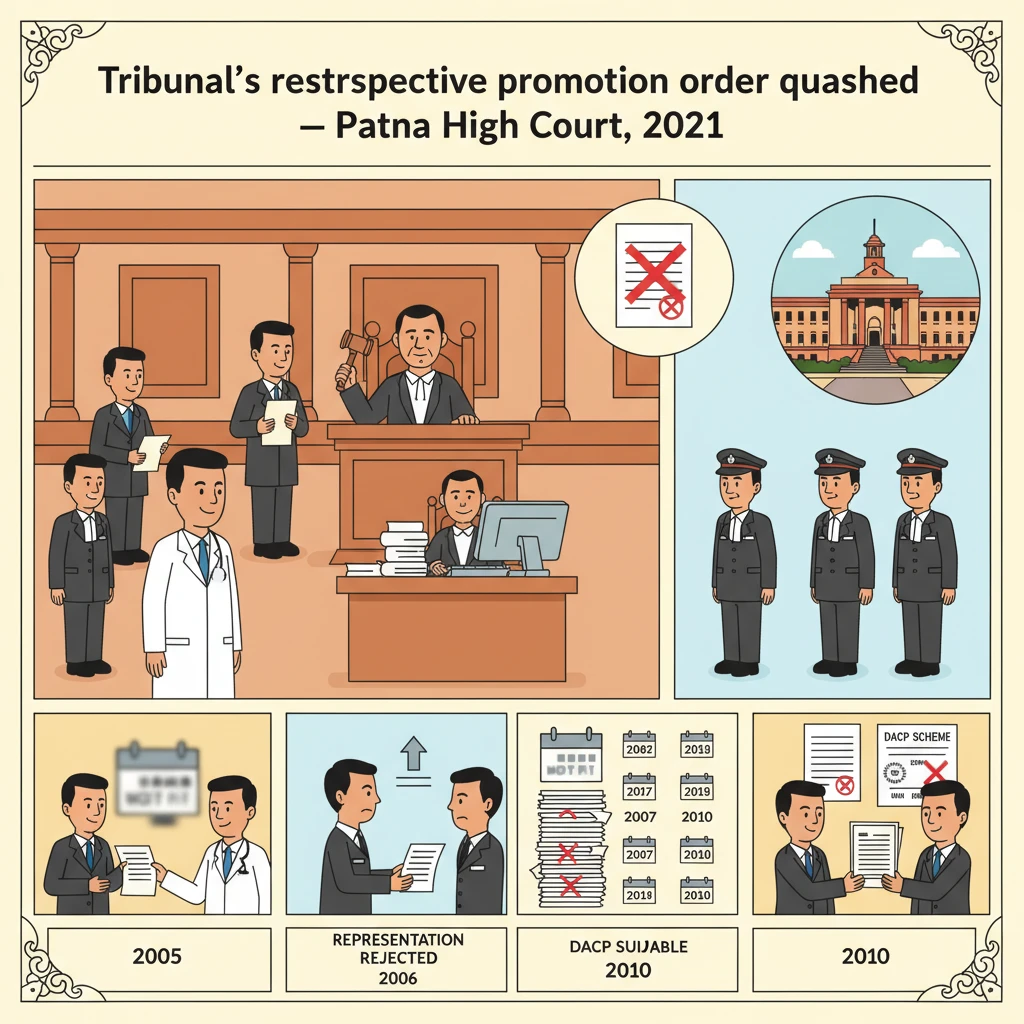
Case Background
The case arose from a service dispute in the Railways about promotion and Annual Confidential Reports (ACRs), now called Annual Performance Assessment Reports (APARs).
The respondent, a doctor in the Indian Railway Medical Service (IRMS), joined service on 01.04.1998. He was in the Senior Scale and aspired to be promoted to the Junior Administrative Grade (JAG) and later to the Selection Grade and Senior Administrative Grade (SAG) under the Dynamic Assured Career Progression Scheme (DACP).
For promotion to JAG for IRMS officers, a Departmental Promotion Committee (DPC) was constituted in 2007. The benchmark for promotion was “Good”, as per Railway Board letters dated 03.06.2002 and 30.09.2002.
The doctor’s ACRs for 2003-04 and 2004-05 (Part I and Part II) were graded “average” and “not fit for promotion”. His ACR for 2005-06 was “good”. These adverse entries for 2003-04 and 2004-05 were communicated to him on 02.12.2005. He submitted a representation, which was rejected on 29.06.2006. In the rejection, the accepting authority clearly recorded: “Hence I agree with the adverse remarks recorded in the ACRs for the period 2003-04 and 2004-05.”
The doctor then filed an appeal before the General Manager, East Central Railway. The General Manager also rejected his appeal, stating: “I have gone through the records and I am constrained to direct that adverse entries shall remain.”
Despite this, the doctor’s case for promotion to JAG was repeatedly considered and rejected by the DPC. On 11.05.2007, 27.02.2008, 04.02.2009 and 04.02.2010, he was found not suitable on the basis of his performance as reflected in his ACRs.
Meanwhile, the doctor went on study leave from 27.01.2006 to 04.01.2009 and re-joined on 05.01.2009. Because of this, there were no ACRs for him for 2006-07, 2007-08 and 2008-09. Hence, for the DPCs held in 2007-08 and 2009, his earlier ACRs for 2003-04, 2004-05 and 2005-06 were again considered.
What the Court Examined and Decided
In 2009, the Government of India introduced the Dynamic Assured Career Progression Scheme, extended up to SAG in the Railways. Under DACP, a benchmark was prescribed for promotion based on ACR/APAR gradings.
Earlier, only adverse remarks in ACRs were communicated to officers. Other grades such as “good” or “average”, though they could affect promotion because of the benchmark requirement, were not routinely communicated. This led to a legal question: could an officer be denied promotion on the basis of an uncommunicated below-benchmark grading?
The Supreme Court, in Dev Dutt v. Union of India, (2008) 8 SCC 725, held that all entries in ACRs, whether “poor, fair, average, good or very good”, must be communicated so that the officer can represent and seek upgradation. Non-communication was held to offend Article 14 of the Constitution.
Following this, the Department of Personnel and Training (DOPT) issued an Office Memorandum dated 13.04.2010, directing that when an employee is to be considered in a future DPC, and earlier ACRs (before 2008-09) which will be used in that DPC contain gradings below the benchmark, those ACRs must be communicated for representation before being placed before the DPC.
In the respondent doctor’s case, his below-benchmark ACRs for March 2003, March 2004, March 2005 (Part I and II) and March 2006 were again communicated in terms of this 2010 OM, even though the adverse entries for 2003-04 and 2004-05 had already been communicated earlier and his representation and appeal had been rejected.
The doctor submitted another representation dated 25.10.2010. In this fresh round, the competent authority upgraded his gradings as follows:
- March 2003 – from “Good” to “Very Good”
- March 2004 – from “Average/Not Fit” to “Good”
- March 2005 (Part I) – from “Average/Not Fit” to “Very Good”
- March 2005 (Part II) – from “Average/Not Fit” to “Good”
- March 2006 – “Good” retained
This upgradation was ordered by the General Manager, East Central Railway on 17.01.2011. After this, the doctor’s case was placed before the DPC in 2012. On the basis of his upgraded APARs, he was found fit and was promoted to JAG with effect from 21.11.2012, vide order dated 10.01.2013. Later, he was also promoted to Selection Grade under the DACP Scheme with effect from 21.11.2016.
After enjoying these promotions, the doctor in 2016 sought antedating of his JAG promotion to 2007 and his Selection Grade promotion to 2012, on the footing that his APARs for 2003-04 and 2004-05 had been upgraded. His representation dated 25.10.2016 was rejected on 23.03.2017 by relying on a DOPT OM dated 24.08.2015 stating that such retrospective promotions were not admissible.
Aggrieved, the doctor approached the Central Administrative Tribunal, Patna Bench, in OA No.215 of 2017. He claimed that his case was similar to that of one Dr. T.N. Wary, whose OA No.284 of 2010 had been allowed by the CAT, Guwahati Bench, and whose retrospective promotion had eventually been upheld up to the Supreme Court.
The Patna Bench of the Tribunal initially dismissed his OA by order dated 06.06.2019. The doctor then filed a writ petition, CWJC No.20058 of 2019, before the Patna High Court. On 26.09.2019, the High Court found that the Tribunal had not fully considered the effect of the decision in Dr. T.N. Wary’s case and remanded the matter for fresh consideration.
On remand, the Tribunal, by a short order dated 14.02.2020 in M.A. No.50/391/2019 arising from OA No.051/00215/2017, allowed the doctor’s claim. It directed the Railways to hold a review DPC and, if he was found fit, to grant him retrospective promotion from 2007 (to JAG) and 2011 (to Selection Grade), relying on the upgraded APARs and the precedent of Dr. T.N. Wary and Dev Dutt.
The Union of India and Railway authorities challenged this fresh Tribunal order before the Patna High Court in the present Civil Writ Jurisdiction Case No.2706 of 2021.
Before the High Court, the petitioners argued that the facts of the respondent’s case were materially different from those of Dr. T.N. Wary. They pointed out that:
- In Dr. Wary’s case, the ACR remark was “Good” (below benchmark of “Very Good” for SAG), but it was never communicated to him earlier, as it was not adverse.
- The below-benchmark grading came to light only after the 07.01.2009 DACP notification, and was then communicated. On his representation, the grading for 2006 was upgraded from “Good” to “Very Good” on 02.08.2011, and he was promoted prospectively on 29.08.2011.
- The CAT, Guwahati, thereafter directed a review DPC and retrospective promotion from the date his juniors were promoted (19.10.2009), holding that he was prejudiced because the below-benchmark ACR had never been communicated.
By contrast, in the Patna case, the doctor’s ACRs for 2003-04 and 2004-05 contained clear adverse remarks and “not fit for promotion”. These were communicated to him in 2005. His representation was rejected in 2006, and his appeal was also rejected. The petitioners stressed that this meant the principles in Dev Dutt about non-communication simply did not apply in the same way.
The petitioners further submitted that the DOPT OM dated 13.04.2010 did not require re-communication of already communicated adverse ACRs where representations and appeals had been finally rejected. In their view, the second representation of 25.10.2010, which the doctor made without disclosing his earlier failed challenge, and the subsequent upgradation of his entries were irregular and could not be used to claim retrospective promotion.
The respondent doctor, on the other hand, argued that after 17.01.2011 his APARs were no longer below the benchmark, just like Dr. Wary’s. He said both he and Dr. Wary were initially denied promotion on the basis of below-benchmark gradings which were later upgraded, and both were then promoted prospectively. He contended that, therefore, like Dr. Wary, he too was entitled to retrospective promotion from the date his batchmates or juniors were promoted.
He also disputed that his appeal against the first rejection was ever communicated to him and claimed that the Railways had not properly served the order dated 19.10.2006. He relied on the Supreme Court rulings in Dev Dutt and Abhijit Ghosh Dastidar v. Union of India, (2009) 16 SCC 146, and on a Delhi High Court judgment in Union of India v. V.K. Vashisht, to argue that non-communication or improper treatment of ACRs affecting promotion is illegal.
The Patna High Court carefully reviewed these rival positions. It reiterated the legal principles laid down in Dev Dutt and Abhijit Ghosh Dastidar about the need to communicate ACR entries and the consequences of non-communication. However, the Court underlined that in the respondent’s case, the crucial adverse entries for 2003-04 and 2004-05 had been communicated, his representation was considered and rejected, and his appeal was also dismissed.
The Court noted that the Tribunal had failed to properly consider this admitted fact. It also noted that Dev Dutt and the Guwahati Bench decision in Dr. T.N. Wary’s case dealt specifically with situations where below-benchmark ACRs had never been communicated and therefore prejudiced the officer without an opportunity of representation.
The Delhi High Court judgment relied on by the respondent was found inapplicable because in that case too the ACR had not been served at all, whereas here it had been served.
On this basis, the Patna High Court held that the respondent’s case was not comparable or “at par” with that of Dr. T.N. Wary. The Tribunal, in simply applying the relief granted to Dr. Wary, had ignored the material factual differences and had not examined the respondent’s case independently. This amounted to an error in law.
Accordingly, the Court set aside the Tribunal’s order dated 14.02.2020 in M.A. No.50/391/2019 arising from O.A. No.051/00215/2017. The writ petition filed by the Union of India and Railway authorities was allowed.
Why This Judgment Matters
This decision is important for government and public sector employees, especially those in the Railways, who seek promotions based on upgraded ACRs or APARs.
The Patna High Court makes clear that the benefit of Supreme Court rulings on non-communication of ACRs, and of cases like Dr. T.N. Wary, cannot be automatically extended to every officer whose grading was later improved. The employee must show that the earlier below-benchmark entry was never properly communicated in the first place.
If an officer has already been told about adverse remarks, has had an opportunity to submit a representation and appeal, and both have been decided against him, he cannot later rely on a second, irregular upgradation to demand automatic retrospective promotion going back many years.
The judgment also stresses that tribunals must carefully compare facts before treating two cases as identical. Merely because two officers are in the same service or under the same scheme (like DACP) does not mean they are entitled to the same relief.
For employees in Bihar and beyond, this ruling serves as a reminder to promptly challenge adverse ACRs when communicated and to keep records of representations and orders. For the administration, it confirms that once adverse remarks are duly communicated and decided, subsequent changes do not, by themselves, compel retrospective promotions unless the legal conditions are clearly met.
Legal Issues and Answers
-
Issue: Whether the Central Administrative Tribunal, Patna Bench, was justified in directing a review DPC and granting the respondent retrospective promotion from 2007 and 2011 on the basis of upgraded APARs and by treating his case as identical to that of Dr. T.N. Wary.
Answer: No. The Patna High Court held that the respondent’s adverse ACRs had been duly communicated, his representation and appeal were rejected, and his case was factually different from Dr. Wary’s. The Tribunal erred in ignoring these differences and its order granting retrospective promotion was set aside. -
Issue: Whether the principles in Dev Dutt and Abhijit Ghosh Dastidar concerning non-communication of ACR entries automatically entitle an officer to retrospective promotion once ACRs are upgraded.
Answer: No. The Court clarified that those principles apply where below-benchmark or adverse entries were not communicated at all, causing prejudice. Where entries were communicated and duly considered on representation and appeal, later upgradation does not automatically mandate retrospective promotion.
Cases Cited by the Court
- Dev Dutt v. Union of India, (2008) 8 SCC 725
- Abhijit Ghosh Dastidar v. Union of India & Ors., (2009) 16 SCC 146
- Union of India v. V.K. Vashisht, W.P.(C) 5036/2012, Delhi High Court (held distinguishable)
- Reference to CAT, Guwahati Bench decision in O.A. No.284/2010 (Dr. T.N. Wary) and subsequent litigation up to the Supreme Court
Case Details
Case Number: Civil Writ Jurisdiction Case No.2706 of 2021
Case Title: The Union of India & Ors. v. Dr. Arvind Kumar
Coram: Hon’ble Mr. Justice Vikash Jain and Hon’ble Mr. Justice Anjani Kumar Sharan
Citation: 2022(1) PLJR 8
Date of Judgment: 02.12.2021
Advocates:
- For the Petitioners (Union of India and Railway authorities): Mr. P.K. Verma, Senior Advocate; Dr. Anand Kumar, Advocate
- For the Respondent (Railway doctor): Mr. M.P. Dixit, Advocate; Mr. S.K. Dixit, Advocate; Mr. S.K. Chaubey, Advocate; Mrs. Swastika, Advocate
Nature of the Case: Writ petition (service matter) challenging an order of the Central Administrative Tribunal, Patna Bench, concerning retrospective promotion and review DPC under the DACP Scheme.
Final Outcome: Tribunal’s order dated 14.02.2020 in M.A. No.50/391/2019 arising from O.A. No.051/00215/2017 set aside; writ petition allowed.
Link to Judgment: Patna High Court Judgment CWJC No.2706 of 2021
If you found this explanation helpful and wish to stay informed about
how legal developments may affect your rights in Bihar,
you may consider following Samvida Law Associates for more updates.







