
Case Background
This case arises out of Aurangabad Cyber P.S. Case No. 11 of 2023. The informant, who is the petitioner in this criminal revision, lodged an FIR on 04.08.2023. The FIR was registered under Sections 420, 467, 468, 471, 120B of the Indian Penal Code and Section 66D of the Information Technology Act.
According to the prosecution, the petitioner was cheated of an amount of Rs. 5,60,600/-. The case involved alleged cyber cheating and forgery. After investigation, a charge sheet was submitted on 21.07.2024. The charge sheet took into consideration events that took place from 22.06.2023 up to the arrest of the accused Rakesh Kumar @ Bablu on 24.05.2024.
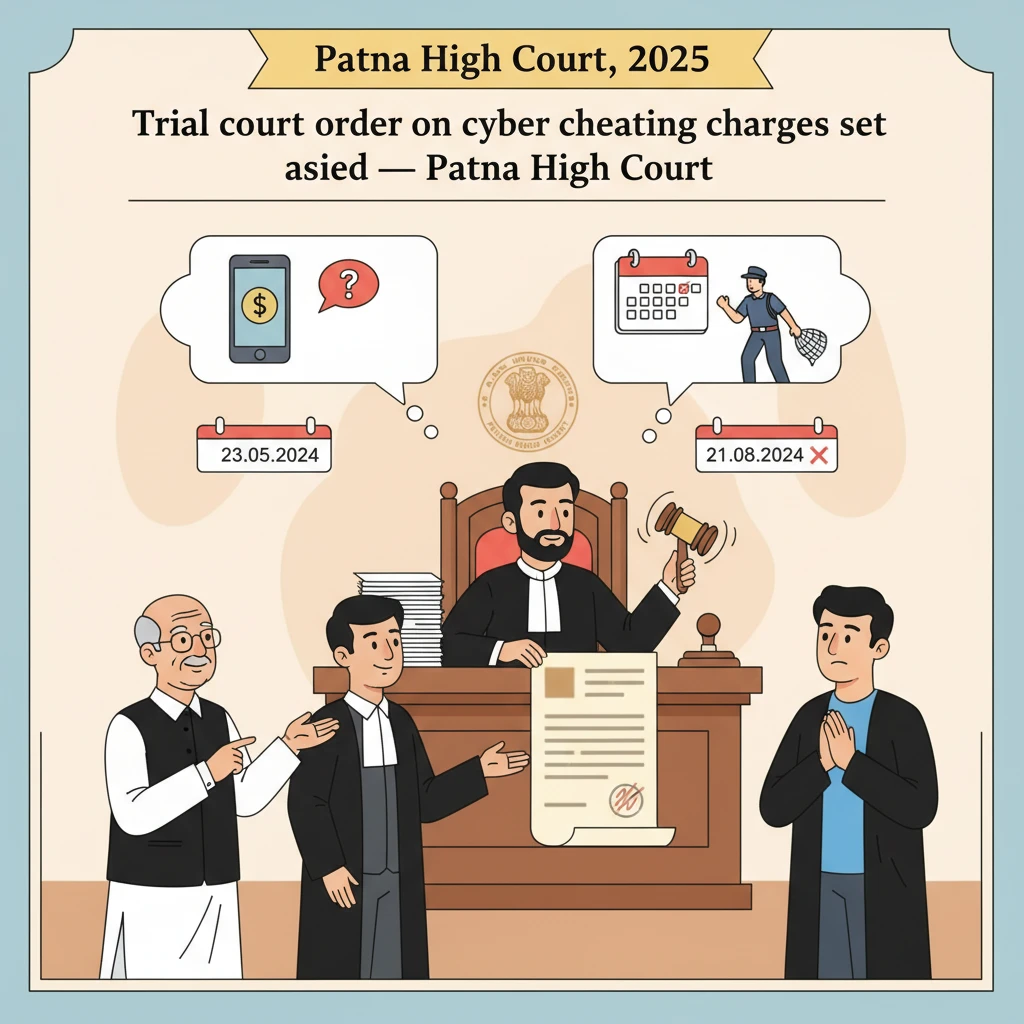
On 26.07.2024, the trial court took cognizance under Sections 420, 467, 468, 471, 120B of the IPC and Section 66D of the I.T. Act. Subsequently, on 21.08.2024, while framing charges, the trial court restricted the “period of occurrence” to 22.06.2023 to 28.07.2023.
The informant then moved an application before the trial court on 16.09.2025 seeking addition or alteration of the charge. He argued that an incident that took place on 23.05.2024, which led directly to the arrest of the accused on 24.05.2024, should be included as part of the same transaction. On 13.10.2025, the Additional Chief Judicial Magistrate 1st, Aurangabad, rejected this application. That rejection order became the subject of the present criminal revision before the Patna High Court.
What the Court Examined and Decided
The core dispute before the Patna High Court was narrow but important: whether the trial court was wrong in refusing to consider the incident dated 23.05.2024 as part of the same transaction while framing the charge, and whether it could reject the informant’s application for alteration of charge.
The petitioner’s counsel explained the sequence of events. After the initial cheating in which the petitioner lost Rs. 5,60,600/-, he later received another fraudulent call on 23.05.2024. The caller asked him to perform certain acts to “claim” the defrauded amount and claimed to be an official of the cyber cell. Sensing something wrong, the petitioner immediately informed the police.
Acting on this information, the police apprehended accused Rakesh Kumar @ Bablu on 24.05.2024. A seizure list was prepared for articles recovered from the accused. The accused’s confessional statement was also recorded. According to the petitioner, these steps—arrest, confession and seizure—were part of the same chain of events arising from the original FIR in Aurangabad Cyber P.S. Case No. 11 of 2023.
The petitioner argued that the investigation and resulting charge sheet had, in fact, covered the full period from 22.06.2023 up to the arrest on 24.05.2024, including the events of 23.05.2024 and 24.05.2024. The trial court had also taken cognizance on that basis. Yet, at the stage of framing of charge, the trial court fixed the period of occurrence only between 22.06.2023 and 28.07.2023 and omitted 23.05.2024 without any stated reason.
When the petitioner sought alteration of the charge to include 23.05.2024 as part of the same transaction, the trial court rejected the request on 13.10.2025. The trial court relied on Section 215 of the Code of Criminal Procedure and took the view that including the additional date would affect proper adjudication and that there was no basis in the FIR or prosecution evidence to change the date of occurrence.
Before the Patna High Court, counsel for the petitioner argued that Section 215 CrPC was wrongly invoked. Instead, Section 216 CrPC clearly gives power to the court to alter or add to any charge at any time before judgment. The petitioner’s counsel highlighted that charges must be framed on the basis of the entire set of police papers, not just the FIR.
He further relied on Section 220(1) CrPC, which allows multiple offences to be charged and tried together if they arise out of “one series of acts so connected together as to form the same transaction”. To support this understanding, he cited the Supreme Court judgment in Mohan Baitha and others v. State of Bihar and another, AIR 2001 SC 1490. In that decision, the Supreme Court explained that the expression “same transaction” is to be understood using common sense, taking into account factors such as proximity of time, unity or proximity of place, continuity of action, and community of purpose or design.
On the other side, the learned APP for the State and counsel for the accused supported the trial court’s order. Counsel for the accused contended that the trial court had correctly applied Section 215 CrPC. According to them, if 23.05.2024 was incorporated as one of the dates of incident, it would affect proper adjudication. They also argued that, based on the FIR and prosecution materials, there was no basis to change the date of occurrence.
Justice Arun Kumar Jha carefully examined Sections 216 and 220 CrPC. Section 216, as reproduced in the judgment, makes it clear that any court may alter or add to any charge at any time before judgment. It also provides safeguards: any such alteration must be explained to the accused; and if immediate continuation of trial would prejudice either side, the court may order a new trial or adjournment.
Section 220, also set out in detail in the judgment, allows trial for more than one offence when the offences are committed in a single transaction. The provision also covers situations where multiple acts combine to form a different offence, or where falsification of accounts is used to conceal misappropriation or breach of trust.
From these provisions, the High Court drew a clear conclusion: if offences are committed by the same person in the same transaction, that person can be tried for all of them in one trial.
Applying this principle, the Court turned back to the facts of the case. It found that, in the “facts and circumstances of the present case”, the incident dated 23.05.2024 formed part of the same transaction. Therefore, it ought to be reflected when framing the charge.
The Court noted that the trial court had focused only on the period 22.06.2023 to 28.07.2023 and the absence of a reference to 23.05.2024 in the FIR. However, the High Court emphasised that charges are to be framed on the basis of the material available before the court, commonly understood as the investigation report or police papers, and not just the FIR.
Here, the charge sheet specifically mentioned the incidents of 23.05.2024 and 24.05.2024. It stated that the charge sheet was being submitted after taking into account the seizure list, the confessional statement of the accused, and other available materials. These documents clearly formed part of the case record at the time of framing of charge.
Because these materials directly referred to the events of 23.05.2024 and 24.05.2024, the High Court held that they were “relevant for the purpose of framing of charge”. The trial court was duty-bound to look into all such papers before framing charges.
By ignoring the seizure list, confession, and other investigation materials referring to 23.05.2024 and 24.05.2024, the trial court failed to consider the full record. This omission made its order improper. The High Court described the impugned order as suffering from “material irregularity and impropriety”.
Accordingly, the Patna High Court set aside the order dated 13.10.2025 passed by the Additional Chief Judicial Magistrate 1st, Aurangabad. The criminal revision was allowed.
Finally, the Court directed the trial court to reconsider the petitioner’s application dated 16.09.2025 seeking addition or alteration of charge, in the light of the observations made in the High Court’s judgment. This means the trial court must now re-examine whether to include the incident dated 23.05.2024 within the period of occurrence and charges, taking into account all relevant police papers and the legal position explained by the High Court.
Why This Judgment Matters
This judgment is significant for complainants in cyber cheating and other criminal cases where offences continue over a period of time. It clarifies that the court, while framing charges, cannot confine itself only to the FIR’s initial dates if later connected incidents emerge during investigation.
The Patna High Court has reinforced that:
- Courts have a clear power under Section 216 CrPC to alter or add charges any time before judgment.
- Where multiple acts form part of one continuous cheating or fraud, they can be treated as a single transaction under Section 220 CrPC and tried together.
- Trial courts must consider the entire police record—including seizure lists and confessional statements—while framing charges, and not just the FIR.
For victims, this means that if fresh incidents linked to the original crime come to light later, those can still be brought within the same trial. For accused persons, it ensures that all connected allegations are decided in one proceeding rather than through multiple fragmented trials.
Legal Issues and Answers
- Issue: Whether the trial court was justified in refusing to alter or add to the charges by including the incident dated 23.05.2024 as part of the same transaction.
Answer: No. The Patna High Court held that the incident of 23.05.2024 formed part of the same transaction, and the trial court wrongly ignored relevant investigation materials. The impugned order was set aside and the matter remitted for reconsideration. - Issue: Whether offences arising out of continuous acts of cheating in this case could be tried together in one trial.
Answer: Yes. Referring to Section 220 CrPC and the Supreme Court’s decision in Mohan Baitha, the Court held that where acts are so connected as to form the same transaction, they can be charged and tried together. - Issue: On what basis should charges be framed—only the FIR or the entire police record.
Answer: The Court clarified that charges must be framed on all materials available before the court, including the charge sheet, seizure list, confessional statement and other investigation papers, and not solely on the FIR.
Cases Cited by the Court
- Mohan Baitha and others v. State of Bihar and another, AIR 2001 Supreme Court 1490 – cited to explain the meaning of “same transaction” under Section 220 CrPC and the factors like proximity of time, place, continuity of action and community of purpose.
Case Details
Case Number: Criminal Revision No. 1215 of 2025; arising out of Aurangabad Cyber P.S. Case No. 11 of 2023, G.R. No. 2074 of 2023.
Case Title: Rajesh Kumar Singh v. The State of Bihar.
Coram: Hon’ble Mr. Justice Arun Kumar Jha.
Date of Judgment: 16.12.2025 (Uploading Date: 17.12.2025; Transmission Date: 17.12.2025).
Citation: 2026 (1) PLJR 431.
Advocates:
For the Petitioner (informant): Mr. Rajeev Kumar Singh, Advocate; Mr. Gyanendra Kumar Diwakar, Advocate; Mr. Mohit Ranjan, Advocate; Mr. Harsh Raj, Advocate; Mr. Kumar Abhishek, Advocate.
For the State: Mr. Md. Fahimuddin, APP.
For the Accused: Mr. Bipin Kumar, Advocate; Mr. Ravi Kant, Advocate; Mr. Abhishek Kumar, Advocate.
Nature of the Case: Criminal revision petition challenging an order of the trial court refusing to allow addition/alteration of charges in a cyber cheating case.
Link to Full Judgment: Patna High Court Judgment in Cr. Rev. No. 1215 of 2025
If you found this explanation helpful and wish to stay informed about
how legal developments may affect your rights in Bihar,
you may consider following Samvida Law Associates for more updates.







