

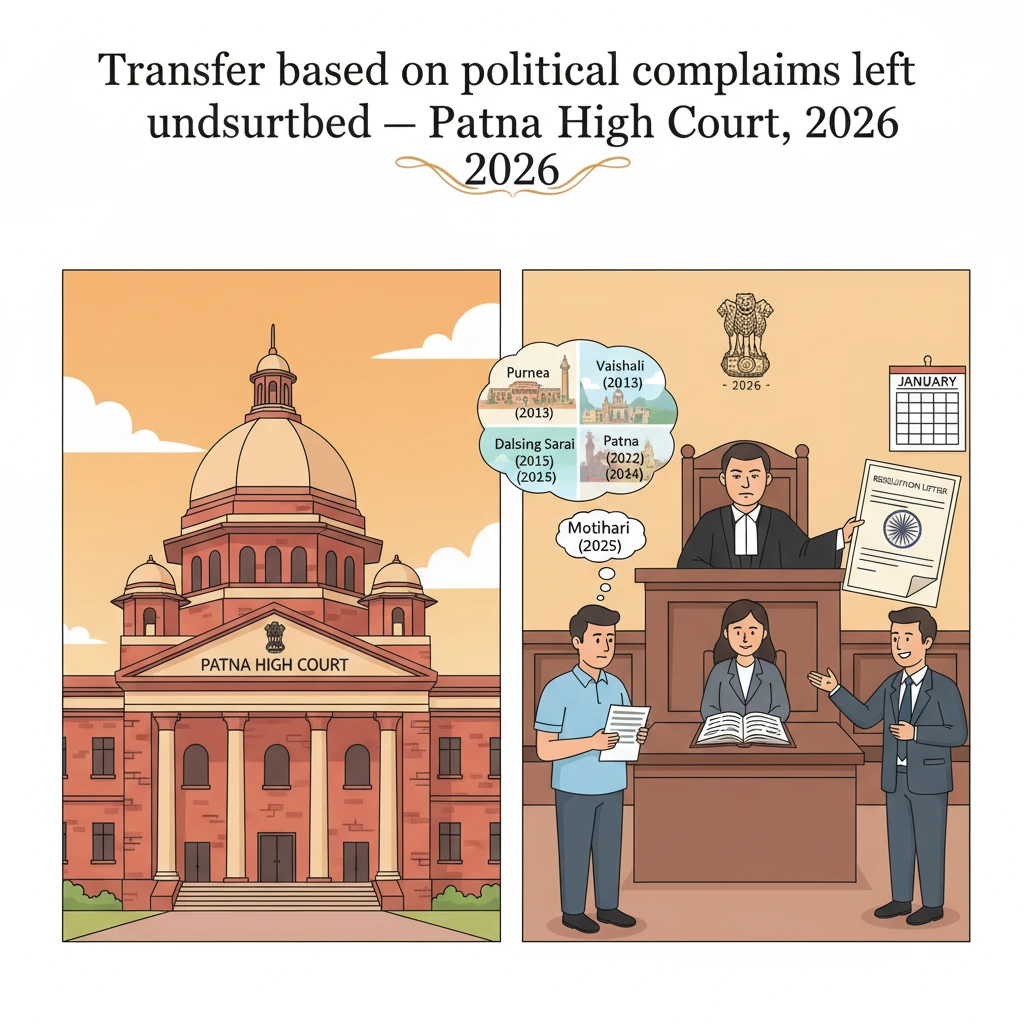
Case Background
The petitioner is an Executive Engineer in the Rural Works Department of the Government of Bihar.
He first joined government service as an Assistant Engineer in the Irrigation Department at Purnea in 2018. In 2013, he was transferred to Vaishali as Assistant Engineer in the Rural Works Department. In 2015, he was again transferred to Dalsing Sarai as Assistant Engineer, Rural Works Department, where he continued till 2020.
In 2020, he was transferred to Khagaria. In 2022, he was promoted to the post of Executive Engineer and posted at Patna. In June 2024, he was posted as Executive Engineer, Rural Works Department at Kishanganj (II).
On 31.01.2025, an order was issued transferring him from Kishanganj (II) to the post of Technical Advisor, Rural Works Department, to the Superintending Engineer at Motihari. This is the transfer order challenged before the Patna High Court through Civil Writ Jurisdiction Case No. 3030 of 2025.
What the Court Examined and Decided
The Patna High Court, speaking through Hon’ble Mr. Justice Bibek Chaudhuri, began by framing the central question in very clear terms. The Court asked whether an executive transfer order can be made only on the basis of a complaint against a government employee made by a former Member of Legislative Assembly, a Member of Parliament, or any private person.
The petitioner attacked the transfer order on multiple grounds. First, he said the transfer from Kishanganj (II) to Motihari came within six months of his posting at Kishanganj, which went against the normal transfer policy where postings are generally for a longer period.
Second, he argued that the transfer was in fact punitive. In other words, it was not a routine administrative decision but was meant to punish him without following proper departmental proceedings.
Third, he pointed out that he, an Executive Engineer, was made to replace an Assistant Engineer who was working as Technical Advisor to the Superintending Engineer. According to him, this meant that a higher-ranked officer had been placed in a post meant for a lower rank, violating the general rules of transfer.
Later, through a supplementary affidavit, the petitioner added another challenge. He claimed that the order was not issued by the Additional Chief Secretary of the Rural Works Department but by an officer who was only in charge of that post. He questioned the authority and validity of such issuance.
The State respondents — represented by the Additional Chief Secretary, Special Secretary and Joint Secretary of the Rural Works Department — filed a counter-affidavit. In paragraphs 8 to 11 of this affidavit, they explained their stand, which the Court reproduced in the judgment.
They referred to Resolution Letter No. 28/2006/434 dated 01.03.2007 of the Cabinet Secretariat and Coordination Department, Bihar. Under this policy, transfers and postings of State Government employees are generally to be made once in a year, in the month of June. However, the same Resolution allows transfers at any time in cases of promotion, in the interest of work, or for administrative reasons.
The respondents further stated that within six months of the petitioner’s posting at Kishanganj (II), the department received three complaints against him. The complaints, dated 18.01.2025, 21.10.2024 and 02.10.2024, made allegations of corrupt practice, demand of bribe, and manipulation in tender disposal in Work Division Kishanganj-2. One complaint came from a sitting Member of Parliament, another from a former MLA, and the third from a private contractor.
Based on these complaints, the Joint Secretary, Rural Works Department, wrote to the Chief Engineer-4 of the Department through three letters dated 25.10.2024 (Letter No. 27751), 10.01.2025 (Letter No. 403), and 13.01.2025 (Letter No. 1213). In these letters, he requested an enquiry regarding the allegations against the petitioner and sought submission of an enquiry report.
According to the respondents, considering these complaints and in the interest of better execution of work under Work Division Kishanganj-2, the petitioner was transferred from Kishanganj to Motihari. They maintained that the order was not punitive but corrective in nature.
After hearing both sides, the Patna High Court examined how the transfer actually came about. The Court observed that the executive branch of the State had transferred the petitioner essentially on the basis of complaints from people’s representatives and a contractor.
When asked, the State’s counsel informed the Court that a departmental enquiry was still in progress to find out the truth of the complaints. No preliminary enquiry report had been received when the transfer order was issued on 31.01.2025.
The Court then delivered important observations about how the executive should function in a democracy. It stated that executive action must be independent and free from pressure from people’s representatives. If an officer is transferred only because an MLA or MP has complained, it would effectively mean that out of the three pillars of democracy — Legislature, Executive and Judiciary — two pillars (Legislature and Executive) are being run by the same group of people.
The judgment used strong language, saying that such a situation makes executive officers “dance like puppets” at the movement of the fingers of people’s representatives. The Court clearly held that this is not the constitutional scheme of the country.
At the same time, the Court acknowledged that an executive authority is fully empowered to take necessary action against a departmental employee if there are allegations of corruption. But such action should be based on allegations that are at least prima facie proved.
In this case, the enquiry into the complaints was still going on. No preliminary enquiry report had been received when the transfer was ordered. On these facts, the Court expressed its disapproval, saying that the impugned transfer order was “not at all happy”. This phrase reflected the Court’s view that the decision-making process behind the transfer was unsatisfactory and premature.
However, the Court then turned to the present situation on the date of hearing. It took note of the fact that the petitioner had already joined his new posting at Motihari as Technical Assistant to the Superintending Engineer. He had been working there for about one year.
Given that the order had already been complied with and a considerable period had passed, the Court was not inclined to “unsettle the order of transfer by passing any prerogative writ”. In practical terms, this means that although the Court criticised how the transfer was done, it chose not to quash the order or direct that the petitioner be sent back to Kishanganj or any other post.
Ultimately, the Patna High Court disposed of the writ petition with these observations, leaving the transfer order intact but making it clear that transfers should not be driven simply by complaints from politicians or private persons without at least a basic inquiry.
Why This Judgment Matters
This judgment of the Patna High Court is important for government employees and citizens alike, especially in Bihar.
First, the Court has clearly said that executive decisions, including transfer of officers, must be independent. They cannot be made just because an MLA, MP or contractor complains. If transfers are driven by such pressure, it damages the basic balance between Legislature and Executive in a democracy.
Second, the Court has also clarified that when there are allegations of corruption, the government is free to act. But it should have at least some prima facie material from an enquiry before taking serious steps like transfer, especially when the transfer is linked to the allegations.
Third, for government servants, the judgment shows that courts may not always interfere with transfers, even if they are critical of the process, particularly where the officer has already joined the new post and time has passed. In such cases, the Court may prefer not to disturb the administrative arrangement.
For citizens and people’s representatives, this judgment is a reminder that while they can file complaints about corruption or misuse of power, the decision on transfers has to be taken by the executive on its own independent assessment.
Legal Issues and Answers
Issue: Can the State transfer a government officer on the basis of complaints made by a Member of Parliament, a former MLA or a private person, without even receiving a preliminary enquiry report?
Answer: The Court held that executive action must be independent and not under pressure from people’s representatives, and that action like transfer on allegations of corruption should follow at least prima facie proof. In this case, the Court found the transfer order “not at all happy” as it was issued before receipt of a preliminary enquiry report, but ultimately did not quash the order because the officer had already joined and served at the new posting for about a year.
Issue: Will the Patna High Court interfere with a transfer order already implemented and continuing for about one year?
Answer: The Court refused to unsettle the transfer by issuing a prerogative writ, noting that the petitioner had already joined his new post at Motihari and worked there for around one year. The writ petition was disposed of without cancelling the transfer.
Cases Cited by the Court
- No prior judicial decisions or case law have been cited or relied upon in the text of this judgment.
Case Details
Case Number: Civil Writ Jurisdiction Case No. 3030 of 2025
Case Title: Rajesh Kumar Choudhary vs. The State of Bihar & Ors.
Citation: 2026 (2) PLJR 334
Court: High Court of Judicature at Patna
Coram: Hon’ble Mr. Justice Bibek Chaudhuri
Date of Judgment: 28-01-2026
Advocates: For the petitioner – Mr. Madhumay Madhup, Advocate; For the respondents – Mr. Anuj Kumar, AC to GP-24
Nature of the Case: Writ petition (civil) challenging a transfer order of a government officer in the Rural Works Department
Link to Judgment: Click here to access the full judgment of the Patna High Court
If you found this explanation helpful and wish to stay informed about how legal developments may affect your rights in Bihar, you may consider following Samvida Law Associates for more updates.







