

Case Background
This case arises from a public tender issued by Bihar Urban Infrastructure Development Corporation Limited (BUIDCO). The tender was for a revenue-generating project involving Bus Queue Shelters, under the Urban Development and Housing Department of the State of Bihar.
The petitioner, Adam Media and Recreation Private Limited, participated as a bidder. The 7th respondent, M/s Magadh Advertising Bureau, and the 8th respondent, PI System Pvt. Ltd., were also bidders.
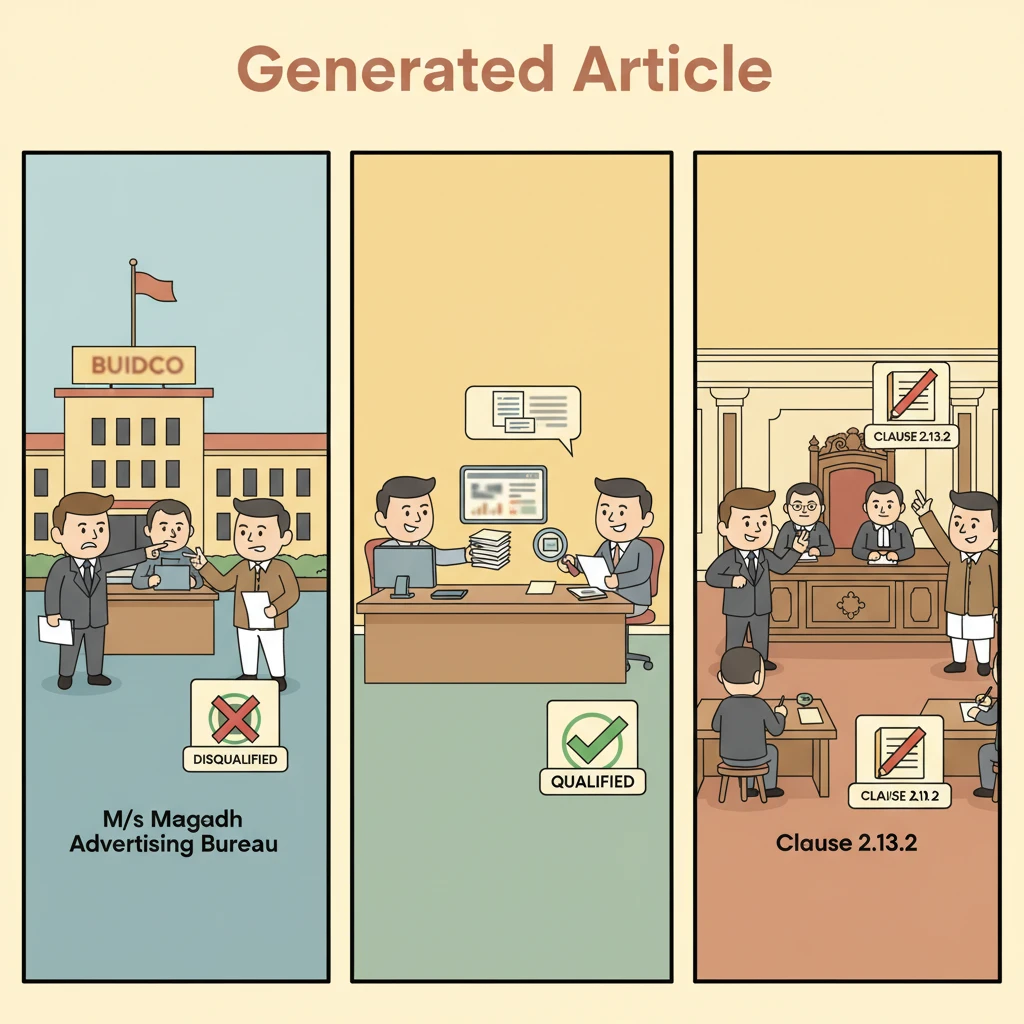
On 21.05.2024, the Technical Bid Evaluation Committee considered the technical bids. As per Annexure-P6, only three bidders, including the petitioner and the 8th respondent, were found technically qualified. The 7th respondent was disqualified for not submitting a certified payment certificate of experience, which was a mandatory condition under the Request for Proposal (RFP).
Later, the 7th respondent submitted a complaint dated 25.05.2024 to BUIDCO, asking for reconsideration of its disqualification. On 26.06.2024, the committee met again and, on the basis of that complaint and further verification, reversed its earlier decision and treated the 7th respondent as technically qualified.
BUIDCO then issued a Letter of Acceptance (LOA) in favour of the 7th respondent on 05.07.2024. An agreement with the 7th respondent was signed on 25.07.2024. During this time, the petitioner kept receiving e-mails and checking the official website, which continued to show the tender as “pending” even after the LOA date.
Feeling that the process lacked transparency, the petitioner approached the Patna High Court in Civil Writ Jurisdiction Case No. 11068 of 2024. During the case, the petitioner also filed I.A. No. 02 of 2024 to specifically challenge the LOA dated 05.07.2024 issued in favour of the 7th respondent.
What the Court Examined and Decided
The Patna High Court, speaking through the Hon’ble Chief Justice and concurred by Hon’ble Mr. Justice Partha Sarthy, closely examined the tender process followed by BUIDCO.
The main complaint of the petitioner was that the 7th respondent, once disqualified for not meeting an essential technical condition, was later quietly brought back into the competition without informing the originally qualified bidders. The petitioner said this was done in collusion with officials and in violation of the RFP.
The petitioner relied on Annexure-P6, the Technical Bid Evaluation Committee’s decision dated 21.05.2024, which clearly disqualified the 7th respondent for not submitting certified payment certificate of experience. The petitioner also produced Annexure-P8, a print-out of the Government of Bihar website, showing the subject tender as “pending” on 11.07.2024, despite the LOA already having been issued on 05.07.2024.
Further, the petitioner produced e-mails (Annexure-P9) received as late as 27.07.2024, stating that “evaluation cover-2 has been completed and the petitioner has qualified.” These communications suggested that, even when an agreement had already been signed with the 7th respondent on 25.07.2024, the system continued to tell the petitioner that its bid was still in play and that it had qualified.
The petitioner also relied on Clause 2.13.2 of the RFP, which clearly states that any alteration, modification, or extra information supplied after the bid due date must be disregarded unless specifically asked for by the authority. The petitioner argued that the 7th respondent was allowed to cure a fundamental defect after disqualification, without any formal request by the authority, and that this was not permissible under the RFP.
On the other side, BUIDCO’s senior counsel argued that there were no new documents furnished by the 7th respondent. According to BUIDCO, the 7th respondent’s complaint was only asking for reconsideration by attaching readable copies of documents that had in fact already been uploaded with the bid.
BUIDCO stated, through Annexure R7/C, that the hard copy in the file was illegible, which had initially led to the disqualification. After the complaint, the Project Director downloaded the soft copy from the e-procurement portal and matched it with the certificates attached to the complaint. The Project Director also claimed to have verified the authenticity of the certificate from the employer, Indian Oil Corporation Limited (IOCL), and found it genuine. On this basis, the committee decided on 26.06.2024 to treat the 7th respondent as technically qualified.
The 7th respondent’s counsel supported this version, saying that all required certificates were already in the uploaded tender, and that the objection merely highlighted what was already there. Hard copies were provided again, and once verified, the 7th respondent was rightly qualified.
Both BUIDCO and the 7th respondent also argued that the 7th respondent’s bid quoted a much higher amount than the petitioner’s, suggesting this was better for revenue generation. The 8th respondent submitted that if the 7th respondent’s qualification was struck down, the tender should naturally go to the second highest bidder, i.e., the 8th respondent.
Before judging these rival stands, the Court referred to the Supreme Court decision in Tata Motors Limited vs. The Brihan Mumbai Electric Supply & Transport Undertaking (BEST) and Others, reported in 2023 LiveLaw (SC) 467. That decision warns courts to be very careful in interfering with commercial tenders, and to do so only when arbitrariness, mala fide, bias or clear irrationality is evident. Courts are not to re-evaluate technical or commercial choices of the authorities.
Keeping that caution in mind, the Patna High Court then analysed the facts of this case.
First, the Court noted that only three bidders, including the petitioner and the 8th respondent, were found technically qualified on 21.05.2024, and the 7th respondent was expressly disqualified for want of a certified payment certificate of experience.
Second, the Court examined Annexure R7/C, the proceedings of 26.06.2024. It recorded that the Project Director informed the committee that the hard copy was illegible. After the complaint from the 7th respondent, the document was downloaded again from the e-proc portal, matched with the certificate attached to the complaint, and even verified for authenticity from IOCL. On that basis, the committee reversed its earlier decision.
The Court stressed that this entire exercise took place “behind the back” of the three originally qualified bidders. They were never informed that a previously disqualified competitor had been reintroduced into the race. The counter affidavit itself admitted that only three bidders had initially qualified and that the petitioner’s objection against the 8th respondent had been rejected. However, there was no explanation why the tender documents of the 7th respondent, said to contain all necessary certificates, were not properly scrutinised at the first evaluation.
Next, the Court looked at the LOA dated 05.07.2024 issued to the 7th respondent and the website print-out of 11.07.2024 showing the tender as “pending.” BUIDCO explained that the status is shown as pending till the agreement is executed, in case the highest bidder refuses to sign. However, when seen with the e-mails of 27.07.2024 telling the petitioner that its bid had been qualified in cover-2 evaluation, the Court found the situation suspicious.
BUIDCO tried to clarify via a supplementary counter affidavit that an automatic e-mail had been generated on 28.06.2024 when committee proceedings were uploaded. That e-mail only stated that the petitioner’s cover-1 (technical bid) had been qualified, which had already been decided on 21.05.2024. But the Court was disturbed that the re-qualification of the 7th respondent on 28.06.2024 was never directly informed to the already qualified bidders.
The Court then relied on Clause 2.13.2 of the RFP, which prohibits any change or addition to the bid documents after the last date, unless the authority expressly asks for it. The Court held that if the hard copy was illegible, it was for the authority to seek clarification from the bidder. If this was not done before disqualification, then later relying on documents supplied by the disqualified bidder raised serious concerns.
The Court described the first evaluation’s failure to notice the relevant certificates as “absolute laxity” in examination of tender documents. Even if the certificates were in fact present in the uploaded documents, once disqualification had happened, it was incumbent on the authority to call the qualified bidders and clearly inform them that the earlier disqualification was being reversed.
A public tender, the Court emphasised, must be conducted with transparency and fairness, particularly when it is competitive and when financial bids are opened only after technical qualification. Technical evaluation is the threshold stage, and any change at that stage must be openly and fairly communicated.
The Court found “gross and palpable infirmity” in the way BUIDCO accepted documents from a disqualified bidder after the fact, and then claimed those documents were anyway present earlier. This, coupled with the lack of communication to other bidders and the suspicious e-mail trail, made the procedure arbitrary, irrational and unfair.
The Court rejected the argument that a higher financial quote by the 7th respondent could save the process. Even if the government stands to gain more revenue, that cannot justify an arbitrary or biased process. Further, the Court pointed out that in a revenue-generating tender, if the authority finds the quotes unsatisfactory, it is always free not to accept them and go for a fresh tender.
In conclusion, the Court interfered with the LOA dated 05.07.2024 issued in favour of the 7th respondent. It allowed I.A. No. 02 of 2024, which had sought quashing of that LOA (issued as Memo No. 553 dated 05.07.2025, as described in the application).
However, the Court consciously did not declare that the 8th respondent should get the work. It left that decision to BUIDCO, noting that financial feasibility and other considerations may lead the authority either to award the work to a qualified bidder or to go for a re-tender.
The Court directed that if there is a re-tender, all bidders may participate, unless any are disqualified for fraud, concealment or false statements. Thus, the tender process must be redone or carried forward in a way that is transparent and fair to all concerned.
Why This Judgment Matters
This judgment is important for anyone who participates in government tenders in Bihar, especially those handled by BUIDCO and similar bodies. It shows that once a bidder is disqualified on technical grounds, the authority cannot quietly reverse that decision without informing the competing bidders.
The Court made it clear that transparency is as important as getting a higher financial offer. Authorities must follow their own tender conditions strictly, including clauses like 2.13.2 that stop bidders from adding or correcting documents after the last date, unless the authority itself seeks clarification.
For small and medium contractors or advertisers, this ruling offers assurance that the Patna High Court will step in when the tender process becomes arbitrary, irrational or appears biased. It also signals to government bodies that internal corrections or “re-considerations” of bids must be handled openly and in line with the tender rules.
Legal Issues and Answers
- Issue: Can a bidder, once disqualified for not meeting an essential technical condition, be later declared qualified on the basis of documents said to be already on record, without informing the other qualified bidders?
Answer: No. The Court held that such a reversal, carried out behind the back of other bidders and contrary to Clause 2.13.2 of the RFP, was arbitrary, irrational and unfair, and it vitiated the tender process. - Issue: Should courts interfere in commercial tenders where the authority claims higher revenue from the challenged decision?
Answer: Yes, but only where arbitrariness, mala fide, bias or irrationality is shown. Here, the Court found gross procedural infirmities and set aside the LOA despite the authority’s claim of higher revenue. - Issue: What is the proper course when the tender process is found tainted?
Answer: The Court set aside the LOA to the 7th respondent and left it to BUIDCO either to consider awarding the tender afresh in a lawful manner or to go for a re-tender, allowing all non-disqualified bidders to participate.
Cases Cited by the Court
- Tata Motors Limited vs. The Brihan Mumbai Electric Supply & Transport Undertaking (BEST) and Others, 2023 LiveLaw (SC) 467.
Case Details
Case Number: Civil Writ Jurisdiction Case No. 11068 of 2024
Case Title: Adam Media and Recreation Private Limited vs. The State of Bihar & Others
Citation: 2024 (4) PLJR 326
Court: High Court of Judicature at Patna
Coram: Hon’ble the Chief Justice K. Vinod Chandran and Hon’ble Mr. Justice Partha Sarthy
Date of Judgment: 17.09.2024
Advocates:
- For the petitioner: Mr. Avinash Shekhar, Advocate
- For the State and BUIDCO (official respondents): Mr. Lalit Kishore, Senior Standing Counsel; Mr. R.K. Priyadarshi, Advocate; Mr. Siddhartha Prasad, Advocate; Mr. Ayush Kumar, Advocate; Mr. Kanishka Shankar, Advocate
- For the 7th respondent: Mr. Siddhartha Prasad, Advocate
- For the 8th respondent: Mrs. Kalpana, Advocate (as recorded in the judgment)
Nature of the Case: Writ petition under civil writ jurisdiction challenging tender evaluation and Letter of Acceptance in a public procurement process.
Link to Full Judgment: Click here to read the complete judgment of the Patna High Court
If you found this explanation helpful and wish to stay informed about
how legal developments may affect your rights in Bihar,
you may consider following Samvida Law Associates for more updates.







