
Case Background
Two women were appointed as Panchayat Teachers under the Bihar Panchayat Primary Teacher (Appointment and Service Conditions) Rules, 2006. Their appointments were made against sanctioned vacant posts after selection, counselling and verification, as shown by their appointment letters.
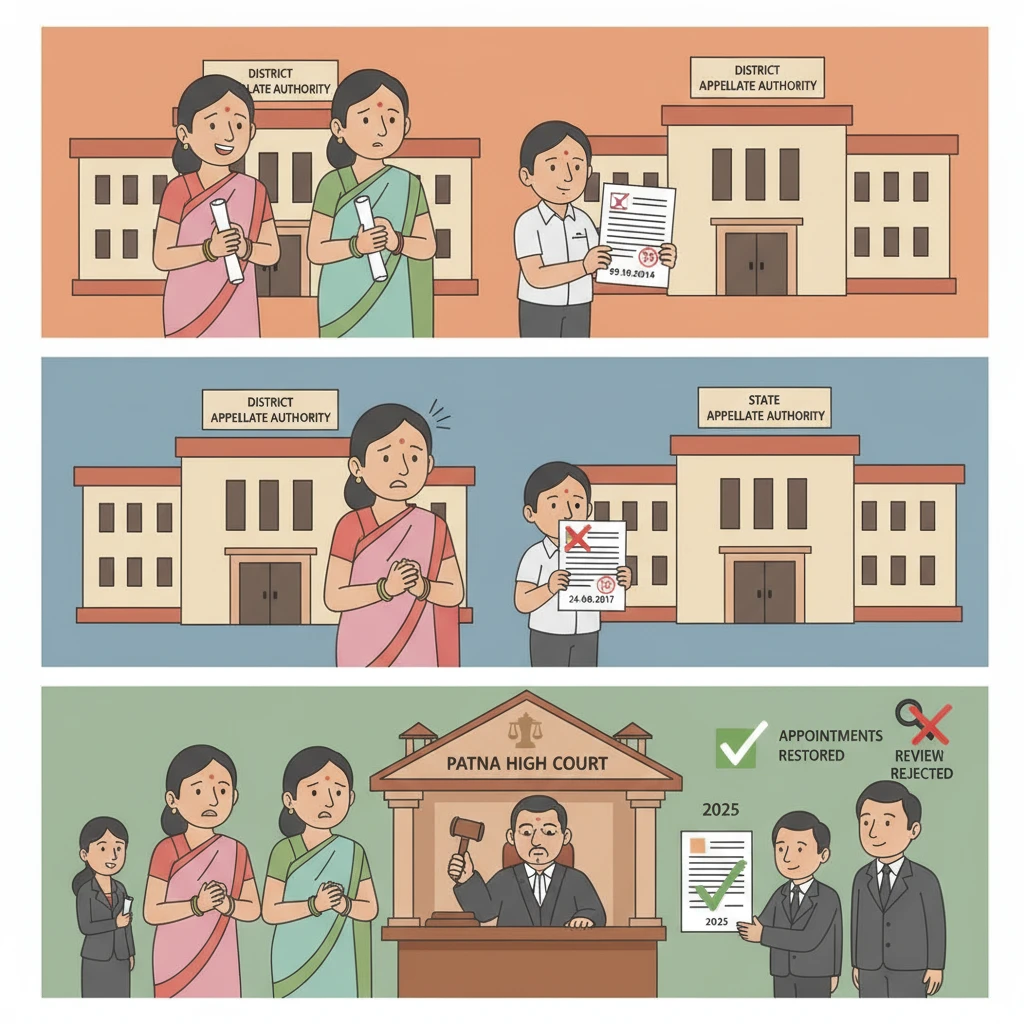
Later, a dispute arose about the legality of these appointments. The matter went before the District Teachers Employment Appellate Authority, Buxar. By order dated 09.10.2014, that Authority allowed the claim of the petitioners and directed that their joining be accepted in the schools where they had been appointed.
However, on 25.01.2016, the same District Appellate Authority reviewed and recalled its earlier order dated 09.10.2014, saying that the earlier order suffered from error. This second order went against the petitioners.
The petitioners filed an appeal before the State Teachers Employment Appellate Authority, Bihar. On 24.08.2017, the State Authority dismissed their appeal in Appeal No. 83 of 2017 and affirmed the order of the District Appellate Authority dated 25.01.2016.
Aggrieved by both these orders, the petitioners approached the Patna High Court in Civil Writ Jurisdiction Case No. 15887 of 2017. They also asked for directions to allow them to join as teachers and to grant all consequential benefits from the date of their appointment letters.
What the Court Examined and Decided
Hon’ble Mr. Justice Alok Kumar Sinha heard the matter. The core question was whether the District Teachers Employment Appellate Authority had any power in law to review or reopen its own final order of 09.10.2014 under the then applicable rules.
The petitioners’ counsel argued that once the District Appellate Authority had passed its final order in 2014, it became “functus officio”. This means its job in that case was over, and it had no legal power left to reopen or review that order. The petitioners pointed out that the Authority was created under the Bihar Panchayat Primary Teacher (Appointment and Service Conditions) Rules, 2006 and the Guidelines of 2008, and these did not give any power of review.
They stressed that the power of review is not automatic. It must come from a clear provision in a law or rule. Since there was no such provision in the 2006 Rules or 2008 Guidelines, the District Authority’s second order dated 25.01.2016 was without jurisdiction and void from the very beginning.
The petitioners also submitted that the State and its authorities were trying to justify this review by relying on later rules framed in 2020. Under the Rules of 2020, for the first time, an express power of review was given to the Appellate Authority. The petitioners argued that these 2020 Rules could not be used to support an order passed much earlier in 2016.
In their view, the very fact that the 2020 Rules specifically introduced a review power showed that such power did not exist earlier. Therefore, all actions based on the 2016 review order, including the State Appellate Authority’s 2017 order, should be struck down.
On the other hand, the State’s counsel defended the impugned orders. She argued that the Appellate Authorities were quasi-judicial bodies responsible for preventing illegal appointments from continuing. According to her, what the District Authority did was not exactly a “review”, but a necessary step to correct an illegality that had crept into the 2014 order.
She submitted that such authorities have incidental and ancillary powers to correct obvious mistakes and that these powers should be read broadly in matters involving public interest, such as appointment of teachers. The State urged that preventing illegal appointments was more important than sticking to technical objections about review power.
The Court framed four key issues: whether the District Appellate Authority had power to review its own final order under the 2006 Rules and 2008 Guidelines; whether the 2016 order was without jurisdiction; whether the later State Appellate Authority order of 2017 also stood vitiated; and whether the 2020 Rules could be applied retrospectively to validate these actions.
The Court first examined the 2006 Rules and 2008 Guidelines. It found that they set out the procedure for selection and appointment of teachers, regulated service conditions, and provided for appeals before the designated Appellate Authority in disputes relating to appointment.
However, the Rules and Guidelines did not contain any provision, either directly or by necessary implication, giving the Appellate Authority the power to review, recall, or reopen its own final orders. The Authority’s jurisdiction was limited to hearing and deciding appeals arising from appointment disputes. Once a final order was passed, that jurisdiction came to an end.
The Court relied on well-established Supreme Court case law on this point. In Patel Narshi Thakershi v. Pradyumansinghji Arjunsinghji, (1971) 3 SCC 844, the Supreme Court held that the power to review is not an inherent power and must be expressly or impliedly granted by statute. If there is no such provision, an authority cannot review its own order.
Similarly, in Dr. Kuntesh Gupta v. Management of Hindu Kanya Mahavidyalaya, (1987) 4 SCC 525, the Supreme Court confirmed that a quasi-judicial authority cannot review its own order unless the statute under which it works clearly gives that power.
The Court also referred to Kalabharati Advertising v. Hemant Vimalnath Narichania, (2010) 9 SCC 437. There, the Supreme Court summarised that in absence of an express statutory provision for review, entertaining a review application, even in the name of clarification or correction, is not permitted. Any such review order would be ultra vires, illegal and without jurisdiction.
Applying these principles, the Patna High Court held that after passing its final order on 09.10.2014, the District Teachers Employment Appellate Authority, Buxar became functus officio. It had no power to reopen or reconsider the matter in 2016.
The Court then examined the Rules of 2020. Rule 15 of those Rules specifically provides that the Appellate Authority shall have jurisdiction to review its own order and rectify any error. The Court viewed this as decisive. The very need to introduce an explicit review power in 2020 showed that no such power existed under the 2006 Rules and 2008 Guidelines.
The Court further held that the power of review is substantive in nature and cannot be applied retrospectively. Therefore, the 2020 Rules could not be used to validate the 2016 review order or later acts based on it.
On this reasoning, the Court concluded that the order dated 25.01.2016 passed in Appeal No. 04 of 2013 and the State Appellate Authority’s order dated 24.08.2017 in Appeal No. 83 of 2017 were both ex facie without jurisdiction. All four issues framed by the Court were answered in favour of the petitioners.
Once the Court found a complete lack of jurisdiction, it did not need to go into the merits of the original dispute about the appointments. It simply restored the position that existed under the earlier order of 09.10.2014 which had allowed the petitioners’ claims.
Accordingly, the Patna High Court set aside the impugned orders of 25.01.2016 and 24.08.2017. It directed the respondents to accept the joining of both petitioners as per the order dated 09.10.2014 of the District Teachers Employment Appellate Authority, Buxar.
The Court also ordered that, pursuant to their appointments, the petitioners must be given all consequential benefits they are legally entitled to from the date of issuance of their appointment letters. The respondents were given a specific time limit: they must complete this exercise within fifteen days from the date of the judgment.
With these directions, the writ petition was allowed. All pending interlocutory applications were disposed of, and there was no order as to costs.
Why This Judgment Matters
This judgment is important for teachers and other appointees whose jobs have been disturbed by later “reviews” or re-openings of final orders. The Patna High Court has clearly said that an appellate authority cannot, on its own, reopen a closed case unless the law clearly gives it that power.
For Panchayat Teachers appointed under the 2006 Rules and 2008 Guidelines, this ruling confirms that their rights cannot be disturbed by using a review power that did not legally exist at that time. It protects them from unexpected cancellations years after they have been selected.
The judgment also sends a message to government authorities that they must act strictly within the four corners of the statute. Good intentions or claims of “correcting illegality” cannot justify exercising powers that the law does not grant.
Finally, by directing reinstatement and full consequential benefits from the date of appointment letters, the Court shows that when an order is found to be without jurisdiction, affected employees should be restored to the position they would have held if the illegal action had not taken place.
Legal Issues and Answers
-
Issue: Did the District Teachers Employment Appellate Authority, Buxar, have power under the 2006 Rules and 2008 Guidelines to review, recall or reopen its own final order dated 09.10.2014?
Answer: No. The Rules and Guidelines did not give any express or implied power of review, so the Authority became functus officio after passing its final order. -
Issue: Was the order dated 25.01.2016 in Appeal No. 04 of 2013, and the State Appellate Authority’s order dated 24.08.2017 in Appeal No. 83 of 2017, without jurisdiction and liable to be set aside?
Answer: Yes. Both orders were passed without any statutory review power and are ex facie without jurisdiction; they were therefore quashed. -
Issue: Could the review power introduced later under the Rules of 2020 be applied retrospectively to validate the 2016 order?
Answer: No. The power of review is substantive and cannot operate retrospectively; the 2020 Rules cannot cure the earlier lack of jurisdiction.
Cases Cited by the Court
- Patel Narshi Thakershi v. Pradyumansinghji Arjunsinghji, (1971) 3 SCC 844.
- Dr. Kuntesh Gupta v. Management of Hindu Kanya Mahavidyalaya, (1987) 4 SCC 525.
- Kalabharati Advertising v. Hemant Vimalnath Narichania, (2010) 9 SCC 437.
Case Details
Case Number: Civil Writ Jurisdiction Case No. 15887 of 2017
Case Title: Kumari Bandana and another v. The State of Bihar and others
Coram: Hon’ble Mr. Justice Alok Kumar Sinha
Citation: 2026(1) PLJR 547
Date of Judgment: 23.12.2025
Advocates: Mr. Akash Chaturvedi, Advocate for the petitioners; Smt. B. Singh, SC-28, for the respondents.
Nature of the Case: Writ petition (civil) challenging orders of District Teachers Employment Appellate Authority, Buxar, and State Teachers Employment Appellate Authority, Bihar, relating to Panchayat Teacher appointments.
Link to Full Judgment: Click here to read the complete judgment on the Patna High Court website
If you found this explanation helpful and wish to stay informed about
how legal developments may affect your rights in Bihar,
you may consider following Samvida Law Associates for more updates.







