

Case Background
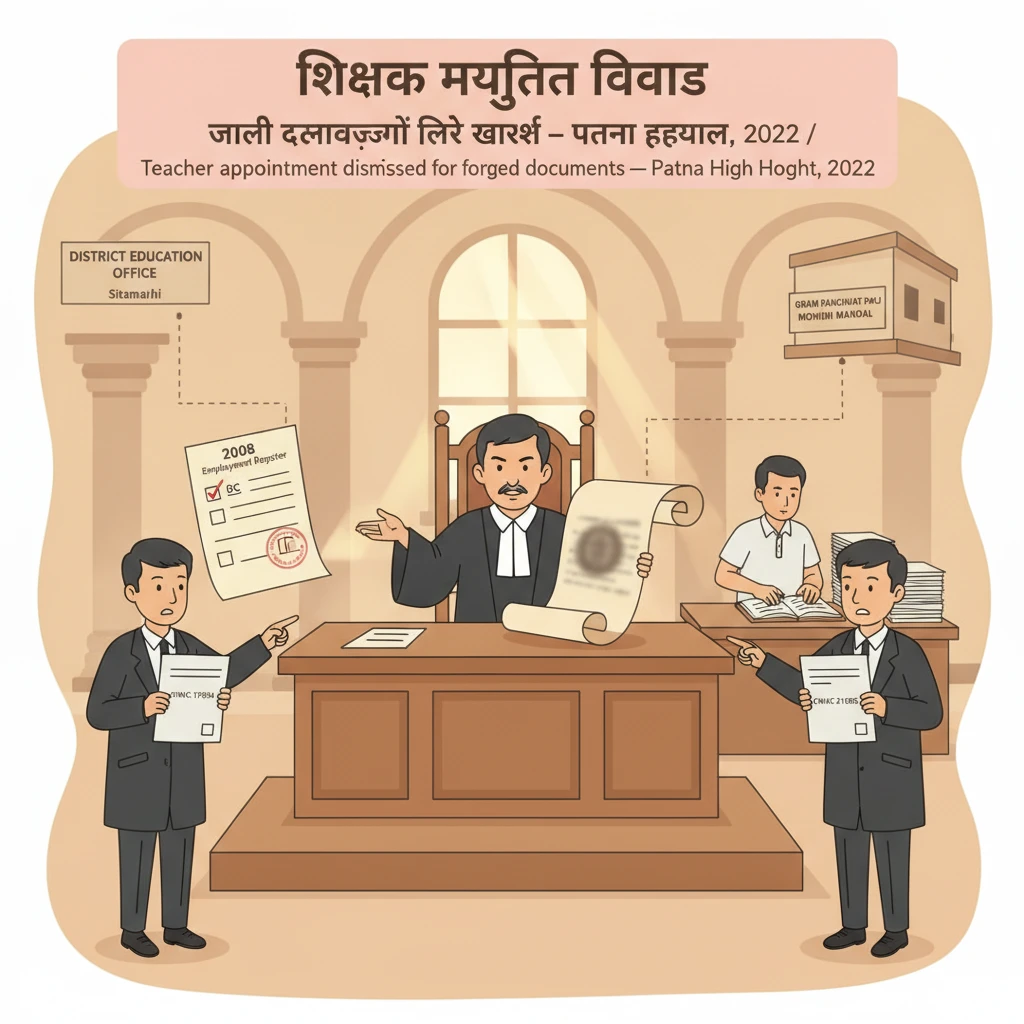
The dispute arose from recruitment to the post of teacher under Gram Panchayat Raj Mohini Mandal in Block Suppi, District Sitamarhi, Bihar.
Gopal Kumar filed Civil Writ Jurisdiction Case No. 17954 of 2019 before the Patna High Court. He challenged an order passed by the State Appellate Authority, Education Department, Bihar, Patna. That State Appellate Authority had reversed an earlier order of the District Appellate Authority, Sitamarhi.
The District Appellate Authority had earlier held that another candidate, Shankar Kumar (arrayed as respondent no. 10 in the first writ petition), had applied for the teacher post under the unreserved (general) category. Because of that, the District Appellate Authority ruled that Shankar Kumar could not later claim the benefit of being in the Backward Class (B.C.) category.
The State Appellate Authority took a different view. It set aside the District Appellate Authority’s decision and held that Shankar Kumar had applied under the reserved category and had mentioned in his form that he belonged to the B.C. category. This reversal by the State Appellate Authority was the main decision assailed in Gopal Kumar’s writ petition.
Separately, Shankar Kumar himself approached the Patna High Court through Civil Writ Jurisdiction Case No. 21685 of 2019. In this second writ petition, he was the petitioner and Gopal Kumar was arrayed as respondent no. 10. Both writ matters related to the same teacher recruitment and were heard together.
What the Court Examined and Decided
The single judge, Hon’ble Mr. Justice Sanjeev Prakash Sharma, heard both writ petitions together on 28 April 2022.
The Court noted at the outset that the case was being taken up from the “defect side”. The petitioners were directed to file original petitions with attested affidavits and to remove registry defects within two weeks. However, the Court proceeded to examine the merits of the dispute between the two rival candidates.
The central question before the Court was whether Shankar Kumar had originally applied as an unreserved category candidate or as a Backward Class candidate. The answer to this question would determine the validity of the State Appellate Authority’s decision that favoured him and reversed the earlier District Appellate Authority order.
Learned counsel for Gopal Kumar (the petitioner in the first case) relied on an enquiry report prepared by the Government. This enquiry had been conducted into the recruitment records.
According to the Court’s summary of the enquiry report, the “true copy of the original application form” of Shankar Kumar showed that he had applied under the general category. The enquiry also recorded that, in the certified true copy of the employment register (pages 1 to 51), Shankar Kumar’s name appeared at serial no. 209 and he was mentioned as coming under the unreserved category.
To support this stand, Gopal Kumar filed Annexure-2, stated to be a copy of Shankar Kumar’s application form. In this form, there was a tick mark in the box relating to the unreserved category. On this basis, Gopal Kumar argued that Shankar Kumar could not later be treated as a B.C. category candidate for the same recruitment.
In response, learned counsel for Shankar Kumar (respondent no. 10 in the first case and petitioner in the second case) pointed to different documents.
He relied on a counter affidavit and a document supplied to Shankar Kumar under the Right to Information Act relating to the employment register of 2008. In that employment register, Shankar Kumar had been described as belonging to a reserved category. Thus, according to him, the official register itself showed that he was treated as a reserved category candidate.
Counsel for Shankar Kumar also referred to earlier litigation between these parties. That earlier matter had been registered as CWJC No. 21409 of 2011 before the Patna High Court.
In that earlier writ petition, Gopal Kumar (the present petitioner) had filed a reply to a counter affidavit. In that reply, he had taken a stand that Shankar Kumar (who was respondent no. 9 in that case) had not submitted his caste certificate.
Along with the reply to the counter affidavit in the earlier case, an application form, purportedly belonging to Shankar Kumar, had been annexed as Annexure-14. In that application form, Shankar Kumar was shown as belonging to the B.C. category. The Court noted that in that form there were two tick marks against the boxes relating to B.C. category.
The Patna High Court carefully compared these competing documents. It observed that the format of the application form filed as Annexure-2 in the present proceedings and the format of the application form filed as Annexure-14 in the earlier writ petition were different.
The Court pointed out that even the columns in the two forms were different, though both forms were said to belong to the same person, Shankar Kumar, and both concerned the same recruitment in Gram Panchayat Raj Mohini Mandal, Block Suppi, District Sitamarhi.
Similarly, the Court noticed contradictions in the recruitment register entries.
The registration document placed on record by Shankar Kumar showed his name at serial no. 209, describing him as belonging to a reserved category. However, the Government enquiry report stated that Shankar Kumar’s name at serial no. 209 in the employment register was recorded under the unreserved category.
These conflicting versions — two different application forms for the same candidate and contradictory records in the employment register — led the Court to a serious conclusion.
The Court held that, in these circumstances, both Gopal Kumar and Shankar Kumar appeared to have attempted to place forged documents before the Court in order to support their respective claims.
The judge remarked that both candidates had applied for the post of teacher, which the Court described as a “sacred profession”. Persons aspiring to such posts could not be expected to indulge in filing forged documents.
Because of their conduct, the Court held that neither of them deserved to be considered for the post of teacher. Their behaviour was described as “unscrupulous”.
The Court further observed that such conduct was sufficient to oust both candidates from participation and consideration as a teacher in any educational field. In other words, it was not limited to this particular recruitment cycle or school but affected their eligibility more broadly within the teaching sector.
Despite reaching such a strong finding about the use of forged documents, the Court expressly recorded that it was refraining from initiating criminal proceedings against them.
Instead, the Court took a strong administrative and financial approach. It directed the State Government not to consider either Gopal Kumar or Shankar Kumar for the post of teacher. It further directed that if any one of them was already working on any teaching post, he should be “releaved” from that post.
Finally, both writ petitions — CWJC No. 17954 of 2019 and CWJC No. 21685 of 2019 — were dismissed.
The Court imposed costs of Rs. 50,000 (fifty thousand) each on Gopal Kumar and on Shankar Kumar. The amount was directed to be deposited with the Bihar State Legal Services Authority. The Court also clarified that the amount would be recoverable under Public Demand Recovery (PDR) proceedings in the event of non-payment.
Thus, the Patna High Court not only rejected the challenges to the appellate orders but also penalised both rival candidates for their alleged use of forged documents and barred them from future teacher appointments.
Why This Judgment Matters
This judgment sends a clear warning to candidates involved in teacher recruitment in Bihar and elsewhere.
First, the Court treated teaching as a “sacred profession”. Candidates who play with documents, categories, or certificates to gain advantage in recruitment run the risk of being completely disqualified from the profession.
Second, the Patna High Court did not favour either side simply because the other might have been wrong. When both sides relied on suspicious or inconsistent documents, the Court refused to grant relief to anyone.
Third, instead of a simple rejection, the Court imposed heavy monetary costs and directed that the candidates should not be considered for any teaching post, and should be removed if already appointed. This emphasises that misuse of reservation categories and forged documents has serious, long-term consequences.
For ordinary readers and job seekers, this judgment underlines the importance of filing genuine and consistent documents in recruitment processes, especially in government jobs and in sectors like education where trust and integrity are essential.
Legal Issues and Answers
- Issue: Whether Shankar Kumar had applied for the teacher post under the unreserved category or the Backward Class reserved category, and whether the State Appellate Authority’s order in his favour could stand.
Answer: The Court found conflicting and apparently forged documents from both sides, making it unsafe to accept either version. Instead of upholding either appellate order, the Court dismissed both writ petitions and barred both candidates from teacher appointments. - Issue: How should the Court respond when rival candidates in public employment place forged or doubtful documents before it?
Answer: The Court held that such conduct disqualifies the candidates from the teaching profession. It directed the State not to consider either for teacher posts, ordered removal if already appointed, and imposed costs recoverable as public demand.
Cases Cited by the Court
- The judgment text does not mention or rely on any prior case law. No earlier decisions have been cited.
Case Details
Case Numbers: Civil Writ Jurisdiction Case No. 17954 of 2019; Civil Writ Jurisdiction Case No. 21685 of 2019
Case Titles: Gopal Kumar v. The State of Bihar & Ors; Shankar Kumar v. The State of Bihar & Ors
Citation: 2022(3) PLJR 106
Court and Bench: High Court of Judicature at Patna; Hon’ble Mr. Justice Sanjeev Prakash Sharma
Date of Judgment: 28-04-2022
Coram: Hon’ble Mr. Justice Sanjeev Prakash Sharma
Advocates (CWJC No. 17954 of 2019): For the petitioner: Mr. Rajeev Kumar Singh, Advocate. For the State: Mr. Ram Vinay Prasad Sinha, AC to GA 12. For respondent no. 10: Mr. Sharda Nand Mishra, Advocate.
Advocates (CWJC No. 21685 of 2019): For the petitioner: Mr. Sharda Nand Mishra, Advocate; Mr. Harish Chandra Patel, Advocate. For the respondents: Mr. Prabhakar Jha, GP 27; Mr. Umesh Narayan Dubey, AC to GP 27.
Nature of the Case: Writ petitions challenging and arising out of appellate orders in teacher recruitment proceedings, concerning reservation category status and alleged forged documents.
Link to Judgment: Click here to read the full judgment of the Patna High Court
If you found this explanation helpful and wish to stay informed about
how legal developments may affect your rights in Bihar,
you may consider following Samvida Law Associates for more updates.







