
Case Background
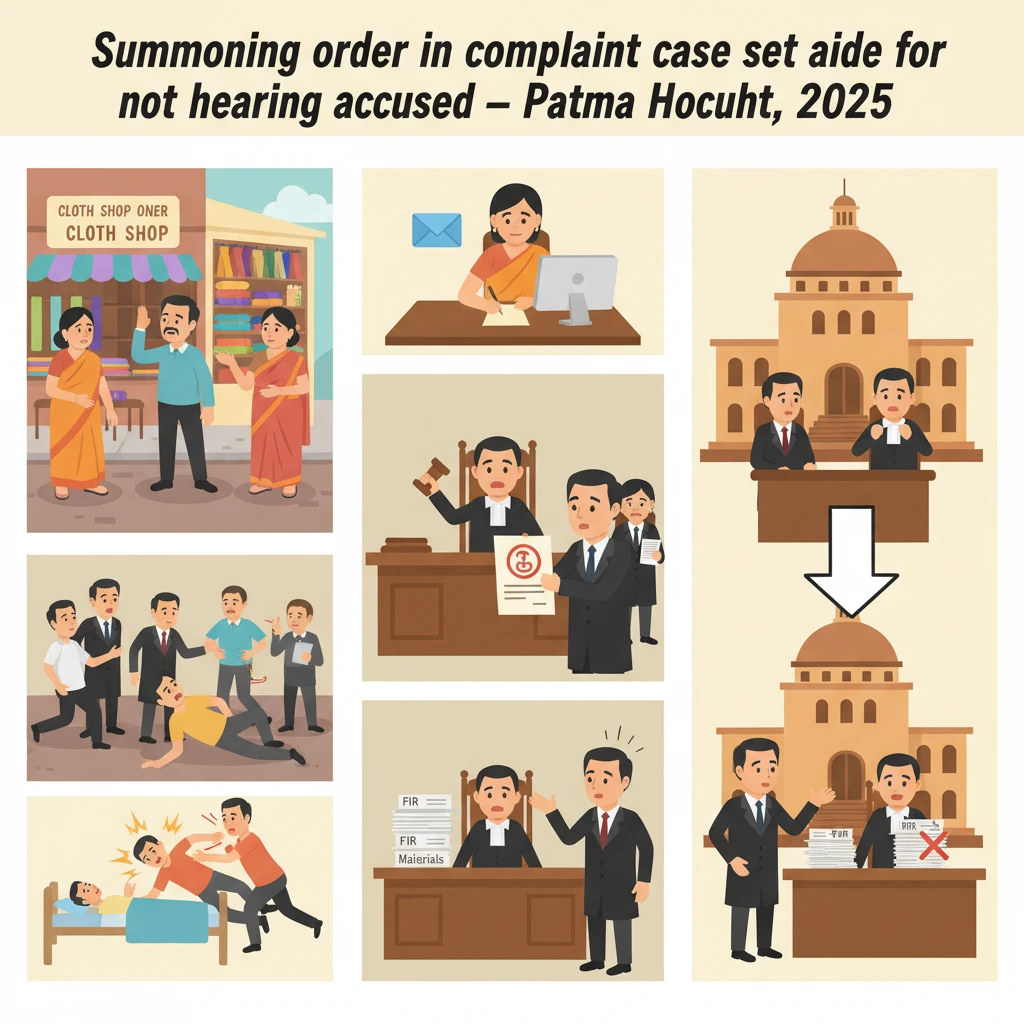
This case arose from a dispute between a tailor and a cloth shop owner in Kishanganj, Bihar. The complainant is the mother of the tailor, who is stated to be running a tailoring shop on the footpath at Nemchand Road.
According to the complaint, the tailor had earlier business dealings with the petitioner’s cloth shop. An amount of Rs. 4,000/- was allegedly due. On 22.02.2025, after finishing some stitching work, a dispute allegedly broke out over payment and settlement of accounts.
In the evening, the petitioner is said to have abused the complainant’s son. Later, at his shop, the petitioner allegedly raised a fresh demand of Rs. 5,000/- on the basis of “incorrect calculations”. When the tailor protested, the petitioner is alleged to have instigated his staff to assault him.
The complaint further says that the petitioner called the owner of Raymonds Showroom and a Councillor, Manish Jalan. They allegedly came with several staff members and assaulted the complainant’s son, causing injuries. One well-wisher, Bipul Aggarwal, who tried to mediate, was also allegedly beaten.
The complainant’s son reportedly escaped and received treatment at Kishanganj Hospital. Out of fear, the complainant did not go to the police the same day. On 23.02.2025, she lodged a written complaint and also emailed senior police officials. She alleged that no action was taken on her complaint.
Later, she filed Complaint Case No. 130C/2025 (Ladli Khatoon v Manoj Dugar & Anr.) before the Judicial Magistrate First Class-cum-Civil Judge (Junior Division)-II, Kishanganj. On 27.08.2025, the Magistrate took cognizance and passed a summoning order against the petitioner for offences under Sections 126(2), 115(2), 318(4), 352 read with Section 3(5) of the Bharatiya Nyaya Sanhita, 2023.
Meanwhile, the petitioner had already lodged Kishanganj P.S. Case No. 99 of 2025 against the complainant under various sections of the Bharatiya Nyaya Sanhita. On 21.07.2025, he filed an application before the Magistrate informing about this earlier police case and submitted materials in support.
Feeling aggrieved by the summoning order dated 27.08.2025, the petitioner approached the Patna High Court under Section 528 of the Bharatiya Nagarik Suraksha Sanhita, 2023 (BNSS), seeking quashing of the order and all proceedings in Complaint Case No. 130C/2025.
What the Court Examined and Decided
The Patna High Court, through Hon’ble Mr. Justice Purnendu Singh, heard learned counsel for the petitioner and the learned Additional Public Prosecutor (APP) for the State of Bihar.
The petitioner’s side argued that the allegations in the complaint were false and concocted. According to him, the complaint was filed only to harass him and to counter the earlier FIR, Kishanganj P.S. Case No. 99 of 2025, which he had lodged against the complainant. He also relied on the application dated 21.07.2025 and materials placed before the Magistrate to show that there was a prior police case and that the Magistrate had failed to consider his submissions.
On the other hand, the learned APP for the State supported the order of the Magistrate. He submitted that there was no infirmity in the cognizance order dated 27.08.2025 passed in Complaint Case No. 130C/2025, and therefore no interference was required by the High Court.
The High Court then turned to the legal framework under the new criminal laws that came into force on 01.07.2024. It noted that the Bharatiya Nyaya Sanhita, 2023 (BNS), the Bharatiya Nagarik Suraksha Sanhita, 2023 (BNSS), and the Bharatiya Sakshya Adhiniyam, 2023 had replaced the Indian Penal Code, the Code of Criminal Procedure (CrPC), and the Indian Evidence Act respectively.
The Court explained that under the old CrPC, if the police refused to register an FIR, a person could approach a Magistrate under Section 190 CrPC seeking a direction to the police to investigate under Section 156(1). If the Magistrate found it unjust to simply send the complaint to the police, but still found that a cognizable offence was disclosed, he would proceed under Section 200 CrPC.
Under Section 200 CrPC, the Magistrate had to examine the complainant and witnesses on oath before taking cognizance. At that stage, the accused had no right to participate. Only after the Magistrate found sufficient grounds and issued process under Section 204 CrPC did the accused get a right to appear and contest.
The Court cited the Supreme Court decision in Chandra Deo Singh v. Prokash Chandra Bose & Anr., 1963 SCC OnLine SC 4. There, the Apex Court had held that during the Section 200 stage, since the question is whether the accused should at all be called, the accused has no right to take part in the proceedings and the Magistrate cannot permit him to do so. The Magistrate can only look at the complaint and the statements on oath made by the complainant and his witnesses.
The High Court further referred to A.R. Antulay v. Ramdas Sriniwas Nayak, 1984 2 SCC 500, where the Supreme Court described the procedure in private complaint cases. It clarified that when a private complaint is filed, the complainant must be examined on oath (except when the complainant is a public servant). After examining the complainant and any witnesses, the Court decides judicially whether there is a case for issuing process. Issuing process means taking cognizance and calling the accused to appear.
The Patna High Court also noted that a similar view had been taken recently by the Supreme Court in Sarla Gupta v. Directorate of Enforcement, reported in 2025 INSC 645, while interpreting Sections 200 to 204 CrPC.
The High Court then addressed the short question in this case under Section 528 BNSS: whether the Magistrate was required to consider the application filed by the petitioner pursuant to the notice issued to him under Section 223(1) BNSS.
Section 223 BNSS, which has replaced Section 200 CrPC, was reproduced in the judgment. It states that a Magistrate taking cognizance on a complaint shall examine the complainant and witnesses on oath and record their statements. Importantly, the first proviso says that “no cognizance of an offence shall be taken by the Magistrate without giving the accused an opportunity of being heard.”
The Court highlighted that this is a major change from the old law. Under Section 200 CrPC, the accused had no role before process was issued. Under Section 223(1) BNSS, the accused must now be given an opportunity to be heard at the preliminary stage, before cognizance is taken.
The Court explained that Section 223 BNSS is built on the old Section 200 structure but adds new safeguards for the accused. While it still requires examination of the complainant and witnesses before cognizance, it now clearly insists that the accused be heard before the Magistrate decides whether to take cognizance.
The Court then referred to the Supreme Court decision in D. Lakshminarayana Reddy v. V. Narayana Reddy, AIR 1976 SC 1672, to explain what “taking cognizance” means. When a Magistrate receives a complaint and applies his mind to proceed under Section 200 and the following sections (now corresponding to Section 210 BNSS and Chapter XVI of BNSS), he is said to have taken cognizance. If he only orders investigation under Section 156(3) or issues a search warrant, he is not said to have taken cognizance.
With this background, the Patna High Court examined the way the Magistrate had acted in Complaint Case No. 130C/2025. The Court found that the Magistrate had passed the summoning order dated 27.08.2025 “in a very mechanical manner” without exercising jurisdiction in the way required under Sections 223 and 210 BNSS.
The record showed that the petitioner had filed an application dated 21.07.2025 before the Magistrate. In that application, he had informed the Court that before the present complaint, he had already lodged Kishanganj P.S. Case No. 99 of 2025 against the complainant under various sections of BNS, and he had produced certain materials in support.
The High Court noted that the materials produced by the petitioner before the Magistrate found no reference in the Magistrate’s order. There was nothing to show that the Magistrate had considered the petitioner’s application or given him a meaningful hearing as required by Section 223(1) BNSS.
In the High Court’s view, this failure to follow the BNSS procedure, especially the mandatory opportunity of hearing to the accused before cognizance, made the summoning order unsustainable.
Accordingly, the Patna High Court quashed and set aside the order dated 27.08.2025 in Complaint Case No. 130C/2025. The Court was careful to state that it had not gone into the merits of the complaint or its contents. It confined itself only to the procedural irregularity and disposed of the quashing application on that basis.
Why This Judgment Matters
This judgment is important for anyone facing a private criminal complaint under the new BNSS system, especially in Bihar.
The Patna High Court has clearly stated that under Section 223(1) BNSS, a Magistrate cannot take cognizance of a complaint and summon the accused without first giving the accused an opportunity to be heard. This is a new right which did not exist under the old CrPC.
For accused persons, this means they can now present their side at an early stage, even before the court decides to formally start criminal proceedings against them. For complainants, it means they must be prepared that the person they are accusing will get to speak or submit materials before cognizance is taken.
The judgment also warns Magistrates that they must carefully follow the new BNSS procedure and cannot act mechanically. If they ignore applications or materials filed by the proposed accused at the pre-cognizance stage, their orders can be set aside.
Legal Issues and Answers
-
Issue: Whether, under Section 223(1) of the BNSS, the Magistrate was required to give the accused an opportunity of being heard and consider his application before taking cognizance on a private complaint.
Answer: Yes. The High Court held that Section 223(1) BNSS mandates an opportunity of hearing to the accused at the preliminary stage and found that the Magistrate had not followed this requirement. -
Issue: Whether the summoning order dated 27.08.2025 in Complaint Case No. 130C/2025 was sustainable when passed without reference to the petitioner’s application and materials.
Answer: No. The High Court held that the Magistrate had acted mechanically and without exercising jurisdiction in the manner prescribed under Sections 223 and 210 BNSS, and therefore quashed the summoning order.
Cases Cited by the Court
- Chandra Deo Singh v. Prokash Chandra Bose & Anr., 1963 SCC OnLine SC 4.
- A.R. Antulay v. Ramdas Sriniwas Nayak, 1984 2 SCC 500.
- Sarla Gupta v. Directorate of Enforcement, 2025 INSC 645.
- D. Lakshminarayana Reddy v. V. Narayana Reddy, AIR 1976 SC 1672.
Case Details
Case Number: Criminal Miscellaneous No. 79857 of 2025; arising out of Complaint Case No. 130C/2025; P.S. Case No. 130 of 2025, Kishanganj.
Case Title: Manoj Kumar Dugar v. The State of Bihar & Anr.
Coram: Hon’ble Mr. Justice Purnendu Singh.
Date of Judgment: 15.12.2025.
Citation: 2026(1) PLJR 525.
Advocates: Mr. Ravi Ranjan, Advocate for the petitioner; Mr. Ajit Kumar, APP for the State/opposite party.
Nature of the Case: Petition under Section 528 of the Bharatiya Nagarik Suraksha Sanhita, 2023, seeking quashing of summoning order and consequential proceedings in a private complaint case.
Link to Judgment: View official Patna High Court judgment
If you found this explanation helpful and wish to stay informed about
how legal developments may affect your rights in Bihar,
you may consider following Samvida Law Associates for more updates.







