

Case Background
This case concerns a group of Labour Enforcement Officers from the Labour Resources Department, Government of Bihar. Most of them had already retired from government service, while one petitioner was still in service at the time of the case.
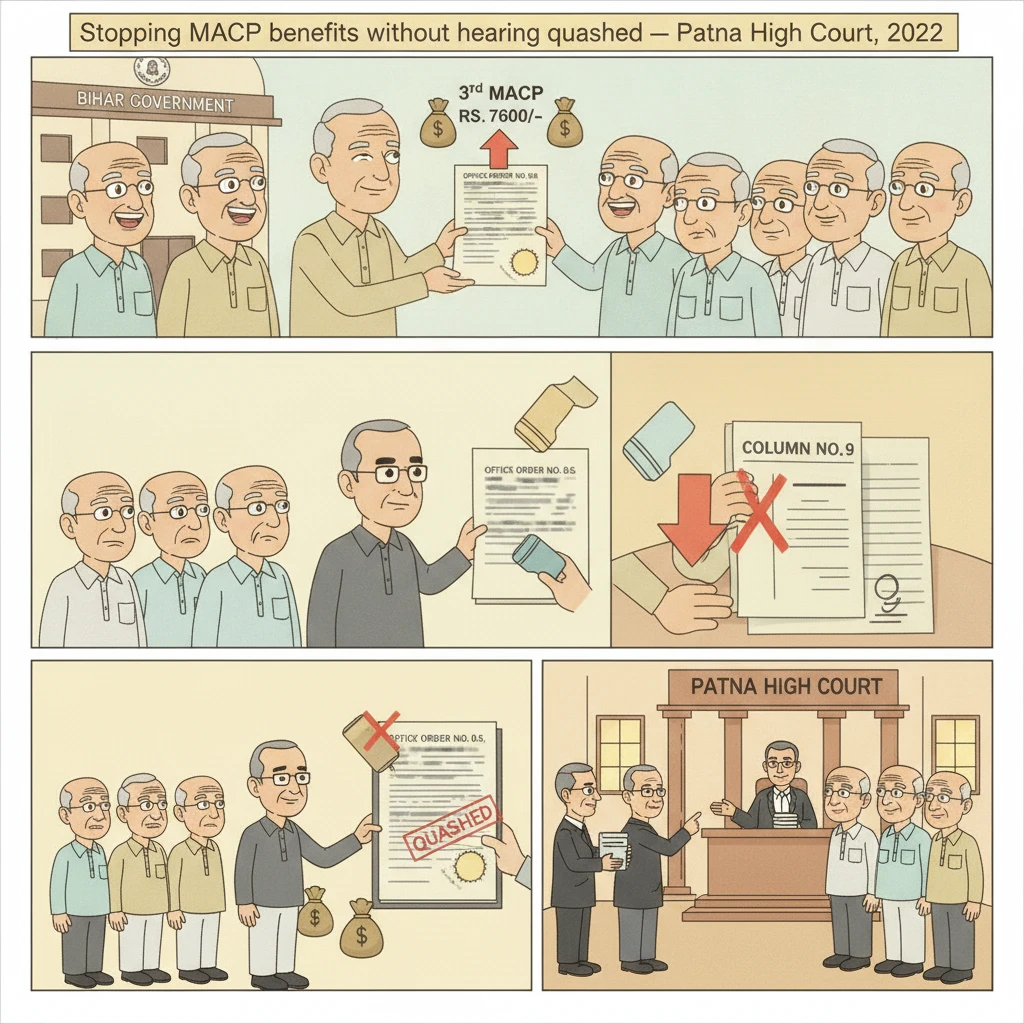
On 11.12.2017, the department granted them the benefit of the 3rd Modified Assured Career Progression (MACP). This meant that an entry was made in Column No. 9 of their service records, and they began drawing a higher pay scale from that date.
Later, on 16.02.2018, the department stalled this grant of MACP. The entry in Column No. 9 related to MACP was deleted by office order no. 05 read with memo no. 5/R.L.-40-40/2011 Sra.San. 939 Patna dated 16.02.2018. As a result, their pay was reduced and they were treated as not entitled to the earlier financial upgradation.
Subsequently, on 26.06.2018, a Screening Committee met and, under item B of its proceedings, refused to approve the 3rd MACP with revised grade pay of Rs. 7600/- for these petitioners. The ground was that their confidential remarks were allegedly not up to the standard/criteria laid down by the General Administration Department, Government of Bihar, under letter no. 929 dated 30.03.2011.
The petitioners approached the Patna High Court in Civil Writ Jurisdiction Case No. 1882 of 2021. They challenged the stopping of their MACP benefits and the Screening Committee’s decision, and they sought directions for restoration of MACP, revision of pay and pension, and payment of arrears with interest.
What the Court Examined and Decided
The Patna High Court, through Hon’ble Mr. Justice P. B. Bajanthri, heard the matter and recorded the reliefs sought by the petitioners. They asked for quashing of office order no. 05 dated 16.02.2018, which stalled the earlier MACP order dated 11.12.2017, and also for quashing the relevant part of the Screening Committee proceedings dated 26.06.2018 that denied them the 3rd MACP.
The petitioners further prayed for writs of mandamus directing the State to implement its own earlier order granting 3rd MACP, to fix their pay accordingly, to pay arrears of salary and other benefits, to revise their pension based on the higher pay, and to pay all pensionary benefits along with interest at 18% per annum. They also requested any other appropriate relief.
The starting point for the Court’s analysis was the undisputed fact that the petitioners had actually been granted the MACP benefit on 11.12.2017. An entry to this effect was made in Column No. 9 of their records. In plain terms, from that date they were drawing a higher pay scale based on the 3rd MACP.
However, on 16.02.2018, the department stalled the grant of MACP and deleted the entry in Column No. 9. This act of deletion meant that the higher pay they had been receiving was effectively taken away. The Court noted that such a step clearly had “civil consequences” because it reduced their pay. In service law, a civil consequence includes any order that adversely affects a person’s rights, benefits, pay, or status.
Once the Court recognized that the petitioners’ pay had been reduced by administrative action, it emphasised the principle of natural justice, especially the rule of “Audi Alteram Partem”. This Latin phrase means “hear the other side”. It is a fundamental rule that before any authority passes an order affecting someone’s rights or benefits, that person must be given notice and a fair chance to be heard.
The Court observed that if any order leads to civil consequences and affects a person’s rights, the person is entitled to notice before such an order is passed. This principle had been repeatedly upheld by the Supreme Court (“Apex Court from time to time”), and the High Court treated it as binding.
The State’s counsel sought to justify the deletion of the MACP entry by referring to the Screening Committee’s decision. The argument was that, when the Screening Committee examined the matter, it concluded that the petitioners did not fulfil the required criteria for 3rd MACP. In particular, the petitioners were said to have certain adverse remarks in their confidential records, and because of those remarks they were treated as not eligible for the higher grade pay.
The petitioners’ counsel strongly contested this justification. He argued that any adverse remarks against the petitioners had never been communicated to them. In other words, if there were negative entries in their confidential records, they had not been informed, nor given a chance to challenge or explain those remarks. The counsel submitted that uncommunicated adverse remarks could not legally be used to deny them service benefits such as MACP.
The Court did not directly adjudicate on whether the adverse remarks existed or whether they met the criteria prescribed under letter no. 929 dated 30.03.2011. Instead, it focused on the procedural fairness required before such remarks could be used to deny MACP.
The Court held that when the Screening Committee or competent authority considers alleged adverse remarks while deciding the entitlement of an employee to MACP, certain minimum safeguards are mandatory.
First, the Screening Committee or authority should issue a show cause notice to the concerned employees. This notice should clearly inform them that there are adverse remarks in their record and that, because of those remarks, the department is proposing to deny them MACP.
Secondly, after issuing such a notice, the authority must give the employees an opportunity to submit their explanation. The employees must be able to show how the alleged adverse remarks are incorrect, outdated, or otherwise should not be used against them. Without giving this opportunity, the authority cannot fairly rely on those remarks.
The Court stressed that, in the absence of such an opportunity of hearing, any adverse order is impermissible. The denial of MACP purely on the basis of uncommunicated adverse remarks, without show cause and without hearing, was thus contrary to the principles of natural justice.
On this reasoning, the Court concluded that the petitioners had made out a clear case for interference. The two key orders — the order dated 16.02.2018 that stalled and deleted the MACP entry, and the part of the Screening Committee proceedings dated 26.06.2018 that denied 3rd MACP to the petitioners — were both held to be unsustainable.
Accordingly, the Court set aside the orders dated 16.02.2018 and 26.06.2018.
At the same time, the Court did not grant an automatic final declaration that the petitioners were entitled to 3rd MACP. Instead, it gave liberty to the concerned respondent to proceed in accordance with law. The Court spelt out what “in accordance with law” meant in this context.
The department is free to re-examine the petitioners’ entitlement to MACP. However, before taking any adverse view, it must issue a detailed show cause notice to the petitioners explaining why they are considered not entitled to MACP, even though it was earlier granted to them.
After the petitioners submit their explanations to such notices, the competent authority must pass a “speaking order”. A speaking order is a reasoned written order that clearly sets out the facts, the relevant rules, the contentions of the parties, and the reasons for the final decision. The authority must clearly state whether each petitioner is entitled to MACP or not, and why.
Thus, the Court’s decision restored procedural fairness to the process without pre-judging the final outcome on eligibility. The department can still deny MACP if, after following due process, it finds valid reasons. But it cannot do so behind the employees’ backs or on the basis of uncommunicated adverse remarks.
In addition, the Court allowed the writ petition with costs. It directed that costs of Rs. 5,000/- be paid by the concerned department and remitted to the Patna High Court Legal Services Committee within eight weeks.
Why This Judgment Matters
This judgment is important for government employees, especially those nearing retirement or already retired, who rely on financial upgradations like MACP for a stable income. It makes clear that once a benefit like MACP is granted, the department cannot quietly withdraw it without hearing the affected employees.
For employees, this decision reinforces that pay reductions and denial of promotions or financial upgradations are not just internal departmental matters. They are decisions with serious civil consequences, and basic fairness requires prior notice and a chance to respond.
For government departments, the judgment is a reminder that Screening Committees and administrative decisions must strictly follow natural justice. If adverse remarks or confidential entries are to be used to deny benefits, those remarks must be properly communicated and the employee must be given an opportunity to contest them before any adverse decision is finalised.
The Patna High Court’s ruling thus strengthens transparency and accountability in service matters and provides a clear path for employees to challenge arbitrary withdrawal of MACP or similar benefits.
Legal Issues and Answers
Issue: Can the department stall and withdraw the 3rd MACP benefit already granted to employees, and reduce their pay, without giving them prior notice or an opportunity of hearing?
Answer: No. Since withdrawal of MACP and deletion of the related entry in service records leads to civil consequences and reduces pay, the principle of natural justice (Audi Alteram Partem) requires that the employees be given notice and an opportunity to explain before any adverse order is passed.
Issue: Can uncommunicated adverse remarks in the confidential records be relied upon by a Screening Committee to deny MACP benefits?
Answer: Not without first giving the employees a show cause notice about such remarks and an opportunity to submit an explanation. Using alleged adverse remarks without communication and hearing is impermissible.
Issue: What directions did the Court give for future action by the department regarding MACP entitlement?
Answer: The Court set aside the orders dated 16.02.2018 and 26.06.2018, gave liberty to the department to issue detailed show cause notices explaining why MACP is proposed to be denied, and directed that after considering the petitioners’ explanations, a speaking order must be passed on their entitlement to MACP.
Cases Cited by the Court
- The judgment refers generally to decisions of the Supreme Court (“Apex Court from time to time”) on the principle of natural justice, but does not cite any specific case by name or citation.
Case Details
Case Number: Civil Writ Jurisdiction Case No. 1882 of 2021
Case Title: Chandra Shekhar Prasad Sinha & Ors. v. The State of Bihar & Ors.
Court: High Court of Judicature at Patna
Coram: Hon’ble Mr. Justice P. B. Bajanthri
Date of Judgment: 31.03.2022
Citation: 2022 (2) PLJR 411
Advocates:
For the petitioners: Mr. Arun Kumar Sinha, Advocate
For the respondents (State of Bihar): Mr. Ajay Kumar Rastogi, AAG-10
Parties:
Petitioners: Fourteen Labour Enforcement Officers of the Labour Resources Department, Government of Bihar (thirteen superannuated, one in service).
Respondents: The State of Bihar through its Chief Secretary; Additional Chief Secretary/Principal Secretary, Labour Resources Department; Principal Secretary, Finance Department; Commissioner, Labour Resources Department; and Joint Commissioner, Labour Resources Department.
Nature of the Case: Writ petition under civil writ jurisdiction challenging withdrawal of 3rd MACP benefit and related Screening Committee decision, and seeking directions for restoration of MACP, revision of pay and pension, and payment of arrears.
Impugned Orders:
Office order no. 05 read with memo no. 5/R.L.-40-40/2011 Sra.San. 939 Patna dated 16.02.2018 stalling and deleting MACP granted on 11.12.2017.
Part of the resolution of the Screening Committee dated 26.06.2018, item B, refusing approval of 3rd MACP (revised grade pay Rs. 7600/-) in respect of the petitioners.
Final Outcome: Writ petition allowed; orders dated 16.02.2018 and 26.06.2018 set aside; liberty to the department to issue show cause notices and pass a speaking order on MACP entitlement; costs of Rs. 5,000/- imposed on the department, payable to the Patna High Court Legal Services Committee within eight weeks.
Link to judgement; https://patnahighcourt.gov.in/viewjudgment/MTUjMTg4MiMyMDIxIzEjTg==-jyDOS7AGiCg=
If you found this explanation helpful and wish to stay informed about
how legal developments may affect your rights in Bihar,
you may consider following Samvida Law Associates for more updates.







