
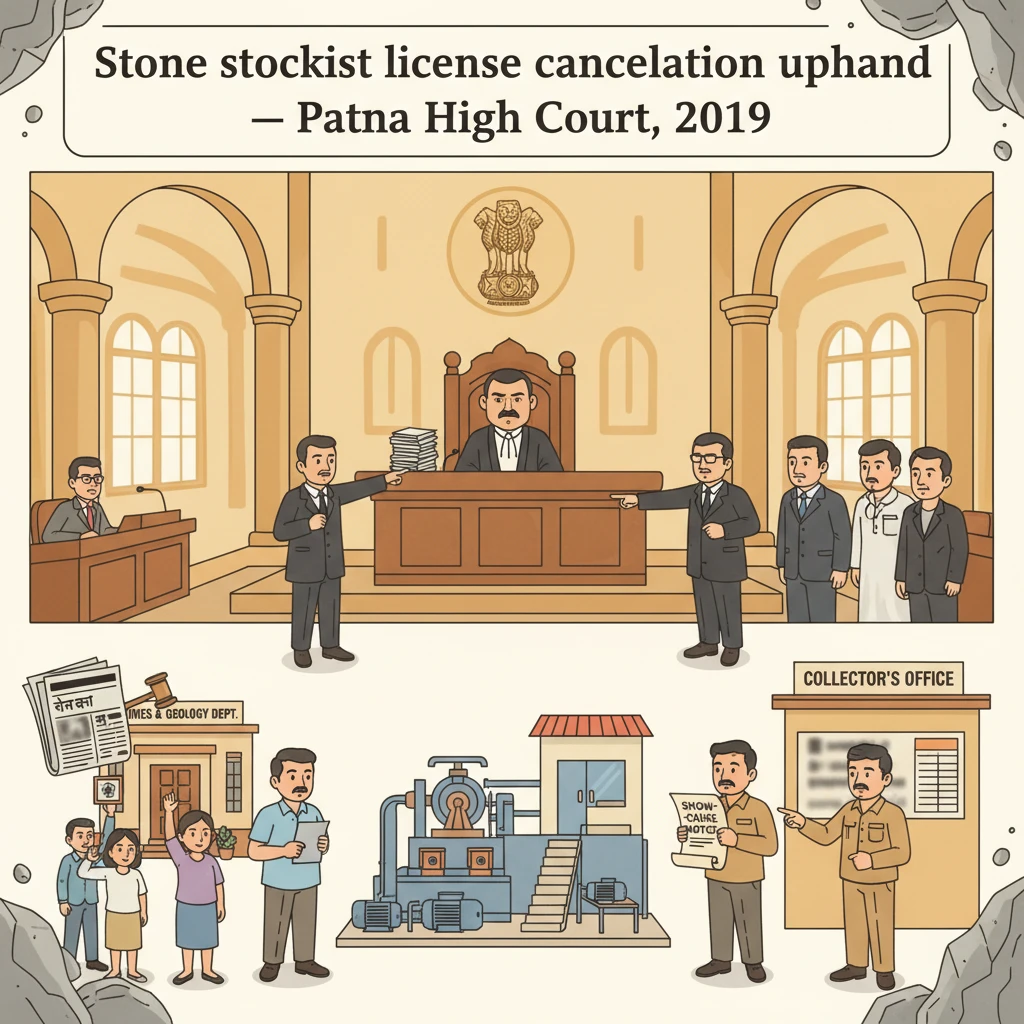
Case Background
The case arose from the cancellation of a stone stockist licence in Rohtas district, Bihar. The petitioner was M/s S.S. Traders, a proprietorship firm represented through its proprietor. The respondents were the State of Bihar and officers of the Mines and Geology Department, including the District Magistrate and the Assistant Director, Mines and Geology, Rohtas.
According to the writ petition, the petitioner had been granted a licence for stocking stone mineral beyond leasehold areas on 29.11.2003 in Form “L” under Rule 49 of the Bihar Minor Mineral Concession Rules, 1972. Later, the State Government framed the Bihar Minerals (Prevention of Illegal Mining, Transportation and Storage) Rules, 2003, under powers conferred by Section 23C of the Mines and Minerals (Development and Regulation) Act. Rule 7 of these 2003 Rules laid down the procedure for granting stone stockist licences for use of crusher machines.
For Rohtas district, the authorities assessed the availability of stone minerals based on the leasehold area of existing mines and fixed about 265 stone stockist licences. A notice was then published in a Hindi daily newspaper inviting applications for settlement of stockist licences by auction. As per Rule 7, interested persons had to submit, among other things, a No Objection Certificate from the Pollution Control Board and a licence under the Bihar Factory Rules.
The petitioner applied along with the required security deposit and documents and participated in the auction. The petitioner was declared the successful bidder and was directed to deposit the first instalment of the auction amount. Upon such deposit, the authorities granted him the stone stockist licence.
The licence was numbered 283/07 and was granted on 21.3.2007 in respect of Plot Nos. 98, 99 and 101, Khata No. 115, situated at Mauza Rudrapura in Rohtas district. The agreed consideration money was Rs. 13,00,100/-, and the petitioner deposited the first instalment of Rs. 1,85,730/-. The petitioner claims to have invested a substantial amount in crusher machines, heavy motors, generators, and construction of foundations and buildings for office, staff and labourers, under a legitimate expectation of a 20-year licence period.
The petitioner states that he began operating the crusher without hindrance and was paying licence fees in time. However, he allegedly faced serious problems in getting sufficient stone boulders. He asserts that he could pay the full instalment only for the year 2007–2008.
On 12.7.2011, the Collector issued a show-cause notice to the petitioner. The notice recorded dues of Rs. 1,85,730/- as instalment and Rs. 8,91,503/- as interest, and called upon the petitioner to explain why his licence should not be cancelled. During this period, the State Government amended the Bihar Minor Mineral Concession Rules, 1972 through the 2010 Amendment Rules, which introduced a new Rule 53. The petitioner’s case was that, because of these changes, boulder supply was disrupted and he could not deposit the royalty amount.
The Collector finally cancelled the petitioner’s licence by order dated 30.9.2011 on the ground of violation of various provisions of the Bihar Minor Mineral Concession Rules, 1972 and related obligations. Against this cancellation, the petitioner filed Revision Case No. 08 of 2013 before the Commissioner, Mines, Bihar, Patna. By order dated 8.6.2015, the Revisional Authority dismissed the revision and upheld the Collector’s order, including cancellation of licence No. 283.
The petitioner then approached the Patna High Court in Civil Writ Jurisdiction Case No. 4983 of 2016. He sought quashing of both the Collector’s order dated 30.9.2011 and the Mines Commissioner’s order dated 8.6.2015.
What the Court Examined and Decided
The writ petition came up before Hon’ble Mr. Justice Sanjay Priya on 23.04.2019. On an earlier date, 17.4.2019, the Court had directed the petitioner to file a supplementary affidavit bringing on record the reply to show cause filed before the Revisional Authority. Despite this direction, no supplementary affidavit was filed and no one appeared on behalf of the petitioner on the date of hearing.
On the other hand, counsel for the Mines Department and the State were present. They relied on the counter affidavit already on record, which set out the State’s defence and the reasons for cancellation of the licence.
The State’s stand was that the petitioner was bound by the terms of the licence and the settlement. Under the agreement, he had to pay the royalty or settlement amount in instalments. The Government could not waive the royalty and instalment dues. The petitioner had been granted stockist licence No. 283/07 over the specified plots at village Rudrapur, but he had failed to deposit the third, fourth, fifth and sixth instalments of the settlement amount within 31st December of the years 2008, 2009, 2010 and 2011.
Because of this non-payment, the petitioner’s dues towards the settlement amount alone came to Rs. 7,42,920/-, apart from the interest payable. In addition, the petitioner, as a stone stockist, was required under Rule 7(1)(k) of the Bihar Minerals (Prevention of Illegal Mining, Transportation and Storage) Rules, 2003 to maintain a daily record of his stock in Form ‘G’. The counter affidavit asserted that he had not maintained this daily stock register.
The Collector, Rohtas, issued notice to the petitioner, asking him to submit his defence. After providing this opportunity and considering the reply, the Collector concluded that there had been violations of the Bihar Minor Mineral Concession Rules, 1972 and related obligations. On this basis, the Collector cancelled the licence of the petitioner.
In revision, the Mines Commissioner examined the matter along with the cases of several other stockists whose licences had also been cancelled. From the High Court’s reading of the Revisional order (Annexure-5), it appeared that the main reason for cancellation in this particular case was the petitioner’s failure to pay the third, fourth, fifth and sixth instalments of royalty or settlement amount by the due dates and his failure to pay interest. Another important ground was non-compliance with Rule 7(1)(k) of the 2003 Rules, i.e., the failure to maintain the daily stock record in Form ‘G’.
Before the High Court, the material on record showed that the petitioner had not deposited the royalty or settlement amount for four consecutive years. The Court recorded that the petitioner could not give any valid reason for not depositing these amounts before the competent authority. The petitioner had himself admitted that he had not paid the royalty.
The only defence taken by the petitioner, as noted by the Court from the pleadings, was that he could not get adequate boulders, allegedly because of changes brought in by the 2010 Amendment Rules and the introduction of Rule 53. Due to this shortage of boulders, he claimed he was unable to pay the royalty amount.
The Patna High Court examined this defence against the background of the contractual and statutory obligations. The Court observed that the petitioner was required to deposit the royalty amount as per the agreement. There was no material to show that the Government had agreed to waive or reduce the dues, nor any legal basis in the record for treating non-supply or shortage of boulders as a valid excuse for non-payment.
Further, the Court noted that the competent authorities had followed the principle of natural justice. A show-cause notice was issued, the petitioner was given an opportunity to put forward his case, and the authorities considered his reply before cancelling the licence. The Revisional Authority had again examined his contentions but found them insufficient.
The High Court did not find any procedural irregularity in the cancellation process. There was no finding in the judgment that the authorities had acted without jurisdiction, in bad faith, or in violation of any specific statutory requirement. Instead, the record showed a clear and repeated default by the petitioner in paying the agreed instalments and interest, as well as failure to maintain required records.
In these circumstances, the Court held that the Collector and the Mines Commissioner had acted within their powers in cancelling the licence. Since the petitioner was bound by the terms of the licence and had admittedly defaulted on his payment obligations and record-keeping duties, the Court saw no ground to interfere.
The Court therefore concluded that there was no illegality in the impugned orders of the Collector and the Mines Commissioner. On this basis, the writ application filed by the petitioner was dismissed.
Why This Judgment Matters
This judgment is important for stone stockists, crusher operators and other mineral licence holders in Bihar. It shows that once a person accepts a licence on auction terms, he must strictly follow the conditions, especially timely payment of instalments and royalty.
The Patna High Court made it clear that problems in getting raw material, such as boulders, will not automatically excuse non-payment of agreed dues, unless there is some clear provision or decision of the Government granting relief. Simply citing difficulty in business cannot protect a licence holder from cancellation when he repeatedly defaults on payments and does not maintain mandatory records.
The decision also underlines that the Court will not lightly interfere with orders of the Collector and Mines Commissioner when they have given notice, considered explanations, and applied the relevant rules. For other licence holders, this serves as a warning that long-term defaults and non-compliance with documentation requirements can lead to cancellation that may not be reversible in writ proceedings.
Legal Issues and Answers
Issue: Whether the cancellation of the petitioner’s stone stockist licence for non-payment of instalments and non-compliance with Rules was illegal or arbitrary.
Answer: No. The Patna High Court held that the petitioner was bound to pay royalty and settlement instalments as per agreement and to comply with Rule 7(1)(k) of the 2003 Rules. After show-cause and consideration, the authorities lawfully cancelled the licence, and the Court found no illegality in their orders.
Cases Cited by the Court
- No earlier judgments or case law are cited or relied upon in the text of this decision.
Case Details
Case Number: Civil Writ Jurisdiction Case No. 4983 of 2016
Case Title: M/s S.S. Traders v. The State of Bihar & Ors.
Citation: 2019 (3) PLJR 237
Coram: Hon’ble Mr. Justice Sanjay Priya
Advocates:
- For the Petitioner: None appeared at final hearing.
- For the Mines Department: Mr. Naresh Dikshit, Special P.P. Mines; Mr. Sumit Shekhar Pandey, A.C. to Naresh Dikshit.
- For the State: Mr. Sudish Kumar, A.C. to PAAG.
Nature of the Case: Writ petition (civil) challenging orders of the Collector, Rohtas, and the Mines Commissioner relating to cancellation of stone stockist licence.
Date of Judgment: 23.04.2019
Impugned Orders:
- Order dated 30.09.2011 passed by the Collector, Rohtas (cancelling licence).
- Order dated 08.06.2015 passed by the Commissioner, Mines, Bihar, Patna in Revision Case No. 08 of 2013 (upholding cancellation and rejecting revision).
Link to Judgment: Patna High Court official judgment link
If you found this explanation helpful and wish to stay informed about
how legal developments may affect your rights in Bihar,
you may consider following Samvida Law Associates for more updates.







