

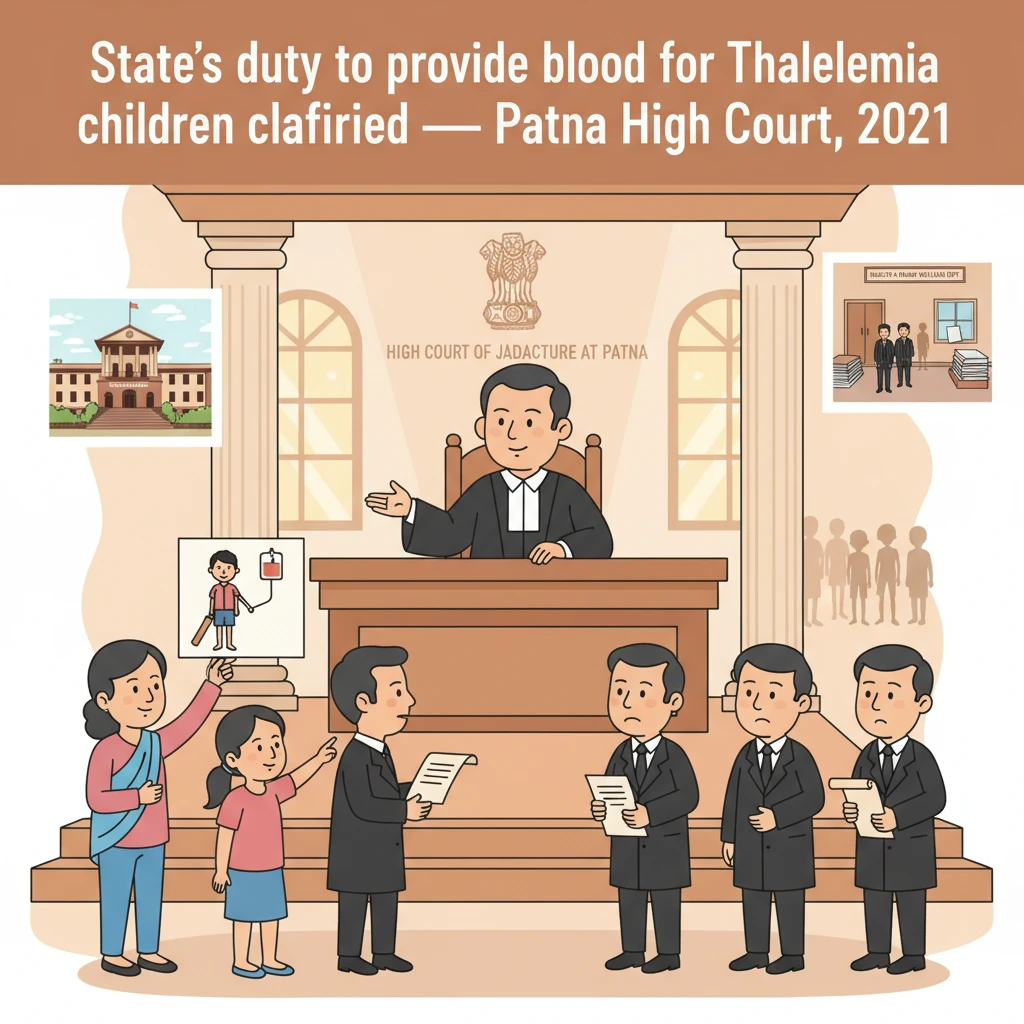
Case Background
The case was filed as a civil writ petition by three individuals who are directly or indirectly connected with persons suffering from Thalassemia. They approached the Patna High Court claiming that the situation of Thalassemia patients in Bihar had become critical, especially in the backdrop of the COVID-19 pandemic.
According to the petitioners, there was a serious shortage of blood and proper treatment arrangements for Thalassemia patients in the State. They relied on various reports in national newspapers and online portals describing the poor condition of such patients.
The petitioners placed before the Court seven specific instances involving young children with Thalassemia from Purnea and Muzaffarpur districts. In five of these cases, the children had died allegedly due to non-availability of proper medication and blood. Two children were said to be still fighting the disease. The common complaint in all these incidents was that basic medical resources, including blood and essential equipment, were not available, and there were even allegations of blood being sold in the black market.
On this background, the writ petition asked the Court to examine the State’s obligation to ensure availability of blood and other facilities to Thalassemia patients, and to consider compensation for the families of children who died due to lack of medical facilities.
What the Court Examined and Decided
The Patna High Court, speaking through the Hon’ble Chief Justice, first framed three key questions. One, whether the State is under an obligation to make available all facilities, including blood, to patients with the disability of Thalassemia. Two, whether refusal of blood on account of unavailability can be a valid defence for the State. Three, whether the State is bound to pay compensation to families of Thalassemia patients who died due to non-availability of adequate medical facilities.
The Court then recorded the petitioners’ narrative about Thalassemia itself. It noted that Thalassemia is an inherited blood disorder. In this condition, the body does not produce enough haemoglobin, which is the protein in red blood cells responsible for carrying oxygen. Due to lack of haemoglobin, red blood cells do not function properly and have a shorter life, resulting in fewer healthy red blood cells in circulation.
Red blood cells carry oxygen to all parts of the body. When there are not enough healthy red cells, the body’s cells do not get enough oxygen. This causes a person to feel tired, weak, or short of breath, a state called anaemia. The Court highlighted that people with Thalassemia may have mild or severe anaemia, and severe anaemia can damage organs and lead to death.
The Court observed that prevention of Thalassemia is very hard as it is passed from parents to children through genes. Treatment generally consists of vitamins, repeated blood transfusions and drugs that reduce iron overload. A significant equipment requirement is the use of filters during transfusion to prevent the patient’s iron level from rising beyond acceptable limits. Excess iron can cause fatal iron poisoning.
The petitioners pointed out that in Bihar, patients face serious problems because these filters are often not available in hospitals. In addition, vital medicines are scarce. They are neither found in government hospitals nor in regular medical stores, and sometimes can only be obtained through Thalassemia societies.
The Court recorded that Desferal, a costly drug used for Thalassemia treatment, and its pump are considered essential. Yet, according to the petitioners, these are not available in hospitals and parents are required to purchase them themselves if they want treatment for their children.
The petitioners also shared statistics suggesting that a high proportion of Thalassemia cases in India come from Bihar and Uttar Pradesh. Thalassemia treatment featured in India’s 12th Five Year Plan, and the disease has been recognised as a disability under the Right of Persons with Disabilities Act, 2016.
As a solution, the petitioners suggested that the State should set up Thalassemia Day Care Centres to prevent children from suffering iron overload from repeated transfusions. They sought Court intervention for systemic measures.
In response, the State of Bihar, through its counter affidavit, detailed steps it claimed to have taken. The Health Department said it was working to improve infrastructure for Thalassemia patients. These initiatives included awareness, education and screening programmes in communities and schools, establishing laboratories to screen for hemoglobinopathies, screening pregnant women and their husbands to prevent birth of children with Thalassemia, and setting up prenatal diagnostic centres in medical colleges.
The Government also stated that it was following National Health Mission guidelines and was in the process of establishing “Integrated Centre for Hemoglobinopathies and Haemophilia” as Day Care Centres at several key hospitals: PMCH, Patna; SKMCH, Muzaffarpur; JNMCH, Bhagalpur; ANMCH, Gaya; and Sadar Hospital, Purnea. PMCH and SKMCH were said to be already functional, fully dedicated to treatment of Thalassemia, Haemophilia and Sickle Cell Anaemia.
To ensure regular blood supply, storage centres had been created at these Day Care Centres. Blood collected from different blood banks would be stored there for Thalassemia patients. The State also launched a website, thalassemiaregistry.bihar.gov.in, where patients could self-register for appointments.
The Court noted further that Bihar has 38 districts, and according to the State, Thalassemia treatment facilities and blood banks were present in all districts except Sheohar and Supaul. All 98 blood banks in Bihar were said to be supplying blood to Thalassemia patients, with more than 984 registered patients. Regular district-level meetings were claimed to be held to monitor and improve implementation.
However, after examining constitutional provisions and international human rights instruments, the Court took a wider view of the State’s legal obligation. It cited the Universal Declaration of Human Rights, the International Covenant on Economic, Social and Cultural Rights, and the UN Convention on the Rights of Persons with Disabilities. These documents recognise the right to the highest attainable standard of health and prohibit discrimination against persons with disabilities.
The Court referred to the decision of the Supreme Court in Vikash Kumar v. Union Public Service Commission, which explained “reasonable accommodation” for persons with disabilities and underlined that the State has a positive duty to create conditions that remove barriers faced by disabled persons.
Relying on earlier judgments such as Consumer Education & Research Centre v. Union of India and other decisions recognising the Right to Health as part of Article 21 of the Constitution, the High Court reiterated that social justice and human dignity demand effective access to healthcare.
The Court then turned to the Rights of Persons with Disabilities Act, 2016. Under this Act, Thalassemia is treated as a blood disorder disability and Section 25 imposes obligations on the appropriate Government and local authorities. These include providing free healthcare in the vicinity (especially in rural areas, subject to notified income limits), barrier-free access in hospitals, priority in treatment, annual screening of children, and essential life-saving medical facilities, among other measures.
Taking all this together, the Court concluded that the Supreme Court has clearly established the Right to Health as a fundamental right and elaborated the broad scope of reasonable accommodation. For Thalassemia patients, reasonable accommodation includes all possible medication, facilities and care needed to protect their Right to Life and Liberty under Article 21 and to honour India’s commitments under the UN Convention.
The Court held that in such a situation, unavailability or shortage of blood, medicines or any other essentials for treating Thalassemia patients is not a permissible defence for the Government. The judgment emphatically stated that the death of even one disabled person due to lack of resources is an affront to the State’s obligations under international law and to constitutional values.
The Court expressed particular shock at the State’s silence about the five named children who had died. It noted that the State did not even acknowledge these deaths in its pleadings. This, the Court felt, revealed a failure in discharging one of the most important responsibilities of a welfare State: ensuring the right to health of its citizens.
On this reasoning, the Court declared three key conclusions. First, the State is under an obligation to make available all facilities, including blood, to Thalassemia patients. Second, refusal of blood on the plea of non-availability is not open to the State. Third, the State is obliged to compensate families of patients who died solely due to non-availability of adequate medical facilities.
To translate these findings into action, the Court directed the constitution of an independent committee of doctors. This committee, consisting of senior specialists from AIIMS Patna and a consultant haematologist from a private hospital, was given a two-fold mandate. One, to inspect all institutions offering treatment to Thalassemia patients and assess their readiness, availability, accessibility and quality of care. Two, to suggest suitable compensation for the five juvenile fatalities named by the petitioners.
The committee was ordered to submit its report within four months to the Chief Secretary, Government of Bihar. The State was directed to provide all necessary assistance to the committee. The Chief Secretary was then required to act on the report, including on the issue of compensation recommended.
The Court further ordered the State to take all possible steps to meet the health-related needs of Thalassemia patients and other vulnerable groups. For the two surviving children mentioned in the petition from Muzaffarpur, the Government was directed to appoint an officer to verify their details and extend all assistance permissible under law to prevent further fatalities.
The judgment went on to suggest that the Government explore appointing a nodal officer in each district to ensure that the needs of vulnerable groups are addressed. The Court directed that blood banks be set up at the earliest in Sheohar and Supaul, and that constructive steps be taken to ensure proper availability of blood throughout Bihar.
For the second child of one of the deceased children’s fathers, the Court specifically directed the State to ensure proper care in line with the legal provisions cited in the judgment. Finally, the Court reserved liberty to the petitioners to approach it again if needed, and disposed of the writ petition and all related applications in these terms.
Why This Judgment Matters
This judgment is important because it clearly tells the State that lack of blood or medicines cannot be an excuse when children with Thalassemia die for want of treatment. The Patna High Court has said in simple terms that the Government must ensure that facilities and blood are available, and that it must pay compensation where deaths are caused only because facilities were missing.
For families of Thalassemia patients in Bihar, this decision gives a strong legal backing to demand regular blood transfusions, necessary drugs, filters and dedicated care centres. The Court’s directions for a statewide survey and district-wise improvements can, if implemented properly, directly improve the day-to-day treatment of hundreds of children.
The judgment also reinforces that persons with Thalassemia are covered as persons with disabilities under the 2016 Act, and that they are entitled to special protection and reasonable accommodation. It links international human rights obligations with concrete directions, making it clear that health care for vulnerable patients is not charity but a legal right.
Legal Issues and Answers
- Issue: Is the State obliged to make available all facilities, including blood, to patients with the disability of Thalassemia?
Answer: Yes. The Court held that the State is under an obligation to provide all necessary facilities, including blood, so that Thalassemia patients can enjoy their fundamental Right to Health and Life. - Issue: Can the State refuse blood to Thalassemia patients on the ground of non-availability?
Answer: No. The Court ruled that non-availability or shortage of blood is not a ground open to the State; refusal of blood on this basis is impermissible. - Issue: Is the State liable to compensate families of Thalassemia patients who died due to non-availability of adequate medical facilities?
Answer: Yes. The Court held that the State is obliged to pay compensation where the death occurred solely on account of non-availability of adequate medical facilities.
Cases Cited by the Court
- Vikash Kumar v. Union Public Service Commission, (2021) 5 SCC 370
- Consumer Education & Research Centre and others v. Union of India & Ors., (1995) 3 SCC 42
- Paschim Banga Khet Mazdoor Samity v. State of West Bengal, (1996) 4 SCC 37
- State of Punjab v. Mohinder Singh Chawla, (1997) 2 SCC 83
- Union of India v. Moolchand Kharaiti Ram Trust, (2018) 8 SCC 32
- National Legal Services Authority v. Union of India and Ors., (2014) 5 SCC 438
- Ankit Abhishek v. State of Bihar, LPA 255 of 2020 (as referred by the Court)
Case Details
Case Number: Civil Writ Jurisdiction Case No.10986 of 2021
Case Title: Amit Kumar Agarwal & Ors. v. The Union of India & Ors.
Coram: Hon’ble the Chief Justice Sanjay Karol; Hon’ble Mr. Justice P. B. Bajanthri
Citation: 2022(1) PLJR 29
Advocates for Petitioners: Mr. Vishal Kumar Singh, Advocate; Mr. Deepak Kumar Singh, Advocate; Mr. Akash Keshav, Advocate; Ms. Akanksha Malviya, Advocate
Advocates for Respondents: Dr. K. N. Singh, Additional Solicitor General; Mr. Kumar Priya Ranjan, Central Government Counsel; Mr. S. D. Yadav, AAG-9
Nature of the Case: Public interest writ petition concerning Right to Health of Thalassemia patients and State obligation to provide treatment and compensation
Date of Judgment: 01-11-2021
Link to Judgment: https://patnahighcourt.gov.in/viewjudgment/MTUjMTA5ODYjMjAyMSMxI04=-OfTVmFkasis=
If you found this explanation helpful and wish to stay informed about how legal developments may affect your rights in Bihar, you may consider following Samvida Law Associates for more updates.







