

Case Background
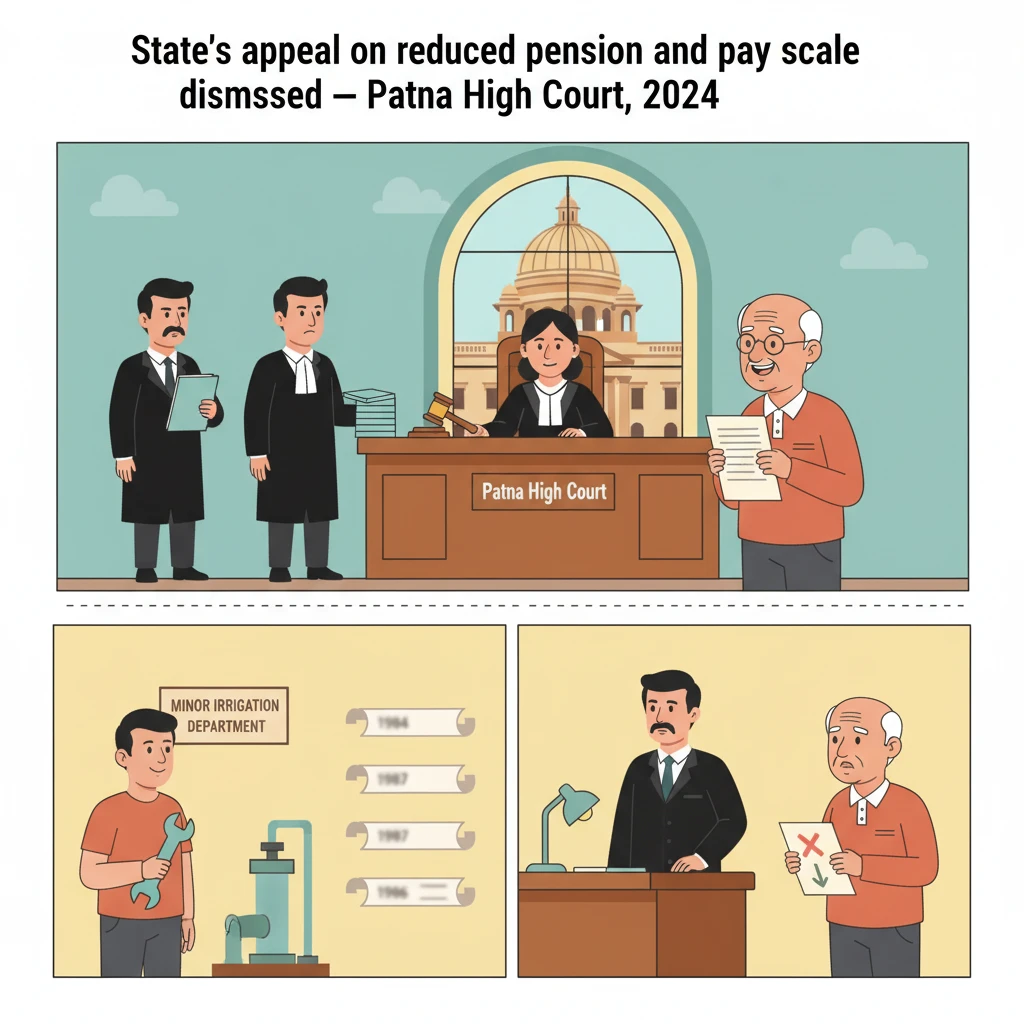
This case arose from a long service career of a government employee working in the Minor Irrigation Department. He initially worked as a Fuse-Man in the work-charged establishment from 12.05.1970. Over time, he was promoted as Assistant Armature Winder and then as Armature Winder, and he also received a time bound promotion while in that post.
Later, the State Government decided to absorb work-charged employees into the regular establishment. By an order dated 22.10.1984 (Annexure-A), work-charged staff were adjusted into the regular establishment. Their services were further regularised by another order dated 23.10.1987 (Annexure-B).
According to the employee’s Service Register, when he was converted into the regular establishment as an Electrician, his pay scale was fixed at Rs. 1200–1800. On implementation of the 5th Pay Revision with effect from 01.01.1996, this scale was revised to Rs. 4000–6000.
Years later, by an order dated 07.05.2010, the State modified this pay fixation. The pay scale for the post of Electrician was changed from Rs. 4000–6000 to Rs. 3050–4590, and recovery of alleged excess payment was also ordered. The employee challenged this before the Patna High Court in CWJC No. 10325 of 2012.
In that writ case, by judgment dated 08.03.2019, the learned Single Judge set aside the recovery in view of the Supreme Court decision in State of Punjab & Ors. v. Rafiq Masih (White Washer), (2015) 4 SCC 334. However, the Single Judge directed the authorities to reconsider the issue of re-fixation of pay, as there was no clear explanation about how the employee had been brought from the work-charged to the regular establishment and what pay scale properly applied to him.
On reconsideration in 2019, after the employee had retired, the department reiterated the lower pay scale plea, effectively reducing the basis for his pension. The employee again approached the High Court through CWJC No. 6028 of 2020. The learned Single Judge allowed the writ, relying mainly on the Service Register entry showing that he had been placed in the higher pay scale of Rs. 1200–1800, revised to Rs. 4000–6000, and held that the later re-fixation was unsustainable.
Aggrieved by this, the State of Bihar and departmental authorities filed Letters Patent Appeal No. 257 of 2022 before a Division Bench of the Patna High Court.
What the Court Examined and Decided
The Division Bench, speaking through the Hon’ble Chief Justice, examined whether the State was justified in re-fixing the pay of the retired Electrician to a lower scale and in altering his pension on the theory that he should have remained on a work-charged scale.
The State argued that, as on 01.01.1996, there were two distinct pay scales for Electricians. One was a lower pay scale of Rs. 950–1400, applicable to the work-charged establishment and revised to Rs. 3050–4590 under the 5th Pay Revision. The other was a higher pay scale of Rs. 1200–1800, revised to Rs. 4000–6000, applicable to regularly employed Electricians.
According to the State, the employee was only ever entitled to the lower scale because he originally belonged to the work-charged establishment. It was claimed that, when he was first taken into the regular establishment, his pay was inadvertently fixed in the higher scale applicable to regular Electricians. This “mistake”, the State contended, led to higher pay and a higher revised scale, which was later corrected by the 2010 order. The State further tried to argue that currently there was no order for recovery; only pension had been recalculated on a notional reduction of pay.
On the other hand, counsel for the employee pointed out that he had been taken into the regular establishment and continued on the higher regular pay scale. He argued that once in the regular establishment, there cannot be two different pay scales for persons doing similar work with similar duties and responsibilities. He also stressed that the reconsideration and fresh reduction took place after his retirement, which caused prejudice to his pensionary benefits.
The Division Bench first corrected the factual narrative. It noted that the employee was right in saying that the re-fixation attempt had earlier been coupled with a recovery order. The order dated 07.05.2010 had both reduced his pay scale for the post of Electrician from Rs. 4000–6000 to Rs. 3050–4590 and directed recovery of alleged excess payments.
The Bench also clarified that the employee was wrong to say that the first re-fixation took place only after retirement. The initial modification order was passed on 07.05.2010, while he was still in service, and that order was challenged in CWJC No. 10325 of 2012. In that case, the Single Judge had, on 08.03.2019, quashed the recovery by relying on Rafiq Masih but had asked the State to reconsider the pay re-fixation question in light of the distinction between work-charged and regular establishments.
The fresh decision, which became the subject of CWJC No. 6028 of 2020 and the present appeal, was taken in 2019, after the employee’s retirement, and only impacted his pension computation. Thus, the dispute before the Division Bench focused on whether the State could validly treat him as entitled only to the lower work-charged scale for the purposes of pension.
To resolve this, the Division Bench closely examined three key resolutions and orders: Annexure-A (22.10.1984), Annexure-B (23.10.1987), and Annexure-C (Finance Department Resolution dated 17.10.2013).
Annexure-A dealt with adjustment of work-charged employees into the regular establishment and conferred the benefit of pension. The Court specifically referred to clause (a) and (c), as translated in the judgment:
Clause (a) stated that, on converting work-charged employees into the regular establishment, the respective posts of the work-charged establishment would be converted into regular establishment. Clause (c) provided that the amount earmarked in the work-charged (ordinary) unit for their salaries and allowances would be transferred to the budget head of the regular establishment.
The Court interpreted clause (a) to mean that, after conversion, the employee occupies the same post, but within the regular establishment. Clause (c), in the Court’s view, was only a budgetary direction: money kept for their salary in the work-charged unit was to be transferred to the regular budget head because the work-charged setup was being phased out.
Crucially, the Court held that nothing in clause (c) could be read to say that after conversion the employee must continue in the same lower pay scale that he had in the work-charged establishment. It was a financial re-allocation clause, not a pay protection clause in the sense argued by the State.
Annexure-B, dated 23.10.1987, related to regularisation of work-charged employees appointed after 23.07.1975 who had completed five years of continuous satisfactory service as on 21.10.1984. It expressly recorded that these employees had long been discharging Government duties with dedication. Again, the Court highlighted clauses (a) and (c) of Annexure-B, which were in terms similar to those in Annexure-A, converting the posts into regular establishment posts and transferring the salary budget.
The Bench held that Annexure-B, like Annexure-A, did not support the State’s position that, after conversion and regularisation, the employees were to remain on their former work-charged scales of pay. Rather, they were to be treated as part of the regular establishment.
The Court then turned to Annexure-C, a Finance Department resolution dated 17.10.2013. This resolution modified the cut-off date for regularisation of work-charged employees based on earlier High Court orders and extended the benefit to a larger group. It also directed that, if posts were not available in the regular establishment, the converted posts in excess of sanctioned strength would not count towards cadre strength and would automatically be abolished on the retirement of the concerned employee.
The Division Bench found that Annexure-C had no direct bearing on the employee’s case because he had already been brought into the regular establishment under Annexures-A and B within the original cut-off. Even on merits, Annexure-C only dealt with cadre strength and abolition of converted posts after retirement. It did not imply that such employees should receive a lower pay scale than others in the same cadre.
The Bench stressed an important general principle: when an employee is promoted to a new cadre or regularised into the regular establishment, there cannot be discrimination based solely on the source from which he came, as long as he discharges the same duties, responsibilities, and obligations as others in the same post. In other words, a person drawn from the work-charged side cannot be paid less than a person directly appointed or promoted into the same regular post doing the same work.
Applying this principle, the Court noted that the employee had already been placed in the higher pay scale of Rs. 1200–1800 upon conversion, as clearly shown in his Service Register (Annexure-1 to the writ petition). When the 5th Pay Revision took effect on 01.01.1996, his scale was accordingly revised to Rs. 4000–6000. There was no documentary evidence from the State to show that he had ever been appointed or continued in the lower pay scale of Rs. 950–1400 in the regular establishment.
The Division Bench therefore found no merit in the State’s contention that the original fixation in the higher scale was an “inadvertent omission” or mistake. It held that the employee was validly granted the higher scale upon conversion to the regular establishment, and there was no legal basis in Annexures A, B, or C to downgrade him later on the ground of his work-charged origin.
The Court also pointed out the discriminatory effect of the State’s position. If employees converted into regular establishment but accommodated against “excess” posts created out of work-charged positions were to be kept on a lower pay scale, they would be doing identical work as regular incumbents in the same cadre but receiving less pay, and their posts would vanish on retirement. This would be impermissible discrimination, which the Court found contrary to the intent behind the Government resolutions.
In light of this analysis, the Division Bench agreed fully with the learned Single Judge, both in reading of the Service Register and interpretation of the Government resolutions. It found “absolutely no reason” to interfere with the order which had quashed the re-fixation of pay scale and restored the higher scale for pension purposes.
Accordingly, the Letters Patent Appeal filed by the State of Bihar and departmental authorities was dismissed, with the parties left to bear their own costs.
Why This Judgment Matters
This judgment is important for many employees in Bihar who started as work-charged staff and were later brought into the regular establishment. It clarifies that once such workers are converted and regularised into a regular cadre on a certain pay scale, the State cannot later push them back to a lower work-charged scale just to reduce salary or pension.
The Patna High Court has clearly said that the Government’s own resolutions do not allow this kind of downgrade. The budget adjustment clauses only shift money from the work-charged head to the regular establishment budget; they do not authorise paying less to those who are doing the same work as other regular employees.
The decision also strengthens the principle that employees performing equal work, with equal duties and responsibilities in the same cadre, must not be discriminated against based on where they originally came from. For retired employees, it sends a signal that pension cannot be cut on the basis of a belated claim of “mistaken” higher pay, in absence of clear proof from service records.
Legal Issues and Answers
- Issue: After converting and regularising a work-charged employee into the regular establishment, can the State later reduce his pay scale and pension by treating him as if he remained on the lower work-charged scale?
Answer: No. The Patna High Court held that, once absorbed in the regular establishment on a higher scale and performing the same duties and responsibilities as others in the cadre, he cannot be discriminated against or downgraded based on his earlier work-charged status, especially when the service records and Government resolutions do not support such reduction.
Cases Cited by the Court
- State of Punjab & Ors v. Rafiq Masih (White Washer), (2015) 4 SCC 334 – cited by the Single Judge in earlier proceedings (CWJC No. 10325 of 2012) to set aside recovery of excess payments.
Case Details
Case Number: Letters Patent Appeal No. 257 of 2022 in Civil Writ Jurisdiction Case No. 6028 of 2020
Case Title: The State of Bihar & Ors v. Hirdayanand Tiwari
Coram: Hon’ble the Chief Justice K. Vinod Chandran; Hon’ble Mr. Justice Partha Sarthy
Citation: 2024 (4) PLJR 291
Advocates: For the appellants (State and departmental authorities): Mr. Ajit Kumar, GA-9; Mr. Vikash Jha, A.C. to G.A. 9. For the respondent (writ petitioner): Mr. Satish Kumar Sinha, Advocate.
Nature of the case: Letters Patent Appeal against the judgment of a Single Judge in a writ petition concerning re-fixation of pay scale and consequent pension.
Link to judgment: Click here to read the full judgment of the Patna High Court
If you found this explanation helpful and wish to stay informed about
how legal developments may affect your rights in Bihar,
you may consider following Samvida Law Associates for more updates.







