

Case Background
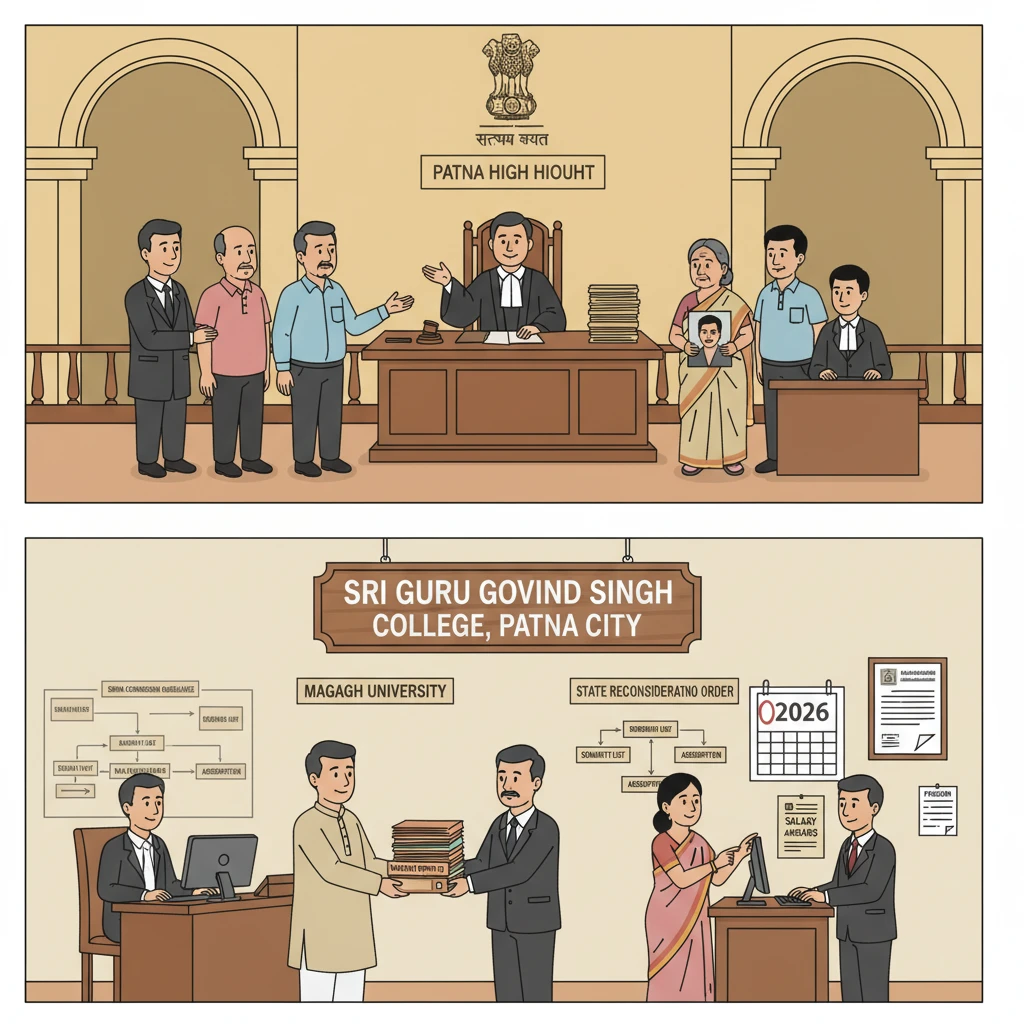
This writ petition was filed by four petitioners connected with Sri Guru Govind Singh College, Patna City, a minority-cum-constituent college of Patliputra University. Petitioners No. 1 and 2 were non-teaching employees. Petitioner No. 3 is the widow of a deceased employee, and Petitioner No. 4 is his son.
In the petition, they sought a writ of mandamus for three main reliefs. First, they asked for payment of withheld salary of Petitioners No. 1 and 2 from March 2009. Second, they sought arrears of salary and pension for Petitioner No. 3, in respect of the deceased employee. Third, they requested consideration of Petitioner No. 4 for compassionate appointment in the college.
Their case was mainly built on the order dated 11.05.2016 passed by Justice S.B. Sinha (Retd.) Commission, New Delhi, popularly referred to as the Sinha Commission. The Commission had been constituted pursuant to the Supreme Court judgment in State of Bihar vs. Bihar Rajya MSESKK Mahasangh, reported in (2005) 9 SCC 129, to deal with issues of absorption of teaching and non-teaching staff working in various colleges.
The Sinha Commission considered claim petitions filed by these employees, including Claim Petition Nos. 573 of 2013 (Akhileshwar Sharma), 576 of 2013 (Manoj Kumar Rajak) and 563 of 2019 (Manmohan Singh). After adjudicating all claims together, the Commission passed a composite order on 11.05.2016.
Despite the Commission’s recommendations and subsequent steps taken by Magadh University, the State Government, through its Education Department, approved absorption of only some of the recommended employees. The names of these petitioners were left out, even though they were similarly situated. Feeling aggrieved by this selective absorption and continued denial of consequential monetary benefits, the petitioners approached the Patna High Court in Civil Writ Jurisdiction Case No. 12163 of 2019.
What the Court Examined and Decided
Justice Ajit Kumar of the Patna High Court heard the matter and delivered an oral judgment on 13.01.2026. The Court first recorded the reliefs sought and then examined the factual history placed on record.
The petitioners relied heavily on the Sinha Commission’s order dated 11.05.2016. The Commission had found that six persons were appointed on 26.06.1985—namely, Rajeshwar Prasad, Manoj Kumar Rajak (since deceased, represented by Petitioners No. 3 and 4), Akhileshwar Sharma, Raj Kumar Prasad, Md. Abid Ansari and Birendra Kumar. Two others, including Petitioners No. 1 and 2, were appointed on 06.07.1985: Manmohan Singh and Akhileshwar Sharma.
The Commission held that these eight persons were senior and directed that their cases for absorption be considered first. Only thereafter were the cases of other eligible candidates to be considered as per their seniority. For determining inter se seniority, the Commission directed the University to follow its guidelines applicable to assistants.
The petitioners also asserted that they had been receiving salary since 1989. In 2014, when the University sought information from the college regarding vacancy position, the Principal of Sri Guru Govind Singh College responded vide letter dated 06.02.2019. He confirmed that there were 19 vacancies under the “DRT Category” in the non-teaching cadre, arising due to promotion, retirement, death or resignation of staff.
The grievance of the petitioners was that, despite the Sinha Commission’s findings and availability of vacancies, the State Government selectively implemented the recommendations. The petitioners contended that others similarly appointed and similarly recommended were absorbed, while their names were left out without any explanation.
The Court referred to its earlier detailed order dated 08.09.2025 in this very case. In that order, it had noted the vacancy position letter prepared by the in-charge Principal (Annexure-10), showing more than eight vacancies, and observed that all recommended persons could have been adjusted. The Court had also referred to the Supreme Court decision in State of Bihar v. Bihar Rajya MSESKK Mahasangh, and a coordinate Bench judgment in CWJC No. 17670 of 2017 (Akhilanand Singh & Ors. vs. The State of Bihar & Ors.).
In Akhilanand Singh, this Court had already held that if the name of an employee appeared in the list prepared by either Justice Agarwal Commission or Justice S.B. Sinha Commission, his or her case for absorption could be considered. The present petitioners, therefore, were on even stronger footing, because there was an express recommendation in their favour by the Sinha Commission itself.
Pursuant to the Court’s directions of 08.09.2025, Magadh University filed a supplementary counter affidavit. Through Annexure-R/2, the University explained that, in terms of DRT/Promotion Category vacancies and inter se criteria (date of joining/date of birth), it had recommended nine persons for absorption. The list included Uma Devi, Birendra Kumar, Raj Kumar Prasad, Md. Abid Ansari, Akhileshwar Kumar Singh, Rajeshwar Prasad, Manoj Kumar Rajak, Akhileshwar Sharma and Manmohan Singh. These were the very names in whose favour the Sinha Commission had recommended absorption.
However, the Education Department, through letter no. 2177 dated 29.11.2018, asked the University to “re-look” its recommendations and send an appropriate list for compliance. The University then issued a speaking order and again sent recommendations vide Letter No. 223 of 2018 dated 05.12.2018, explaining that although the Sinha Commission had mentioned six posts in the DRT category, in fact nine posts had fallen vacant. Relying on Justice S.C. Agarwal Commission report and the Sinha Commission order, the University proposed adjustment of nine persons according to their inter se seniority.
In that communication, the University even clarified that if the Government wanted to consider only six posts in the DRT category, it might restrict itself to six persons as per the seniority already determined in the earlier speaking order.
Despite this clarity, the Education Department issued Office Order contained in Memo No. 98 dated 12.01.2019. That memo annexed a list of thirteen cases but approved absorption of only six persons from the recommended list. The names of Petitioners Akhileshwar Sharma, Manoj Kumar Rajak and Manmohan Singh were not included, though they had been specifically recommended for absorption by the Sinha Commission and the University.
Magadh University further stated that, based on the State’s decision, it issued a notification dated 22.01.2019 (Annexure-R/6) absorbing those employees whose names the Government had cleared, again excluding the present petitioners.
The State’s counsel did not dispute the Principal’s letter stating that there were 19 vacancies under the DRT category. Nor could the State offer any satisfactory explanation for why, when nine vacancies were available and nine persons were recommended, absorption orders were passed for only six and the petitioners were left out.
The Court found this conduct to be arbitrary and contrary to the directions of the Sinha Commission. It noted that the Commission had been created by the Supreme Court itself in State of Bihar vs. Bihar Rajya MSESKK Mahasangh (2005) 9 SCC 129 for resolving absorption-related disputes. The University had duly identified vacant posts and followed the Commission’s directions in recommending these petitioners for absorption. The State, despite being a party before the Commission and fully aware of its order, ignored these recommendations without “any prudent reason”.
The Court concluded that the petitioners were similarly situated to those six persons whose absorption had been approved and notified. They too were eligible for consideration against existing vacancies and had been specifically recommended by the Sinha Commission and the University. By adopting a “pick and choose” method, the State had acted in an unjust and discriminatory manner.
In paragraph 7 of the judgment, the Court held that the State Government “miserably failed” to justify this arbitrary action. Because the list of recommended candidates dated 17.11.2018, in line with the Sinha Commission’s directions, included these petitioners, their exclusion had no lawful basis.
Accordingly, the Court directed the State Government to consider the case of these petitioners for absorption strictly in accordance with the Commission’s order dated 11.05.2016. The State must pass necessary orders granting them all benefits to which they are entitled, in the same manner as given to other similarly situated persons whose absorption had already been approved under memo dated 12.01.2019.
The Court gave the State a time-frame of two months from the date of receipt of such representation to pass these orders. It also directed that the State take care of all financial implications. Necessary funds are to be allocated to the concerned University so that it can meet its obligations, including payment of dues.
Recognising that original employee Manoj Kumar Rajak had died and that his widow Madhuri Devi and son Tarun Kumar Rajak were on record as Petitioners No. 3 and 4, the Court specifically directed the University to settle the claim in favour of the legal heirs. This has to be done mutually after completion of legal formalities and without causing “any unwarranted harassment” so as to avoid further litigation.
With these directions, the writ petition was disposed of.
Why This Judgment Matters
This judgment is important for non-teaching staff in colleges across Bihar who were recommended for absorption by the Sinha Commission but later ignored by the State.
The Patna High Court has clearly said that the Government cannot choose some names and drop others from the same recommended list without a good reason. When a Commission created under Supreme Court orders recommends certain employees and the University identifies matching vacancies, the State must follow that recommendation fairly.
The decision also matters for families of deceased employees. The Court has ensured that the legal heirs of the deceased staff member will receive whatever benefits flow from the absorption, and that authorities must not harass them or push them into fresh court battles.
For many workers who have served colleges for decades on uncertain status, this ruling by the Patna High Court reinforces that their long service and Commission recommendations cannot be ignored arbitrarily.
Legal Issues and Answers
-
Issue: Can the State Government ignore or partially implement the Sinha Commission’s recommendations on absorption of non-teaching staff, by approving some recommended names and excluding others without adequate reason, despite availability of vacancies?
Answer: No. The Court held that such selective implementation is arbitrary and unjustified. The State is bound to consider all recommended employees, including the petitioners, for absorption against identified vacancies in line with the Sinha Commission’s order and the University’s recommendations. -
Issue: Are the petitioners entitled to similar benefits of absorption and financial dues as other non-teaching staff whose names were approved under memo dated 12.01.2019?
Answer: Yes. The Court directed the State to consider their absorption and extend the same benefits, with the State providing necessary funds and the University settling the petitioners’ and legal heirs’ claims within a fixed time.
Cases Cited by the Court
- State of Bihar vs. Bihar Rajya MSESKK Mahasangh, (2005) 9 SCC 129.
- CWJC No. 17670 of 2017, Akhilanand Singh & Ors. vs. The State of Bihar & Ors. (coordinate Bench of Patna High Court).
Case Details
Case Number: Civil Writ Jurisdiction Case No. 12163 of 2019
Case Title: Akhileshwar Sharma & Ors. vs. The State of Bihar & Ors.
Citation: 2026 (2) PLJR 176
Coram: Hon’ble Mr. Justice Ajit Kumar
Date of Judgment: 13.01.2026
Advocates:
For the Petitioners: Mr. Sujeet Kumar Sinha
For the State of Bihar: Smt. Binita Singh (SC 28)
For Magadh University: Mr. Sunit Kumar
For Patliputra University: Mr. Rana Vikram Singh
Respondents: State of Bihar (through Principal Secretary, Human Resources Development Department), Director, Higher Education, Magadh University, Patliputra University, and Principal, Sri Guru Govind Singh College, Patna City.
Nature of Case: Writ petition (Civil) seeking mandamus for payment of salary and pensionary benefits and for consideration of absorption and compassionate appointment in a constituent college.
Link to Judgment: Patna High Court Judgment in CWJC No. 12163 of 2019
If you found this explanation helpful and wish to stay informed about
how legal developments may affect your rights in Bihar,
you may consider following Samvida Law Associates for more updates.







