
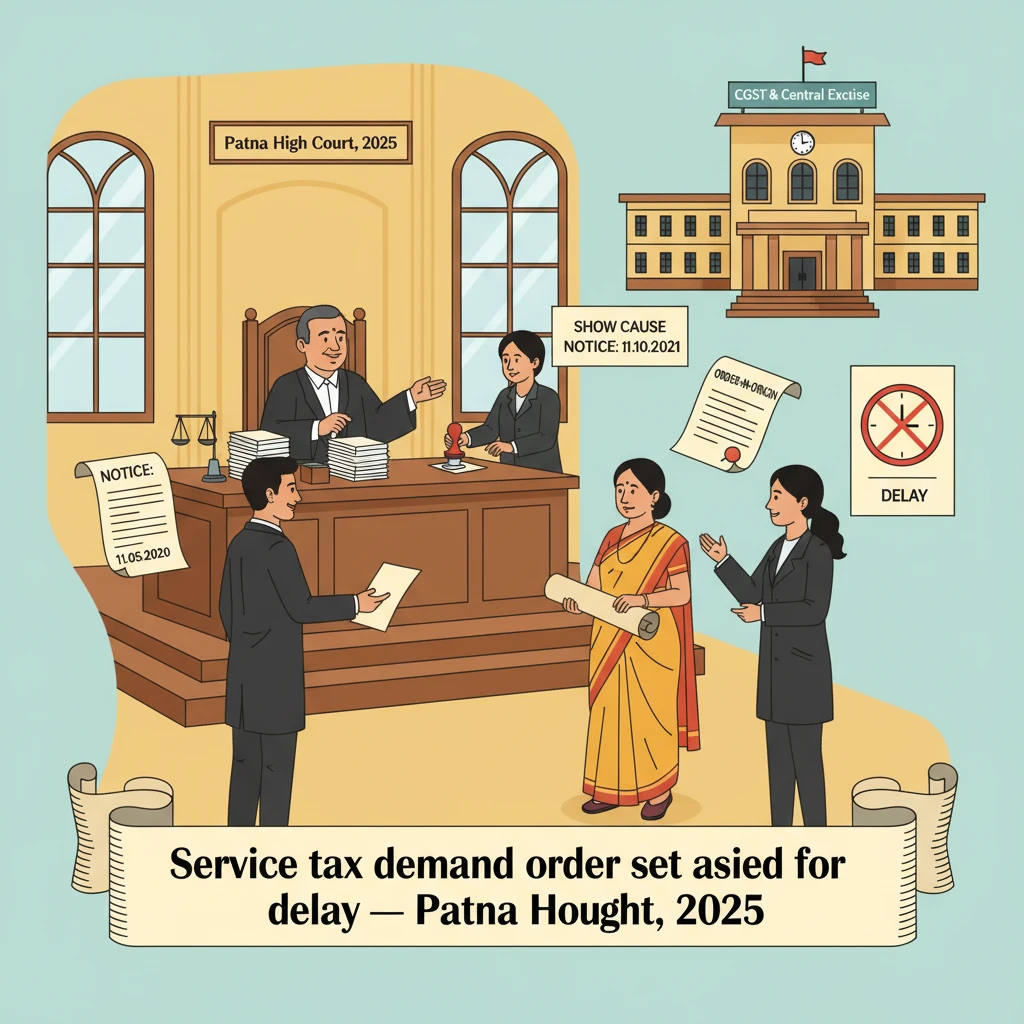
Case Background
The case arose from a dispute between a proprietorship concern and the Central GST and Central Excise authorities over alleged non-payment of service tax for the period April 2016 to June 2017.
On 11.05.2020, the Superintendent of CGST and CX, Buxar (Respondent No. 3) issued a notice to the petitioner’s late husband, Pankaj Rai. The notice alleged non-payment of service tax for the financial year 2016-17 on the basis of the gross turnover shown in the income tax return, particularly the amounts credited under Sections 194C, 194J and 194H of the Income Tax Act.
In that notice, the department demanded various documentary evidences within 15 days. When there was no compliance in the manner expected, a reminder notice was also issued. The late husband of the petitioner then submitted his reply on 06.09.2020. According to the petitioner, this reply was ignored and not acknowledged by the department.
Later, on 11.10.2021, a formal show cause notice was issued to the petitioner’s late husband by the Assistant Commissioner, CGST and CX, Patna West Division (Respondent No. 4). This show cause notice demanded service tax of Rs. 13,07,700/- for the period April 2016 to June 2017. It was issued under the proviso to sub-section (1) of Section 73 of the Finance Act, 1994 read with Section 174 of the CGST Act, 2017.
In this show cause notice, Respondent No. 4 alleged that there was wilful suppression and misrepresentation of facts by the noticee. Based on this allegation, the department invoked the extended limitation period of five years under the proviso to Section 73(1) of the Finance Act, 1994.
Subsequently, the file was transferred, and the Assistant Commissioner, CGST and Central Excise, Jamshedpur (Respondent No. 5) passed an Order-in-Original bearing No. AC/JSR/ST-120/2024 dated 13.05.2024. Through this order, Respondent No. 5 confirmed the demand of Rs. 13,07,700/- as service tax, imposed a penalty of a similar amount, and also levied applicable interest for the same period.
Aggrieved by this Order-in-Original and the very show cause notice itself, the proprietorship concern, acting through its authorised signatory, approached the Patna High Court in Civil Writ Jurisdiction Case No. 11936 of 2024. The main challenge was on the ground of limitation and delay in adjudication under Section 73 of the Finance Act, 1994.
What the Court Examined and Decided
The petitioner sought multiple reliefs. First, the petitioner asked for quashing of the show cause notice dated 11.10.2021 on the ground that it was time-barred under Section 73(1) of the Finance Act, 1994. According to the petitioner, the normal period of 30 months for issuing notice had expired and the extended period of limitation was not applicable.
Second, and more importantly, the petitioner challenged the Order-in-Original dated 13.05.2024. The core argument was that under sub-section (4B) of Section 73 of the Finance Act, 1994, the adjudicating authority is required to determine the service tax within one year from the date of the show cause notice, where it is possible to do so.
Here, the show cause notice was issued on 11.10.2021. However, the Order-in-Original was passed only on 13.05.2024, after a gap of more than two years and seven months. The petitioner argued that this long and unexplained delay violated the statutory scheme of Section 73(4B) and rendered the demand order without jurisdiction.
On 28.04.2025, when the matter first came up for substantive consideration, the Patna High Court took note of earlier decisions, including:
1. M/s Kanak Automobiles Private Limited vs. Union of India and Others (CWJC No. 18398 of 2023, decided on 04.04.2024).
2. Pawan Kumar Upmanyu vs. Union of India and Others (CWJC No. 11975 of 2024, decided on 14.02.2025).
3. M/s Power Spectrum, Sarbidipur, Kahalgaon, Bhagalpur vs. Union of India and Another (CWJC No. 16772 of 2024, decided on 17.04.2025).
The Court, therefore, asked the Additional Solicitor General to produce the departmental records to show what steps, if any, had been taken between 29.10.2021 and 18.12.2023.
When the records were produced, the Court examined them closely. It found that a draft show cause notice was placed before the competent authority on 08.10.2021 and was approved by the Assistant Commissioner on 11.10.2021. Thereafter, as per the Court’s finding, no action at all was taken in the file for a very long period.
The Court further noted that a response on behalf of the proprietorship concern was submitted on 20.10.2021. From the records, it appeared that the reply was actually received by the department on 02.11.2021, as shown by the seal and date affixed on the reply kept on file.
However, this receipt of reply was not recorded in the ordersheet. Between 11.10.2021 and 13.05.2024, the file showed no movement. No date was fixed, no hearing was recorded, and the matter was practically lying unattended.
Only at the time of passing the final order on 13.05.2024 did Respondent No. 5 record that he had gone through the show cause notice, the relevant case records, and the noticee’s submissions. The Court found this particularly problematic in light of Section 73(4B), which aims at expeditious determination of service tax dues.
The Court also noted that, in the counter affidavit filed by the respondents, there was no explanation as to why notice of personal hearing was issued only on 18.12.2023, i.e., after more than two years from the issuance of the show cause notice. No reason was offered for the long silence on the file.
The Patna High Court then discussed the legal position emerging from earlier judgments. In M/s Kanak Automobiles, a co-ordinate Bench had held that the one-year period in clause (b) of sub-section (4B) of Section 73 is not an absolute mandate that proceedings must always be completed within one year.
However, the same Bench clearly held that the statutory authority must take all possible steps to conclude the proceedings within one year. If no steps are taken during the entire one-year period, it frustrates the statutory goal of expediency, and such proceedings cannot be continued.
The decision in M/s Kanak Automobiles was challenged before the Supreme Court in SLP (Civil) Diary No. 54313/2024. By order dated 03.01.2025, the Supreme Court declined to interfere with the High Court’s judgment, noting that it was not laying down any general law but, considering the quantum involved, the Court was not inclined to interfere.
The Patna High Court also referred to its own earlier judgment in M/s Power Spectrum. In that case, the Order-in-Original had been passed after five years of the show cause notice. The Court, relying on decisions of the Delhi High Court in L.R. Sharma & Co. vs. Union of India (2024 SCC OnLine Del 9031) and Sunder System Pvt. Ltd. vs. Union of India and Others (2020 (33) G.S.T.L. 621 (Del)), emphasised that sub-section (4B) of Section 73 prescribes a time frame for adjudication.
The Delhi High Court, in turn, had relied on National Building Construction Co. Ltd. vs. Union of India, reported in 2019 (20) G.S.T.L. 515 (Del), where it was held that the limitation period for passing the adjudication order (Order-in-Original) under Section 73(4B) starts from the date of the show cause notice.
Further, the Patna High Court noted that the Delhi High Court in L.R. Sharma had referred to the judgment of the Gujarat High Court in Siddhi Vinayak Syntex Pvt. Ltd. vs. Union of India, reported in 2017 (352) E.L.T. 455 (Guj.). In that decision, interpreting Section 11A of the Central Excise Act, 1944, the Gujarat High Court explained that the phrase “where it is possible to do so” means that if in the ordinary course it is possible to determine the duty within the specified time frame, it should be done.
The Gujarat High Court recognised that genuine reasons such as large volume of evidence, bulky records, heavy workload, or non-availability of officers may sometimes prevent timely adjudication. But it made clear that consigning matters to the “call book” or keeping them in cold storage for years without genuine reasons is not permissible. The adjudicating authority must decide each case as it comes, unless stayed by a higher forum.
In the present writ petition, the Patna High Court also took note of yet another co-ordinate Bench decision in Pawan Kumar Upmanyu, where the Court set aside the departmental order due to unexplained delay beyond one year, considering both the delay and the quantum involved.
Applying these principles to the facts before it, the Court recorded a firm finding: from the records, there was absolutely no movement of the file for about two years after issuance of the show cause notice. No reason was shown to suggest that it was not possible to determine the petitioner’s liability within one year. The delay was entirely at the end of the tax authorities, without any justification on record.
In such circumstances, the Court held that the case is covered by its earlier decisions, including M/s Kanak Automobiles, M/s Power Spectrum and Pawan Kumar Upmanyu. As a result, the Patna High Court set aside the impugned Order-in-Original dated 13.05.2024 (Annexure P-5) and all consequential demands raised against the petitioner.
Before closing, the Court recorded its concern over the manner in which this case was kept pending without any movement of the file for more than two years. The Court observed that similar situations were appearing in several cases. It therefore requested the Chief Commissioner of CGST and CX (Respondent No. 2) to look into what went wrong in this matter and to examine the failure in the system. The nature of action to be taken was left to the wisdom of Respondent No. 2.
With these observations, the writ application was allowed.
Why This Judgment Matters
This judgment has practical importance for small businesses and service providers facing delayed tax adjudication. The Patna High Court reinforced that tax officers cannot simply issue a show cause notice and then keep the matter idle for years without any steps or reasons.
Section 73(4B) of the Finance Act, 1994 exists to ensure quick decision-making. For taxpayers, long uncertainty about large tax demands can cause serious financial and mental stress. The Court recognised this and treated unexplained departmental inaction as a serious flaw.
The ruling makes clear that when the department does nothing for years after issuing a show cause notice, and offers no genuine difficulty for not deciding within a year, the final demand order may be struck down. This encourages tax officers to process cases in a time-bound and documented manner.
It also signals to senior departmental authorities, like the Chief Commissioner, that internal failures in handling files must be examined and corrected. The Court’s direction to look into “what went wrong” reflects a broader concern about systemic delay in service tax and GST-related adjudications.
Legal Issues and Answers
- Issue: Whether an Order-in-Original passed more than two years after a show cause notice, with no movement of the file and no reason shown for delay, can stand in light of Section 73(4B) of the Finance Act, 1994.
Answer: No. In the facts of this case, where there was complete inaction for about two years and no reason shown that it was not possible to determine the tax within one year, the Patna High Court held that the Order-in-Original and consequent demands must be set aside. - Issue: Whether the tax department can ignore the statutory objective of expeditious adjudication under Section 73(4B) by keeping files pending without any steps.
Answer: No. The Court held that authorities must take all possible steps to conclude proceedings within the prescribed period. Total inaction frustrates the statutory goal of expediency and cannot be permitted.
Cases Cited by the Court
- M/s Kanak Automobiles Private Limited vs. The Union of India and Others (CWJC No. 18398 of 2023, Patna High Court, judgment dated 04.04.2024).
- M/s Power Spectrum, Sarbidipur, Kahalgaon, Bhagalpur vs. The Union of India and Another (CWJC No. 16772 of 2024, Patna High Court, judgment dated 17.04.2025).
- Pawan Kumar Upmanyu vs. The Union of India and Others (CWJC No. 11975 of 2024, Patna High Court, judgment dated 14.02.2025).
- L.R. Sharma & Co. vs. Union of India, 2024 SCC OnLine Del 9031 (Delhi High Court).
- Sunder System Pvt. Ltd. vs. Union of India and Others, 2020 (33) G.S.T.L. 621 (Del) (Delhi High Court).
- National Building Construction Co. Ltd. vs. Union of India, 2019 (20) G.S.T.L. 515 (Del) (Delhi High Court).
- Siddhi Vinayak Syntex Pvt. Ltd. vs. Union of India, 2017 (352) E.L.T. 455 (Guj.) (Gujarat High Court).
Case Details
Case Number: Civil Writ Jurisdiction Case No. 11936 of 2024
Case Title: Pankaj Rai (proprietorship concern) through authorised signatory Sima Rai vs. The Union of India & Others
Court: High Court of Judicature at Patna
Coram: Hon’ble Mr. Justice Rajeev Ranjan Prasad; Hon’ble Mr. Justice Ashok Kumar Pandey
Date of Judgment: 05.05.2025
Citation: 2025(3) PLJR 97
Advocates:
- For the Petitioner: Mr. Bijay Kumar Gupta, Advocate
- For the CGST & CX (Respondents): Dr. K.N. Singh, Additional Solicitor General; Mr. Anshuman Singh, Senior Standing Counsel; Mr. Shivaditya Dhari Sinha, Advocate; Mr. Alok Kumar, Advocate
Nature of the Case: Writ petition under Article 226 challenging show cause notice and Order-in-Original relating to service tax demand under Section 73 of the Finance Act, 1994 read with Section 174 of the CGST Act, 2017.
Link to judgement ; https://patnahighcourt.gov.in/viewjudgment/MTUjMTE5MzYjMjAyNCMxI04=-kMX–am1–FoApbBM=
If you found this explanation helpful and wish to stay informed about how legal developments may affect your rights in Bihar, you may consider following Samvida Law Associates for more updates.







