

Case Background
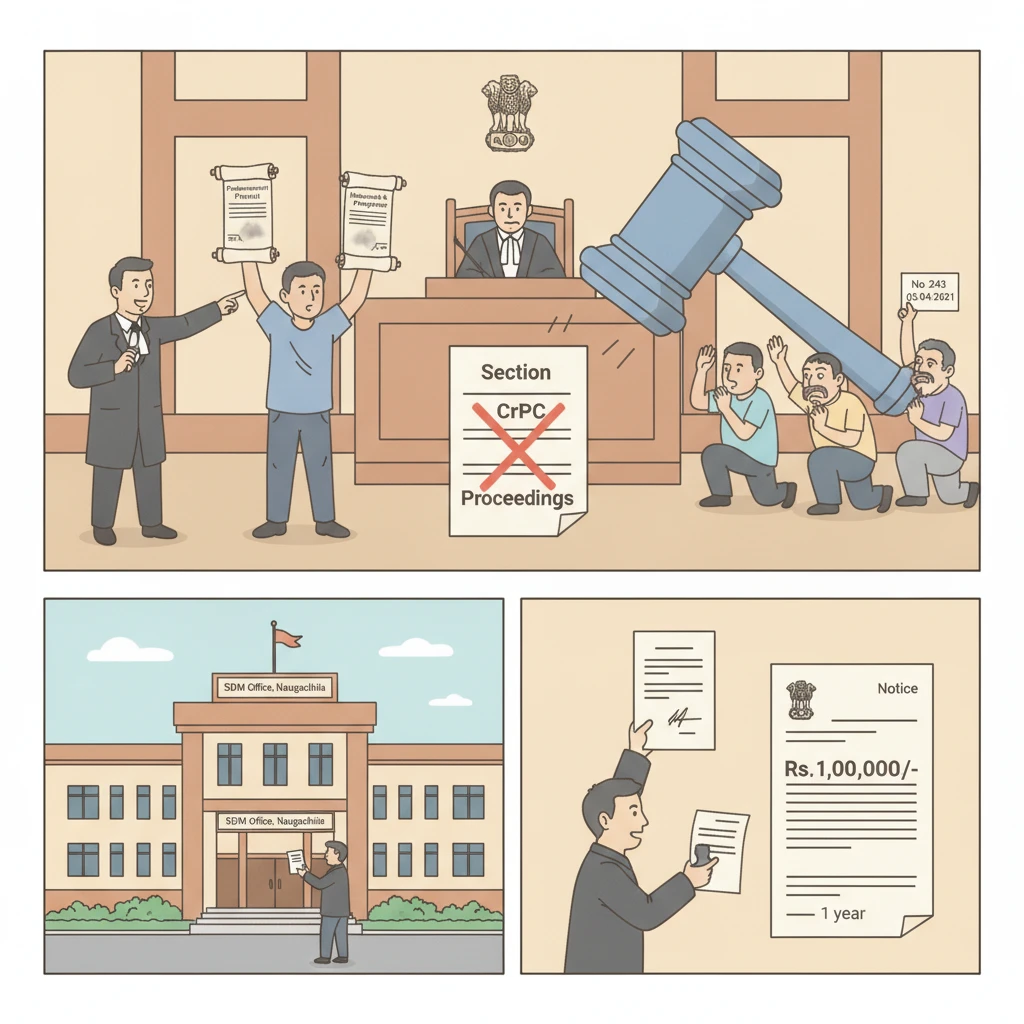
A criminal writ petition was filed before the Patna High Court challenging Case No. 437 of 2021. This case had been started by the Sub-Divisional Magistrate (SDM), Naugachhia, Bhagalpur under Section 107 of the Code of Criminal Procedure, 1973 (Cr.PC).
The trigger was a letter bearing No. 243 dated 03.04.2021, sent by the Assistant District Supply Officer, Naugachhia, to the Executive Magistrate. In this letter, it was alleged that the petitioner unnecessarily harassed Public Distribution System (PDS) dealers, demanded money from them and threatened to implicate them in false cases if his demands were not met.
Acting on this letter, the SDM initiated proceedings under Section 107 Cr.PC to “maintain peace”. The SDM ordered issuance of notice to the petitioner, calling upon him to show cause why he should not be directed to execute a bond of Rs. 1,00,000/-, with two sureties, for one year.
The petitioner appeared before the SDM in response to the notice and filed his show cause. He stated that he had earlier filed two RTI applications against the District Supply Officer. These related to distribution under the “Pradhanmantri Pravasi Majdoor” scheme and to the officer’s movable and immovable properties. According to the petitioner, the complaint by the Assistant District Supply Officer was a false and retaliatory one, made only because of these RTI filings, and that this had led to the initiation of the Section 107 Cr.PC proceeding.
Evidence was invited from both sides. After considering the pleadings and evidence, the SDM concluded that the petitioner extended “threat of journalism” to officers of the Supply Department and different schools of the Education Department, demanded money, and thereby created fear among employees and PDS dealers. Holding that there was a “possibility of breach of peace” in the area, the SDM passed a final order on 02.04.2022 directing the petitioner to execute a bond of Rs. 1,00,000/- with two sureties for one year.
By the time the writ petition came up for final hearing before the Patna High Court, the period of the bond had already lapsed. The State argued that the case had therefore become infructuous, and there was no need to examine the issues. The petitioner, however, pressed that the legality of such a proceeding still needed to be examined so that Executive Magistrates do not misuse Section 107 Cr.PC to harass ordinary citizens.
What the Court Examined and Decided
Hon’ble Mr. Justice Jitendra Kumar heard counsel for the petitioner and the State and also perused the SDM’s record. The Court first noted that the Section 107 Cr.PC proceeding had already been concluded by the final order dated 02.04.2022, and the bond period had expired. Despite this, the Court decided to decide the matter on merits, given the importance of clarifying the extent and scope of Executive Magistrates’ powers under Section 107 Cr.PC.
To explain the legal framework, the Court reproduced and discussed sections from Chapter VIII of the Cr.PC, particularly Sections 107, 111, 116, 117 and 118. It also noted the corresponding provisions now placed in Chapter IX of the Bharatiya Nagarik Suraksha Sanhita, 2023.
Section 107 Cr.PC empowers an Executive Magistrate to require a person to show cause why he should not execute a bond for keeping the peace, when the Magistrate receives information that such person is likely to commit a breach of the peace or disturb public tranquillity or to do any wrongful act that may probably cause such breach or disturbance, and if the Magistrate is of the opinion that there is sufficient ground for proceeding.
Section 111 Cr.PC requires the Magistrate to make a written order setting forth the substance of the information received, the amount of the bond, its term and details of sureties. Section 116 Cr.PC mandates an inquiry into the truth of the information, with evidence taken as in summons cases. Under Section 117 Cr.PC, only if it is proved through such inquiry that a bond is necessary for keeping the peace or maintaining good behaviour can the Magistrate order it. Section 118 Cr.PC requires discharge if such necessity is not proved.
On this legal base, the Court emphasised that Chapter VIII is “preventive and not punitive” in nature. Relying on the Supreme Court’s decision in Madhu Limaye v. Sub Divisional Magistrate Monghyr, 1970 (3) SCC 746, the Court stressed that this chapter confers an “extraordinary jurisdiction” meant to maintain public peace and good behaviour from persons who may be dangerous to the peace of society. It is not meant to punish for past acts.
The Court then surveyed several decisions explaining when Section 107 Cr.PC should not be used:
In Brahmdeo Singh v. State of Bihar, 1979 SCC OnLine Pat 172, this High Court held that when a substantive offence (such as assault) is already being prosecuted and there is no allegation of fresh overt act, starting a Section 107 proceeding is improper.
In Lovely v. State of Kerala, 2023 SCC OnLine Ker 7567, the Kerala High Court held that Section 107 is not meant to punish for past crime; it is a tool to prevent future breach of peace, and cannot be invoked merely because a person is accused in a registered crime.
In Jayanth K.C. v. State of Kerala, 2025 KHC 1591, it was reiterated that being an accused in a case is not enough to attract Section 107, and the apprehended breach of peace must be imminent, not a distant possibility.
In Christalin Costa v. State of Goa, 1992 SCC OnLine Bom 252, the Bombay High Court held that quarrels between private individuals, which at most create law-and-order issues, do not amount to “public order” or “public peace” justifying Section 107 action.
In Perswami Kandswami Devendra v. Sr. Inspector of Police, 2003 SCC OnLine Bom 251, and Sandeep Shivaji Mhatre v. State of Maharashtra, 2014 SCC OnLine Bom 5297, Bombay High Court ruled that domestic or petty neighbourhood quarrels or solitary incidents of violence cannot justify Section 107 proceedings.
In Ram Prakash v. State, 1996 SCC OnLine Del 314, the Delhi High Court set aside Section 107 proceedings arising out of a landlord–tenant dispute.
In Kuldeep Singh v. State of Bihar, 1988 SCC OnLine Pat 77, this Court held that vague allegations are not enough. There must be specific overt acts by the person concerned which reasonably give rise to apprehension of breach of peace.
From these precedents, the Patna High Court distilled key principles: Section 107 Cr.PC is for preventing imminent breach of public peace and disturbance of public tranquillity. It is not to be used for every ordinary dispute or past offence. There must be clear, specific acts indicating real danger to public peace at large, not just fear among a few individuals.
Next, the Court examined whether, instead of filing a writ petition, the petitioner ought to have invoked the High Court’s inherent criminal jurisdiction under Section 482 Cr.PC to challenge the SDM’s order. The Court discussed in detail the concept of alternative remedy and the difference between “maintainability” and “entertainability” of a writ petition.
Relying on Godrej Sara Lee Ltd. v. Excise and Taxation Officer-cum-Assessing Authority, 2023 SCC OnLine SC 95, the Court explained that although High Courts ordinarily do not entertain writ petitions when an effective alternative remedy exists, this is not a strict bar. It is a rule of policy, convenience and discretion, not of law. Maintainability concerns the court’s power to receive the case; entertainability concerns whether the court chooses to exercise that power.
The Court further cited Whirlpool Corporation v. Registrar of Trade Marks, Mumbai, (1998) 8 SCC 1, and Radha Krishan Industries v. State of Himachal Pradesh, (2021) 6 SCC 771, which lay down recognised exceptions when a writ can be entertained despite alternative remedies: where fundamental rights are involved, where principles of natural justice are violated, where orders are wholly without jurisdiction, or where the vires of legislation is challenged.
Applying these principles, the Court observed that although the petitioner could technically have approached the Court under Section 482 Cr.PC, the case fell within the recognised exceptions. If the Executive Magistrate had acted wholly without jurisdiction in starting the Section 107 proceeding, and if such action curtailed the petitioner’s liberty under Article 21 of the Constitution, the High Court could and should exercise its writ jurisdiction.
Turning to the facts, the Court noted that the allegations, even if accepted, suggested that at most the petitioner might have committed substantive offences under the Indian Penal Code (such as extortion or criminal intimidation). For such acts, the proper legal route was ordinary criminal prosecution, not a Section 107 Cr.PC proceeding.
Crucially, there was no allegation of any specific overt act by the petitioner that posed an imminent risk of breach of “public peace” or “public tranquillity” affecting the public at large. The SDM’s conclusion that employees and PDS dealers were living in fear from the petitioner did not automatically translate into a threat to public peace in the legal sense.
The Court held that, under Section 107 Cr.PC, there must be an allegation that the person’s acts are likely to disturb public order beyond a small circle of individuals. Fear experienced by some government employees or dealers, without more, is inadequate to invoke this extraordinary preventive jurisdiction.
On this reasoning, the Court concluded that the Executive Magistrate had “initiated the proceeding without any jurisdiction”. The SDM, under the guise of acting within authority, had “transcended his authority/jurisdiction”. Instead of resorting to Section 107 Cr.PC, the authorities should have lodged and pursued regular criminal cases, if they believed any offence had actually been committed.
The Court further characterised the initiation of the Section 107 Cr.PC proceeding as an infringement and curtailment of the petitioner’s fundamental right to personal liberty guaranteed by Article 21 of the Constitution. It held that life and liberty of a citizen cannot be curtailed or restricted in the manner adopted by the Executive Magistrate in this case.
Because the order was held to be wholly without jurisdiction and violative of Article 21, the High Court held that it was duty bound under Article 226 to entertain the writ petition and grant relief, despite the existence of an alternative remedy and despite the fact that the bond period had already expired.
Finally, by issuing a writ of certiorari, the Patna High Court quashed the entire proceeding in Case No. 437 of 2021 initiated under Section 107 Cr.PC by order dated 03.04.2021. The writ petition was allowed.
Recognising the wider implications, the Court directed the Registrar General to send a copy of this judgment to the concerned Executive Magistrate and also to the Chief Secretary, Government of Bihar, for circulation among all Executive Magistrates, so that they are properly informed about the limits of their power under Section 107 Cr.PC.
Why This Judgment Matters
This judgment is important for ordinary citizens who may face preventive proceedings under Section 107 Cr.PC based on complaints by officials or neighbours.
First, the Patna High Court has clearly said that Section 107 Cr.PC is not to be used as a shortcut whenever someone is accused of demanding money, harassing others or even committing offences. If an offence is alleged, police must register and investigate a proper criminal case instead of pushing a person into a preventive bond case.
Second, the Court has emphasised that Section 107 Cr.PC is only for preventing likely breach of public peace or disturbance of public tranquillity. Fear or annoyance affecting a limited set of individuals is not enough. For rural activists, RTI users, journalists or whistle-blowers who often face retaliatory actions, this clarification is particularly significant.
Third, the decision reinforces that misuse of preventive powers can amount to violation of Article 21. Even if a bond period has expired, courts can still step in to declare such actions illegal, so that the misuse is recorded and does not repeat.
Finally, by directing circulation of the order among Executive Magistrates in Bihar, the Court aims to prevent similar misuse in future and to ensure that preventive powers are exercised cautiously, with respect for citizens’ fundamental rights.
Legal Issues and Answers
Issue: Can the Patna High Court entertain a criminal writ petition against a Section 107 Cr.PC proceeding despite availability of a remedy under Section 482 Cr.PC?
Answer: Yes. The Court held that availability of an alternative remedy is not an absolute bar. Since the Executive Magistrate’s order was without jurisdiction and infringed the petitioner’s Article 21 right, the writ petition was entertainable under recognised exceptions.
Issue: Were the facts alleged against the petitioner sufficient in law to justify initiation of proceedings under Section 107 Cr.PC and the order to execute a bond for keeping peace?
Answer: No. The Court held that, at most, the allegations disclosed substantive offences triable under the IPC. There was no specific overt act showing imminent breach of public peace or disturbance of public tranquillity affecting the public at large. The Executive Magistrate therefore had no jurisdiction to invoke Section 107 Cr.PC.
Issue: What is the legal consequence of the SDM’s lack of jurisdiction in this case?
Answer: The entire proceeding in Case No. 437 of 2021, initiated by order dated 03.04.2021 under Section 107 Cr.PC, was quashed by writ of certiorari, and directions were issued for circulation of the judgment to Executive Magistrates in Bihar.
Cases Cited by the Court
- Madhu Limaye v. Sub Divisional Magistrate Monghyr, 1970 (3) SCC 746
- Brahmdeo Singh v. State of Bihar, 1979 SCC OnLine Pat 172
- Lovely v. State of Kerala, 2023 SCC OnLine Ker 7567
- Jayanth K.C. v. State of Kerala, 2025 KHC 1591
- Christalin Costa v. State of Goa and Others, 1992 SCC OnLine Bom 252
- Perswami Kandswami Devendra v. Sr. Inspector of Police, 2003 SCC OnLine Bom 251
- Sandeep Shivaji Mhatre v. State of Maharashtra and Another, 2014 SCC OnLine Bom 5297
- Ram Prakash and Another v. State, 1996 SCC OnLine Del 314
- Kuldeep Singh and Others v. State of Bihar and Others, 1988 SCC OnLine Pat 77
- Godrej Sara Lee Ltd. v. Excise and Taxation Officer-cum-Assessing Authority and Others, 2023 SCC OnLine SC 95
- Whirlpool Corporation v. Registrar of Trade Marks, Mumbai and Others, (1998) 8 SCC 1
- Radha Krishan Industries v. State of Himachal Pradesh and Others, (2021) 6 SCC 771
Case Details
Case Number: Criminal Writ Jurisdiction Case No. 1119 of 2021
Case Title: Lalan Prasad Singh v. The State of Bihar & Others
Citation: 2022 (2) PLJR 440
Coram: Hon’ble Mr. Justice Jitendra Kumar
Advocates:
- For the petitioner: Mr. Shambhu Sharan Singh, Advocate
- For the State: Mr. Vijay Kumar Sinha, AC to AAG-5
Nature of the Case: Criminal writ petition under Article 226 of the Constitution challenging proceedings under Section 107 Cr.PC and seeking quashing of the entire proceeding in Case No. 437 of 2021.
Date of Judgment: 07.04.2026
Impugned Proceeding: Order dated 03.04.2021 passed by the Sub-Divisional Magistrate, Naugachhia, Bhagalpur in Case No. 437 of 2021 under Section 107 Cr.PC, and final order dated 02.04.2022 directing execution of bond for one year.
Link to Judgment: Full text of Patna High Court judgment
If you found this explanation helpful and wish to stay informed about
how legal developments may affect your rights in Bihar,
you may consider following Samvida Law Associates for more updates.







