
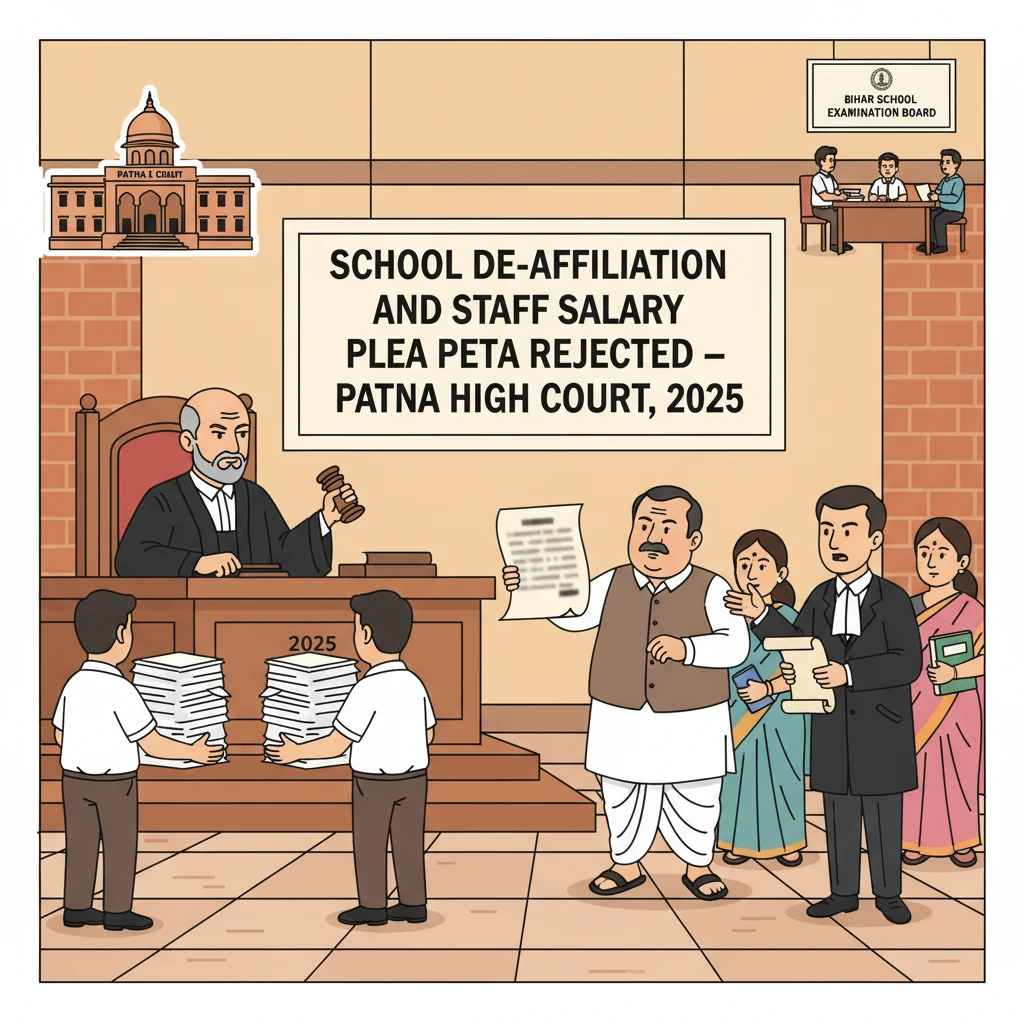
Case Background
The main dispute arose from the cancellation of recognition and affiliation of Dr. Zakir Hussain High School, Sultanganj, Patna. The school approached the Patna High Court in Civil Writ Jurisdiction Case No. 12304 of 2021 through its Secretary.
The school was established on 06.01.1970. On 29.06.1978, “Dr. Zakir Hussain Millat Memorial Education Society” was registered under the Societies Registration Act. Later, by Memo No. 1999 dated 02.10.1980, the Department of Education, Government of Bihar, under the order of the Governor, acquired 2860 non-government secondary schools, including this school, with effect from 02.10.1980.
The petitioner asserted that before the school was given Government-aided minority status, the matter went to the State Education Minister. The Minister allegedly recommended affiliation by relaxing land and building requirements. Acting on this, the Director, Secondary Education, issued Memo No. 10235-44 dated 19.04.1983, conferring minority status and approving the services of the teaching and non-teaching staff.
After approval, the Education Department began paying regular pay scale salaries to the school staff up to May 2021. Later, by Memo No. 648 dated 03.09.1991, the Director, Secondary Education, permitted the school to run +2 (Intermediate) classes in Arts, Science, and Commerce from the 1991–1992 session, with fixed intake capacities in each stream.
On 06.04.2021, the Bihar School Examination Board (BSEB) received a complaint against the school. A three-member Enquiry Committee was formed. The present litigation stems from that complaint and the resulting inspection, suspension, and cancellation orders.
Alongside the school’s writ petition, another writ petition, CWJC No. 13142 of 2023, was filed by the teaching and non-teaching employees. They sought directions for release of monthly salary, which the District Education Officer, Patna, had withheld from June 2021, after the school’s affiliation was put under question.
Because the employees’ claim depended entirely on the outcome of the school’s challenge to de-affiliation, both cases were heard together and decided by a common judgment dated 09.12.2025 by Hon’ble Mr. Justice Harish Kumar of the Patna High Court.
What the Court Examined and Decided
After hearing counsel for the school, the employees, the State, and the Bihar School Examination Board, the Patna High Court narrates in detail how the BSEB proceeded.
The Enquiry Committee visited the school on 10.04.2021. During inspection, the Principal could not produce the required documents and sought more time. The Director (Academic), BSEB, by Memo No. 302 dated 13.04.2021, gave one week’s time to the Secretary of the school.
When the requested documents were still not submitted, the Director (Academic) issued letter No. 743 dated 29.04.2021. By this letter, the BSEB suspended the school’s affiliation and issued a show-cause notice asking why the permanent affiliation, and codes (Secondary Code 71102 and Higher Secondary Code 17011), should not be cancelled.
The school replied to the show-cause notice. However, its explanation was not accepted. After considering the enquiry report and materials on record, the Director (Academic) passed the impugned letter No. BSEB (SS) Coll-Estab/806/D-2021 dated 14.06.2021 cancelling the school’s recognition, affiliation, and codes.
In the writ petition, the school challenged this cancellation and alleged serious procedural lapses. The main submissions of the school were:
First, that no proper written notice of inspection was served and only a telephonic intimation was allegedly given to the Principal. It was argued that inspection and swift suspension of affiliation during the peak of the COVID-19 pandemic showed haste and malafides.
Second, the school complained that the initial inspection was triggered by an anonymous complaint. A copy of this complaint was never supplied to the school. Therefore, according to the petitioner, the entire process violated principles of natural justice.
Third, the school relied heavily on a letter No. 227 dated 29.06.1982 of the Regional Deputy Director, Patna Division. According to the petitioner, this letter allowed minority schools like this one to get permanent affiliation with relaxed conditions regarding land and building. The petitioner maintained that this order was still in force and, at the time of affiliation in 1983, land was not a strict requirement under the Bihar Education Board Ordinance, 1974 and Bihar Education Board Act, 1976.
On that basis, the school argued that the later Bihar School Examination Board (Senior Secondary) Affiliation Regulation, 2011 (as amended in 2013) and the BSEB Act, 2019 should not apply to it. Instead, it claimed that only the Bihar Non-Government Secondary School (Taking Over of Management and Control) Act, 1981 would govern it.
The petitioner further argued that the appointment of the Principal was legal. It said the Principal, Md. Naqui Imam, was appointed on recommendation of the Vidyalaya Seva Board through letter No. 1755 dated 01.07.1996 issued by the District Education Officer, Patna. The Principal allegedly possessed all required qualifications, and there was no provision to de-affiliate a school merely for alleged irregularities in principal’s appointment.
The petitioner also denied allegations of misappropriating government funds under the Poshak (uniform) and Cycle schemes, stating that all funds were directly transferred to students through Direct Benefit Transfer (DBT).
To allege discrimination, the school placed on record, by an interlocutory application, a list of 28 schools which, according to the petitioner, had been granted recognition without meeting land and building requirements yet continued to function. The school claimed that canceling its affiliation while letting similarly placed, allegedly “landless and building-less” schools run, violated Article 14 of the Constitution.
On the other hand, counsel for the BSEB defended the impugned order as a detailed and reasoned one passed strictly under the Bihar School Examination Board Act, 2019 and Bihar School Examination Board (Senior Secondary) Affiliation Regulation, 2011 (as amended in 2013). The Board submitted that the Enquiry Committee conducted on-spot inspection, the school failed to produce documents, suspension and show-cause followed, and after considering the reply, a final order was passed.
The Board pointed out that under the 2011 Regulations, Chapter 2, Regulation 3(3) prescribes mandatory land requirements: at least 1158 square metres (0.29 acres) of land for physical infrastructure, a minimum playground of one acre (which can be shared in urban areas), and in cities, land of not less than one acre with at least two acres total (owned or on 30-year lease). Under Regulation 15(3)(vii), the Board can withdraw affiliation for non-availability of proper space, staff, or equipment for teaching.
On facts, the Board found that the school possessed only 9 katha of land in the name of the society, clearly below the prescribed norms. The Board further alleged that records submitted by the school were interpolated, and that the Principal had been initially appointed as a clerk before being made Principal without the prescribed eligibility.
The Board argued that there was no power to relax statutory conditions under the 2011 Affiliation Regulations, so any letter of the Regional Deputy Director could not override them. It also referred to earlier decisions of the Patna High Court, including CWJC No. 8752 of 2017 and LPA No. 1478 of 2017, which had already upheld BSEB’s power to inspect schools even if they were affiliated before the 2011 Regulations came into force.
The State and private respondents supported the BSEB’s stand. They highlighted that Title Suit No. 80 of 2022 was pending before the Sub-Judge 1st, Patna, alleging illegal mutation of part of the school’s land by the society, and that an FIR had been lodged alleging fraud in mutation.
After hearing all sides, the Court framed four specific issues: (i) whether BSEB’s action violated Article 14 by targeting this school while allegedly sparing others; (ii) whether statutory conditions could be waived by executive orders; (iii) whether BSEB could inspect schools affiliated prior to the 2011 Regulations; and (iv) whether minority institutions could claim autonomy or relaxation from such statutory measures.
On the first issue, the Court noted the admitted fact that the school only had 9 katha of land, far short of the requirements in Regulation 3(3) of Chapter 2 of the 2011 Regulations. Relying on Supreme Court rulings in Basawaraj v. Special Land Acquisition Officer and State of Bihar v. Kameshwar Prasad Singh, the Court held that Article 14 does not permit “negative equality”. In simple terms, just because some other schools may have been wrongly allowed to function without meeting norms, that illegality cannot be used to demand the same benefit.
Therefore, even if some other schools are non-compliant, that does not give this school a right to continue in violation of statutory land requirements. The Court held that BSEB’s action was not hit by Article 14.
On the second issue, the Court reiterated the settled law that executive instructions or office orders cannot override or contradict statutory rules. Citing Pimpri Chinchwad New Township Development Authority v. Vishnudev Cooperative Housing Society and M. Narayan Nambiar v. State of Kerala, the Court said that exercising power not vested in an authority amounts to abuse of power.
Since both the 2011 Affiliation Regulations and earlier the Intermediate Education Council Act, 1992 required specified land, building, playground and other infrastructure, the Regional Deputy Director or even the Education Minister could not legally waive those statutory conditions. The Court found that the school never met the mandatory norms under Section 18(1) and 18(2) of the 1992 Act either. Thus any earlier relaxation letter could not protect the school against statutory requirements.
On the third issue, regarding BSEB’s power to inspect old institutions, the Court followed the Division Bench decision in Ganesh Prasad Singh v. State of Bihar (LPA No. 1478 of 2017) and related cases. Those decisions had already upheld that, following amendments in 2013, the BSEB could insist that even previously recognized intermediate colleges and schools comply with updated norms and could inspect them for that purpose.
The Court also referred to LPA No. 405 of 2022 (The Chairman, Bihar School Examination Board (Senior Secondary) v. Sambadh Degree Mahavidyalaya Seva Sangh and analogous cases). In that case, the Division Bench held that although earlier recognition of intermediate colleges continued under deeming provisions, the State and BSEB could still impose new standards and conditions to improve the quality of secondary and senior secondary education. The Court underlined that educational standards cannot be frozen at the level of 1992 and must evolve.
Based on these precedents, the Court concluded that BSEB clearly had power to inspect schools, including those affiliated before the 2011 Regulations, and to check whether they still fulfilled norms.
On the fourth issue, concerning minority institutions, the Court relied on the Supreme Court’s seven-judge bench decision in P.A. Inamdar v. State of Maharashtra and on Kanya Junior High School, Bal Vidya Mandir Etah v. U.P. Basic Shiksha Parishad. These decisions clarify that minority institutions do not enjoy higher rights than others; they only receive additional protection. They remain subject to reasonable regulatory measures necessary to maintain educational standards, unless the statute itself grants an exemption.
The Court observed that under the 2011 Regulations and the 2013 amendments, no special relaxation is provided to minority institutions regarding infrastructure and land. Therefore, even assuming the petitioner-school is a minority institution, it cannot be exempted from basic affiliation norms like land, building, and playground, which are treated as sine qua non (absolute prerequisites) for affiliation and its continuance.
The Court also noted inspection findings about interpolation of records and irregularities in the Principal’s appointment, but even leaving these aside, the admitted lack of required land and infrastructure was, by itself, sufficient reason to cancel affiliation.
After answering all four issues against the petitioner-school, the Patna High Court held that there was no merit in CWJC No. 12304 of 2021 and dismissed the writ petition.
Since CWJC No. 13142 of 2023 by teachers and staff depended entirely on the school’s success in challenging de-affiliation, that writ petition also failed. However, the Court gave an important clarification: the dismissal of the writs will not prevent teaching and non-teaching employees from claiming any benefits (such as salary) that had accrued to them for services rendered before the cancellation order. For such claims, they are free to approach appropriate authorities or courts in accordance with law.
Why This Judgment Matters
This judgment is significant for private and minority schools across Bihar, especially those functioning with limited land or infrastructure. The Patna High Court has made it clear that affiliation norms under the Bihar School Examination Board’s Regulations are mandatory, not optional.
Schools cannot rely on old letters or alleged ministerial relaxations if they do not meet the basic statutory requirements. Similarly, pointing to other non-compliant schools that are still running will not help; the Court has reaffirmed that no one can claim “equality” in illegality.
For minority institutions, the decision reinforces that constitutional protection does not mean exemption from essential safety and quality standards set for all schools. Minority status cannot be used as a shield against land, building, and infrastructure norms aimed at ensuring a proper learning environment.
For teachers and staff, the judgment underlines that salary claims after de-affiliation may not succeed if the institution itself loses recognition. However, their rights to salary and benefits for work already done before cancellation remain intact, and they may pursue them separately.
Legal Issues and Answers
- Issue: Did cancelling this school’s affiliation while other allegedly non-compliant schools were allowed to function violate Article 14 (equality) of the Constitution?
Answer: No. The Court held there is no concept of negative equality; one illegality cannot justify another. The school’s admitted failure to meet land norms justified cancellation. - Issue: Can statutory conditions for affiliation, like land and infrastructure norms, be relaxed by executive orders or ministerial directions?
Answer: No. Executive instructions cannot override statutory rules. The Regional Deputy Director and Education Minister had no authority to waive mandatory conditions prescribed in law and regulations. - Issue: Does the Bihar School Examination Board have power to inspect and enforce norms on schools that were affiliated before the 2011 Affiliation Regulations came into force?
Answer: Yes. Relying on earlier Division Bench judgments, the Court held BSEB can inspect and regulate such schools under the 2011 Regulations and 2013 amendments. - Issue: Are minority institutions exempt from these statutory measures regulating infrastructure and affiliation?
Answer: No. Minority institutions have additional protection but are not immune from general regulatory measures. As the 2011 Regulations give no special relaxation, minority schools must also meet the same land and infrastructure requirements.
Cases Cited by the Court
- Basawaraj and Anr. v. Special Land Acquisition Officer, (2013) 14 SCC 81
- State of Bihar and Ors. v. Kameshwar Prasad Singh and Anr., (2009) 9 SCC 1994
- Gursharan Singh v. New Delhi Municipal Committee, (1996) 2 SCC 459 (quoted within Kameshwar Prasad)
- Secy., Jaipur Development Authority v. Daulat Mal Jain, (1997) 1 SCC 35
- Pimpri Chinchwad New Township Development Authority v. Vishnudev Cooperative Housing Society & Ors., (2018) 8 SCC 215
- M. Narayan Nambiar v. State of Kerala, 1962 SCC OnLine SC 85
- Ganesh Prasad Singh & Anr. v. The State of Bihar & Ors., LPA No. 1478 of 2017
- The Chairman, Bihar School Examination Board (Senior Secondary) & Anr. v. Sambadh Degree Mahavidyalaya Seva Sangh, LPA No. 405 of 2022 and analogous cases
- P.A. Inamdar v. State of Maharashtra, (2005) 6 SCC 537
- Kanya Junior High School, Bal Vidya Mandir Etah, U.P. v. U.P. Basic Shiksha Parishad Allahabad & Ors., (2006) 1 SCC 1992
Case Details
Case Number: Civil Writ Jurisdiction Case No. 12304 of 2021; with Civil Writ Jurisdiction Case No. 13142 of 2023
Case Title: Dr. Zakir Hussain 10 plus 2 High School Sultanganj, Patna, Bihar through its Secretary Mumtaz Ahmad v. The State of Bihar & Ors.; with Abdus Sattar & Ors. v. The State of Bihar & Ors.
Coram: Hon’ble Mr. Justice Harish Kumar
Citation: 2024(2) PLJR 411
Advocates:
In CWJC No. 12304 of 2021:
- For the petitioner-school: Mr. Purushottam Kumar Jha, Advocate; Mr. Suman Kumar, Advocate
- For the State-respondents: Mr. P. Mishra, Assistant Counsel to Standing Counsel-16
- For Bihar School Examination Board: Mr. Siddhartha Prasad, Advocate
In CWJC No. 13142 of 2023:
- For the petitioner-employees: Mr. Purushottam Kumar Jha, Advocate; Mr. Avanindra Kumar Jha, Advocate
- For the State-respondents: Mr. Madhaw Prasad Yadaw, Government Pleader-23
- For Bihar School Examination Board: Mr. Siddhartha Prasad, Advocate
Nature of the Case: Writ petitions under Article 226 of the Constitution challenging cancellation of school recognition and affiliation by Bihar School Examination Board, and a connected writ by teaching and non-teaching staff seeking release of withheld salary.
Date of Judgment: 09.12.2025
Link to Full Judgment: MTUjMTIzMDQjMjAyMSMxI04=-W3d3ONHiQDw=
If you found this explanation helpful and wish to stay informed about
how legal developments may affect your rights in Bihar,
you may consider following Samvida Law Associates for more updates.







