
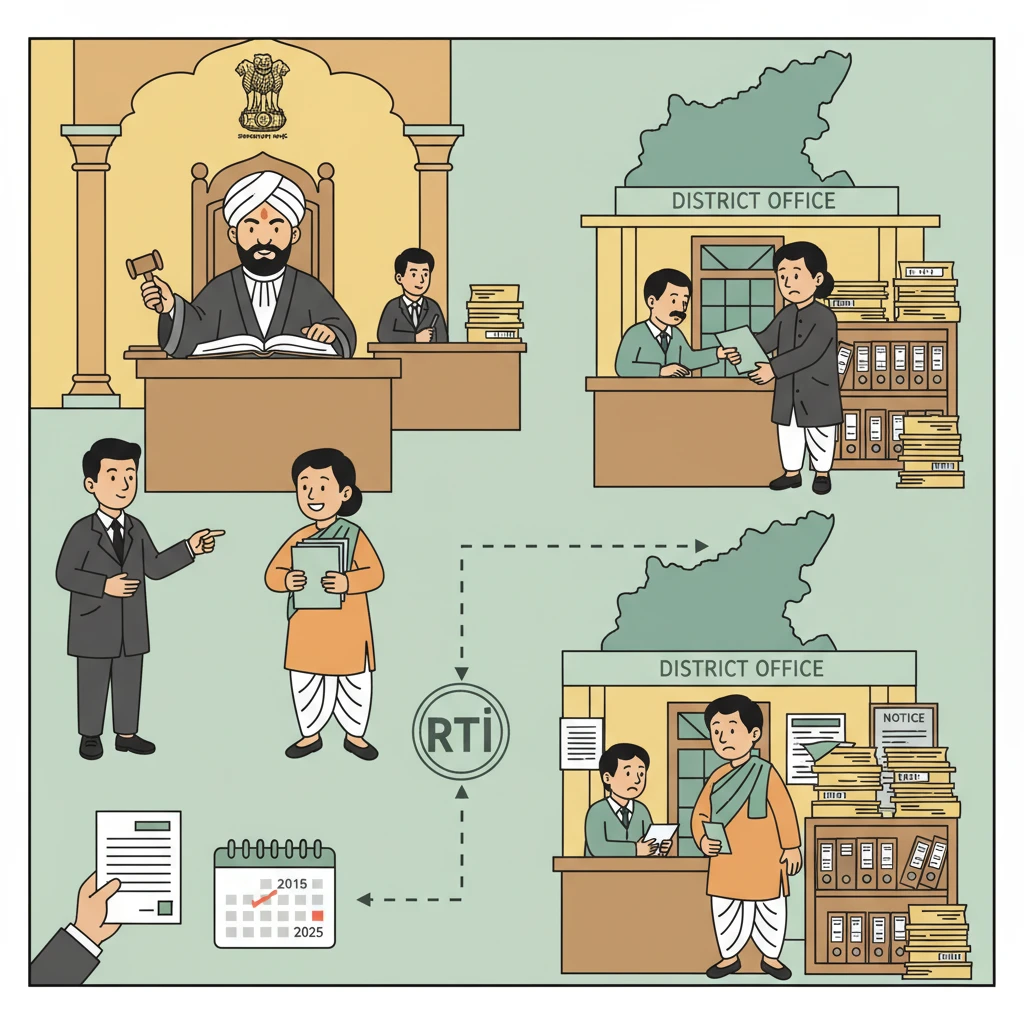
Case Background
The petitioner was appointed as a Panchayat Teacher against one of 18 vacant posts under the Bihar Panchayat Primary Teacher (Appointment and Service Conditions) Rules, 2006.
After his appointment, the authorities treated his entry in service as “illegal” and alleged that he had wrongly entered into service. On this basis, they did not pay him salary from the date of joining, even though he continued to work.
The petitioner stated that he has been discharging his duties as Panchayat Teacher from his initial joining and that, unlike some others, his services were never terminated.
In the same district, similar allegations had earlier arisen against other Panchayat Teachers. In those matters, enquiries were held, termination orders were passed, appeals were filed before the District Teacher Employment Appellate Tribunal, and then writ petitions and appeals reached the Patna High Court.
One such earlier writ petition, CWJC No. 935 of 2010, led to an order dated 21.02.2013, where the High Court directed the Appellate Tribunal at Sheikhpura to reconsider those teachers’ cases afresh, using authenticated documents obtained under the Right to Information Act, and to seek clarification from the concerned Judicial Magistrate if needed.
On remand, the Appellate Authority passed an order dated 27.08.2013 saying that, in the absence of documents, it could not decide and consequently dismissed the appeals. The affected teachers challenged that order in CWJC No. 19201 of 2013, which was dismissed, and then filed Letters Patent Appeal No. 63 of 2014.
In LPA No. 63 of 2014, the Division Bench found that though the Block Development Officer’s termination order had been interfered with by the Appellate Authority, no authority had recorded any finding that the appointments were illegal. Because the enquiry could not be concluded for want of documents, the Division Bench held that the appellants could not be kept out of service on that ground alone. The Bench directed their reinstatement and payment of wages from the date of reinstatement by order dated 01.09.2016.
Later, in CWJC No. 24491 of 2019, other similarly situated persons from the same district sought arrears of salary in light of the LPA No. 63 of 2014 judgment. By order dated 14.02.2020, the High Court, without going into the merits, directed the respondents to examine their cases in the light of the LPA decision and to pass appropriate orders regarding payment of salary within three months.
Against this backdrop, the present petitioner approached the Patna High Court in Civil Writ Jurisdiction Case No. 7931 of 2019, asking for payment of salary from his date of joining, in terms of the Division Bench’s judgment in LPA No. 63 of 2014.
What the Court Examined and Decided
The core claim of the petitioner was that he was duly appointed as a Panchayat Teacher under the 2006 Rules against one of 18 vacant posts, has continuously discharged his duties since joining, and yet has been denied salary on the allegation that his entry into service was illegal.
He relied on the judgment of the Division Bench in Letters Patent Appeal No. 63 of 2014, decided on 01.09.2016. In that appeal, teachers whose services had been terminated had successfully challenged the orders of the authorities because no clear finding of illegal appointment had been recorded against them.
The petitioner argued that his case was on an even better footing than those appellants. In their case, services were terminated, yet they were ultimately reinstated and granted wages from reinstatement. In his case, there was not even any termination order. He has been allowed to continue working on the post of Panchayat Teacher since his initial joining, and therefore, if his case falls within the parameters of LPA No. 63 of 2014, he should also get relief in terms of salary.
He further pointed out that in CWJC No. 24491 of 2019, the Patna High Court had already directed authorities to examine similar claims of other teachers from the same district in light of LPA No. 63 of 2014, and to pass orders for payment of salary. He asked for a similar direction in his case.
Importantly, the petitioner made it clear that he had no objection to any enquiry being undertaken by the respondents, as directed in the case of the LPA appellants. He expressed readiness to cooperate with such enquiry, and submitted that if, upon verification, his claim is found genuine, the authorities should be directed to pass consequential orders for payment of salary without delay.
The State, through its counsel, opposed the writ petition. It relied on its counter affidavit, particularly paragraphs 10 and 11, alleging that the petitioner had wrongfully entered into service and challenging the applicability of the Division Bench judgment in LPA No. 63 of 2014 to him.
The State also argued that since the petitioner was not a party in CWJC No. 24491 of 2019 or in LPA No. 63 of 2014, he could not claim the benefit of those judgments.
The Patna High Court, presided over by Hon’ble Mr. Justice Ajit Kumar, carefully considered these rival submissions.
The Court first noted that the Division Bench in LPA No. 63 of 2014 had directed the authorities to undertake enquiry for verification of documents and, in that context, had ordered reinstatement and payment of wages from reinstatement date for the appellants, because no adverse finding of illegal appointment had been recorded against them.
The Court then observed that the present petitioner’s case stands on a better footing. While the State alleges his appointment is illegal, they have simultaneously allowed him to continue discharging his duties since 2018, without ever passing a termination order.
This conduct of the authorities was central to the Court’s reasoning. The Court found that, on one hand, the respondents contend that the petitioner’s appointment is illegal; on the other hand, they have let him continue in service for years. This, in the Court’s view, was sufficient, at least prima facie, to show that no adverse material has been found against the petitioner.
On this basis, the Court held that the argument that the petitioner’s appointment is illegal could not be accepted. It expressly rejected that contention.
To explain this, the Court relied on the legal doctrine that a party cannot “approbate and reprobate”. This doctrine is described as a species of estoppel, lying between “estoppel by record” and “estoppel in pais”. The Court explained that “estoppel in pais”, also known as equitable estoppel or estoppel by conduct, prevents a party from asserting a right or defence that is inconsistent with their earlier conduct.
Since the respondents themselves had allowed the petitioner to serve on the post without interruption from his joining in 2018, they could not now be heard to say his appointment was illegal while still retaining him in service. Their conduct was inconsistent with their allegation of illegality.
At the same time, the Court did not bypass the need for verification. Respecting the framework of LPA No. 63 of 2014, the Court granted liberty to the respondents to verify the petitioner’s documents, but clearly limited their power.
The Court directed that the respondents are “vested only with the liberty” to verify his documents strictly in consonance with the directions issued in LPA No. 63 of 2014. It specifically held that this must be done “without disturbing the petitioner in any manner.” In other words, the petitioner’s service and position as Panchayat Teacher are to remain intact during the verification process.
The Court further ordered that if, after such verification, the petitioner’s documents are found to be genuine and he is found eligible for payment of arrears of salary from the date of initial joining, then the concerned authorities must calculate and pay the arrears “without any further delay”, and in any case within a maximum period of three months from the date of production or receipt of a copy of the Court’s order.
With these directions and observations, the writ petition was disposed of. The Court did not directly compute or order immediate payment of arrears but created a clear, time-bound mechanism which strongly protects the petitioner’s continuity in service and gives him a conditional right to arrears subject to document verification.
Why This Judgment Matters
This judgment is significant for Panchayat Teachers and other contractual teachers in Bihar who face allegations of illegal appointment but continue to work for years without salary or with partial benefits.
The Patna High Court has made it clear that the State cannot enjoy the benefit of a person’s work while simultaneously claiming that his appointment is illegal, without ever terminating him.
By applying the doctrine of estoppel in conduct, the Court has warned authorities that they cannot “approbate and reprobate” — they must act consistently. If they treat a person as an employee over time, they cannot easily deny him basic dues like salary on vague allegations.
The judgment also ties the petitioner’s case to the earlier Division Bench ruling in LPA No. 63 of 2014. It confirms that similarly placed teachers can seek comparable treatment, at least to the extent of document verification as per that precedent and consideration of salary claims thereafter.
For affected teachers, this order shows that the Court is willing to protect their service, insist on proper verification of records, and fix a clear time limit for deciding arrears claims, instead of leaving them in prolonged uncertainty.
Legal Issues and Answers
- Issue: Can the State deny salary to a Panchayat Teacher on the ground of alleged illegal appointment while allowing him to continue in service without any termination order?
Answer: No. The Court held that such a stand is barred by the doctrine of estoppel; the respondents cannot approbate and reprobate. Their conduct in continuously allowing him to work shows no adverse material, and the plea of illegality was rejected. - Issue: What action can the authorities take regarding verification of the teacher’s appointment and salary entitlement?
Answer: The authorities are permitted only to verify his documents strictly as directed in LPA No. 63 of 2014, without disturbing his service, and if the documents are found genuine, they must calculate and pay arrears from the date of initial joining within three months. - Issue: Is the petitioner entitled to rely on the Division Bench judgment in LPA No. 63 of 2014 even though he was not a party to that case?
Answer: While not declaring him a direct beneficiary of that judgment, the Court applied its principles and directions on enquiry and verification, and extended similar procedural protection and relief structure to the petitioner’s case.
Cases Cited by the Court
- The Court expressly relied on the judgment of the Hon’ble Division Bench in Letters Patent Appeal No. 63 of 2014, order dated 01.09.2016.
- The Court also referred to earlier proceedings in CWJC No. 935 of 2010 (order dated 21.02.2013), CWJC No. 19201 of 2013, and CWJC No. 24491 of 2019 as part of the factual and procedural background.
Case Details
Case Number: Civil Writ Jurisdiction Case No. 7931 of 2019
Case Title: Pankaj Kumar v. The State of Bihar & Ors.
Coram: Hon’ble Mr. Justice Ajit Kumar
Citation: 2025 (4) PLJR 518
Advocates:
- For the Petitioner: Mr. Abhishek Krishna Gupta, Advocate
- For the Respondents/State: Ms. Abhanjali, AC to GA-12
Nature of the Case: Writ petition under Article 226 of the Constitution seeking direction for payment of salary from date of joining as Panchayat Teacher and related relief, in light of prior Division Bench judgment.
Date of Judgment: 15.09.2025
Link to Judgment: Patna High Court Judgment – CWJC No. 7931 of 2019
If you found this explanation helpful and wish to stay informed about
how legal developments may affect your rights in Bihar,
you may consider following Samvida Law Associates for more updates.







