

Case Background
The dispute began as a partition case within a joint family from Village Pathkhauli, Police Station Bagaha, District West Champaran. A Title Partition Suit No. 94 of 1984 was filed by some family members as plaintiffs before the civil court.
On 30.08.1996, the Trial Court dismissed the partition suit on contest. The decree followed on 18.09.1996. The plaintiffs were unhappy and moved the First Appellate Court by filing Title Appeal No. 76 of 1996.
In that appeal, appellant numbers 1 to 5 were the original plaintiffs. Some of the defendants from the Trial Court, who were sons of defendant no. 2 and were arrayed as defendant nos. 9 to 12, became respondent nos. 7 to 10 in the appeal. On their prayer, they were transposed as appellant nos. 6 to 9 in the appeal, on the basis that they had an interest in contesting the matter.
The First Appellate Court, by judgment dated 01.11.2014, dismissed Title Appeal No. 76 of 1996 on contest. Thus, both the Trial Court and the First Appellate Court had rejected the partition claim.
Against the First Appellate Court’s judgment, the aggrieved appellants filed Second Appeal No. 17 of 2015 before the Patna High Court. On 02.08.2022, the High Court dismissed the second appeal. It held that the findings of the Trial Court and the First Appellate Court were based on proper appreciation of evidence, were not perverse or unreasonable and that no “substantial question of law” arose for consideration in the second appeal.
Unhappy with this dismissal, the same appellants, now referred to as petitioners, filed Civil Review No. 199 of 2022. They invoked Order XLVII Rule 1 of the Code of Civil Procedure, 1908 and asked the High Court to review and reopen its own judgment dated 02.08.2022 in Second Appeal No. 17 of 2015.
What the Court Examined and Decided
The review petition was heard by Hon’ble Mr. Justice Sunil Dutta Mishra. The Court focused on whether there was any “error apparent on the face of the record” or other valid ground under Order XLVII Rule 1 C.P.C. to justify reviewing the earlier judgment in the second appeal.
The petitioners argued that there were serious legal mistakes in the earlier judgment. First, they said that after their transposition from defendants to appellants, they had acquired all rights of the original plaintiffs. According to them, this included the right to seek amendment of the plaint at any stage of the proceedings, even in appeal.
They pointed out that they had filed amendment petitions before the First Appellate Court on 18.09.2009 and 13.10.2014. These amendment applications were rejected. The petitioners claimed that such rejection was illegal and not sustainable in law and that the High Court, while deciding the second appeal, failed to consider this aspect properly.
Secondly, they challenged the First Appellate Court’s finding regarding the nature of the property described in Schedule-II of the plaint. According to the petitioners, the learned Trial Court had held that the suit property was joint family property.
However, the First Appellate Court held that the Schedule-II property was the separate property of contesting respondent no. 1 and his descendants, and not joint property. The petitioners argued that this reversal of the Trial Court’s finding was legally wrong and that the High Court ought to have interfered in second appeal. Because the High Court did not do so, they claimed the 02.08.2022 judgment contained manifest errors.
To support their plea for review, the petitioners relied on a Full Bench judgment of the Patna High Court in High Court of Judicature at Patna v. K.K. Chaubey, reported in 2015 (4) PLJR 328. They cited paragraph 32 of that judgment, which summarised the law on review, including the principles that:
- a court’s power of review is created by statute and its limits are found in Order XLVII Rule 1 C.P.C.;
- review can be allowed for discovery of new and important evidence, for error apparent on the face of the record, or for sufficient reason;
- in exceptional cases, to prevent grave miscarriage of justice, courts may rely on the doctrine “actus curiae neminem gravabit” (an act of the court should prejudice no one).
The Patna High Court carefully considered these submissions and examined the materials on record. The Court began by restating the basic rule: review under Order XLVII Rule 1 of the C.P.C. is “extremely limited”. A judgment can be reviewed only if there is discovery of new and important matter or evidence which, despite due diligence, could not be produced earlier, or where there is some mistake or error apparent on the face of the record, or some other sufficient reason analogous to these grounds.
The Court emphasised that review proceedings cannot be permitted to function as an appeal in disguise. In other words, a party cannot use review to get a second or third round of arguments on the same issues. Nor can review be used for re-hearing the case on merits or re-appreciating evidence that has already been considered.
To reinforce this, the Court referred to the Supreme Court’s decision in S. Murali Sundaram v. Jothibai Kannan & Ors., reported in (2023) 13 SCC 515. In that case, the Supreme Court discussed review powers under Order XLVII Rule 1 read with Section 114 C.P.C. It relied on earlier decisions such as Perry Kansagra v. Smriti Madan Kansagra, (2019) 20 SCC 753, and Shanti Conductors (P) Ltd. v. Assam SEB, (2020) 2 SCC 677.
Quoting these decisions, the Patna High Court highlighted key principles:
- In review, the Court does not sit in appeal over its own order; rehearing on merits is not allowed.
- Review is not an appeal in disguise and can be exercised only to correct a mistake, not to substitute a new view.
- An error apparent on the face of the record must be one that strikes a person on looking at the record, without needing a long process of reasoning.
- Errors that require detailed arguments or where two views are possible are not “apparent errors” for the purpose of review.
- Questions that have already been addressed and decided cannot be reopened under the guise of review.
After restating these settled rules, the Court turned to the specific case. It observed that in the earlier second appeal judgment dated 02.08.2022, it had already examined the findings of both the Trial Court and the First Appellate Court. It had then concluded that those findings were based on proper appreciation of evidence, were neither perverse nor unreasonable, and that no substantial question of law arose. For that reason alone, the second appeal had been dismissed.
The Court noted that the review petitioners were trying to invite the Court to again examine the way the First Appellate Court had appreciated evidence relating to the nature of the Schedule-II property and the amendment applications filed at the appellate stage. These are all matters of merits and factual assessment.
Importantly, the Court pointed out that, on a careful reading of the First Appellate Court’s judgment dated 11.11.2014, it was clear that the question of amendment of plaint concerning the transposed defendants had been duly dealt with on the merits of the case. There was no indication that this issue had been ignored or left undecided.
Therefore, in the review proceedings, the petitioners were only seeking a reconsideration of findings already recorded by this Court in the second appeal and by the First Appellate Court earlier. The issues they tried to raise related to appreciation of evidence, burden of proof, maintainability of amendment at the appellate stage, and the method by which the First Appellate Court handled the Trial Court’s findings.
The Court held that, even if any of these points might be arguable in an appeal, they did not amount to “error apparent on the face of the record” required to invoke review jurisdiction. They involved debatable questions which would require a detailed process of reasoning and a full re-examination of the evidence, which is precisely what review cannot permit.
In light of the established law and the facts of the case, the Court concluded that none of the grounds in the review petition satisfied the requirements of Order XLVII Rule 1 C.P.C. The petitioners failed to show any new evidence, or any self-evident mistake, or any other sufficient reason. As a result, the Civil Review was held to be devoid of merit.
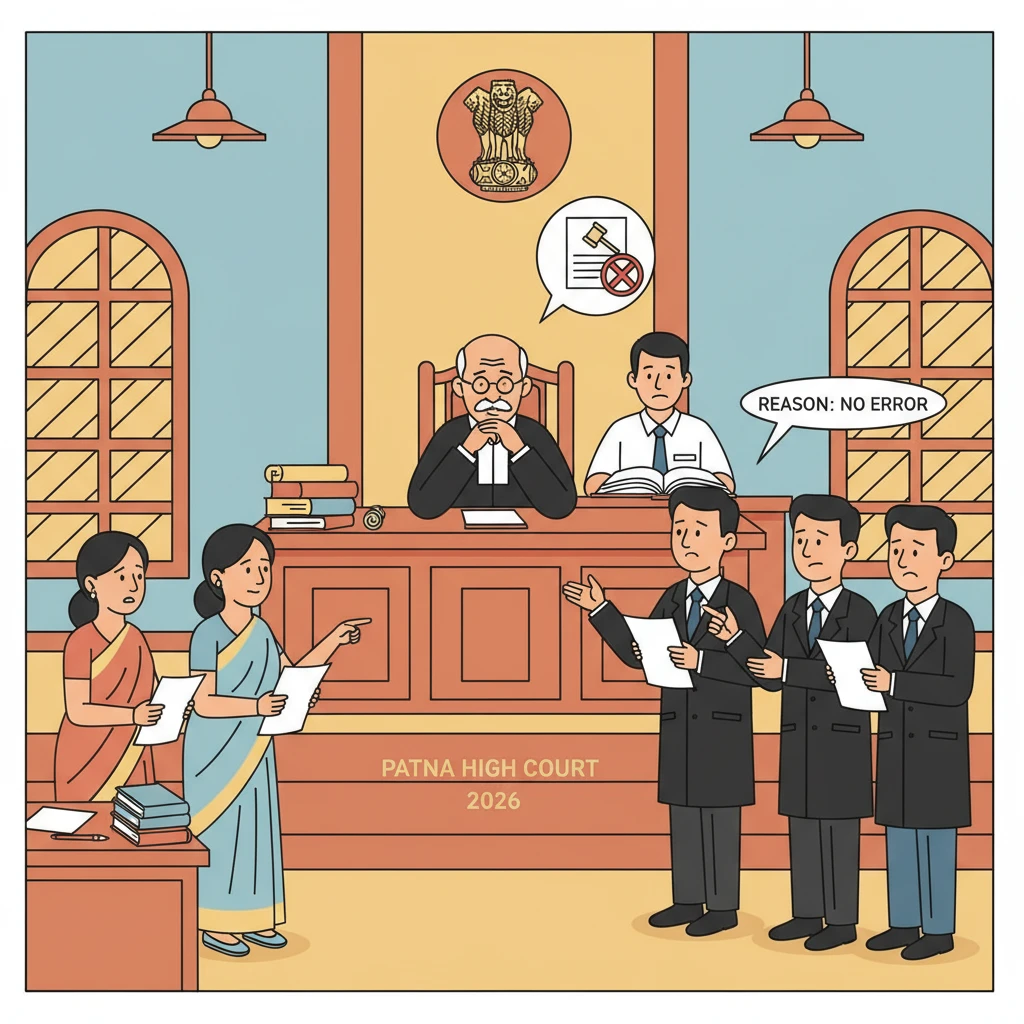
Accordingly, by judgment dated 16.01.2026, the Patna High Court dismissed Civil Review No. 199 of 2022. It also directed that there would be no order as to costs, meaning each party would bear its own expenses.
Why This Judgment Matters
This judgment is important for people involved in long-running civil disputes, especially partition suits within families. It clearly shows that once a second appeal has been dismissed for lack of substantial question of law, it is very difficult to get that decision reviewed.
The Patna High Court has underlined that review is not another chance to argue the case. Parties cannot use civil review to challenge how the courts have weighed evidence or interpreted facts unless there is a clear, obvious mistake visible on the record itself.
For litigants, this means that the main battle must be fought effectively before the Trial Court and the First Appellate Court. By the time the matter reaches second appeal and then review, the scope for changing the outcome becomes extremely narrow.
Legal Issues and Answers
Issue: Can the High Court review its own judgment in a second appeal on the ground that the First Appellate Court wrongly appreciated evidence and rejected amendment applications of transposed appellants?
Answer: No. Such grounds involve re-appreciation of evidence and arguable questions of fact and law, which do not amount to an error apparent on the face of the record under Order XLVII Rule 1 C.P.C.
Issue: Did the petitioners show any mistake or manifest error in the earlier second appeal judgment dated 02.08.2022 to justify review?
Answer: No. The Court held that the earlier judgment had already recorded clear reasons for dismissing the second appeal, and no self-evident error or sufficient reason was demonstrated to warrant review.
Cases Cited by the Court
- High Court of Judicature at Patna v. K.K. Chaubey, 2015 (4) PLJR 328 (Full Bench) – cited by petitioners on the scope of review.
- S. Murali Sundaram v. Jothibai Kannan & Ors., (2023) 13 SCC 515 – relied upon for principles limiting review jurisdiction.
- Perry Kansagra v. Smriti Madan Kansagra, (2019) 20 SCC 753 – cited within Murali Sundaram on the nature of review as not an appeal.
- Shanti Conductors (P) Ltd. v. Assam SEB, (2020) 2 SCC 677 : (2020) 2 SCC (Civ) 788 – cited within Murali Sundaram on limits of review and what constitutes error apparent.
- Inderchand Jain v. Motilal, (2009) 14 SCC 663 – referred to within the Supreme Court quotations regarding sufficient reason and “actus curiae neminem gravabit”.
- Rajesh D. Darbar v. Narasingrao Krishnaji Kulkarni, (2003) 7 SCC 219 – referred to within K.K. Chaubey on application of the doctrine “actus curiae neminem gravabit”.
Case Details
Case Number: Civil Review No. 199 of 2022 in Second Appeal No. 17 of 2015
Case Title: Ran Vijay Kumar @ Ranvijay Kumar Gupta & Ors. v. Sanjay Kumar & Ors.
Citation: 2026 (2) PLJR 212
Coram: Hon’ble Mr. Justice Sunil Dutta Mishra
Advocates:
- For the Petitioners: Mr. Chandra Kant, Advocate; Mr. Vaibhav Kr. Jha, Advocate; Ms. Shristi, Advocate; Ms. Karnika, Advocate; Mr. Navin Kumar, Advocate; Mr. Ravi Bhushan Bharat, Advocate.
- For the Opposite Parties: Not specified in the judgment (recorded as “Mr.” without name).
Nature of the Case: Civil Review under Order XLVII Rule 1 C.P.C. seeking review of judgment in a second appeal arising from a partition suit.
Date of Judgment: 16.01.2026
Link to Judgment: Click here to view the official Patna High Court judgment
If you found this explanation helpful and wish to stay informed about
how legal developments may affect your rights in Bihar,
you may consider following Samvida Law Associates for more updates.







