
Case Background
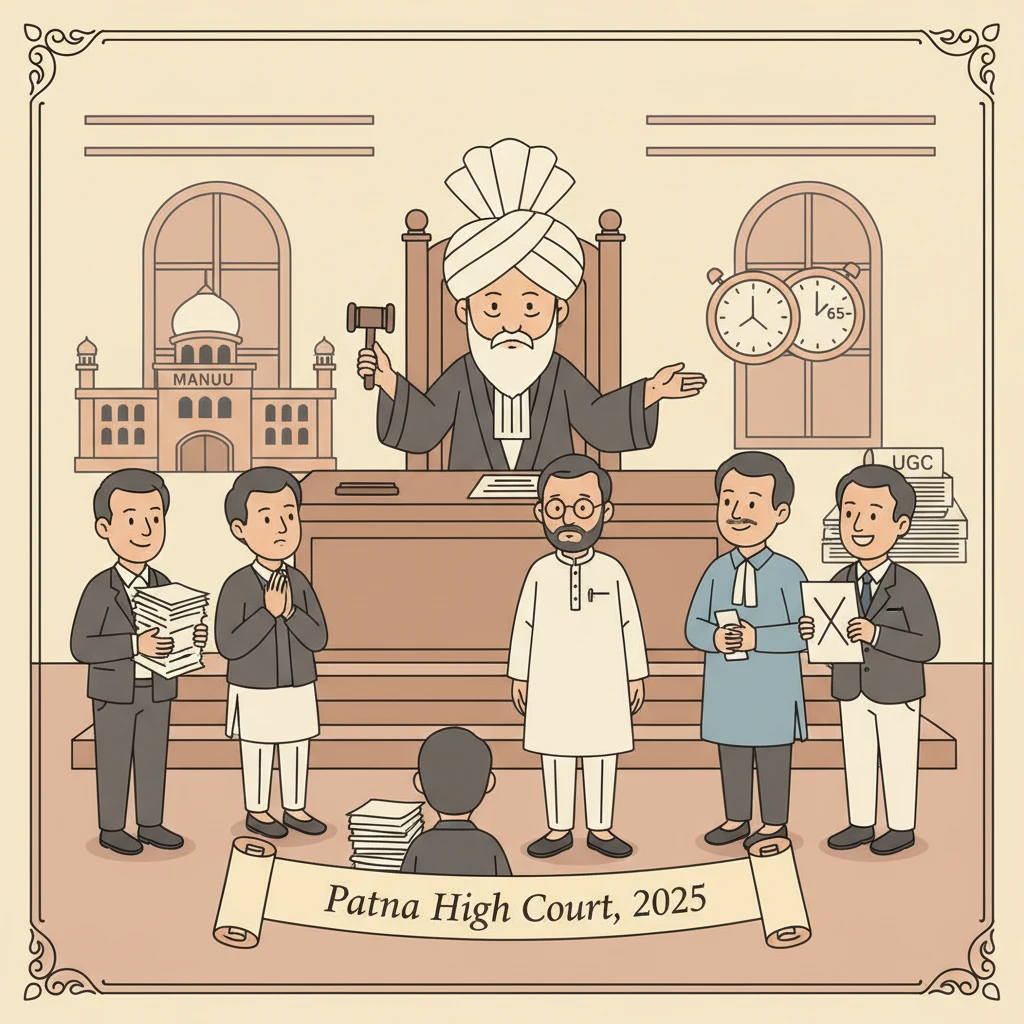
This case arose from a service dispute between a Regional Director of Maulana Azad National Urdu University (MANUU) and the University authorities over his age of retirement.
The University issued letter no. 1098 dated 05.11.2024 informing the petitioner that he would superannuate on 28.02.2025 on attaining the age of 60 years, which is the age of retirement for non-teaching staff. In the same letter, the University also mentioned that recovery of excess payment made on revision of pay, due to conversion from “Other Academic Staff” to “Non-Teaching” staff, was pending. The petitioner was also asked to submit his APARs (Annual Performance Appraisal Reports) of the last five years so that financial upgradation under the MACP (Modified Assured Career Progression) scheme could be processed before retirement.
Feeling aggrieved, the petitioner filed this writ petition before the Patna High Court. His primary grievance was that his post of Regional Director should be treated as a teaching post, giving him a retirement age of 65 years, instead of 60 years applicable to non-teaching employees. He also complained of discrimination in how other Regional Directors and Assistant Regional Directors had been treated.
What the Court Examined and Decided
The High Court first examined the structure and background of Maulana Azad National Urdu University (MANUU). It noted that MANUU is a Central University established by an Act of Parliament in 1998, fully funded by the Government of India through the University Grants Commission (UGC), and offering education in both regular and distance modes through Regional Centres across the country. The Executive Council is its apex governing body.
The Court then traced the evolution of the post of Regional Director and Assistant Regional Director. Initially, UGC had sanctioned these posts under the “teaching” category in Readers/Lecturers’ grade by sanction order dated 25.04.2001. Later, however, the University itself wrote to the UGC stating that the work of Regional Directors and Assistant Regional Directors was administrative in nature, without classroom teaching responsibilities. The University proposed that these posts be re-classified as non-teaching/Educational Administrators.
Acting on this proposal, UGC, by its letter dated 30.03.2005 (as referred to in Annexure R/1), approved the change in nomenclature from “teaching” to “non-teaching” and recognized these posts as “Educational Administrators” (non-teaching). This formal reclassification took place before the petitioner’s appointment.
Subsequently, MANUU issued Employment Notification No. 17/2006 dated 30.07.2006. This notification advertised one post of Regional Director in the category of “Non-Teaching (Academic Administrator)” in the pay scale of Rs. 12,000–18,300/-. The advertisement itself clearly described the post as non-teaching, and this notification formed the basis of the petitioner’s recruitment.
The petitioner, who possessed a Ph.D., NET, JRF in Urdu from JNU and M.A. and M.Phil from JNU, applied for the post of Regional Director as “Academic Administrator” under the non-teaching category. He was placed at serial no. 2 in the waiting list recommended by the Selection Committee and approved by the Executive Council in its meeting held on 23.11.2006.
Later, on non-joining of candidates higher in the list, the petitioner was offered appointment on the post of Regional Director, Regional Centre, Mumbai, by appointment letter no. 76 dated 05.12.2006. This appointment letter clearly stated that the post was a non-teaching post and that the petitioner’s services would be governed by the MANUU Non-Teaching Employees Service Rules, along with orders issued by the UGC/University/Government of India from time to time.
The petitioner accepted the offer unconditionally. By his letter dated 08.12.2006 (Annexure R/3), he informed the Registrar that he would report for duty on 13.12.2006 at the Regional Centre, Mumbai, and he actually joined on that date. At no point then did he protest or challenge the non-teaching classification.
Over time, some Regional Directors and Assistant Regional Directors, including the petitioner, raised grievances about pay scales, Career Advancement Scheme (CAS) benefits, and retirement age, especially because some incumbents were classified as teaching staff while others were placed in non-teaching category. To address these concerns, the Executive Council, in its 44th meeting held on 04.05.2013, set up a Committee under the Pro Vice Chancellor with an external expert from IGNOU.
This Committee recommended that Regional Directors and Assistant Regional Directors possessing prescribed teaching qualifications could be treated as “Other Academic Staff” with UGC-prescribed benefits, including a retirement age of 62 years, prospectively from the date of the University’s order. Based on this recommendation, at its 52nd meeting on 25.04.2015, the Executive Council decided to treat non-teaching Regional Directors and Assistant Regional Directors, including the petitioner, as “Other Academic Staff” at par with IGNOU counterparts, prospectively from 05.05.2015, and their pay scales were revised accordingly.
However, during a performance audit in July 2018, the audit party objected to granting teaching pay scales and related benefits to non-teaching employees without explicit UGC approval. In the wake of this objection and further clarification from UGC, the University reversed course. By order dated 26.11.2021 (Annexure R/8), the University withdrew the “Other Academic Staff” status from the petitioner and others with effect from 22.11.2021 and re-fixed their pay as Regional Directors under the non-teaching category with retrospective effect from 05.05.2015. The petitioner did not challenge this 26.11.2021 order.
In defending the writ, the University argued that:
- After 30.03.2005, UGC had clearly approved reclassification of these posts as non-teaching, and the petitioner was appointed only thereafter.
- The employment notification, appointment letter, and service rules all clearly indicated that the petitioner’s post was non-teaching.
- The petitioner had accepted these terms and continued in service for nearly two decades without questioning the classification or the UGC’s 30.03.2005 decision.
- The Government of India, through DoPT Memo No. 25012/8/98-Estt.(A) dated 30.05.1998, fixed the age of superannuation of Central Government employees, including those in autonomous bodies, at 60 years, which applies to non-teaching staff like the petitioner.
On alleged discrimination, the petitioner had pointed out that some Regional Directors and Assistant Regional Directors, such as Dr. Shahid Parvez, Dr. Sanaullah and Dr. Sahab Singh, were allowed to superannuate at 65 years, and that in some orders other officers were described as “Academic Administrator (teaching employee)”. He argued that his post was also treated as teaching earlier, and that he should receive the same benefit.
The Court accepted the University’s explanation that:
- Those officers who were allowed to retire at 65 years were appointed before 30.03.2005, when the posts were still classified as teaching posts.
- UGC’s letter dated 17.08.2021 clarified that all incumbents already appointed under the teaching category before reclassification may continue till their superannuation, but all subsequent appointments must be treated as non-teaching.
- The petitioner and others appointed after 30.03.2005 were expressly under the non-teaching category, even if the pay scale was similar to Reader’s scale under the Fifth Pay Commission.
- Annexure P/10 dated 22.11.2006 was only a seniority list of teaching and academic staff and did not itself prove that Regional Directors or Assistant Regional Directors were in the teaching cadre.
- Officers like Dr. Hasanuddin Haider, cited by the petitioner as similarly placed, were in fact also treated as non-teaching, and Dr. Haider retired at 60 years. This was supported by Annexure R/12.
After going through the documents, the Court concluded that there was no ambiguity: the petitioner was appointed to a non-teaching post, his appointment letter made that clear, and he willingly accepted and served under those terms for “almost about two decades”.
On that basis, the Court held that he could not, at the verge of retirement, turn around and challenge the service conditions under which he had been serving all along, especially when he never challenged the key documents such as the UGC’s 30.03.2005 letter, the employment notification, his appointment letter, or the 26.11.2021 order reverting him to non-teaching status.
The Court thus upheld his retirement on 28.02.2025 at age 60 as valid and in accordance with the applicable rules. It rejected any claim that he was entitled to a retirement age of 65 years as a teaching employee.
On the issue of recovery of excess payment mentioned in the impugned letter, the Court took a cautious approach. It noted that the University had indicated that recovery was pending due to revision of pay on conversion from “Other Academic Staff” to “Non-Teaching” staff and that APARs were being sought for MACP benefits. The Court specifically refrained from giving any finding on the legality or correctness of this proposed recovery.
Instead, it left that issue open, granting liberty to the petitioner to submit a representation to the University authorities on the question of recovery. The Court did not interfere further on that point.
In the result, the writ petition was disposed of, with the main relief regarding retirement age denied, and with only this limited liberty regarding representation on recovery.
Why This Judgment Matters
This judgment is significant for employees of Central Universities and similar institutions, particularly those in Regional Centres and distance education systems. It clarifies that when a post has been formally reclassified from teaching to non-teaching with UGC approval, and the employee has been appointed and has served under the non-teaching category, he or she cannot later claim teaching benefits like a higher age of superannuation.
For staff members, it underlines the importance of carefully reading recruitment notifications and appointment letters. Once someone accepts a post clearly advertised and appointed as non-teaching, courts are unlikely to allow a later challenge to change that status after many years of service, especially at the brink of retirement.
The judgment also highlights that perceived inequality with earlier appointees is not always discrimination. Where rules are changed from a particular date, those appointed before and after that cut-off can lawfully be treated differently. The Court accepted that officers appointed before 30.03.2005 could continue as teaching staff with retirement at 65, while later appointees like the petitioner remained non-teaching with retirement at 60.
Finally, the Court’s limited intervention on the recovery issue is relevant for employees facing recovery of alleged excess payments. The Court did not automatically stop recovery but allowed the petitioner to file a representation, keeping that issue open. This shows that, in similar cases, employees should first approach the authority with a detailed representation before seeking judicial intervention.
Legal Issues and Answers
- Issue: Whether the petitioner, appointed as Regional Director under the “Non-Teaching (Academic Administrator)” category, was entitled to be treated as teaching staff and retire at the age of 65 years.
Answer: No. The Court held that the petitioner was appointed to a non-teaching post after UGC had reclassified the post as non-teaching. He accepted the appointment and served under non-teaching rules for nearly two decades. Therefore, he could not claim the retirement age applicable to teaching employees and was rightly superannuated at 60 years. - Issue: Whether the alleged discriminatory treatment with other Regional Directors and Assistant Regional Directors justified interference with the petitioner’s retirement age.
Answer: No. The Court accepted the University’s explanation that those allowed to retire at 65 years were appointed before the UGC’s reclassification on 30.03.2005 and thus legitimately remained in the teaching category. Appointments made after that date, including the petitioner’s, were in the non-teaching cadre. Hence, there was no illegal discrimination. - Issue: Whether the Court would decide the validity of proposed recovery of excess payment from the petitioner due to re-fixation of pay on conversion from “Other Academic Staff” to “Non-Teaching” staff.
Answer: The Court declined to give any finding on the recovery issue and left it open, granting liberty to the petitioner to submit a representation to the University authorities regarding recovery and MACP-related matters.
Cases Cited by the Court
- No judicial precedents or earlier case laws have been cited or relied upon in the text of this judgment.
Case Details
Case Number: Civil Writ Jurisdiction Case No. 2225 of 2025
Case Title: Md. Arshad Ekbal v. Maulana Azad National Urdu University & Ors.
Coram: Hon’ble Mr. Justice Anil Kumar Sinha
Citation: 2025(4) PLJR 202
Advocates:
- For the petitioner: Mr. Amaresh Kumar Singh, Advocate; Mr. Dineshwar Prasad Singh, Advocate
- For the respondents (University): Mrs. Shama Sinha, Advocate
Nature of the case: Civil writ petition challenging fixation of age of superannuation and related service conditions of a Regional Director (Non-Teaching) of MANUU, with incidental reference to recovery of excess payment.
Date of Judgment: 01.09.2025
Court: High Court of Judicature at Patna
Link to Judgment: Click here to read the full judgment
If you found this explanation helpful and wish to stay informed about
how legal developments may affect your rights in Bihar,
you may consider following Samvida Law Associates for more updates.







