
Case Background
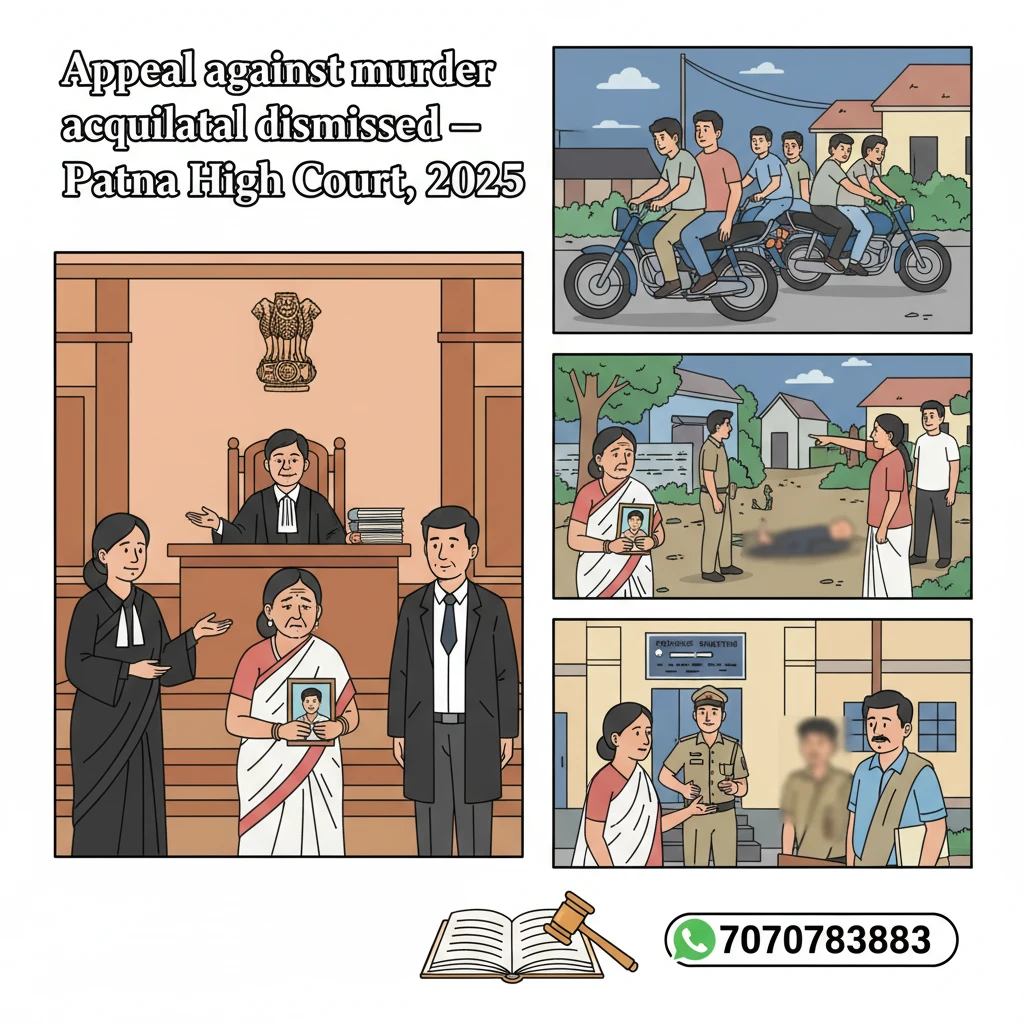
This criminal appeal was filed under Section 372 of the Code of Criminal Procedure before the Patna High Court. The appellant is the mother of the deceased, who challenged a judgment of acquittal passed by the Additional Sessions Judge-III, Madhubani on 07.10.2024 in Sessions Trial No. 633 of 2023.
The sessions case arose out of Benipatti P.S. Case No. 93 of 2023, Madhubani. In that case, Respondent No. 2 had been put on trial for offences under Sections 302 and 201/34 of the Indian Penal Code. After full trial, the sessions court acquitted him of all charges. The mother of the deceased then filed this appeal against acquittal before the Patna High Court.
According to the prosecution, several accused persons in the village, including Respondent No. 2, were allegedly involved in illegal liquor business. The deceased, Pradeep Kumar, son of the informant, initially objected to this illegal business. Later, however, he developed friendly relations with those accused persons despite his mother’s warnings.
On 07.05.2023 at about 10:00 pm, five accused persons, namely Amit Kumar, Arun Kumar Safi, Sita Saran Yadav, Dukhi Yadav (Respondent No. 2), and Bhima @ Vijay Kumar Mahto, allegedly came to the informant’s house on two motorcycles. They called her son Pradeep to accompany them in the barat (marriage procession) of the son of one Kishan Ram. Pradeep went with them and sat on a motorcycle with Amit and Arun.
The next morning, everyone else returned from the barat, but Pradeep did not come back. The informant tried to contact him on his mobile number 7070783883, but the phone was switched off. She then asked neighbours and also Amit and Arun about her son, but they said they did not know anything about him.
Soon after, she heard that an unknown dead body had been found by police. She rushed to the Benipatti Police Station, where the police showed her a photograph of the dead body. She identified the body as her son Pradeep. On the basis of her strong suspicion that her son had been killed by the five named accused persons, she submitted an application that led to registration of the FIR.
What the Court Examined and Decided
On the informant’s written application, Benipatti P.S. Case No. 93 of 2023 was registered under Sections 302, 201 and 120B/34 of the IPC. The police investigated the case. After investigation, the police submitted charge-sheet only against Respondent No. 2, and cognizance was taken accordingly. The case was then committed to the Court of Sessions for trial.
Before the trial court, charges were framed against Respondent No. 2, who pleaded not guilty and claimed to be tried. During trial, the prosecution examined nine witnesses: PW1 Manoj Yadav, PW2 Umesh Yadav, PW3 Dr. Kunal Ahand, PW4 Sunita Devi (the informant and mother of the deceased), PW5 Lalu Kumar Yadav, PW6 Bipin Kumar Yadav, PW7 Praveen Kumar, PW8 Sitaram Prasad (the Investigating Officer), and PW9 Suraj Kumar.
The prosecution produced several documents as exhibits, including the signature of PW1 on the seizure list, the post-mortem report, seizure list of the deceased’s mobile phone, endorsement over the typed application, formal FIR, seizure list of an Apache motorcycle, and the chargesheet. No defence witness was examined. After closure of evidence, the statement of the accused was recorded under Section 313 CrPC. Thereafter, the trial court acquitted Respondent No. 2.
The trial court held that the entire case rested on circumstantial evidence and that the chain of circumstances was not complete. It noted that for a circumstantial case to result in conviction, all links in the chain must be firmly connected and point only to the guilt of the accused.
The trial court found significant contradictions between the witnesses. PW4, the informant, said that all five accused, including Respondent No. 2, came to her house together at about 10:00 pm and that her son went with them. On the other hand, PW1 and PW2 stated that they had seen only three accused persons, namely Amit, Arun and Dukhi (Respondent No. 2), at a place called Brahamasthan earlier.
PW5, however, deposed that Amit and Arun went towards the house of Pradeep from Brahamasthan, while Respondent No. 2 remained at Brahamasthan, and this occurred at about 8:00 pm. This contradicted PW4’s statement that Respondent No. 2 had come to her house with the others and that Pradeep left with all of them at 10:00 pm.
The trial court also noted that although PW4 stated that her son left along with Amit, Arun and other accused persons, no witness stated that after leaving her house, Pradeep was seen with all those accused either on the way, at the barat, or near the place where the dead body was found. Due to such contradictions, the court held that the chain of circumstances was not interlinked and could not safely support a finding of guilt.
Before the Patna High Court, counsel for the appellant attacked the acquittal. He argued that the judgment was illegal and passed without proper application of judicial mind. He emphasized that PW8, the Investigating Officer, conducted a defective investigation. According to the prosecution, the dead body was found hanging from a tree and a mobile phone was recovered from the deceased. Still, the IO did not even obtain the call detail records from the recovered mobile phone.
Counsel for the appellant further argued that this being a case of circumstantial evidence, the chain was fully complete once the dead body was found. He submitted that the deceased had gone with the accused persons, including Respondent No. 2, and that even Respondent No. 2’s motorcycle was used to take the deceased. He claimed that the trial court did not properly consider this aspect, nor the evidence of PW2, PW4 and PW6, which, in his view, showed that the deceased was killed because the accused suspected him to be an informer of the police and that Respondent No. 2 played a major role.
On the other side, the State’s counsel supported the acquittal and argued that there was no perversity in the trial court’s judgment. He submitted that the prosecution had failed to prove the guilt of the accused beyond reasonable doubt, and therefore there was no reason for the appellate court to interfere.
The Patna High Court examined the entire record and focused on one central question: whether the judgment of acquittal called for interference. The Court noted that the whole case was based on circumstantial evidence. The prosecution theory was that there was earlier enmity between the deceased and the accused, and that the deceased was last seen with the accused. However, the Court also observed that the deceased had gone with the accused persons of his own free will and there was no evidence to show that he was forced or taken against his will.
The High Court agreed with the trial court that the prosecution evidence was inconsistent and contradictory. It pointed out that no witness gave a consistent account showing that all five persons named in the FIR were seen going to the barat with the deceased. There were material contradictions regarding who went to the informant’s house, who remained at Brahamasthan, and at what time.
The Court then turned to the “last seen together” theory. It referred to the Supreme Court decisions in Bodhraj v. State of J&K, (2002) 8 SCC 45, and Ramreddy Rajesh Khanna Reddy v. State of AP, (2006) 10 SCC 172. These decisions state that the last seen theory can be applied only where the time gap between the deceased being last seen with the accused and the discovery of the dead body is so small that no one else could realistically have committed the offence. Even then, courts must look for corroboration.
In this case, the High Court noted that at best it could be treated as a last seen case. Yet, there was a time gap of about twelve hours between the time when the deceased allegedly went with the accused persons at night and the time his body was recovered the next day. Further, there was no conclusive evidence that the deceased was last seen alive with Respondent No. 2 just before his death, nor was there any corroborative evidence linking him directly to the killing.
Accordingly, the High Court held that the prosecution had failed to prove the guilt of Respondent No. 2 beyond the shadow of reasonable doubt. The chain of circumstances remained incomplete, and the contradictions in witness statements created serious doubt.
The Court also discussed the limited scope of interference in an appeal against acquittal. It referred to the Supreme Court judgment in Mrinal Das v. State of Tripura, (2011) 9 SCC 479, where it was held that although an appellate court can reappreciate evidence, an acquittal should not be disturbed unless there are compelling and substantial reasons and the findings are perverse or clearly unreasonable. The presumption of innocence is strengthened once a trial court has acquitted the accused.
The High Court further relied on Ghurey Lal v. State of Uttar Pradesh, (2008) 10 SCC 450, which held that a trial court’s acquittal should not be interfered with unless it is totally perverse or wholly unsustainable, especially because the trial judge has the advantage of observing the demeanour of witnesses.
Applying these principles, the Patna High Court concluded that the findings of the trial court did not suffer from illegality or perversity. Even if another view was possible, that by itself would not justify setting aside an acquittal in a criminal case. In the absence of a complete chain of circumstances and in the presence of reasonable doubt, Respondent No. 2 was entitled to the benefit of doubt.
In the result, the Court dismissed the criminal appeal and affirmed the acquittal of Respondent No. 2.
Why This Judgment Matters
This judgment is important for families of victims as well as accused persons in criminal cases based purely on circumstantial evidence. It shows that suspicion, however strong, is not enough for conviction. Courts require a complete and consistent chain of circumstances that leads only to one conclusion: that the accused is guilty.
The Patna High Court has also reinforced that in “last seen together” cases, simply saying that a person went out with some accused persons is not sufficient. There must be a short time gap between that last seen moment and the recovery of the dead body, along with other supporting evidence. A long time gap and lack of corroboration make it unsafe to convict.
The judgment also underlines the limited power of appellate courts when dealing with appeals against acquittal. Once the trial court acquits, the accused benefits from a strong presumption of innocence. Unless the trial court’s decision is clearly wrong or perverse, higher courts will be slow to overturn an acquittal.
For ordinary readers, this case shows that even if there is a tragic loss of life and serious suspicion, the law demands strict proof. Defective investigation, missing call records, and contradictions in witness accounts can all weaken a case. The justice system insists that no person be punished unless the evidence is clear and beyond reasonable doubt.
Legal Issues and Answers
- Issue: Whether the Patna High Court should interfere with the trial court’s judgment acquitting Respondent No. 2 of charges under Sections 302 and 201/34 IPC, in a case based on circumstantial and “last seen together” evidence.
Answer: No. The Court held that the chain of circumstantial evidence was incomplete, witness statements were contradictory, the last seen theory was not conclusively proved, and there was no perversity or illegality in the trial court’s acquittal. Therefore, the appeal was dismissed and the acquittal was upheld.
Cases Cited by the Court
- Bodhraj v. State of J&K, (2002) 8 SCC 45 – on the limits of the “last seen together” theory.
- Ramreddy Rajesh Khanna Reddy v. State of AP, (2006) 10 SCC 172 – reiterating that last seen evidence needs corroboration and a very small time gap.
- Mrinal Das v. State of Tripura, (2011) 9 SCC 479 – on the scope of appellate interference in appeals against acquittal.
- Ghurey Lal v. State of Uttar Pradesh, (2008) 10 SCC 450 – emphasizing that an acquittal should not be disturbed unless perverse or wholly unsustainable.
Case Details
Case Number: Criminal Appeal (DB) No. 1458 of 2024; arising out of Benipatti P.S. Case No. 93 of 2023, District Madhubani
Case Title: Sunita Devi v. The State of Bihar & Anr.
Citation: 2025(4) PLJR 188
Coram: Hon’ble Mr. Justice Sudhir Singh; Hon’ble Mr. Justice Rajesh Kumar Verma
Date of Judgment: 27.08.2025
Advocates: For the appellant: Mr. Murari Narain Chaudhary, Advocate; Mr. Brahmanand Kumar, Advocate; Mr. Vijay Kumar, Advocate. For the State/respondents: Mr. Abhimanyu Sharma, APP.
Nature of the Case: Criminal appeal under Section 372 CrPC against a judgment of acquittal in a sessions trial for offences under Sections 302, 201/34 IPC.
Link to Judgment: Click here to read the full Patna High Court judgment
If you found this explanation helpful and wish to stay informed about
how legal developments may affect your rights in Bihar,
you may consider following Samvida Law Associates for more updates.







