

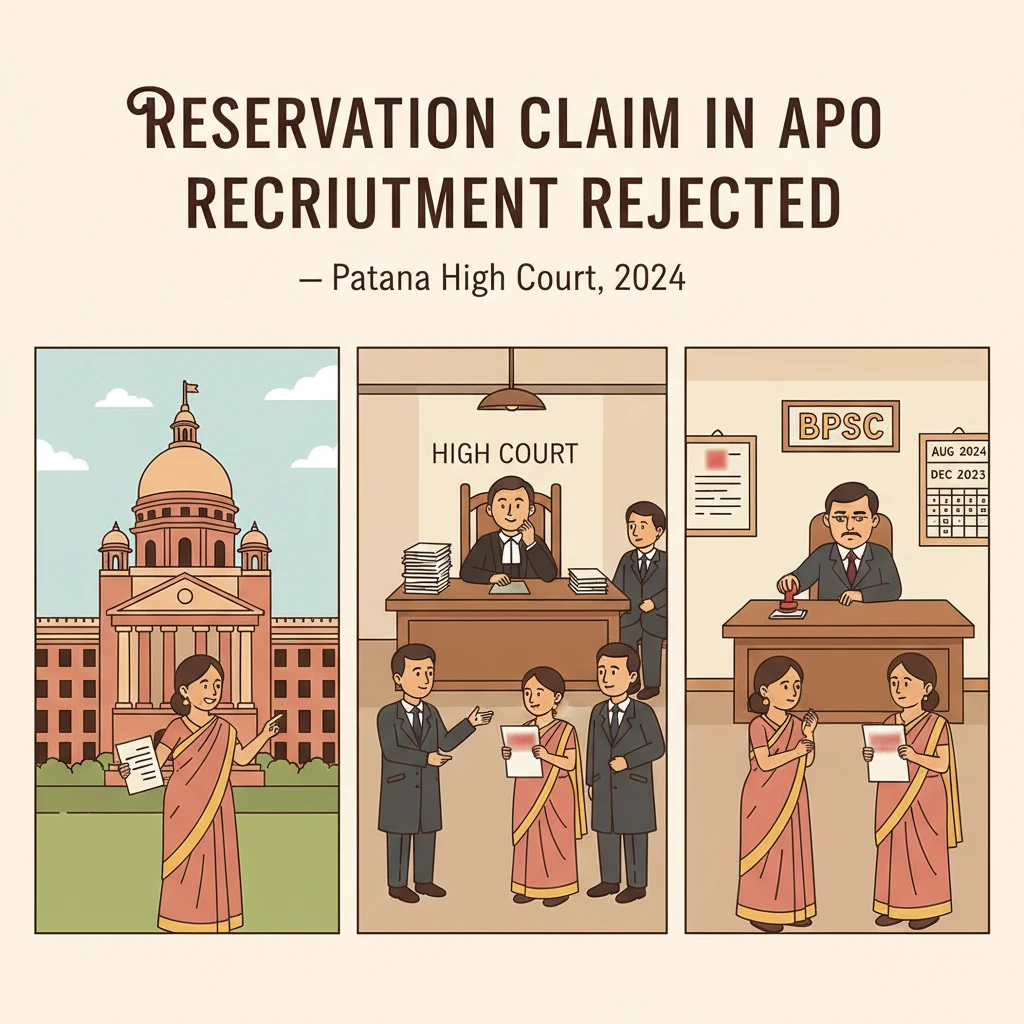
Case Background
This case arises from Advertisement No. 01 of 2020 dated 06.02.2020 issued by the Bihar Public Service Commission (BPSC) for appointment to the post of Assistant Prosecution Officer in the State of Bihar.
The petitioner applied under the Scheduled Caste category. She appeared in the preliminary examination as a Scheduled Caste candidate and qualified. She then appeared in the mains examination, was again declared successful, and was called for interview.
For the interview, the petitioner appeared with her documents. However, when the Commission published the final result for Assistant Prosecution Officer on 02.12.2023, she was among eight candidates declared unsuccessful on the ground that they had not produced the requisite certificates relating to reservation and similar requirements.
Aggrieved by the cancellation of her candidature under the Scheduled Caste category, the petitioner first approached the Patna High Court in CWJC No. 1264 of 2024. By order dated 08.02.2024, she was given liberty to approach the respondent authorities to ventilate her grievance.
Pursuant to this liberty, she submitted a representation before the BPSC. By Memo No. 5018 dated 07.03.2024, the Secretary, BPSC, rejected her representation. The reason given was that reservation benefit is available only to original residents of the State of Bihar. As the petitioner’s father was a resident of Uttar Pradesh, she could not be treated as an original resident of Bihar and hence was not entitled to reservation benefit in Bihar.
The petitioner then filed a review application on 18.03.2024 before the Commission, reiterating that both her husband and father belong to the Scheduled Caste community, that she married on 27.02.1996, completed her entire education in Bihar, and is a permanent resident/domicile of Bihar. On 26.04.2024, the Deputy Secretary, BPSC, rejected her representation again on the same ground: that reservation is admissible only to original residents of Bihar and, because her father is a resident of Uttar Pradesh, she cannot get reservation in Bihar.
The petitioner therefore filed the present writ petition, Civil Writ Jurisdiction Case No. 11672 of 2024, challenging the Commission’s rejection orders and the result of 02.12.2023 insofar as it cancelled her candidature under the Scheduled Caste category.
What the Court Examined and Decided
The petitioner sought multiple reliefs. She asked the Patna High Court to quash Memo No. 5018 dated 07.03.2024 and the letter dated 26.04.2024 by which BPSC had rejected her representations. She also sought quashing of the result dated 02.12.2023 under Advertisement No. 01/2020 to the extent that it cancelled her candidature (Roll No. 100225) for lack of a proper caste/reservation certificate in Bihar.
Further, she requested a writ of mandamus directing BPSC to accept her candidature under the Scheduled Caste category for the Assistant Prosecution Officer post, relying on her caste certificate and the “peculiar circumstances” that both her husband and father belong to a Scheduled Caste community (Dushadh caste), she married in 1996, completed her education in Bihar, and is a permanent resident/domicile of Bihar. She also asked for any other appropriate orders and costs.
On her behalf, learned counsel argued that she fully satisfied the eligibility requirements in Advertisement No. 01 of 2020 for appointment to the post of Assistant Prosecution Officer. She had cleared all stages of the examination—preliminary, mains, and interview—and her candidature was cancelled only at the final stage, on a technical ground relating to reservation certificates.
Her counsel submitted that after the Court’s earlier order in CWJC No. 1264 of 2024, she had made a proper representation, and later a review application dated 18.03.2024, explaining that her husband and father both belong to the Scheduled Caste community, that she has been residing and studying in Bihar for a long time, and that she should be considered a Scheduled Caste in Bihar as well as in Uttar Pradesh. Therefore, rejecting her candidature on the ground that she is not a domicile of Bihar was said to be incorrect.
To support this position, learned Senior Counsel for the petitioner relied on the decision in Dr. Rajesh Kumar Paswan vs. The State of Bihar and Others, reported in AIR 1997 Pat 31. He particularly referred to paragraphs 9 and 10 of that judgment, contending that since the petitioner is Scheduled Caste in both Uttar Pradesh and Bihar, she is entitled to reservation benefit in Bihar.
On the other hand, learned counsel for the Bihar Public Service Commission drew the Court’s attention to the terms of Advertisement No. 01 of 2020. He submitted that before the examination process began, the advertisement clearly laid down the rules regarding reservation. It stated that reservation on the basis of caste would be granted only to those candidates who are permanent residents of Bihar, that is, who are “original residents” or “mool nivasi” of Bihar.
The relevant clause, Column 6(ii), provided in Hindi that reservation on the basis of caste would be available only to those candidates whose permanent residence is in Bihar, i.e., who are original residents of Bihar. It further clarified that residents of other States would not get the benefit of reservation and that the permanent address mentioned in the application would be treated as the permanent residence for reservation purposes.
Column 6(iii)(A) of the advertisement required candidates of Scheduled Caste and Scheduled Tribe categories to produce: (a) caste certificate, and (b) permanent residence/mool nivasi (domicile) certificate.
Counsel for BPSC further pointed out that these conditions were reiterated in the interview call letter (Annexure P/4). Clause 5(ii) of the interview letter stated that in the case of women candidates claiming reservation, the caste certificate, the certificate issued by the competent authority, and the residence certificate must all bear the name and address of the candidate’s father, and not of the husband. The letter also made clear that if such verified certificates were not produced, reservation benefit would not be granted.
Based on these clauses, BPSC argued that the “rules of the game” had been fixed prior to the examination, and the petitioner was fully aware that to claim reservation she needed a domicile certificate in her father’s name showing permanent residence in Bihar. Since her father is a resident of Uttar Pradesh, the Commission concluded that she did not satisfy this requirement. Therefore, its decision to deny reservation benefit and cancel her reserved category candidature was said to be in strict accordance with the advertised rules.
Learned counsel for the State supported the Commission’s stand. He submitted that BPSC had framed these conditions in line with State policy and that the issue had been decided at policy level before the advertisement was issued. He therefore contended that no case was made out for interference with the Commission’s decision.
The Patna High Court then examined the relevant clauses from the advertisement and the interview letter at length. The Court noted that Column 6(ii) clearly limited reservation benefits to candidates whose permanent residence is Bihar and denied such benefits to residents of other States. It also required a permanent residence or domicile certificate. Column 6(iii)(A) made caste and permanent residence/domicile certificates mandatory for Scheduled Caste and Scheduled Tribe candidates.
Similarly, Clause 5(ii) of the interview letter specifically required that women candidates claiming reservation must produce caste and residence certificates issued by the competent authority that carry the name and address of the candidate’s father, not her husband. Without such documentation, reservation would not be granted.
On this basis, the Court observed that the rules regarding eligibility for reservation had been clearly framed before the advertisement and examination process began. Once such rules are in place, candidates have no option but to follow them unless they are changed. The Court emphasised that the petitioner participated in the recruitment process with knowledge of these conditions.
The Court then addressed the reliance placed by the petitioner on the judgment in Dr. Rajesh Kumar Paswan. On perusal of that decision, the Court found that it related to admission to a Post-Graduate Medical Course, not to government service recruitment.
In paragraph 11 of the earlier judgment, it had been observed that it could not be said that the petitioner in that case wanted to settle in Bihar merely to get admission in the P.G. Medical Course or that, by settling in Bihar, he sought any special right or privilege. In contrast, the present case involved entry into government service. The Court remarked that seeking a government job in Bihar means that the person intends to settle in Bihar and thereby seeks a privilege or special right flowing from State employment.
Therefore, the Court held that there is a clear distinction between the facts of Dr. Rajesh Kumar Paswan and the present case. The earlier decision on P.G. medical admission could not control or override the recruitment policy and advertisement terms framed for public service appointments.
Given this distinction, and in light of the explicit clauses in the advertisement and interview letter, the Court concluded that the petitioner was not entitled to any relief. It held that so long as the rules framed and advertised by the Bihar Public Service Commission remain unchanged, the Court cannot direct that she be granted reservation benefit contrary to those rules.
Accordingly, the writ petition was dismissed. The impugned decision of the BPSC and the result dated 02.12.2023 cancelling the petitioner’s candidature under the Scheduled Caste category remain valid and in force.
Why This Judgment Matters
This judgment is important for candidates appearing in BPSC and other State recruitment exams, especially those claiming reservation benefits.
The Patna High Court has made it clear that when an advertisement and call letter lay down specific conditions for claiming reservation, such as requirement of a domicile certificate in the father’s name for women candidates, those conditions must be strictly followed. A candidate cannot later ask the Court to ignore or relax those rules simply because she has been living in Bihar or has completed her education there.
The judgment also shows that policy decisions about who will get reservation benefits—such as restricting them to “original residents” of Bihar—are taken at State level and are implemented by BPSC through its advertisements. Courts are reluctant to interfere with such policy choices in the middle of an ongoing recruitment process.
Finally, the Court has clarified that a case about reservation in education admissions, like the earlier decision in Dr. Rajesh Kumar Paswan, cannot automatically be used to claim reservation in government jobs. The two situations are treated differently, especially where State policy insists on domicile requirements for public employment.
Legal Issues and Answers
- Issue: Can a Scheduled Caste candidate, whose father is a resident of another State, claim reservation benefit in Bihar public service recruitment based on marriage, education, and residence in Bihar?
Answer: No. Under Advertisement No. 01 of 2020 and the interview letter, reservation was available only to original residents of Bihar, supported by domicile and residence certificates in the father’s name. The petitioner did not meet this requirement. - Issue: Does the earlier Patna High Court judgment in Dr. Rajesh Kumar Paswan, dealing with P.G. medical admission, compel recognition of the petitioner’s reservation claim in this service recruitment?
Answer: No. The Court held that the earlier case concerned educational admission, not government service. Seeking a government job implies seeking a privilege and intention to settle in Bihar, and the distinction in context meant that the earlier judgment did not govern this recruitment dispute.
Cases Cited by the Court
- Dr. Rajesh Kumar Paswan vs. The State of Bihar and Others, AIR 1997 Pat 31.
Case Details
Case Number: Civil Writ Jurisdiction Case No. 11672 of 2024
Case Title: Vidyawati Kiran vs. The State of Bihar and Others
Citation: 2024 (4) PLJR 321
Coram: Hon’ble Mr. Justice Dr. Anshuman
Advocates:
- For the petitioner: Mr. Mrigank Mauli, Senior Advocate; Mr. Prince Kumar Mishra, Advocate
- For the State (respondents): Mr. Santosh Chandra Bhaskar, AC to GP-11
- For the Bihar Public Service Commission: Mr. Sanjay Pandey, Advocate; Mr. Nishant Kumar Jha, Advocate
Nature of the case: Writ petition (service/recruitment – challenge to denial of reservation benefit and cancellation of candidature in BPSC Assistant Prosecution Officer recruitment)
Date of Judgment: 06.08.2024
Link to Judgment: Click here to read the full judgment of the Patna High Court
If you found this explanation helpful and wish to stay informed about
how legal developments may affect your rights in Bihar,
you may consider following Samvida Law Associates for more updates.







