
Case Background
The case started with a written complaint given to the police by the informant (opposite party no. 2) on 03.12.2021.
He alleged that on 02.12.2021 at about 4:30 P.M., he received information that the present petitioner, along with his men, was forcibly ploughing the informant’s parental land.
The informant, along with his companions, went to the spot. There they allegedly found the petitioner and 18 other persons forming an unlawful assembly, forcibly ploughing the land and variously armed.
When the informant questioned the petitioner as to why they were ploughing his land, the co-accused persons allegedly assaulted the informant’s companions at the petitioner’s instigation. Several persons were stabbed. The informant’s nephew died on the spot and a number of persons received serious injuries.
On this written report, Vijaipur P.S. Case No. 265 of 2021 dated 03.12.2021 was registered for offences under Sections 147, 148, 149, 341, 323, 324, 326, 307 and 302 of the Indian Penal Code.
From this police case, five separate sessions trials arose. Sessions Trial No. 307 of 2022 and Sessions Trial No. 415 of 2022 concluded in conviction of some accused persons. Three other sessions trials, namely Sessions Trial No. 293 of 2023, Sessions Trial No. 585 of 2023 and Sessions Trial No. 116 of 2024, remained pending.
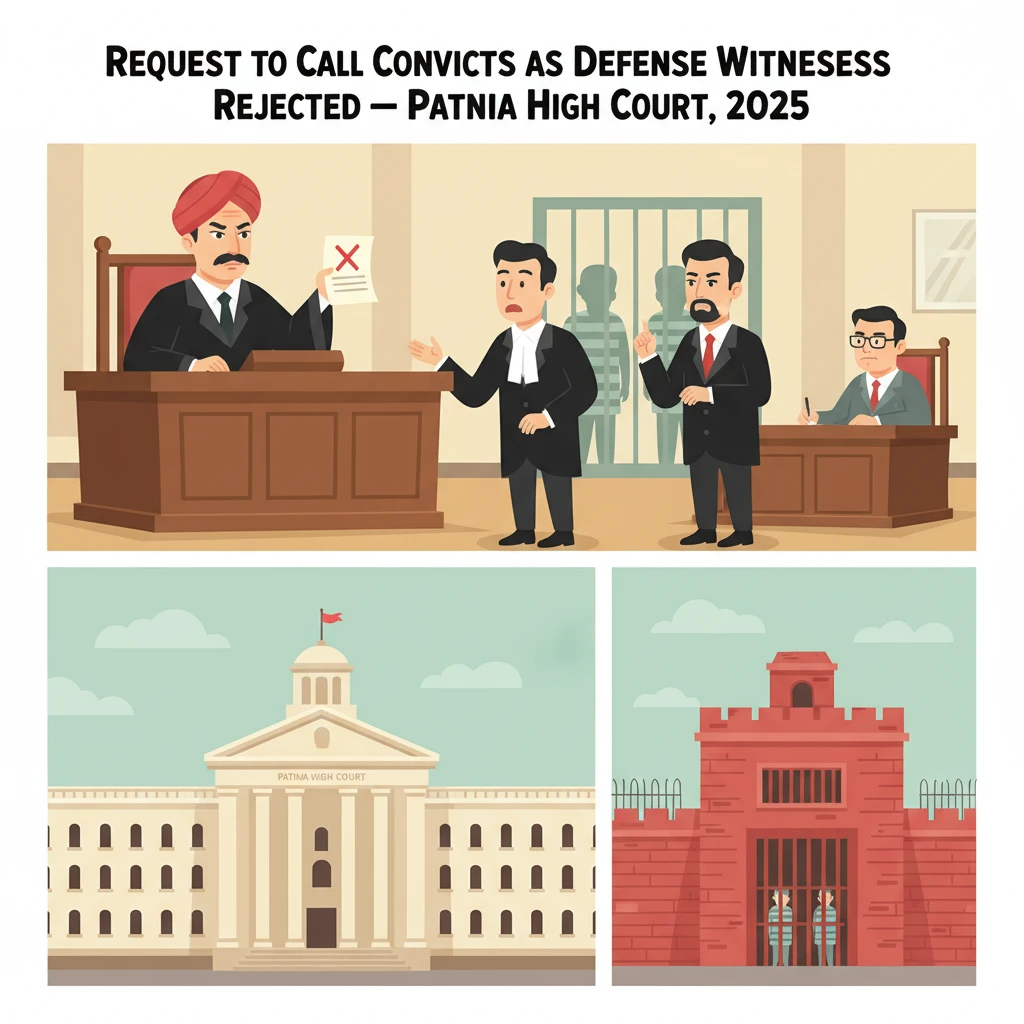
The present petitioner is an accused in Sessions Trial No. 116 of 2024. That trial reached the stage of defence evidence. At that point, on 04.08.2025, the petitioner filed an application under Section 233 of the Code of Criminal Procedure seeking to call two convicts, Prem Kharwar and Raj Kumar Kharwar, from Sessions Trial No. 307 of 2022 as defence witnesses.
The Additional Sessions Judge-XII, Gopalganj, hearing Sessions Trial No. 116 of 2024, rejected this application by order dated 07.08.2025. The present criminal revision was filed before the Patna High Court to challenge that order.
What the Court Examined and Decided
The Patna High Court examined whether the trial court was right in refusing the petitioner’s request under Section 233 CrPC to summon two convicted co-accused as defence witnesses.
On behalf of the petitioner, learned senior counsel Mr. Ramakant Sharma argued that the trial court’s order was unsustainable both in law and on facts. He said the order was mechanical and cryptic.
According to the petitioner, the trial court had rejected the application only on the ground that it did not disclose how the proposed witnesses, who were convicts, were acquainted with the facts of the case.
Counsel argued this was erroneous because these persons were present during the occurrence and had been convicted in a separate sessions trial arising out of the same police case. Therefore, they were eye-witnesses and competent to be examined for the defence.
Learned senior counsel stressed Section 233(3) of the Code. This provision says that when an accused applies for process to secure attendance of a witness or production of any document or thing, the Judge shall issue such process, unless he finds, for recorded reasons, that the application is meant for vexation, delay, or for defeating the ends of justice.
He argued that in this case, the trial court had not recorded any such reasons. Thus, refusal to issue process was said to be illegal. He further submitted that if the petitioner was not allowed to put up his defence by examining these witnesses, his right to a fair trial would be defeated.
He linked this to the fundamental right under Article 21 of the Constitution of India, asserting that fair trial and access to justice are part of that right. He relied on the Supreme Court decision in Maneka Gandhi vs. Union of India, AIR 1978 SC 597, to emphasize that procedure established by law must be fair, just and reasonable.
The petitioner also pointed to Section 311 of the Code, which empowers a court to summon any person as a witness or recall and re-examine a person if his evidence appears essential to a just decision.
He said the trial court ignored this dimension of the law. He further stated that the two convicts had themselves filed an application under Section 315 read with Section 311 CrPC on 18.09.2025, expressing their willingness to be examined as witnesses in Sessions Trial No. 116 of 2024. That application, he submitted, was still pending.
On the other side, learned counsel for opposite party no. 2, Mr. Satyendra Rai, supported the trial court’s order. He asserted that the petitioner’s application dated 04.08.2025 was filed only to delay the trial.
He contended that Section 233 CrPC does not permit calling as a defence witness a person who was a co-accused and then became a convict in a separate trial.
According to him, the accused persons in Vijaipur P.S. Case No. 265 of 2021 allowed different sessions trials to proceed. When some co-accused were convicted, the petitioner now wanted them as defence witnesses to get a favourable order on the basis that they were already convicted.
He described these persons as highly interested witnesses who, despite separate trials, should still be treated as accused of the same case. In that capacity, he argued, they cannot be examined as defence witnesses under Section 233(3) CrPC.
He also submitted that the separate application filed by the convicts under Section 315 read with Section 311 CrPC could not influence the merits of the present revision. According to him, the petitioner had been filing repeated applications to delay the case and escape what he termed a “certain conviction”.
He concluded that there was no illegality or infirmity in the impugned order and that the petitioner had failed to bring any valid ground to interfere with it.
The High Court carefully considered the rival submissions. It first reproduced and analysed the brief petition under Section 233 filed by the defence.
The petition simply sought to call the two convicts, stating they had been lodged in Motihari and Gopalganj jails in connection with Sessions Trial No. 307 of 2022, that they had been convicted and sentenced to life imprisonment, and that their evidence was “essential for just decision of the case”. No further reasons were given.
The Court noted that, except for this bare assertion, the petition did not give any ground or explain how these convicts were connected with the facts in a way that would assist the defence.
The trial court had rejected the application on this basis. The High Court held that, on this factual point, the trial court’s order did not suffer from any infirmity. However, the High Court also went further to address the broader legal questions.
The Court then quoted Section 233 CrPC in full and explained that the provision is meant to give the accused a fair opportunity to enter his defence and adduce evidence. At the same time, the Judge may refuse to issue process if the application appears aimed at vexation, delay, or defeating justice, provided reasons are recorded.
In this case, the Court found that the facts were “peculiar”. There were a total of nineteen accused in the police case. Five separate sessions trials arose from it. In two trials, some co-accused were convicted. The petitioner now wanted these convicts to depose as defence witnesses in his own trial.
The Court observed that in their own trial, these persons had not offered themselves to be examined as witnesses. If they now appeared as defence witnesses for the petitioner, their position would not be different from that of an accused who is still on trial with him.
The Court held that Section 233 CrPC has not been enacted to permit the examination of such persons in defence after their conviction in a separate trial arising from the same case.
The Court went on to state that if convicts from the same police case were allowed to appear as defence witnesses under Section 233 of the Code or under Section 256 of the Bharatiya Nagarik Suraksha Sanhita (BNSS) after their conviction, it would defeat the ends of justice.
However, the Court clarified an important point. A convict in a case arising out of the same police station case number may offer himself as a witness in a separate trial of a co-accused arising out of the same case, but this would have to be done under Section 315 of the Code or Section 353 of the BNSS, not under Section 233 CrPC.
The Court noted that in fact the convicts had already filed an application under Section 315 read with Section 311 CrPC before the trial court, and that this application was still pending consideration.
In light of this analysis, the High Court concluded that the application dated 04.08.2025 filed by the petitioner under Section 233 CrPC was “completely devoid of any merit” and had been rightly rejected by the trial court.
The Court remarked that although the specific reason given by the trial court might “not appear to be attractive at first blush”, the final result, when seen in the correct legal framework, was fully justified.
It therefore held that there was no illegality, infirmity or irregularity in the impugned order and affirmed it.
At the same time, the High Court directed the trial court to take up the application filed under Section 315 read with Section 311 CrPC for consideration and dispose it of at the earliest, strictly in accordance with law.
Finally, the Patna High Court dismissed the criminal revision petition.
Why This Judgment Matters
This judgment is significant for accused persons and lawyers dealing with multi-accused criminal cases, especially where the case has been split into separate sessions trials.
It clearly draws a line between two different legal routes. On one hand is Section 233 CrPC, which governs how an accused can call defence witnesses in a sessions trial. On the other is Section 315 CrPC, which allows an accused person, including a convict, to offer himself as a witness.
The Patna High Court has clarified that a convict from a related trial cannot be summoned as a defence witness under Section 233 CrPC simply because he has been convicted in another sessions trial from the same police case.
Allowing this, the Court said, would risk misuse of the process and could defeat the ends of justice, particularly where the co-accused did not testify in their own trial but later want to help another accused.
At the same time, the Court has not shut the door completely. It has recognized that a convict may still offer himself as a witness in another related trial, but only by following the proper route under Section 315 CrPC (and, where necessary, with the Court’s powers under Section 311 CrPC).
For people facing serious criminal charges, this judgment shows that the right to a fair trial, including a right to defence evidence, must be balanced with the need to prevent delay tactics or manipulative witness strategies.
It also signals to trial courts that while they must carefully consider defence requests, they are not bound to allow every application that simply claims a witness is “essential” without giving any reasons.
Legal Issues and Answers
- Issue: Can an accused in a sessions trial use Section 233 CrPC to summon as defence witnesses co-accused who have already been convicted in separate sessions trials arising from the same police case?
Answer: No. The Patna High Court held that Section 233 CrPC is not meant for examining such persons as defence witnesses. Allowing convicts from related trials to appear under Section 233 would defeat the ends of justice. If a convict wants to testify in another trial from the same police case, it can only be done under Section 315 CrPC (and Section 311 CrPC), not under Section 233. - Issue: Was the trial court’s order dated 07.08.2025 rejecting the petitioner’s Section 233 application illegal or improper?
Answer: No. The High Court found no illegality, infirmity or irregularity in the order. Although the trial court’s reasoning was brief, the petition itself gave no real grounds, and in law the request was untenable. The order was therefore affirmed and the revision dismissed. - Issue: What should happen to the separate application filed by the convicts under Section 315 read with Section 311 CrPC?
Answer: The High Court directed the trial court to consider and decide that application at the earliest, strictly in accordance with law.
Cases Cited by the Court
- Maneka Gandhi vs. Union of India, AIR 1978 SC 597 (cited by the petitioner’s counsel to emphasise that procedure must be fair, just and reasonable under Article 21 of the Constitution of India).
Case Details
Case Number: Criminal Revision No. 946 of 2025, arising out of Vijaipur P.S. Case No. 265 of 2021
Case Title: Jitendra Paswan vs. The State of Bihar & Anr.
Citation: 2026 (1) PLJR 72
Court: High Court of Judicature at Patna
Coram: Hon’ble Mr. Justice Arun Kumar Jha
Date of Judgment: 21.11.2025
Advocates:
For the Petitioner: Mr. Ramakant Sharma, Senior Advocate; Mr. Amarjeet Kumar Singh, Advocate
For the State/Respondent No. 1: Md. Shakir Ahmad, A.P.P.
For Opposite Party No. 2: Mr. Satyendra Rai, Advocate
Nature of the Case: Criminal revision challenging an order of the Additional Sessions Judge-XII, Gopalganj in Sessions Trial No. 116 of 2024 rejecting an application under Section 233 CrPC for summoning two convicted co-accused as defence witnesses.
Link to Judgment: Read full judgment on Patna High Court website
If you found this explanation helpful and wish to stay informed about
how legal developments may affect your rights in Bihar,
you may consider following Samvida Law Associates for more updates.







