

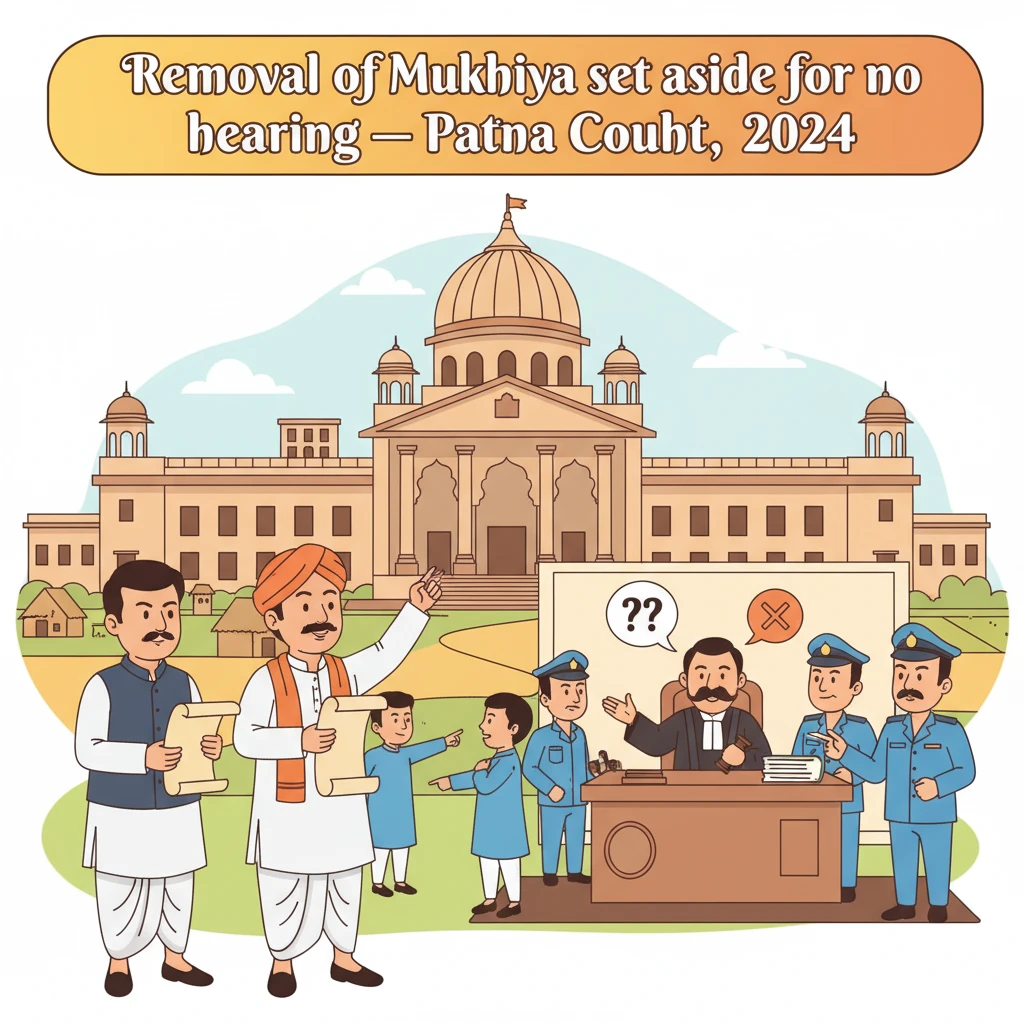
Case Background
The petitioner was the elected Mukhiya of Modanganj Govindpur Gram Panchayat in Jehanabad district, Bihar.
On 10.05.2023, an allegation petition was filed against him by the Up‑Mukhiya. This complaint, later referred to in the judgment as Annexure‑P4, led to an enquiry under the Bihar Panchayat Raj Act, 2006.
Under this Act, when allegations are made against a Mukhiya, the Lok Prahari‑cum‑Divisional Commissioner has to conduct an enquiry under Section 152(5). Based on that enquiry report, the Additional Chief Secretary, Panchayati Raj Department, may act under Section 18(5), which includes power to remove the Mukhiya and disqualify him from contesting Panchayat elections.
In the petitioner’s case, the Lok Prahari‑cum‑Divisional Commissioner, Magadh Division, Gaya, carried out an enquiry. An adverse report was submitted to the Additional Chief Secretary, Panchayati Raj Department, Government of Bihar, Patna.
On 07.11.2023, the Additional Chief Secretary passed an order bearing memo no. 14826 (also referred to as memo no. 322 in the relief clause), removing the petitioner from the post of Mukhiya of Modanganj Govindpur Gram Panchayat, Jehanabad. The order also declared him ineligible for election to any Panchayat body for five years from the date of the order.
Feeling aggrieved, the Mukhiya approached the Patna High Court under its civil writ jurisdiction in CWJC No. 18126 of 2023. He challenged both the Lok Prahari’s enquiry report and the removal order of the Additional Chief Secretary.
What the Court Examined and Decided
The matter was heard by Hon’ble Mr. Justice Purnendu Singh on 15.01.2024. The petitioner was represented by Mr. Y.V. Giri, Senior Advocate, assisted by Ms. Shrishti Singh and Mr. Pranav Kumar. The State was represented by Mr. Venkatesh Kirti, AC to GA‑2.
The petitioner’s core grievance was that the procedure laid down in Section 18(5) read with Section 152(5) of the Bihar Panchayat Raj Act, 2006 was not followed.
According to the petitioner, as Mukhiya he had appeared before the Lok Prahari during the enquiry proceedings. He stated that the proceeding books relating to Gram Sabha and Gram Panchayat meetings, which are required to be held under Section 20 of the Act, were kept in the custody of the Panchayat Secretary.
The petitioner argued that these proceeding books were never called for by the Lok Prahari. Without examining these key records, the Lok Prahari proposed action against him. He claimed that he regularly conducted meetings and discharged his duties, and that any contrary conclusion without checking the original records was illegal.
More importantly, the petitioner submitted that the Additional Chief Secretary, who has to act on the Lok Prahari’s report under Section 18(5), passed the final removal order without giving him any opportunity of hearing. He was neither given a notice to show cause nor supplied with a copy of the enquiry report.
His counsel argued that the Additional Chief Secretary merely reproduced the wording of Section 18(5) and Section 152 of the Act and, without discussing the material or the contents of the enquiry report, went ahead and removed him from office and disqualified him. This, it was argued, amounted to passing an ex parte order on “imaginary accusation” and violated the principles of natural justice.
The State, on the other hand, defended the order. The State’s counsel submitted that the Lok Prahari had exercised his jurisdiction strictly as per Section 152(5). On the basis of the enquiry report submitted by the Lok Prahari, the Additional Chief Secretary exercised his powers under Section 18(5) correctly.
The State argued that there was no denial of opportunity because the petitioner had already participated in the enquiry before the Lok Prahari. According to the State, once he had been heard in that enquiry, he could not later claim violation of natural justice on the ground that the enquiry report was not supplied to him.
The State further emphasised that the Additional Chief Secretary’s order was based on the materials on record, including the allegation petition dated 10.05.2023 filed by the Up‑Mukhiya (Annexure‑P4). It was argued that the allegations were found true and hence the order of removal did not call for interference.
After hearing both sides, the Patna High Court turned to the legal principles that guide interference in administrative decisions.
The Court observed that it is generally “slow to interfere” in administrative matters unless the decision is tainted by illegality, irrationality, or procedural impropriety. Mere assertion of these grounds is not enough; they must be clearly established.
The Court referred to the principle that non‑consideration of materials on record, or consideration of matters not on record, may amount to perversity. In such a case, the High Court can intervene under Article 226 of the Constitution.
The judgment relies on two Supreme Court decisions to support the need for proper consideration and reasoned orders:
First, in Ram Chander v. Union of India & Ors., (1986) 3 SCC 103, the Supreme Court explained that the word “consider” has different shades of meaning. There, non‑recording of clear reasons in disciplinary and appellate orders was held to violate principles of natural justice.
Second, in Union of India v. Mohan Lal Capoor & Ors., (1973) 2 SCC 836, the Supreme Court held that reasons are the link between the material and the conclusion. There must be a rational nexus between the facts considered and the findings reached, so that the decision can be seen as just and reasonable.
Applying these principles, the Patna High Court examined the order contained in memo no. 14826 dated 07.11.2023, the pleadings in the writ petition and the records filed.
The Court found that there was “complete violation of the manner prescribed under sub‑section 5 of Section 18 of the Act” by the Additional Chief Secretary. Under this provision, before taking action, the authority must:
• Issue notice to the concerned Mukhiya.
• Provide the relevant materials and enquiry report.
• Give him an opportunity to place his defence.
However, in this case, the Court recorded two crucial findings.
First, the petitioner was not put on notice by the Additional Chief Secretary to place his case. No opportunity was given to him at the stage where the final decision on removal and disqualification was to be taken.
Second, the enquiry report of the Lok Prahari was not provided to the petitioner. Without this, he could not properly defend himself or challenge the findings in the report.
The Court also noted that the impugned order did not disclose any independent finding on the enquiry report. There was no discussion of what the Lok Prahari had actually found under Section 152(5). In other words, the order did not show any rational link between the material and the conclusion.
Because of these defects, the Court held that the order dated 07.11.2023 (Annexure‑7) did not fulfil the legal requirements. It was passed in violation of the principles of natural justice.
As a result, the Patna High Court set aside and quashed the order of removal and disqualification. The writ petition was allowed.
Why This Judgment Matters
This decision is important for elected representatives at the Panchayat level and for ordinary villagers who vote for them.
The Patna High Court has made it clear that even when serious allegations are made against a Mukhiya, the government must strictly follow the procedure laid down in the Bihar Panchayat Raj Act, 2006.
Participation in an enquiry before the Lok Prahari is not enough. Before passing a final order under Section 18(5), the competent authority must give:
• A proper notice.
• A copy of the enquiry report.
• A real chance to reply and defend.
If these steps are skipped, any removal or disqualification order can be struck down.
For villagers and Panchayat representatives across Bihar, this judgment reinforces that government orders affecting elected posts must be reasoned and fair. Authorities cannot rely on bare reproduction of legal provisions without showing how the evidence supports their conclusions.
Legal Issues and Answers
-
Issue: Whether the Additional Chief Secretary, Panchayati Raj Department, could validly remove the Mukhiya and disqualify him under Section 18(5) of the Bihar Panchayat Raj Act, 2006 without giving him notice or supplying the Lok Prahari’s enquiry report.
Answer: No. The Patna High Court held that the procedure under Section 18(5) was violated, the enquiry report was not supplied, and no proper opportunity of hearing was given. The removal and disqualification order was therefore illegal and was quashed. -
Issue: Whether mere participation in the enquiry before the Lok Prahari cures the lack of hearing before the Additional Chief Secretary.
Answer: No. The Court found that the petitioner had to be noticed and heard by the Additional Chief Secretary on the basis of the enquiry report and materials, and that failure to do so amounted to violation of natural justice.
Cases Cited by the Court
- Ram Chander v. Union of India & Ors., (1986) 3 SCC 103.
- Union of India v. Mohan Lal Capoor & Ors., (1973) 2 SCC 836.
Case Details
Case Number: Civil Writ Jurisdiction Case No. 18126 of 2023
Case Title: Shailesh Paswan v. The State of Bihar & Ors.
Court: High Court of Judicature at Patna
Coram: Hon’ble Mr. Justice Purnendu Singh
Date of Judgment: 15.01.2024
Citation: 2024(1) PLJR 722
Nature of the Case: Writ petition challenging removal and disqualification of a Mukhiya under Section 18(5) of the Bihar Panchayat Raj Act, 2006
Advocates for Petitioner: Mr. Y.V. Giri, Senior Advocate; Ms. Shrishti Singh, Advocate; Mr. Pranav Kumar, Advocate
Advocate for the State: Mr. Venkatesh Kirti, AC to GA‑2
Link to Judgment: Click here to read the full judgment on the Patna High Court website
If you found this explanation helpful and wish to stay informed about
how legal developments may affect your rights in Bihar,
you may consider following Samvida Law Associates for more updates.







