

Case Background
The petitioner is a life convict. He was convicted by judgment dated 25.05.2006 for offences under Section 364A and Section 379/34 of the Indian Penal Code. He was sentenced to undergo rigorous imprisonment for life along with fine.
After spending many years in prison, the petitioner submitted an application dated 30.11.2019 for consideration of his case for premature release. This was to be examined under the Government’s remission policy contained in Notification No. 3106 dated 10.12.2002.
On this application, the Principal Probation Officer, District Probation Office, Bhabhua (Kaimur) started an inquiry. He sought a recommendation from the Superintendent, Mandal Kara, Aurangabad, and also an opinion from the learned District and Sessions Judge, Aurangabad.
In his report, the Principal Probation Officer recorded that during his inquiry it did not appear that the petitioner had any connection with any organisation involved in illegal acts. Based on local inquiry, he concluded that the petitioner’s case may be considered for premature release.
The District and Sessions Judge, Rohtas, Sasaram advised the Superintendent, Mandal Kara, Aurangabad that he could take a decision in accordance with the Prison Rules. The Superintendent of Police, Bhabhua also sent his recommendation to the Remission Board for consideration.
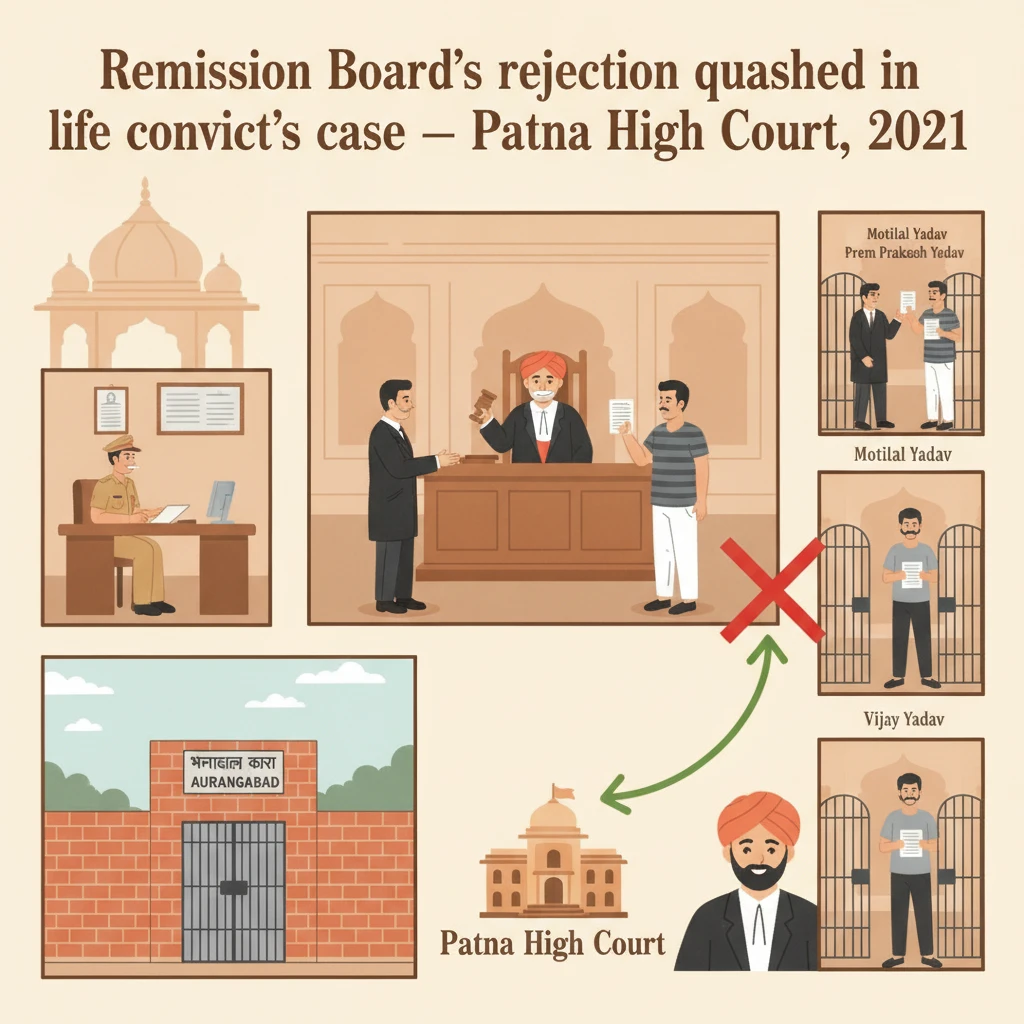
Despite these favourable materials, the State Sentence Remission Board, by order dated 03.04.2020, rejected the petitioner’s request for premature release. The Board relied on paragraph (iv)(kha) of the Government policy in Notification No. 3106 dated 10.12.2002 and held that the petitioner’s case was not fit for consideration.
The relevant part of the Board’s decision, in so far as it relates to the petitioner, was challenged before the Patna High Court by way of the present Criminal Writ Jurisdiction Case No. 453 of 2021.
What the Court Examined and Decided
Before the Patna High Court, the petitioner sought a writ of mandamus to quash the State Sentence Remission Board’s order dated 03.04.2020 as it related to him. He argued that the Board had wrongly applied the Government’s remission policy and had acted arbitrarily.
The petitioner relied on the detailed inquiry and recommendations made in his favour. The Principal Probation Officer’s report clearly stated that he was not associated with any unlawful organisation and recommended that his case be considered for premature release.
The Superintendent of Police, Bhabhua also recommended his case to the Remission Board. The District and Sessions Judge, Rohtas, Sasaram advised the prison authorities to proceed in accordance with the Prison Rules. All this indicated that, at the local level, authorities did not find adverse material against the petitioner for the purpose of remission.
The petitioner further pointed out, particularly in paragraph 14 of his writ application, that other convicts similarly situated had been granted the benefit of premature release. He named two persons, Motilal Yadav and Prem Prakash Yadav, who were convicted and sentenced to life imprisonment under Section 364A IPC. According to the petitioner, they were released from prison after a departmental decision vide letter no. 3874 dated 01.06.2018.
He also stated that another person, Vijay Yadav, convicted in the same matter under Section 364A/34 IPC, had been released by decision of the department vide letter no. 2716 dated 24.04.2020. Annexure 10 to the writ application was placed before the Court to substantiate these statements.
The Patna High Court noted that in the counter affidavit filed by the State, there was no denial of the statements made in paragraph 14 of the writ petition. This meant the State had not disputed that similarly convicted persons had been granted premature release.
On the other hand, the State, represented by learned AC to AAG-3, defended the Remission Board’s decision. The State argued that the allegations proved against the petitioner were heinous in nature. On that basis, it was suggested that his conviction should be treated on par with offences such as rape, dacoity or terrorist acts, which are excluded from premature release under the policy.
However, the State’s counsel did not dispute an important fact: the petitioner was not an accused of rape, dacoity or terrorist acts. Further, he was unable to respond effectively to the specific examples of other convicts under Section 364A IPC who had been granted premature release.
The Court then examined the text of Notification No. 3106 dated 10.12.2002, particularly paragraph (iv). The notification lays down categories of convicts who are ineligible for consideration of premature release. The relevant portion quoted in the judgment specifies, in sub-clause (ka), convicts involved in offences like rape, dacoity and terrorist crimes and, by using the word “vkfn”, appears to cover other similar offences. Sub-clause (kha) has to be read together with sub-clause (ka).
The Court observed that offences under Section 364A IPC (kidnapping for ransom) are not specifically mentioned in paragraph (iv)(ka) of the notification. The Court interpreted the use of the word “vkfn” at the end of sub-clause (ka) by applying the principle of “ejusdem generis” (things of the same kind). Under this principle, a general word following a list of specific offences must be interpreted as covering only offences of a similar nature.
Applying this rule, the Court held that “vkfn” in sub-clause (ka) could only be taken to refer to offences of the same category as those specifically listed, namely rape, dacoity and terrorist acts. In other words, the exclusion from consideration for premature release extended only to offences similar to these in character, not to every serious or heinous offence.
The Court noted that perhaps for this reason, the cases of Vijay Yadav and others, mentioned in paragraph 14 of the writ application, had been considered for premature release despite their conviction under Section 364A IPC. This showed that, in practice, Section 364A was not being treated by the authorities as automatically falling within the excluded category under paragraph (iv)(ka).
In the Court’s view, the Remission Board had not acted with objectivity when it considered the petitioner’s case. The Board had simply rejected his request for premature release by referring to the notification and paragraph (iv)(ka), without properly analysing whether his offence actually came within the excluded category as per the policy and the principle of interpretation.
The Court also highlighted that sub-clause (kha) of the notification must be read together with sub-clause (ka). Only then could the Remission Board correctly identify the cases in which the benefit of premature release could or could not be granted in terms of the policy.
Notably, during the hearing, once it became clear that the State had not denied the petitioner’s assertion regarding other similarly convicted persons being granted release, the learned AC to AAG-3 suggested that the case could be remanded to the State Remission Board for fresh consideration.
After considering all these aspects, the Patna High Court found substance in the petitioner’s challenge. It held that the decision dated 03.04.2020 of the State Remission Board, insofar as it related to the petitioner, could not stand.
The Court, therefore, quashed the said decision and directed the State Remission Board to consider the petitioner’s case afresh. This reconsideration must be done within two months from the date of receipt or communication of the Court’s order.
The Court further directed that the fresh decision should be a reasoned one, considering all aspects of the matter, and that it must be communicated to the petitioner forthwith after it is made and within the prescribed time frame.
With these directions, the criminal writ application was allowed to the extent indicated in the judgment.
Why This Judgment Matters
This judgment is important for life convicts and their families who seek premature release under the Bihar Government’s remission policy. It clarifies that the State Sentence Remission Board cannot simply brand an offence as “heinous” and deny consideration without checking what the policy actually says.
The Patna High Court has held that offences excluded from remission must fall within the specific categories listed in the policy, or be of the same type. For convicts under Section 364A IPC, this decision shows that their cases cannot be rejected merely by stretching the meaning of “similar offences” without proper reasoning.
The ruling also stresses that authorities must act consistently. If some similarly convicted prisoners are released, the State must explain why another convict in the same position is treated differently. Silence or vague justifications are not enough.
Finally, the judgment underlines that when courts remand matters to the Remission Board, the Board must pass a speaking, reasoned order within a fixed time. This helps prevent indefinite delays in deciding prisoners’ remission claims.
Legal Issues and Answers
-
Issue: Could the State Sentence Remission Board treat a conviction under Section 364A IPC as falling within the excluded category of offences (such as rape, dacoity and terrorist acts) under paragraph (iv)(ka) of Notification No. 3106 dated 10.12.2002 and thereby refuse to consider the petitioner’s premature release?
Answer: No. The Patna High Court held that Section 364A IPC is not specifically mentioned in paragraph (iv)(ka). Applying the principle of “ejusdem generis”, only offences similar to rape, dacoity and terrorist acts are excluded. The Board acted without objectivity in rejecting the petitioner’s case solely on this basis. -
Issue: Was the State justified in treating the petitioner differently from other convicts under Section 364A IPC who had been granted premature release?
Answer: No. The Court noted that the State did not deny the petitioner’s assertion that similarly convicted persons had been granted remission. In the absence of any explanation for this differential treatment, and given the favourable reports, the Board’s decision was arbitrary and liable to be quashed. -
Issue: What relief was appropriate in the circumstances?
Answer: The Court quashed the State Sentence Remission Board’s decision dated 03.04.2020 as it related to the petitioner and directed the Board to reconsider his case afresh within two months, by passing a reasoned order and communicating it to the petitioner.
Cases Cited by the Court
- No prior judicial decisions or case law have been cited or relied upon in the text of this judgment.
Case Details
Case Number: Criminal Writ Jurisdiction Case No. 453 of 2021; arising out of P.S. Case No. 27 of 2006, Dehri Town Police Station, District Rohtas.
Case Title: Pradeep Kumar Srivastava @ Pradip Kumar Srivastava vs. The State of Bihar & Ors.
Coram: Hon’ble Mr. Justice Rajeev Ranjan Prasad.
Date of Judgment: 15.09.2021.
Citation: 2022(1) PLJR 217.
Advocates: For the petitioner – Mr. Umeshanand Pandit, Advocate. For the respondents – Mr. Saroj Kumar Sharma, AC to AAG-3.
Respondents: The State of Bihar through its Chief Secretary, Home, Bihar, Patna; State Sentence Remission Board through its Principal Secretary, Home, Bihar, Patna; Law Secretary, Department of Law, Bihar, Patna; Inspector General of Prison and Reforms Services, Government of Bihar, Patna; Superintendent, Mandal Kara, Aurangabad.
Nature of the Case: Criminal writ petition seeking a writ of mandamus to quash the order of the State Sentence Remission Board rejecting the petitioner’s application for premature release and for a direction for fresh consideration.
Link to the Judgment: Click here to read the full judgment of the Patna High Court.
If you found this explanation helpful and wish to stay informed about
how legal developments may affect your rights in Bihar,
you may consider following Samvida Law Associates for more updates.







