
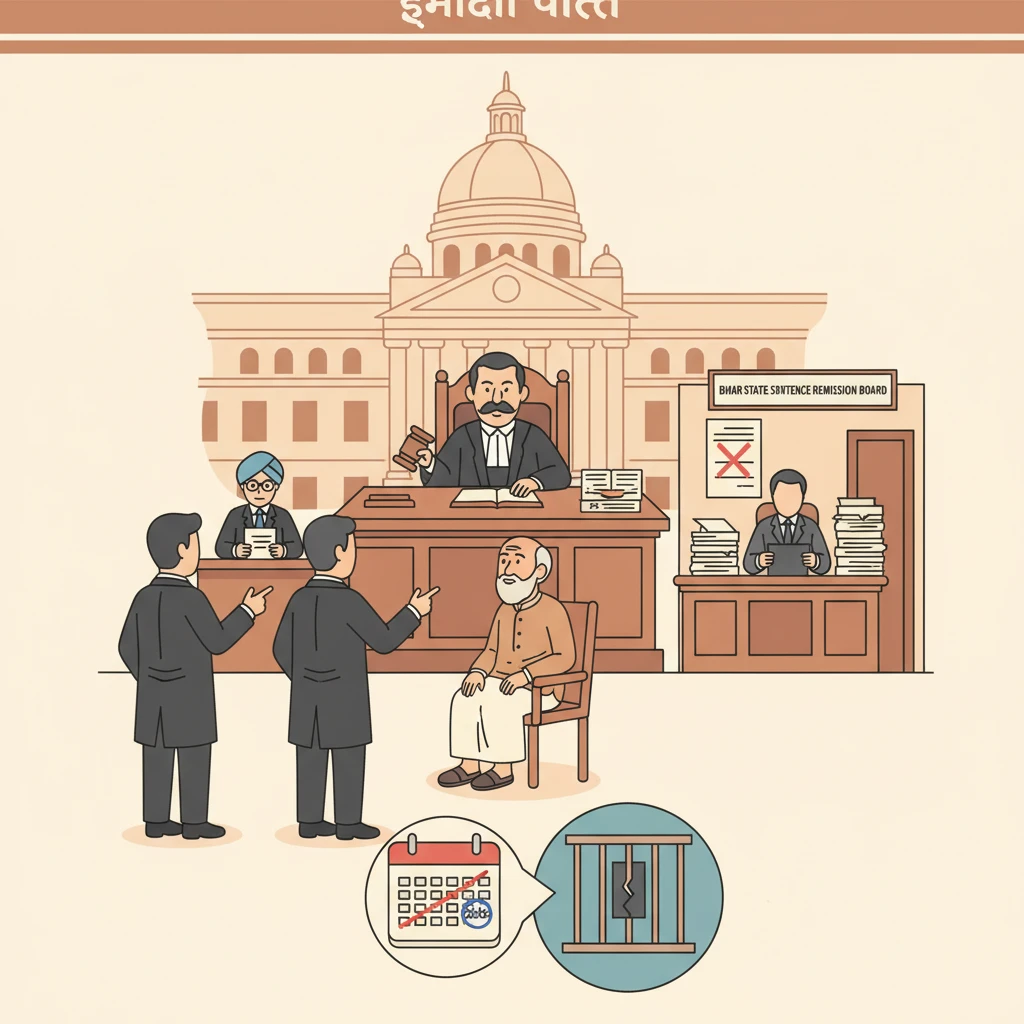
Case Background
The petitioner is a life convict from Gopalganj district. He was tried in Sessions Trial No. 55 of 2006 arising out of Phulwaria P.S. Case No. 1 of 2006.
He was convicted under sections 364, 302 and 201 of the Indian Penal Code by the District and Sessions Judge, Gopalganj. By judgment dated 05.04.2006 and sentencing order dated 10.04.2006, he was awarded the death penalty.
Later, in Criminal Appeal (DB) No. 329 of 2006, the Patna High Court commuted his death sentence to life imprisonment.
Over time, the petitioner spent many years in prison. The judgment notes that he has completed 19 years in actual imprisonment, and in his writ prayer he claimed to have completed more than 22 years with remission and more than 17 years of physical incarceration.
After completing 14 years of actual imprisonment, he first approached the Patna High Court in Criminal Writ Jurisdiction Case No. 103 of 2022. In that earlier case, he challenged the State Remission Board’s order dated 19.05.2021, which had rejected his proposal for premature release.
On 18.07.2023, the High Court set aside that 19.05.2021 order. The Court observed that the State Remission Board had merely copied Clause IV (क) of the Remission Policy without explaining how his offence fell within its scope. The Court called that order “cryptic and non-speaking” and remanded the matter back to the Board.
The State Remission Board was directed to reconsider his case and pass a reasoned order within six months from receipt of the High Court’s order.
After reconsideration, the Board again rejected his proposal, this time by its decision dated 12.09.2023. The petitioner then filed the present Criminal Writ Jurisdiction Case No. 153 of 2024 challenging the fresh rejection.
What the Court Examined and Decided
In this writ petition, the petitioner sought two main reliefs. First, he asked for a writ of certiorari to quash the State Remission Board’s decision dated 12.09.2023, to the extent it related to him. He said the Board had wrongly held that under clause (iv) (ka) and (kha) of Notification No. 3106 dated 10.12.2002, he was not eligible for premature release.
Second, he sought a writ of mandamus directing the authorities to consider and grant his premature release in connection with Sessions Trial No. 55 of 2006. He claimed that his case should be governed by the 1984 remission policy which was prevailing when he was convicted on 10.04.2006, and that the 2002 notification came into effective force only with effect from 02.07.2007.
The core grievance was that even after the earlier writ in 2022 and the High Court’s remand, the Board had again rejected his case, effectively treating his offence as falling in an ineligible category without proper reasoning.
The petitioner relied heavily on a coordinate Bench judgment in Criminal W.J.C. No. 1195 of 2021, Ajit Kumar Mishra vs. The State of Bihar & Ors., and another coordinate Bench judgment in Criminal W.J.C. No. 453 of 2021, Pradeep Kumar Srivastava vs. The State of Bihar & Ors. He argued that his case was “squarely covered” by these decisions.
On the other side, learned counsel for the State, Mr. Prabhu Narayan Sharma, appearing in view of those judgments, was unable to defend the impugned order of the Remission Board. The State could not justify how the Board had applied the policy to reject the petitioner’s claim.
Justice Sandeep Kumar examined at length what the coordinate Bench had held in the Ajit Kumar Mishra case. That earlier judgment had discussed:
- The nature of remission and commutation powers as executive functions traceable to Articles 72 and 161 of the Constitution and sections 433 and 433-A of the CrPC.
- The text and effect of Notification No. 3106 dated 10.12.2002, which amended Rule 529 of the then Jail Manual and set out categories of prisoners ineligible for premature release.
- The controversy about when the 2002 Remission Notification was actually implemented, including reliance on an affidavit of the then Principal Secretary, Home Department, in another case, indicating that life convicts were being released under the earlier 1984 Policy between 28.12.2002 and 24.09.2007, with the formal Board mechanism operating from 25.09.2007 onwards.
- Earlier High Court decisions such as Surendra Mahto, Md. Alauddin Ansari and Sikander Mahto, and the fact that special leave petitions against some of those decisions had been dismissed by the Supreme Court on the ground of delay, leaving the questions of law open.
In the Ajit Kumar Mishra judgment, the coordinate Bench also examined how the Remission Board had treated offences under section 364-A of the IPC. It held that the term “vkfn” (etc.) in clause (iv)(ka) of the 10.12.2002 notification must be read ejusdem generis—limited to offences similar in nature to rape, dacoity and terrorist activities.
Because of this interpretative rule, the Court noted that an offence under section 364-A IPC was not automatically covered in the ineligible category. It also pointed out that in other cases under section 364-A IPC (for example, the cases of certain named convicts referred in that writ petition), the Board had in fact recommended premature release.
The Ajit Kumar Mishra judgment further analysed the Bihar Jail Manual, 2012, which was framed under section 59 of the Prisons Act, 1894, and superseded the earlier manual. Chapter 15 of the 2012 Manual contains rules on premature release, including Rule 481 (as amended) which sets out who can be considered and which categories are excluded.
Rule 478 of the 2012 Manual was also quoted in that judgment. Rule 478 makes it clear that, while considering premature release, the Board must look at general principles of remission, court decisions, earlier precedents, the circumstances of the offence, the prisoner’s propensity to re-offend, family socio-economic conditions, risk of further violence, victim reconciliation and chances of reform.
The coordinate Bench also noted a later amendment dated 10.04.2023 to Rule 481(1)(a), where the phrase “or murder of a public servant on duty” was removed. After that amendment, 27 life convicts received the benefit of the more liberal provision and were released.
In that context, the Supreme Court’s judgment in Rajo @ Rajwa @ Rajendra Mandal vs. The State of Bihar and others, 2023 INSC 771, was discussed. The Supreme Court had held that, although the policy existing on the date of conviction generally applies, if a more liberal policy exists at the time of consideration for premature release, the convict should receive the benefit of that more liberal policy.
The coordinate Bench in Ajit Kumar Mishra concluded that, on the date the petitioner’s case was considered there (23.12.2020), the 2012 Manual had already clarified the earlier ambiguity, and there was no scope to read a conviction under section 364-A IPC into the exception list either under the 2002 notification or the 2012 Manual. It found that the Board had wrongly rejected the case by mechanically applying clause (iv)(d) of the 2002 notification without appreciating that the vague “etc.” wording was no longer a basis for exclusion.
Justice Sandeep Kumar, in the present writ, reproduced these key portions from the Ajit Kumar Mishra judgment and noted that the logic applied there directly impacted the legality of the present Board order.
The Court then stated clearly: “In view of the afore-quoted judgments, the impugned order cannot be sustained.” The reference to “judgments” includes the coordinate Bench decisions in Ajit Kumar Mishra and Pradeep Kumar Srivastava, which had constrained the State’s and the Board’s approach to remission and premature release.
Accordingly, the Patna High Court quashed the order dated 12.09.2023 passed by the Bihar State Remission Board so far as it related to this petitioner.
Instead of directly ordering release, the Court gave a specific direction on the next steps. It granted liberty to the petitioner to approach the authorities afresh for remission “in light of the aforesaid judgment” and specifically in light of the Court’s decision in Ajit Kumar Mishra vs. The State of Bihar and Ors.
The Court further mandated that if such an application is filed, the Remission Board must consider it strictly in accordance with law and in the light of the Ajit Kumar Mishra judgment. The Board has to dispose of the petitioner’s application within three months from the date it is filed.
Thus, the outcome is that the Board’s rejection is wiped out, but the actual decision on whether the petitioner will be released prematurely is left to be freshly taken by the Remission Board, under judicially settled principles and within a fixed time.
Why This Judgment Matters
This judgment matters for life convicts in Bihar who are seeking premature release after long years in prison. It confirms that the State Remission Board cannot simply quote policy clauses and reject proposals without proper reasoning.
The Patna High Court makes it clear that the Board must follow earlier High Court and Supreme Court rulings, the relevant remission policies, and the provisions of the Bihar Jail Manual, 2012. Vague reliance on words like “etc.” in earlier notifications is not enough.
The judgment also shows that if a more liberal remission policy or rule exists at the time of consideration, the convict’s case must be assessed in light of that more beneficial framework. The Board cannot ignore later amendments or favourable precedents that have already been applied to similarly placed prisoners.
For prisoners and families, this decision signals that if their remission proposals are rejected through cryptic or mechanical orders, they can approach the Patna High Court. The Court may then insist on a fresh, reasoned decision within a specific time frame.
Legal Issues and Answers
- Issue: Whether the Bihar State Remission Board’s order dated 12.09.2023 rejecting the petitioner’s request for premature release under Notification No. 3106 dated 10.12.2002 was legally sustainable in light of prior High Court and Supreme Court rulings and the Bihar Jail Manual, 2012.
Answer: No. The Patna High Court held that, in view of the judgments in Ajit Kumar Mishra and Pradeep Kumar Srivastava and the legal framework discussed there, the impugned order could not be sustained and was therefore quashed. The Board must reconsider the petitioner’s case afresh in accordance with law. - Issue: What remedy should be granted when a remission order is found unsustainable?
Answer: The Court did not order direct release. Instead, it quashed the Board’s order, granted liberty to the petitioner to apply again, and directed the State Remission Board to decide his remission application afresh within three months, in line with applicable law and the Ajit Kumar Mishra judgment.
Cases Cited by the Court
- Ajit Kumar Mishra vs. The State of Bihar and Ors., Criminal W.J.C. No. 1195 of 2021 (Patna High Court).
- Pradeep Kumar Srivastava vs. The State of Bihar and Ors., Criminal W.J.C. No. 453 of 2021 (Patna High Court).
- Surendra Mahto vs. The State of Bihar & Ors., 2021 (4) PLJR 393 (Patna High Court) – referred within the extracted portion of Ajit Kumar Mishra.
- Md. Alauddin Ansari vs. State of Bihar & others (Patna High Court) – referred within the extracted portion.
- Sikander Mahto vs. State of Bihar & others (Patna High Court) – referred within the extracted portion.
- Gopal Vinayak Godse vs. State of Maharashtra, [1961] 3 SCR 440 (Supreme Court of India).
- Maru Ram vs. Union of India, [1981] 1 SCR 1196 (Supreme Court of India).
- Jagdish (Supreme Court) – cited and quoted in the extracted discussion.
- Rajo @ Rajwa @ Rajendra Mandal vs. The State of Bihar and others, 2023 INSC 771; W.P. (Criminal) No. 252 of 2023 (Supreme Court of India).
Case Details
Case Number: Criminal Writ Jurisdiction Case No. 153 of 2024
Case Title: Ashok Yadav vs. The State of Bihar & Ors.
Coram: Hon’ble Mr. Justice Sandeep Kumar
Citation: 2025 (4) PLJR 597
Advocates: Mr. Ratnakar Pandey for the petitioner; Mr. A.G. (Assisted by State counsel including Mr. Prabhu Narayan Sharma as recorded in the judgment) for the respondents.
Nature of Case: Criminal writ petition challenging rejection of proposal for premature release/remission by the Bihar State Sentence Remission Board.
Date of Judgment: 10.10.2025
Impugned Order: Order of Bihar State Remission Board dated 12.09.2023
Link to Judgment: Full text of Patna High Court judgment
If you found this explanation helpful and wish to stay informed about how legal developments may affect your rights in Bihar, you may consider following Samvida Law Associates for more updates.







