
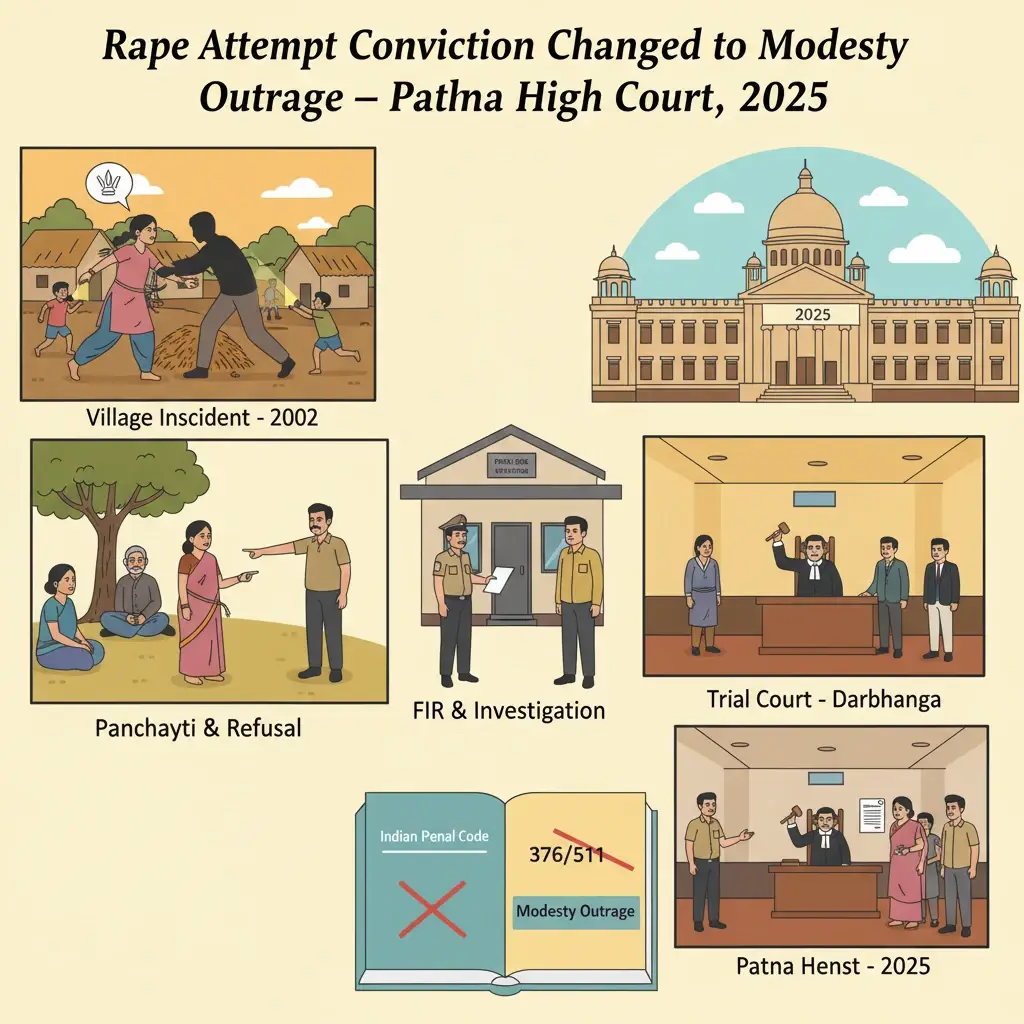
Case Background
This criminal appeal arose from a conviction passed by the Additional Sessions Judge, Fast Track Court No.-V, Aurangabad in Sessions Trial No. 219 of 1997/113 of 2009, arising out of Nabinagar P.S. Case No. 59 of 1995.
The trial court had convicted the appellant under Sections 376, 379 and 448 of the Indian Penal Code. He was sentenced to 10 years rigorous imprisonment and a fine of Rs. 5,000 for the offence under Section 376 IPC, 2 years rigorous imprisonment under Section 379 IPC, and 6 months rigorous imprisonment under Section 448 IPC. In default of payment of fine, he was to undergo an additional 6 months imprisonment. All sentences were to run concurrently.
Aggrieved by this judgment of conviction dated 08.12.2009 and order of sentence dated 10.12.2009, the accused filed Criminal Appeal (SJ) No. 52 of 2010 before the Patna High Court. The appeal was heard by Hon’ble Mr. Justice Ramesh Chand Malviya and decided on 20.03.2025.
What the Court Examined and Decided
The prosecution case started with the statement of the informant, a blind woman aged about 45 years, which led to the registration of Nabinagar P.S. Case No. 59 of 1995 under Sections 448, 376 and 380 IPC. After investigation, charge-sheet was submitted against the sole accused for the same offences, and the case was committed to the Court of Sessions on 11.07.1996.
According to the prosecution, on the alleged night, the informant was sleeping on a cot with her nephew Ranjan, aged about 7–8 years. Around 11 p.m., when a shuttle train was going towards Dehri, someone came and asked her to open the door. She did not open it. It was alleged that the accused then broke the rope (tatti) of the gate, entered the house, and was recognised by the informant by his voice.
The informant stated that the accused caught hold of her hand. When she raised alarm, he gagged her mouth with his gamcha (towel), caught both her hands with one hand, removed her sari and petticoat and forcibly committed rape with her for about 5–15 minutes. She further alleged that he took Rs. 200 from her anchal while leaving and that his gamcha remained at the spot.
She claimed that after he left, she raised alarm. Ajay Kumar, Sachita Kahar and Mallua, who were patrolling nearby, allegedly came, were told about the occurrence, but then went away silently. She also stated that the accused threatened her with dire consequences if she disclosed the incident to anyone.
The informant said that she spent the night at home. The next morning she went to the Irrigation Department colony where she massaged the ladies there, returned home, took a bath, prepared and ate her meal, and then went to the police station with her nephew Ranjan. On the basis of her statement, the FIR was registered. She stated that the police recorded her statement, took her thumb impression, sent her for medical examination with a chowkidar and constable, and later took her restatement. She also claimed to have handed over her stained sari and petticoat to the police, and a seizure list was prepared.
During the trial, the prosecution examined six witnesses: PW-1 Sachita Kumar, PW-2 Mallu Sah, PW-3 Ajay Prasad, PW-4 the victim/informant, PW-5 Ballu Sao and PW-6 Ram Lal Singh (a formal witness).
Crucially, PW-1, PW-2, PW-3 and PW-5 did not support the prosecution case. They were declared hostile. This meant that the prosecution version was effectively supported only by the testimony of PW-4, the victim.
In her cross-examination, PW-4 stated that she became blind due to chicken pox before her marriage and used to beg at the station. She said that the village Simri Jaisiya was about 1 km from her house, but she had never gone there and did not know all the villagers. She claimed she could identify the language of Jaisiya Simri.
She also stated that she had not told the ladies of the Irrigation Department colony about the incident. She went to the police station at about 2 p.m. the day after the occurrence. She further stated that the accused used to come there, so she recognised him from his voice, though she had no relation with him. She also said that people used to say “Kya Binda Singh, Kya Binda Singh”, so she came to know his name that way. She denied the defence suggestion that no such incident took place and that she had falsely implicated the accused at the instance of others.
PW-6, the formal witness, proved the FIR, seizure-cum-production list, medical examination report, supplementary medical report and the case diary as exhibits. However, the doctor who conducted the medical examination was not examined, nor was the Investigating Officer brought to the witness box.
On behalf of the appellant, it was argued that he had been falsely implicated and that the trial court did not properly appreciate the evidence. The defence highlighted that:
- All material witnesses, except the victim, had turned hostile.
- The victim was blind and identified the accused only by voice.
- There was no corroboration of her version from any independent witness.
- The medical and supplementary reports did not support the allegation of rape, as there was no injury on the private parts and no spermatozoa on the clothes.
- The Investigating Officer, chowkidar and medical officer were not examined, creating serious gaps in the prosecution case.
The State, through the learned APP, supported the trial court judgment, arguing that the prosecution had proved its case beyond reasonable doubt and that the conviction should be upheld.
The Patna High Court carefully examined the entire record and evidence. The Court noted that there were material inconsistencies in the deposition of witnesses and that all witnesses other than the informant/victim had turned hostile. The Court also took note that the contents of the FIR and medical report had not been properly proved, as neither the Investigating Officer nor the doctor had been examined during trial.
The Court held that the non-examination of the Investigating Officer and the doctor was fatal to the prosecution in the facts of this case. To explain this, the Court relied upon two Supreme Court decisions.
First, the Court quoted the judgment in Habeeb Mohammad vs The State of Hyderabad, 1954 AIR 51, 1954 SCR 475. In that case, the Supreme Court stressed that it is the duty of the prosecution to examine all material witnesses who can narrate the events forming the basis of the prosecution case, and omission to do so can prejudice the accused and make the trial unfair.
Secondly, the Court referred to Munna Lal vs State of Uttar Pradesh, 2023 SCC OnLine SC 80. The Supreme Court there discussed general principles including that a defective investigation is not always fatal if there is credible ocular evidence. However, it also held that non-examination of the Investigating Officer must be assessed in each case. Where there are gaps and the IO’s evidence is vital, non-examination can create a material lacuna and raise reasonable doubt.
Applying these principles, the Patna High Court held that, in this case, the failure to examine the Investigating Officer and the medical practitioner was not a minor defect but a serious shortcoming. The IO could have clarified the investigation steps, seized articles, and sequence of events. The doctor could have proved whether there was any injury or medical sign consistent or inconsistent with rape.
The Court observed that no injury to the victim was proved, no medical report was properly exhibited through the doctor, and no eyewitness had supported the prosecution case. All relevant prosecution witnesses, except the informant, were hostile and had not seen the occurrence. There were also discrepancies regarding the sequence of events and presence of individuals at the place of occurrence.
In these circumstances, the Court held that the prosecution had failed to prove the charges beyond all reasonable doubt. It would not be proper to maintain a conviction solely on the uncorroborated testimony of the blind victim, when the investigation was incomplete in evidence and other witnesses had turned hostile.
The Court concluded that the trial court had failed to appreciate the deficiencies, infirmities and gaps in the evidence, and had passed the conviction in ignorance of basic criminal law principles that require proof beyond reasonable doubt.
Accordingly, the Patna High Court set aside the judgment of conviction dated 08.12.2009 and order of sentence dated 10.12.2009. The appellant was acquitted of all charges. As he was already on bail, he was discharged from the liability of his bail bond. The criminal appeal was allowed.
Why This Judgment Matters
This judgment shows how crucial proper investigation and complete evidence are in criminal cases, especially serious offences like rape.
The Patna High Court made it clear that when material witnesses, such as the Investigating Officer and the doctor, are not examined, and independent witnesses turn hostile, the court must be slow to uphold a conviction.
For victims, this case highlights that prompt reporting, medical examination and consistent support from witnesses are vital to sustaining a criminal case.
For accused persons, it reinforces the principle that no one should be convicted unless the prosecution proves the case beyond reasonable doubt through reliable and properly tested evidence.
The decision also serves as a reminder to police and prosecutors that failure to present crucial witnesses can lead to acquittal, even in grave offences, because courts must ensure a fair trial and adherence to criminal jurisprudence.
Legal Issues and Answers
- Issue: Whether the conviction of the appellant for offences under Sections 376, 379 and 448 IPC could be sustained on the basis of the sole testimony of the blind victim, when other witnesses had turned hostile and the Investigating Officer and doctor were not examined.
Answer: No. The Patna High Court held that due to hostile witnesses, non-examination of the Investigating Officer and doctor, lack of proved medical evidence, and discrepancies in the prosecution case, the charges were not proved beyond reasonable doubt, and the conviction had to be set aside.
Cases Cited by the Court
- Habeeb Mohammad vs The State of Hyderabad, 1954 AIR 51, 1954 SCR 475
- Munna Lal vs State of Uttar Pradesh, 2023 SCC OnLine SC 80
Case Details
Case Number: Criminal Appeal (SJ) No. 52 of 2010
Case Title: Binda Singh vs The State of Bihar
Court: High Court of Judicature at Patna
Coram: Hon’ble Mr. Justice Ramesh Chand Malviya
Date of Judgment: 20.03.2025
Citation: 2025 (2) PLJR 665
Advocates:
For the Appellant: Mr. Rajeev Kumar Singh, Advocate; Ms. Rushali, Advocate; Mr. Prabhojot Singh, Advocate
For the State/Respondent: Mr. A.M.P. Mehta, APP
Nature of the Case: Criminal appeal against conviction and sentence in a sessions trial for offences under Sections 376, 379 and 448 IPC.
Originating Case: Sessions Trial No. 219 of 1997/113 of 2009 arising out of Nabinagar P.S. Case No. 59 of 1995.
Link to judgement ; https://patnahighcourt.gov.in/viewjudgment/MjQjNTIjMjAxMCMxI04=-UuTotq1MlLw=
If you found this explanation helpful and wish to stay informed about
how legal developments may affect your rights in Bihar,
you may consider following Samvida Law Associates for more updates.







