
Case Background
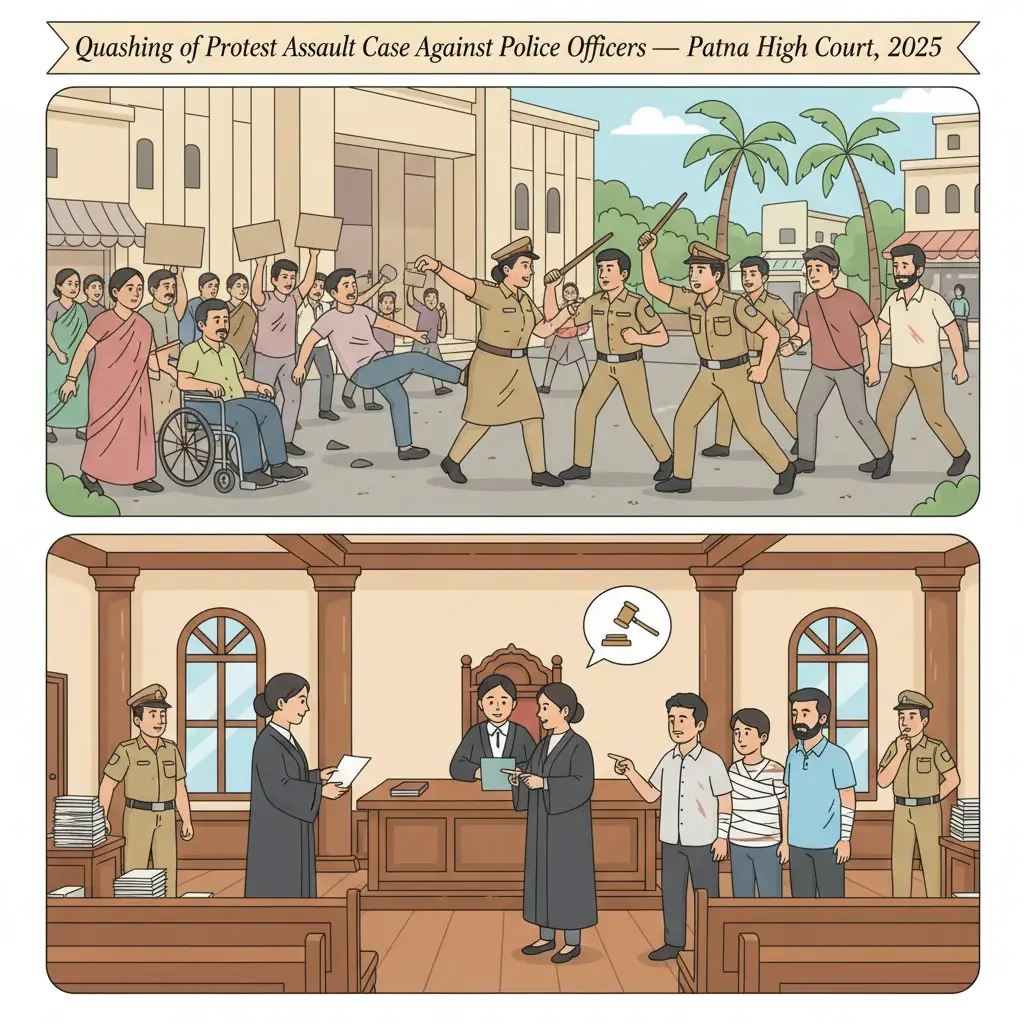
The case arises out of a protest in Begusarai on 28.03.2014. A one-day “Begusarai Bandh” was called by a group named “Aparadh Virodhi Sangharsh Samiti” to protest alleged kidnapping of three children and the killing of one child, Piyush.
The bandh was said to be supported by civil society and business organisations. Two district advocate associations of Begusarai reportedly supported the strike by staying away from court work. The convener of the Samiti, Suman Kumar, is stated to have informed the Sub-Divisional Officer, Begusarai in writing. The bandh call was also published in newspapers.
On the day of the bandh, protesters marched towards Power House Chowk, Begusarai. According to the complaint later filed, a Deputy Superintendent of Police, the Sadar S.D.O., and the Circle Officer came with armed forces, detained the complainant and several protesters, and took them to Town Thana. More protesters were brought there later.
Around 12:00 P.M., the then Superintendent of Police, Begusarai (petitioner in one of these cases), is alleged to have reached the police station, abused the protesters and, along with other officers, assaulted them. There are allegations of beatings with rods, including on a physically disabled protester, and a specific allegation that one protester, Zafir Khan, was kicked on his testicles, leading to bleeding. Another protester, Mukund Kumar, is alleged to have sustained a hand fracture from a police rod. The Circle Officer is said to have torn the complainant’s shirt.
The complaint further states that around 8:00 P.M. the detained protesters were produced before the Chief Judicial Magistrate (CJM), Begusarai in connection with Town P.S. Case No. 221/2014. It is alleged that the police officers threatened the protesters not to disclose the assault to the CJM, but the protesters still showed their injuries. The CJM ordered proper treatment on 28.03.2014. The complaint claims this order was not followed immediately, and appropriate treatment was given only later upon applications from the jail doctor and superintendent, followed by formation of a medical board on 07.04.2014 on the CJM’s order dated 02.04.2014.
On 14.04.2014, about 15 days after the protest, the complainant, Abhinav Kumar Akela, filed Complaint Case No. 13373(C) of 2014 before the Magistrate at Begusarai against the then Superintendent of Police, the Deputy Superintendent of Police and three other officials.
The complaint was processed slowly. The complainant’s statement was recorded on 06.06.2014, and statements of eight witnesses were recorded between June 2014 and December 2016, with a gap until 2016 for the last two witnesses. Meanwhile, the complainant moved an application on 20.02.2017 to call for medical reports from Town P.S. Case No. 221/2014. The Magistrate allowed this, and the complaint remained pending for want of these papers till 23.03.2018.
On 13.06.2018 a petition with a list of documents was filed by the complainant. Thereafter, the case was transferred from the CJM to another Magistrate. From 04.08.2018 to 19.04.2024, the complainant remained absent and did not take any steps in the complaint case.
Finally, on 29.04.2024, the Judicial Magistrate, 2nd Class, Begusarai passed the impugned order taking cognizance of offences under Sections 166, 323, 504 and 506/34 of the Indian Penal Code and issued summons to all accused persons, including both petitioners.
Aggrieved by this, the then Superintendent of Police (Harpreet Kaur) and the then Deputy Superintendent of Police (Rajkishor Singh) approached the Patna High Court by filing two petitions under Section 482 of the Code of Criminal Procedure, seeking quashing of the cognizance order and the entire criminal proceeding, to the extent it concerned them.
What the Court Examined and Decided
The Patna High Court, through Hon’ble Mr. Justice Chandra Shekhar Jha, heard both petitions together, as both arose from the same complaint and the same cognizance order dated 29.04.2024.
The petitioners argued that they were on official duty on 28.03.2014, when the Model Code of Conduct for the 2014 General Election was in force by Notification dated 05.03.2014 of the Election Commission of India. As senior police officers, they were duty-bound to maintain law and order, especially during elections.
Counsel for the petitioners submitted that the complaint was an afterthought and was filed to counter Town P.S. Case No. 221/2014, lodged on 28.03.2014 itself against the complainant and his associates. That FIR invoked Sections 147, 149, 188, 353, 435, 332, 333, 427, 323 and 341 IPC and alleged that the protest turned violent. The protesters were accused of blocking roads, forcing shop closures, assaulting pedestrians and scuffling with police, where police had to use “mild force” to control the situation.
The petitioners also highlighted that the complainant had allegedly been involved in other criminal cases, namely Town P.S. Case Nos. 212/2014 and 213/2014, involving offences under Sections 188, 153, 144, 353, 332, 333 IPC, Section 126 of the Representation of People Act and provisions of the Bihar Loudspeaker and Control Act, 1955. Both these cases were said to have been found true in investigation and charge-sheets submitted. On this basis, they argued that the complainant was a habitual violator of law and order.
A key plank of the petitioners’ case was Section 197 Cr.P.C., which provides that when a public servant is accused of an offence alleged to have been committed while acting or purporting to act in the discharge of official duty, the court cannot take cognizance without previous sanction from the appropriate government. The petitioners contended that the Magistrate took cognizance without obtaining such sanction, making the entire proceeding void.
The petitioners further submitted that the injury reports relied upon by the Magistrate did not support the extreme allegations of assault. For example, for Zafir Khan the medical report recorded only “pain in right hand” and “pain in whole body”. There was no medical finding of injury to the testicles or bleeding from the penis. Similarly, for Rupak Kumar, only complaints of pain in both hands and whole body were recorded. The petitioners argued that such discrepancies showed the allegations about brutal custodial assault were exaggerated and motivated.
They also drew the Court’s attention to the abnormal delay of ten years between the alleged incident (2014) and the summoning order (2024), and the long period of inaction by the complainant between 2018 and 2024. They contended that such delay itself was oppressive and amounted to abuse of process.
The High Court examined in detail the impugned cognizance order dated 29.04.2024. The Magistrate had recorded that the complainant and eight inquiry witnesses fully supported the allegations; that there were no substantial contradictions; and that the medical board’s reports showed injuries caused in custody by hard and blunt substances. The Magistrate also expressly discussed Section 197 Cr.P.C. and concluded that no sanction was required, holding that acts of custodial torture could not be treated as acts done in discharge of official duty.
To justify that view, the Magistrate relied on a recent Supreme Court ruling in Shadakshari v. State of Karnataka, (2024) SCC OnLine SC 48, and on the Patna High Court decision in Jitendra Kumar v. State of Bihar, (2019) 4 PLJR 1128, both stating that unlawful assault in custody is not protected by Section 197 Cr.P.C.
The Patna High Court, however, approached the matter differently. It first noted that on 28.03.2014, the Model Code of Conduct was in operation for the General Election, 2014. The petitioner Superintendent of Police was responsible to maintain law and order, and the bandh call was admittedly on the issue of law and order. The complaint itself suggested only that intimation of the bandh had been given in writing, not that any formal permission was obtained from the administration. The Court recorded that the protest turned violent and that Town P.S. Case No. 221/2014 had been lodged against the complainant and other protesters.
The High Court also pointed out that the complaint was filed after a 15-day delay and only after the police case against the complainant had been registered. The complainant was also an accused in two other cases of similar nature. The Court observed that, while normally the defence of the accused is not to be examined at the cognizance stage, documents of “sterling” quality cannot be ignored. For this principle, the Court relied on the Supreme Court judgment in State of Orissa v. Debendra Nath Padhi, AIR 2005 SC 359.
On the medical aspect, the High Court noted that the injury report, as discussed in the Magistrate’s order, did not corroborate the serious allegation of a kick on the testicles causing bleeding. Instead, it recorded only body pain and pain in hand for Zafir Khan. This, the Court held, prima facie negated the most serious part of the complaint and suggested an ulterior and oblique motive to counter the police case.
Critically, the High Court held that the allegations were “admittedly raised in the background” where the petitioners and other police personnel were discharging official duty in handling a strike/demonstration during the Model Code of Conduct. Therefore, sanction for prosecution under Section 197 Cr.P.C. was “mandatorily required”. The Magistrate’s contrary reasoning was not accepted.
The Court also commented that keeping a complaint inquiry pending for ten years was itself an “eyebrow raising event”. Considering the nature of injuries as alleged in the complaint and the actual medical reports, the Court held that it did not appear that the police exceeded permissible limits in the circumstances of a tense law and order situation during elections.
Relying on the principles laid down in Neeharika Infrastructure Private Limited v. State of Maharashtra, (2021) 19 SCC 401, the Court reiterated that power to quash should be used sparingly but can be invoked to prevent abuse of process. It also drew support from D.T. Virupakshappa v. C. Subash, (2015) 12 SCC 231, particularly the guidelines in paragraph 8 of that judgment regarding the scope of Section 197 Cr.P.C. in “police excess” cases.
Applying these principles, the Patna High Court concluded that the cognizance order dated 29.04.2024 in Complaint Case No. 13373(C) of 2014, insofar as it related to the two petitioners, was flawed and unsustainable in law. The absence of prior sanction, the delayed and retaliatory nature of the complaint, the medical evidence, and the prolonged pendency all weighed with the Court.
Accordingly, the Court set aside and quashed the cognizance order qua the petitioners and allowed both petitions under Section 482 Cr.P.C. It directed that a copy of the judgment be sent to the trial court for information and compliance.
Why This Judgment Matters
This decision is important for both police officers and citizens who participate in protests.
First, it reinforces that when a public servant is accused of acts done while handling law and order situations, especially during sensitive times like elections, the law generally requires prior government sanction before a court can take criminal cognizance. Without such sanction, prosecution cannot proceed.
Second, the Patna High Court shows that it will look carefully at the timing and background of complaints. A complaint filed much later, after a police case against the complainant, can be viewed as retaliatory, especially where medical reports do not support the more serious allegations.
Third, the judgment highlights that long, unexplained delay in moving a complaint case, like ten years here, can itself amount to abuse of process. Courts can use their inherent powers to stop such proceedings to protect individuals from endless uncertainty.
For ordinary citizens, the case also shows that while allegations of police brutality are serious, they must be backed by timely complaints, consistent witness statements and medical evidence. For public servants, it reassures that courts will respect statutory protections like Section 197 Cr.P.C., particularly when actions are reasonably connected with official duties.
Legal Issues and Answers
- Issue: Can a Magistrate take cognizance of offences against police officers for acts during a protest without prior sanction under Section 197 Cr.P.C.?
Answer: No. Since the acts were alleged to have occurred while the petitioners were discharging their official duties in maintaining law and order during the Model Code of Conduct, prior sanction under Section 197 Cr.P.C. was mandatory. Its absence made the cognizance order unsustainable. - Issue: Do the facts and medical records support continuation of criminal proceedings against the petitioners for alleged custodial assault?
Answer: The Court found that the medical report showed only bodily pain and pain in hand, which prima facie contradicted the serious allegation of injury to the testicles with bleeding. Viewed alongside the 15-day delay, background of counter cases, and ten years of pendency, the Court held the complaint appeared motivated and quashed the proceedings against the petitioners. - Issue: When can the High Court use its inherent powers under Section 482 Cr.P.C. to quash proceedings arising from protests and law and order operations?
Answer: Guided by precedents like Neeharika Infrastructure and D.T. Virupakshappa, the Court held that where prosecution is clearly an abuse of process—such as lack of mandatory sanction, apparent retaliatory motive, and lack of supporting medical evidence—it can and should quash proceedings even at the cognizance stage.
Cases Cited by the Court
- Neeharika Infrastructure Private Limited v. State of Maharashtra & Others, (2021) 19 SCC 401
- D.T. Virupakshappa v. C. Subash, (2015) 12 SCC 231
- State of Haryana v. Bhajan Lal, 1992 Supp (1) SCC 335 : 1992 SCC (Cri) 426 (referred through Neeharika)
- R.P. Kapur v. State of Punjab, AIR 1960 SC 866 (referred in Neeharika principles)
- Khawaja Nazir Ahmad, Privy Council decision (referred in Neeharika)
- State of Orissa v. Debendra Nath Padhi, AIR 2005 SC 359
- Om Prakash v. State of Jharkhand, (2012) 12 SCC 72 : (2013) 3 SCC (Cri) 472
- State of Orissa v. Ganesh Chandra Jew, (2004) 8 SCC 40 : 2004 SCC (Cri) 2104
- K. Satwant Singh v. State of Punjab, AIR 1960 SC 266 : 1960 Cri LJ 410 (referred through Om Prakash)
- Shadakshari v. State of Karnataka, (2024) SCC OnLine SC 48 (relied on by Magistrate, discussed by High Court)
- Jitendra Kumar v. State of Bihar, (2019) 4 PLJR 1128 (relied on by Magistrate, discussed by High Court)
Case Details
Case Number: Criminal Miscellaneous No. 60841 of 2024 with Criminal Miscellaneous No. 62600 of 2024; arising out of Complaint Case No. 13373(C) of 2014, P.S. Case No. 13373 of 2014, Begusarai Complaint Case, District Begusarai.
Case Title: Harpreet Kaur v. The State of Bihar & Anr; Rajkishor Singh v. The State of Bihar & Anr.
Citation: 2025 (2) PLJR 890
Coram: Hon’ble Mr. Justice Chandra Shekhar Jha
Advocates:
For the Petitioners (in both Criminal Miscellaneous cases): Mr. Rana Vikram Singh, Advocate; Mr. Saket Tiwary, Advocate
For the State of Bihar: Mr. Navin Kumar Pandey, Additional Public Prosecutor (A.P.P.)
Appearance of opposite party no. 2 (complainant) before the High Court: Opposite party no. 2 did not appear despite effective service of notice.
Nature of the Case: Petitions under Section 482 of the Code of Criminal Procedure, 1973 seeking quashing of the Magistrate’s order taking cognizance and issuing summons in a complaint case alleging police assault during a bandh.
Link to Judgment: https://patnahighcourt.gov.in/viewjudgment/NiM2MDg0MSMyMDI0IzIjTg==-BHJUf–am1–0B8VE=
If you found this explanation helpful and wish to stay informed about
how legal developments may affect your rights in Bihar,
you may consider following Samvida Law Associates for more updates.







