
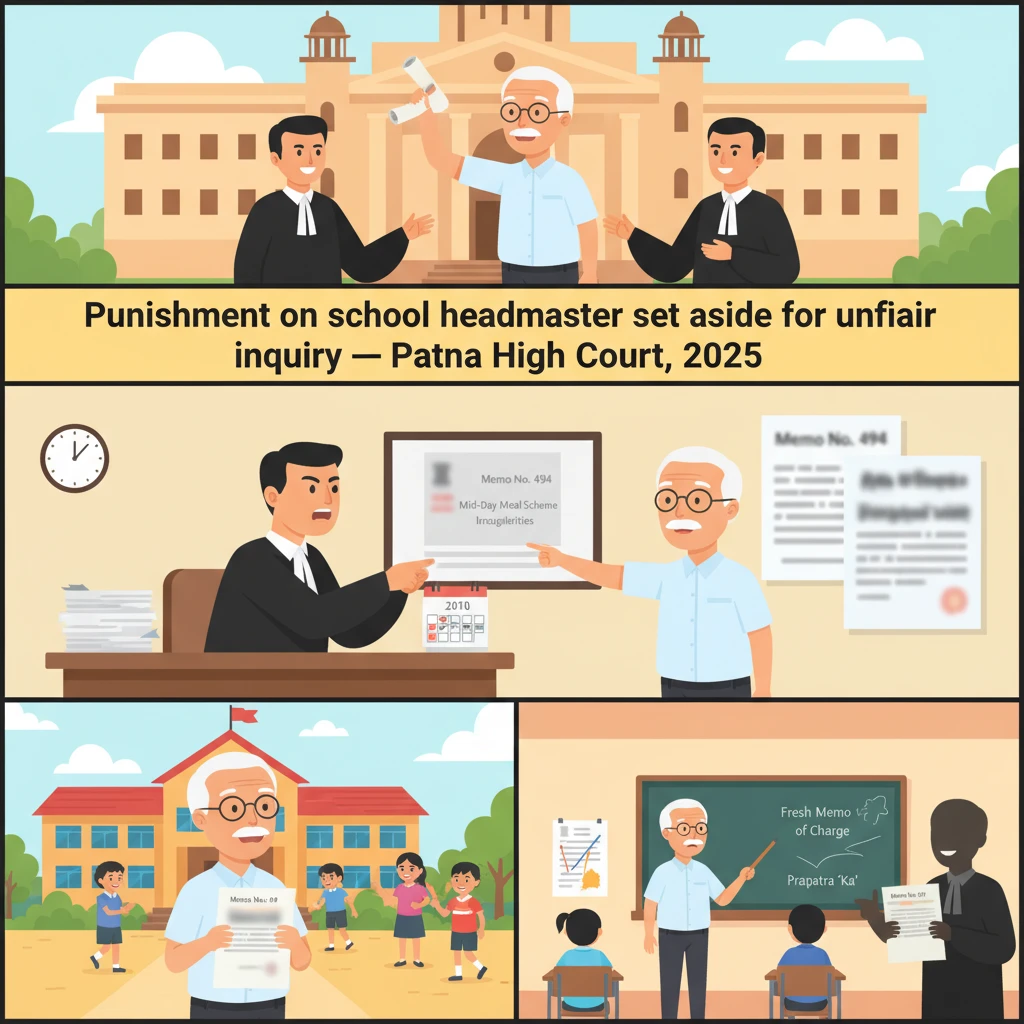
The Court found that the inquiry and punishment violated basic rules and natural justice.
Both the punishment and appellate orders were quashed.
The authorities were directed to pay full salary and benefits for the suspension period within three months.
Case Background
The petitioner was a government school teacher, initially appointed as an Assistant Teacher in the Matric Trained Scale on 01.11.1977 at Primary School, Kendua, Imamganj, District Gaya.
In 1987, he received his first time-bound promotion, and in 1989, he was granted “Pravar Koti” promotion. Later, he was posted as In-charge Headmaster of Middle School, Kochahasa, under Karpi Block in District Arwal. He was due to retire on 30.06.2017.
While serving as In-charge Headmaster, the District Superintendent of Education, Jehanabad, issued Memo No. 494 dated 17.02.2010, placing him under suspension.
The suspension was based on a report of the Area Education Officer-cum-Incharge, Mid-Day Meal Scheme, Arwal. The allegations were that the petitioner was absent without notice and that irregularities were committed in the mid-day meal scheme.
After receiving the suspension order, the petitioner submitted his joining at headquarters on 19.02.2010.
On 06.05.2010, the District Superintendent of Education, Jehanabad, framed a memo of charge in Prapatra “Ka” and appointed the Block Education Officer, Arwal, as Enquiry Officer and the Block Education Officer, Karpi, as Presenting Officer to conduct the departmental inquiry.
Subsequently, by Memo No. 87 dated 10.03.2011, the District Superintendent of Education, Arwal, revoked the suspension and directed that the petitioner be posted back at Middle School, Kochahasa, Karpi, District Arwal. It was, however, made clear that the departmental proceeding would continue. The petitioner rejoined there on 15.03.2011.
Despite the earlier charge memo, a fresh memo of charge in Prapatra “Ka” was again issued to the petitioner on 04.06.2011 by the District Superintendent of Education, Arwal. This time, the Block Education Officer, Kurtha, was appointed as Enquiry Officer and the Block Education Officer, Karpi, as Presenting Officer.
The Enquiry Officer later submitted his inquiry report on 04.04.2016.
On the basis of this report, the District Programme Officer (Establishment), Arwal, by order dated 01.10.2016 (Memo No. 697), imposed punishment of withholding three increments with cumulative effect. He also issued a warning to the petitioner not to remain absent without prior information and departmental permission in future.
In the same punishment order, it was directed that, apart from subsistence allowance during the suspension period, nothing else would be paid to the petitioner for that period.
The petitioner filed an appeal before the Regional Deputy Director of Education, Magadh Division, Gaya, against this punishment order. On 16.01.2018, vide Memo No. 67, the appellate authority upheld the punishment and dismissed the appeal.
Aggrieved, the petitioner filed the present writ petition before the Patna High Court, seeking quashing of the punishment order dated 01.10.2016 and a direction for payment of full salary and subsistence allowance during suspension, along with all consequential monetary benefits.
Through I.A. No. 1 of 2024, the petitioner also sought amendment of the writ petition to additionally challenge the appellate order dated 16.01.2018 passed by the Regional Deputy Director of Education, Magadh Division, Gaya.
What the Court Examined and Decided
The Court first noted the basic sequence: suspension in 2010, charge memo in 2010, revocation of suspension in 2011, second charge memo in 2011, inquiry report in 2016, punishment in 2016, and appellate order in 2018.
The petitioner’s counsel argued that the inquiry was conducted in gross violation of principles of natural justice and the Bihar Civil Services (Classification, Control and Appeal) Rules (Bihar CCA Rules).
According to the petitioner, the Enquiry Officer submitted the inquiry report dated 04.04.2016 without issuing any show-cause notice or giving him an opportunity of hearing. The report was allegedly prepared behind his back, and even a copy of the report was not supplied to him.
The petitioner specifically stated that before passing the order of punishment, no second show-cause notice was served upon him, nor was he given any opportunity of personal hearing. He claimed that non-supply of the inquiry report and non-issuance of second show cause caused serious prejudice.
He further alleged that during the entire period of suspension he was neither paid his regular salary nor even subsistence allowance, despite his entitlement under law.
Challenging the appellate order, the petitioner’s counsel submitted that it was cryptic and passed without independent application of mind. It was said to be a mere repetition of the punishment order, with no analysis of the grounds raised in appeal, and no consideration of the alleged procedural lapses.
Summarising his stand, the petitioner contended that the departmental proceeding was vitiated on multiple grounds: double jeopardy (same accusations in two charge memos), ex-parte inquiry without hearing, unexplained delay of six years in passing punishment, and denial of subsistence allowance.
On the other side, the State’s counsel argued that there were serious complaints regarding the petitioner’s conduct during his posting as In-charge Headmaster of Middle School, Kochahasa, Karpi Block. It was alleged that he remained absent from the school at Kinjar without intimation and that irregularities were found in implementation of the Mid-Day Meal Scheme under his supervision.
The State maintained that the entire departmental proceeding, from suspension to inquiry to punishment to appeal, was conducted strictly in accordance with law and that there was no violation of natural justice.
After hearing both sides, the Court closely examined the record.
The Court found that two separate charge memos had in fact been issued: one by the District Superintendent of Education, Jehanabad, on 06.05.2010 and another by the District Superintendent of Education, Arwal, on 04.06.2011. Although they were on different dates, both substantially carried the same allegations.
However, the Court noted that the inquiry had been conducted only with reference to the second charge memo dated 04.06.2011, for which the Block Education Officer, Kurtha, was appointed Enquiry Officer and the Block Education Officer, Karpi, was the Presenting Officer.
The specific allegations in the charge memo dated 04.06.2011 were:
(i) While functioning as In-charge Headmaster of Middle School, Kinjhar, the petitioner remained absent on 09.02.2010 without prior information or permission of the competent authority.
(ii) During the period of suspension ordered vide Memo No. 494 dated 17.02.2010, the petitioner did not report at headquarters as required.
(iii) He disobeyed directions of superior, appointing and controlling officers.
(iv) He did not comply with Memo No. 493 dated 14.05.2010 and thereby violated orders of the superior authority.
(v) Irregularities were committed by him in the Mid-Day Meal Scheme during his functioning as Headmaster.
On examining the charge memo, the Court found a fundamental legal defect. It held that neither charge memo contained the statutory particulars required under Rule 17(3) of the Bihar CCA Rules.
Specifically, the charge memos did not include a list of documents or a list of witnesses by whom the charges were proposed to be proved, as mandated by Rule 17(3).
The Court observed that absence of these essential elements went to the root of the proceeding. Without being informed of the documents and witnesses to be used against him, the delinquent employee cannot effectively defend himself. On this ground alone, the Court held that the very initiation of the departmental proceeding suffered from foundational illegality.
The Court then looked for the inquiry report. It recorded that neither the petitioner nor the State had placed a copy of the inquiry report on record.
Because of this, the Court could not verify whether the inquiry was conducted according to law, whether any evidence was led, or whether the petitioner had any real opportunity to participate and defend himself.
The petitioner had specifically asserted that no notice of hearing was served on him by the Enquiry Officer and that he was never given an opportunity to offer his defence. He also said that no second show-cause notice, along with a copy of the inquiry report, was issued to him before imposing punishment, though this is a mandatory requirement under the CCA Rules.
The Court noted that these assertions of the petitioner were not specifically denied by the State. In such a situation, and in the absence of the inquiry report, the Court accepted the petitioner’s version.
The Court next examined the appellate order dated 16.01.2018 passed by the Regional Deputy Director of Education, Magadh Division, Gaya. It found that the order was cryptic and non-speaking.
Instead of dealing with the petitioner’s grounds, the appellate authority had merely repeated the conclusion of the disciplinary authority without giving independent reasons or examining whether proper procedure had been followed in the inquiry.
The High Court held that this “mechanical affirmation” clearly showed non-application of mind and rendered the appellate order unsustainable.
Putting all of this together, the Court concluded that both the punishment order dated 01.10.2016 and the appellate order dated 16.01.2018 stood vitiated. They violated principles of natural justice and caused serious prejudice to the petitioner.
Accordingly, the writ petition was allowed. The punishment order passed by the District Programme Officer (Establishment), Arwal, and the appellate order passed by the Regional Deputy Director of Education, Magadh Division, Gaya, were quashed.
The Court further held that the petitioner was entitled to be paid his full salary for the suspension period, along with consequential benefits. It directed that the entire payment should be made within three months from the date of receipt or production of a copy of the Court’s order.
Why This Judgment Matters
This judgment is significant for government teachers and other public servants facing departmental proceedings in Bihar.
The Patna High Court has clearly stated that charge memos must include the required details under Rule 17(3) of the Bihar CCA Rules, including lists of documents and witnesses. Without these, the proceeding itself becomes illegal.
The decision also reinforces that employees must be given a fair chance to defend themselves. If the inquiry report is not supplied and no second show-cause notice is given before punishment, the entire process can be struck down.
The Court’s insistence on a proper, reasoned appellate order is equally important. Authorities cannot simply repeat the disciplinary authority’s conclusion; they must independently examine the issues raised in appeal.
Lastly, the direction to pay full salary and consequential benefits for the suspension period underlines that when punishment is set aside due to illegal procedure, the employee is not to be left financially penalized for that period.
Legal Issues and Answers
- Issue: Whether the departmental proceeding and punishment against the petitioner were valid when the charge memos did not comply with Rule 17(3) of the Bihar CCA Rules and procedural safeguards were allegedly violated.
Answer: No. The Patna High Court held that absence of lists of documents and witnesses in the charge memos, non-supply of the inquiry report, lack of second show-cause notice, and a cryptic appellate order vitiated the entire proceeding and punishment. - Issue: Whether the appellate authority’s order upholding the punishment could stand when it was a mere reiteration of the disciplinary authority’s decision without independent reasoning.
Answer: No. The Court held that the appellate order was cryptic, non-speaking, and showed non-application of mind, and therefore it was liable to be quashed along with the punishment order. - Issue: What relief the petitioner was entitled to after the punishment and appellate orders were quashed.
Answer: The Court directed that the punishment and appellate orders be quashed and held that the petitioner was entitled to full salary for the suspension period and consequential benefits, to be paid within three months.
Cases Cited by the Court
- No previous judgments are expressly cited or relied upon in the text of this decision.
Case Details
Case Number: Civil Writ Jurisdiction Case No. 9274 of 2017
Case Title: Satyendra Kumar Pathak v. The State of Bihar & Ors.
Citation: 2025(4) PLJR 738
Coram: Hon’ble Mr. Justice Anil Kumar Sinha
Advocates:
For the petitioner: Mr. Binod Kumar
For the respondents (State): Mr. Prabhakar Jha, GP-27
Nature of the Case: Writ petition (civil) challenging departmental punishment and appellate order in service matter (education department).
Link to Judgment: Click here to read the full judgment of the Patna High Court
If you found this explanation helpful and wish to stay informed about
how legal developments may affect your rights in Bihar,
you may consider following Samvida Law Associates for more updates.







