

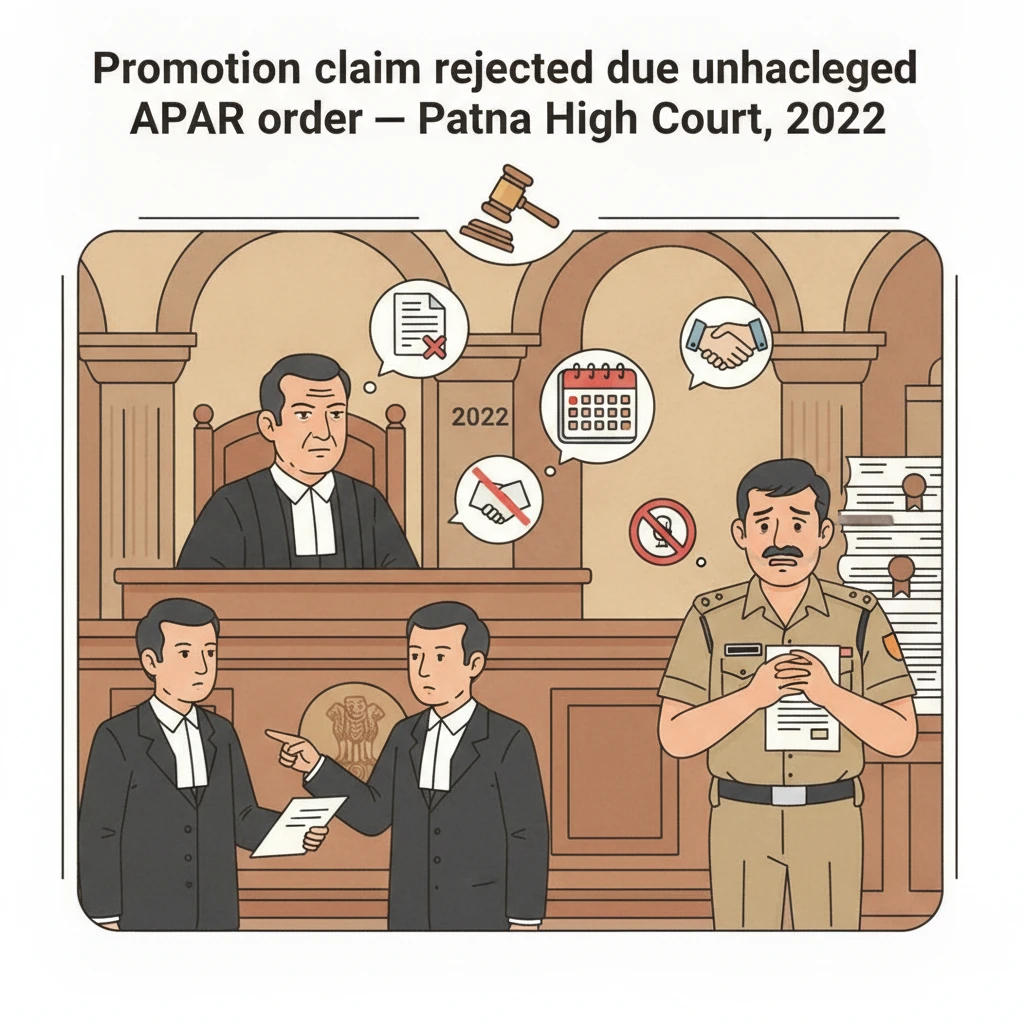
Case Background
The petitioner was serving as an Assistant Commandant in the Border Security Force (BSF). For the assessment year 2014–2015, his Annual Performance Assessment Report (APAR) was written on 30.04.2015 by his superior officers.
In that APAR, under column no. 10, the superiors recorded that the petitioner worked in a methodical way and took his own decisions without consulting his superiors. At the same time, they noted that his professional knowledge was good.
Later, the superior officer treated these observations seriously. On 22.11.2015, a notice was issued to the petitioner asking why these apparently good remarks should not be treated as adverse remarks. The petitioner submitted his explanation on 11.01.2016.
On 05.06.2016, the competent authority rejected the petitioner’s explanation. By this order, the remarks in the APAR for 2014–2015 were converted from “good” to adverse. This order dated 05.06.2016 became central to the dispute.
Subsequently, the petitioner became eligible for promotion to the post of Deputy Commandant. Departmental Promotion Committees considered his case on 28.06.2018 and again on 23.06.2019. While doing so, the promoting authority took note of the adverse order dated 05.06.2016 and rejected his claim for promotion.
In 2020, the petitioner approached the Patna High Court under its civil writ jurisdiction. He challenged the APAR and the impact it had on his promotion prospects.
What the Court Examined and Decided
The petitioner filed the writ petition seeking quashing of the APAR dated 30.04.2015. He alleged that respondent no. 6, his then Commandant, had wrongly recorded and commented on the APAR without properly evaluating his performance.
According to the petition, the APAR had been used to block his promotion to Deputy Commandant. He alleged that this was done with mala fide intention and that his “upgrading” was indirectly restrained.
On this basis, he prayed for a writ of certiorari or other appropriate directions to quash the APAR. He further requested a direction to the authorities to promote him to the post of Deputy Commandant, for which he claimed to be legally eligible, along with other consequential reliefs.
During the hearing, the Court looked at the sequence of events relating to the APAR. The APAR itself was written on 30.04.2015. It contained both positive and negative aspects: it acknowledged his professional knowledge as good, but also stated that he took decisions on his own without consulting his superiors.
These remarks led the superior officer to issue the notice dated 22.11.2015. The notice required the petitioner to explain why the “good” remarks in the APAR should not be treated as adverse. The petitioner did respond with an explanation on 11.01.2016.
However, on 05.06.2016 the authority rejected his explanation. Most importantly, the authority passed an order converting the good remarks into adverse remarks. This meant that the APAR for 2014–2015 carried adverse entries against the petitioner.
The petitioner’s grievance in the writ petition was that his APAR for 2014–2015 was, in his view, otherwise good and should have been treated as such for promotion purposes. He stressed that his APARs as on 28.06.2018 and 23.06.2019 were good, and thus his case should have been considered favourably for promotion to Deputy Commandant.
The Court noted, however, that the official respondents, while considering his promotion, had duly taken into account the order dated 05.06.2016. Because of that adverse order, his claim for promotion was rejected on 28.06.2018 and again on 23.06.2019.
Justice P. B. Bajanthri focused on a crucial legal point: the petitioner had never challenged the validity of the order dated 05.06.2016. That order was the very one which converted his good remarks in the APAR into adverse remarks. It directly affected his promotion chances.
Despite its importance, the petitioner did not seek to quash or set aside that order either soon after it was passed or even when he approached the High Court in this writ petition. The writ petition was framed as a challenge only to the APAR dated 30.04.2015 and to the denial of promotion, not to the 05.06.2016 order itself.
In simple terms, the Court found that the petitioner was attacking the consequences of the adverse order (the non-promotion) without attacking the root cause (the order dated 05.06.2016). As long as the adverse order remained valid and in force, any promotion authority was bound to consider it and could rely on it.
The Court therefore held that, in these circumstances, the petitioner could not claim a right to promotion. His APAR for 2014–2015, after the 05.06.2016 decision, contained adverse material, and those adverse entries were valid on record.
The Court concluded that unless and until the order dated 05.06.2016 was set aside through appropriate legal challenge, the petitioner was not entitled to the reliefs sought in the present writ petition. This included his request for quashing the APAR and his prayer for a direction to promote him as Deputy Commandant.
On this reasoning, the Patna High Court dismissed the writ petition. No other directions were given, and there is no mention in the judgment of any liberty being expressly granted to file a separate challenge to the 05.06.2016 order. The decision is limited to stating that, as things stood, no relief could be granted.
Why This Judgment Matters
This judgment is significant for government and uniformed service employees who depend on their APARs for promotion. It shows that when an APAR is later modified or declared adverse by a separate order, that order becomes the key document affecting future career prospects.
If such an adverse order is not challenged in time, courts may refuse to interfere later when promotion is denied on the basis of that order. In this case, the Patna High Court made it clear that promotion cannot be claimed as a matter of right while an adverse order remains on record.
For employees, this underlines the importance of carefully responding to notices on APARs and, where necessary, legally challenging any final adverse order that follows. For authorities, the case supports their power to rely on valid adverse remarks while considering promotions.
Legal Issues and Answers
-
Issue: Can the High Court direct promotion to Deputy Commandant when an adverse order modifying the APAR remains unchallenged?
Answer: No. The Court held that as long as the order dated 05.06.2016 converting good remarks into adverse remarks stands, the petitioner is not entitled to promotion-related relief. -
Issue: Was there any ground to interfere with the promotion decisions dated 28.06.2018 and 23.06.2019?
Answer: No. The promotion authorities were entitled to rely on the subsisting adverse order dated 05.06.2016 while rejecting the petitioner’s promotional claim.
Cases Cited by the Court
- No earlier judgments or case law are cited or relied upon in this decision.
Case Details
Case Number: Civil Writ Jurisdiction Case No. 6610 of 2020
Case Title: Prawesh Singh v. The Union of India & Ors.
Coram: Hon’ble Mr. Justice P. B. Bajanthri
Citation: 2022(2) PLJR 61
Date of Judgment: 03.03.2022
Advocates:
- For the Petitioner: Mr. Manoj Kumar Singh
- For the Union of India: Mr. Kumar Priya Ranjan (Central Government Counsel), Mr. Pallav
Nature of the Case: Writ petition (service matter relating to APAR and promotion in Border Security Force)
Link to the Judgment: Full text of judgment on Patna High Court website
If you found this explanation helpful and wish to stay informed about
how legal developments may affect your rights in Bihar,
you may consider following Samvida Law Associates for more updates.







