
Case Background
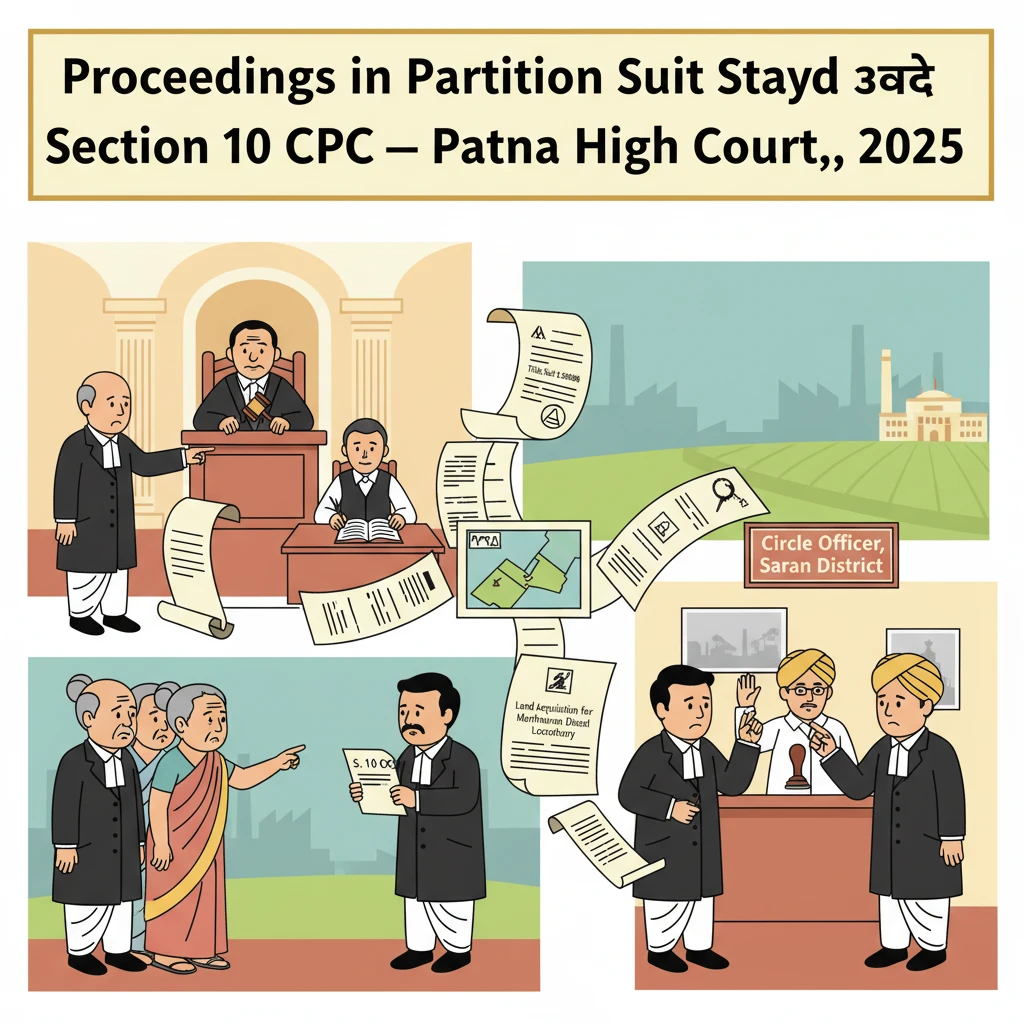
The case arose from a long-standing family dispute over ancestral agricultural land in village Talpuraina, P.S. Marhowrah, District Saran.
According to the plaint in Title Suit No. 562 of 2020, one Badri Raut was the common ancestor. He had three sons: Sakhi, Lakhi and Sewak. The present defendant is from the branch of Sakhi Raut. Plaintiff nos. 1 and 2 are from the branch of Sewak Raut, and plaintiff nos. 3 to 11 are from the branch of Lakhi Raut.
The plaintiffs claimed that a partition among the three branches took place around 1971, giving each branch a one-third share in the ancestral property. They said that, after this, some lands were cultivated separately and some still jointly, but there was no partition by metes and bounds.
They stated that when the defendant started selling ancestral properties without a proper partition, plaintiff nos. 1 and 2 filed Title Partition Suit No. 65 of 2006 before the Sub Judge, Saran, seeking partition of ancestral property. That suit was decreed in favour of plaintiff nos. 1 and 2. Details of the decree’s contents are not set out in this judgment.
Later, some of the disputed lands, particularly Khesra Nos. 2528 and 2551, were to be acquired for the Marhowrah Diesel Locomotive Factory. The defendant sought a land possession certificate from the Circle Officer to support his claim over these lands. The Circle Officer did not grant the certificate.
The appellate authority also did not grant relief to the defendant and observed that he could approach a competent civil court. Following this, the defendant filed Title Suit No. 367 of 2017 before the civil court. In that suit, he sought declaration of his right and title over 8 katha 5 dhur of land in Plot No. 1551, Khata No. 599, and Plot No. 2528, Khata No. 664.
Subsequently, on 01.10.2020, the plaintiffs say they learnt that the defendant had received compensation for the land acquisition concerning Plot Nos. 2528 and 2551 by using forged papers. They also came to know that the defendant had filed Title Suit No. 191 of 2018 concerning these plots against the State of Bihar, without making them parties, and obtained an ex-parte decree in his favour. The specific contents of that decree are not detailed here.
In this backdrop, the plaintiffs instituted Title Suit No. 562 of 2020. In that suit they sought: a declaration of their one-third shares and the defendant’s one-third share in Plot No. 2551 under Khata No. 550 at Mauza Talpuraina; a declaration of their specific katha shares and the defendant’s share in Plot No. 2528 under Khata No. 664 in the same village; and a further declaration that the judgment dated 18.11.2019 and decree dated 29.11.2019 passed in Title Suit No. 191 of 2018 are not binding upon them.
The defendant appeared in Title Suit No. 562 of 2020 and filed a written statement. He denied that Plot Nos. 2528 and 2551 were joint family property. He denied the alleged 1971 partition.
Instead, he asserted that there had been an earlier partition among the three sons of Badri Raut in “Jyesth of 1940”, covering all ancestral (khatiyani) properties in three shares. He provided his version of how Plot Nos. 2528 and 2551 fell exclusively to his share.
He further stated that Title Suit No. 191 of 2018 had been filed by him against the State of Bihar because, in the land acquisition proceedings, the State was asserting that the land was its own.
While Title Suit No. 367 of 2017 was still pending, and after the plaintiffs filed Title Suit No. 562 of 2020, the defendant moved an application dated 07.01.2022 under Section 10 of the Code of Civil Procedure in Title Suit No. 562 of 2020. He requested the Sub Judge-I, Saran at Chapra, to stay the later suit (Title Suit No. 562 of 2020) till disposal of the earlier suit (Title Suit No. 367 of 2017), claiming that the matter in issue and reliefs were substantially the same.
The plaintiffs filed a rejoinder on 10.02.2022 opposing this application. After hearing both sides, the Sub Judge rejected the Section 10 application by order dated 24.11.2022.
Aggrieved by this refusal, the defendant filed Civil Miscellaneous Jurisdiction No. 272 of 2023 before the Patna High Court to set aside that order and to secure a stay of the later partition suit.
What the Court Examined and Decided
The matter came before Hon’ble Mr. Justice Arun Kumar Jha of the Patna High Court. The core issue was whether the trial court ought to have stayed Title Suit No. 562 of 2020 under Section 10 CPC in view of the pendency of Title Suit No. 367 of 2017.
First, the Court recorded the statutory text of Section 10 of the Code of Civil Procedure, which deals with stay of suit where the matter in issue is directly and substantially in issue in a previously instituted suit between the same parties (or their privies) pending before a competent court.
The High Court emphasised the object of Section 10. It is meant to prevent courts with concurrent jurisdiction from trying two parallel suits on the same matter in issue, and to avoid conflicting findings on issues which are directly and substantially in issue in a previously instituted suit.
The Court explained that the fundamental test under Section 10 is whether the final decision in the earlier suit would operate as res judicata in the subsequent suit. It further stated that Section 10 applies only when the whole of the subject matter in both suits is identical or, in other words, there is identity of the matter in issue. It distinguished “directly and substantially in issue” from “incidentally or collaterally in issue”.
For these propositions, the Patna High Court relied on the Supreme Court’s judgment in National Institute of Mental Health & Neuro Sciences vs. C. Parameshwara, AIR 2005 SC 242. It also referred to and quoted from Aspi Jal & Anr. vs. Khushroo Rustom Dadyburjor, (2013) 4 SCC 333, where the Supreme Court reaffirmed the principles laid down in NIMHANS v. Parameshwara.
In Aspi Jal, the Supreme Court had underlined that: the use of the negative expression “no court shall proceed with the trial” in Section 10 made it mandatory; the section aims to pin down the plaintiff to one litigation on the same cause of action, subject matter and relief; and it is meant to protect defendants from multiplicity of proceedings and contradictory verdicts.
After laying down this legal background, the Patna High Court turned to the facts of the two key suits: Title Suit No. 367 of 2017 and Title Suit No. 562 of 2020.
It noted that both the suit properties and the parties were admittedly the same in these two suits. Therefore, the central question was whether the “matter in issue” was directly and substantially the same in both.
In Title Suit No. 367 of 2017, the defendant (petitioner before the High Court) had sought declaration of his right and title over the suit properties, which included Plot Nos. 2528 and 2551. The High Court recorded that, apart from the main declaration, other reliefs deemed fit and proper were also prayed for.
In Title Suit No. 562 of 2020, the plaintiffs sought a declaration of their one-third shares in the same properties and a declaration that the judgment and decree in Title Suit No. 191 of 2018 were not binding on them.
The High Court noted that when the plaintiffs appeared in Title Suit No. 367 of 2017, they filed a written statement contesting the defendant’s claim. In that written statement, they had narrated the same facts that they later repeated in the plaint of Title Suit No. 562 of 2020 and reiterated their claim of one-third shares for all three branches in the suit property.
The Court observed that Title Suit No. 562 of 2020 had effectively been filed with the same core prayer relating to share and title. The additional relief sought against the judgment and decree in Title Suit No. 191 of 2018 was seen as contingent on the decision in Title Suit No. 367 of 2017.
The Court reasoned that if the defendant succeeded in Title Suit No. 367 of 2017 in proving his exclusive title, the plaintiffs’ claim of one-third share would fail and their attack on the decree in Title Suit No. 191 of 2018 would “fall flat”. On the other hand, if the defendant failed in Title Suit No. 367 of 2017, then by implication, the plaintiffs’ claim of one-third share would stand upheld.
The High Court also pointed out a well-known feature of partition suits: that there is always an implicit declaration of title to the extent of each party’s share. Therefore, issues of title and share asserted in the partition suit were necessarily tied to the declaration of title sought in the earlier suit.
On this analysis, the Court held that the “matter in issue” in Title Suit No. 562 of 2020 was substantially the same as in Title Suit No. 367 of 2017, at least as far as declaration of title and shares in the suit properties was concerned. Consequently, the decision in Title Suit No. 367 of 2017 would operate as res judicata on these questions for the later suit.
Given this clear overlap, the High Court concluded that Section 10 CPC was attracted. It stated that the trial court had “committed a serious error of jurisdiction” in rejecting the defendant’s application and had misdirected itself in holding that issues in the two suits were different.
Accordingly, the Patna High Court set aside the impugned order dated 24.11.2022 passed by the Sub Judge-I, Saran at Chapra in Title Suit No. 562 of 2020. It allowed the defendant’s application dated 07.01.2022 under Section 10 CPC. As a result, proceedings in Title Suit No. 562 of 2020 must remain stayed pending disposal of Title Suit No. 367 of 2017.
The Court clarified that its observations were confined to deciding the Section 10 issue and were not comments on the ultimate merits of either party’s case. It made it clear that these observations would not prejudice either side at the stage of final decision in the suits.
Why This Judgment Matters
This judgment of the Patna High Court is important for families involved in land disputes, especially in rural areas where ancestral properties are shared between branches of a common ancestor.
First, it shows that if two civil suits between the same parties involve the same land and the same core question of “who is the owner and what is each person’s share”, the later suit can be put on hold under Section 10 CPC. This avoids confusion and double litigation.
Second, it makes clear that you cannot keep filing fresh suits over the same property and same title dispute while an earlier, similar suit is still pending. Courts will prefer that one suit be decided first and that decision then binds the parties in later proceedings.
Third, for people challenging earlier decrees (for example, an ex-parte decree obtained without making all co-sharers parties), the judgment underlines that such challenges may depend on how the main title dispute is decided in the first suit.
In simple terms, the Patna High Court has reinforced that civil courts must avoid overlapping trials on the same property dispute and must apply Section 10 CPC to prevent conflicting decisions.
Legal Issues and Answers
- Issue: Whether the trial court should have stayed Title Suit No. 562 of 2020 under Section 10 CPC because Title Suit No. 367 of 2017 between the same parties over the same properties was already pending.
Answer: Yes. The Patna High Court held that the matter in issue in both suits was directly and substantially the same, and the earlier suit’s decision would operate as res judicata. It set aside the trial court’s order and allowed the Section 10 application, staying the later suit.
Cases Cited by the Court
- National Institute of Mental Health & Neuro Sciences vs. C. Parameshwara, AIR 2005 SC 242.
- Aspi Jal & Anr. vs. Khushroo Rustom Dadyburjor, (2013) 4 SCC 333.
Case Details
Case Number: Civil Miscellaneous Jurisdiction No. 272 of 2023
Case Title: Saheb Rai @ Saheb Ray vs. Kameshwar Rai & Ors.
Court: High Court of Judicature at Patna, Civil Miscellaneous Jurisdiction
Coram: Hon’ble Mr. Justice Arun Kumar Jha
Date of Judgment: 22.05.2025
Citation: 2025(3) PLJR 476
Advocates:
For the Petitioner: Mr. Nagendra Rai, Advocate; Mr. Navin Nikunj, Advocate; Mr. Koshalendra Rai, Advocate
For the Respondents: Mr. Arun Kumar Rai, Advocate
Nature of the Case: Civil miscellaneous petition challenging an interlocutory order of the Sub Judge-I, Saran at Chapra, refusing to stay a later partition/titled suit under Section 10 CPC.
Impugned Order: Order dated 24.11.2022 passed in Title Suit No. 562 of 2020 by Sub Judge-I, Saran at Chapra, rejecting the defendant’s application under Section 10 CPC.
Result: Petition allowed; impugned order set aside; application dated 07.01.2022 under Section 10 CPC allowed; later suit (Title Suit No. 562 of 2020) to remain stayed pending disposal of earlier suit (Title Suit No. 367 of 2017).
Link to Judgment: Patna High Court Judgment in C. Misc. No. 272 of 2023
If you found this explanation helpful and wish to stay informed about
how legal developments may affect your rights in Bihar,
you may consider following Samvida Law Associates for more updates.







