

Case Background
This criminal appeal arose from a judgment of conviction dated 02.12.2022 and an order of sentence dated 05.12.2022 passed by the Court of the Additional District and Sessions Judge VII-cum-Exclusive Special Judge (POCSO Act), Patna in Special (POCSO) Case No. 30 of 2019, arising out of Bihta P.S. Case No. 214 of 2019.
The appellant was a private tutor who used to give tuition at the home of the informant, the mother of the victim girl. According to her written report, he had been teaching the girl, described as about six years old, for three years between 4–5 p.m. daily. On 23.02.2019, he was giving tuition to the victim, her brother and other local children at their house.
The informant stated that during class the tutor sent the victim’s brother and other children out of the room. She thought the class was over. When she went to the room, she claims she saw her daughter naked in a corner and the tutor committing rape. On her alarm, her sister-in-law and another relative came and allegedly caught the tutor. Neighbours also gathered. Police were informed, came to the house and arrested the tutor. A written complaint was then submitted at Bihta Police Station, leading to registration of Bihta P.S. Case No. 214/2019 under Section 376(2)(f) IPC and Section 6 POCSO.
After investigation, charge-sheet No. 151 of 2019 dated 21.05.2019 was submitted for offences under Section 376(2)(f) IPC and Section 6 POCSO. Cognizance was taken and the case was committed for trial as Special (POCSO) Case No. 30 of 2019.
The trial court examined six prosecution witnesses: the Investigating Officer (PW‑1), the victim’s father (PW‑2), the informant/mother (PW‑3), the victim (PW‑4), the aunt (PW‑5), and the doctor who examined the victim (PW‑6). Various documents including the written report, FIR, statement under Section 164 CrPC and medical report were exhibited.
The appellant, when examined under Section 313 CrPC, denied the allegations and claimed false implication. He stated he was framed due to financial dispute with the victim’s uncle. No defence evidence was adduced. The trial court nonetheless convicted him under Section 376(2)(f) IPC and Section 6 POCSO and sentenced him to 10 years’ rigorous imprisonment with a fine of Rs. 30,000, with default sentence of two months’ RI.
Aggrieved, the appellant approached the Patna High Court in Criminal Appeal (SJ) No. 640 of 2023. The appeal was heard and decided by Hon’ble Mr. Justice Chandra Shekhar Jha, who delivered a CAV judgment on 30.10.2024.
What the Court Examined and Decided
The High Court carefully re‑appreciated the entire evidence. The central question was whether the prosecution had proved “penetrative sexual assault” so as to sustain a conviction under Section 6 of the POCSO Act (aggravated penetrative sexual assault) and Section 376(2)(f) IPC.
The appellant’s counsel argued that the case rested mainly on related witnesses and a child witness whose evidence showed serious contradictions. He pointed out that the mother had given the victim’s age as six years, but the medical report assessed her age as between 12–13 years. This gap was said to be deliberate to make the case fall under “aggravated” assault under Section 5(m) POCSO (victim below 12 years).
He also pointed to inconsistencies between the victim’s court testimony (PW‑4) and her earlier statement under Section 164 CrPC, particularly on whether rape was completed or only attempted, and on details like ejaculation and clothing. It was also highlighted that no independent witnesses were examined, although other children and neighbours were allegedly present.
The defence further challenged the medical evidence. While the doctor found a torn hymen and blood-stained vulva, there was no presence of spermatozoa and no injuries on other parts of the body. Clothes of both victim and accused were not seized and not sent for forensic examination. The I.O. stated that the appellant had been medically examined but that report was never produced. The defence argued that this failure became serious when the very fact of penetration was under doubt.
On the legal side, counsel relied on Supreme Court decisions: Panchhi v. State of U.P. regarding the caution needed with child witnesses; State of Jharkhand v. Shailendra Kumar Rai on finger test; Vishnu v. State of Maharashtra on the corroborative nature of medical evidence; Pradeep v. State of Haryana on proper examination of child witnesses; Jarnail Singh v. State of Haryana and Section 94(2) of the Juvenile Justice Act on age determination; and Chotkau v. State of Uttar Pradesh on non‑compliance with Section 53A CrPC.
On behalf of the State, the APP argued that the victim’s version was supported by her mother (PW‑3) and aunt (PW‑5) and that the medical report, showing torn hymen and bleeding vulva, fully corroborated the allegation. It was submitted that minor contradictions were natural given the rural background of the witnesses and should not undo a conviction backed by medical and ocular evidence.
The High Court placed particular focus on the evidence of the victim (PW‑4), recognising her as the most important witness. It noted that before administering oath, the trial court had not put preliminary questions to assess her understanding and capacity, as emphasised by the Supreme Court in Pradeep’s case. Although in this matter the victim’s age was medically 12–13 years, the Court still stressed that the trial judge should have recorded satisfaction about her ability to understand and speak the truth.
In her examination‑in‑chief, PW‑4 stated that the appellant, her home tutor, had been doing “bad work” with her and had threatened her not to disclose this. On the date of occurrence he allegedly asked her to open her pant, took her to a corner, pressed her mouth, opened his pant and did indecent work forcibly. She said she knew the meaning of “rape” and that he had raped her. She also said her clothes were not blood‑stained.
However, her Section 164 CrPC statement, which was exhibited, presented a different picture. There she stated that the appellant had made attempts to commit penetrative sexual assault/rape on her and whenever such attempt was made she felt pain. She mentioned that the incident was first seen by her mother and that she later told her aunt that similar attempts had been made over the previous three days. She also stated that the appellant ejaculated “some substance” in her urethra after opening his chain.
The High Court highlighted four major contradictions between the two versions: omission of any mention of ejaculation in her deposition; omission of the assertion that attempts had been ongoing for three days; inconsistency about whether the appellant opened his pant or only the chain of his jeans; and, crucially, her categorical statement in court that rape was committed versus her earlier statement that there were attempts to commit penetrative assault.
The Court then turned to the medical evidence of PW‑6. The victim was examined the same day at around 11:15 p.m. The doctor found her hymen torn and vulva lacerated and blood‑stained, but no injury on other parts of the body. Radiological examination done later at PMCH assessed her age as 12–13 years. Vaginal smear tested at PMCH (Lab No. 45 dated 25.02.2019) showed no spermatozoa, though the doctor concluded that “above finding confirms assault done.”
The Court observed that if the allegation in the Section 164 CrPC statement about ejaculation into the urethra were accepted, some spermatozoa would ordinarily be expected. Their absence, though not conclusive on its own, added to the doubts when read with the contradictions in testimony.
The Court then evaluated the evidence of PW‑2 (father), PW‑3 (mother) and PW‑5 (aunt). PW‑2 admitted that he did not witness the incident and came to know over the phone. He also stated his wife did not have a mobile phone, while PW‑3 claimed she herself telephoned the police from her phone and even gave the same number (9905665787) that PW‑2 had claimed as his. This inconsistency weakened the reliability of their narrative about the immediate reporting.
PW‑3 claimed she found her daughter naked, standing by the wall, and the appellant with his pant open and “doing wrong work.” On her alarm, both sisters‑in‑law came; they caught and slapped the appellant. She said she lodged the case and that police wrote down her version.
PW‑5, however, stated that when she reached the room after PW‑3’s alarm, she saw the appellant actually inserting his penis into the victim’s urethra while both were in standing position. The High Court found this version “non‑convincing” and apparently exaggerated, because PW‑3, who reached earlier, did not see such a position. The Court held that PW‑5’s description appeared aimed at aggravating the allegation to “penetrative sexual assault.”
The Investigating Officer PW‑1 stated that the room was on an open terrace, not fitted with a door. She admitted that she did not seize any incriminating material from the spot and did not determine the victim’s age from school records. She said the parents told her the victim studied at home only and not in school, a statement contradicted by the victim and PW‑3, who both said she was a regular school student. PW‑1 also stated that the appellant was medically examined but she had not collected the report.
Taking all this together, the High Court concluded that the prosecution had failed to establish “penetration to any extent” as required under Section 3 POCSO. Without clear proof of penetration, conviction under Section 4 or 6 of the POCSO Act could not be sustained.
The Court also noted that the victim’s age being 12–13 years by radiological report contradicted the consistent oral claim of age six given by the parents and used in the FIR. No school certificate was produced though the victim described herself as a regular student. Therefore, the trial court’s finding that the case fell under aggravated category (victim below 12 years) was unsustainable.
In addition, the absence of seizure of clothes, non‑production of the appellant’s medical report, non‑examination of the victim’s brother who was also present at tuition, and contradictions about duration of tuition (mother said three years, victim said four months) were viewed as serious gaps. The Court held that these foundational defects meant the statutory presumptions under Sections 29 and 30 POCSO could not be invoked.
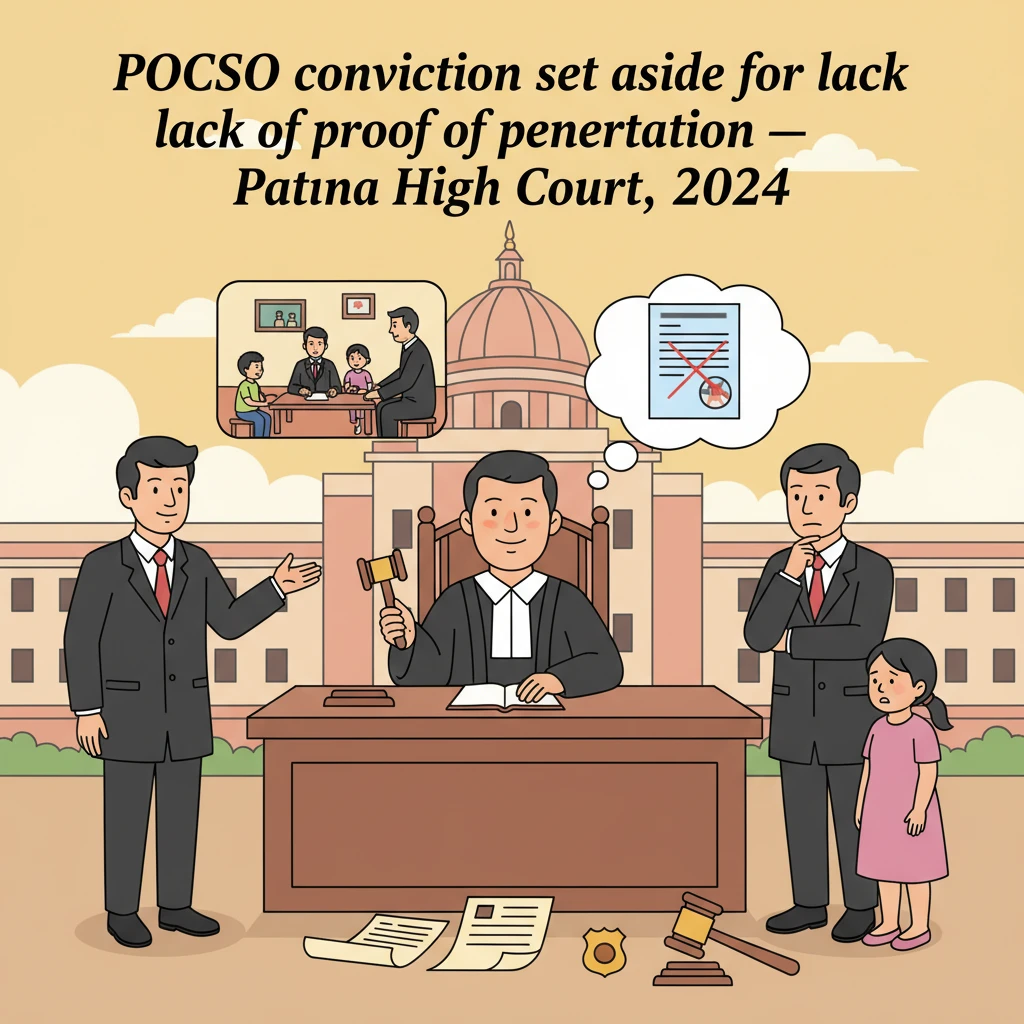
Consequently, the Patna High Court allowed the appeal, set aside the judgment of conviction dated 02.12.2022 and sentence dated 05.12.2022, and ordered that the appellant be released forthwith if not required in any other case. Any fine paid was directed to be refunded.
Why This Judgment Matters
This judgment is important for both prosecution agencies and families involved in POCSO cases. The Patna High Court has made it clear that a serious conviction like aggravated penetrative sexual assault cannot stand unless penetration is clearly proved through consistent, reliable evidence.
The Court underlined that where the main witness is a child, trial judges must strictly follow safeguards: asking preliminary questions, checking capacity to understand, and carefully examining whether the statement is free from tutoring. Merely repeating the word “rape” is not enough; the surrounding facts and earlier statements must be consistent.
For police and doctors, the decision highlights the need for proper, timely seizure of clothes, collection of medical and forensic evidence, and ensuring that medical examination of both the victim (Section 164A CrPC) and the accused (Section 53A CrPC) is properly done and placed on record.
For parents and guardians, it shows that while the law is meant to protect children, courts will still closely examine whether the prosecution story is reliable. Exaggeration of age or incident to “strengthen” a case can actually weaken it and may lead to acquittal.
Legal Issues and Answers
- Issue: Whether the prosecution proved that the appellant committed penetrative sexual assault on the victim so as to attract Section 6 of the POCSO Act and Section 376(2)(f) IPC.
Answer: No. Due to major contradictions in the victim’s versions, unreliable eye-witness accounts, absence of forensic support, non‑production of the appellant’s medical report and doubtful age evidence, the Court held that penetration “to any extent” was not proved beyond reasonable doubt. - Issue: Whether the statutory presumptions under Sections 29 and 30 of the POCSO Act could be invoked against the appellant on the available evidence.
Answer: No. The Court held that the prosecution had failed to establish foundational facts of the alleged penetrative assault, so the presumptions under Sections 29 and 30 could not be applied. - Issue: Whether the case fell under “aggravated” penetrative sexual assault on the basis that the child was below 12 years of age.
Answer: No. Radiological evidence placed the victim’s age between 12–13 years and no school or other documentary proof of a lower age was produced. Therefore, Section 5(m) POCSO (victim below 12 years) was held inapplicable.
Cases Cited by the Court
- Pradeep v. State of Haryana, 2023 SCC OnLine SC 777 (on examination and evaluation of child witnesses).
- Panchhi & Ors. v. State of U.P., 1998 (7) SCC 177 (on need for caution and corroboration with child witnesses).
- State of Jharkhand v. Shailendra Kumar Rai & Pandav Rai, (2022) 14 SCC 299 (on non‑scientific nature of the finger test).
- Vishnu v. State of Maharashtra, (2006) 1 SCC 283 (on the corroborative value of medical opinion).
- Jarnail Singh v. State of Haryana, (2013) 7 SCC 263 (on age determination principles).
- Chotkau v. State of Uttar Pradesh, AIR 2022 SC 4688 (on importance of compliance with Section 53A CrPC in doubtful cases).
Case Details
Case Number: Criminal Appeal (SJ) No. 640 of 2023; arising out of Bihta P.S. Case No. 214 of 2019; Special (POCSO) Case No. 30 of 2019.
Case Title: Amit Kumar v. The State of Bihar.
Citation: 2024 (4) PLJR 877.
Coram: Hon’ble Mr. Justice Chandra Shekhar Jha.
Advocates: For the appellant – Mr. Dhananjay Kumar, Advocate; Mr. Abhinav Pandey, Advocate. For the State – Mr. Ramchandra Singh, APP.
Nature of the Case: Criminal appeal (single judge) against conviction and sentence under Section 376(2)(f) IPC and Section 6 of the POCSO Act.
Date of High Court Judgment: 30.10.2024.
Result: Appeal allowed; conviction and sentence set aside; appellant directed to be released forthwith if not required in any other case; fine, if paid, to be refunded.
Link to Judgment: Click here to read the full Patna High Court judgment
If you found this explanation helpful and wish to stay informed about
how legal developments may affect your rights in Bihar,
you may consider following Samvida Law Associates for more updates.







