
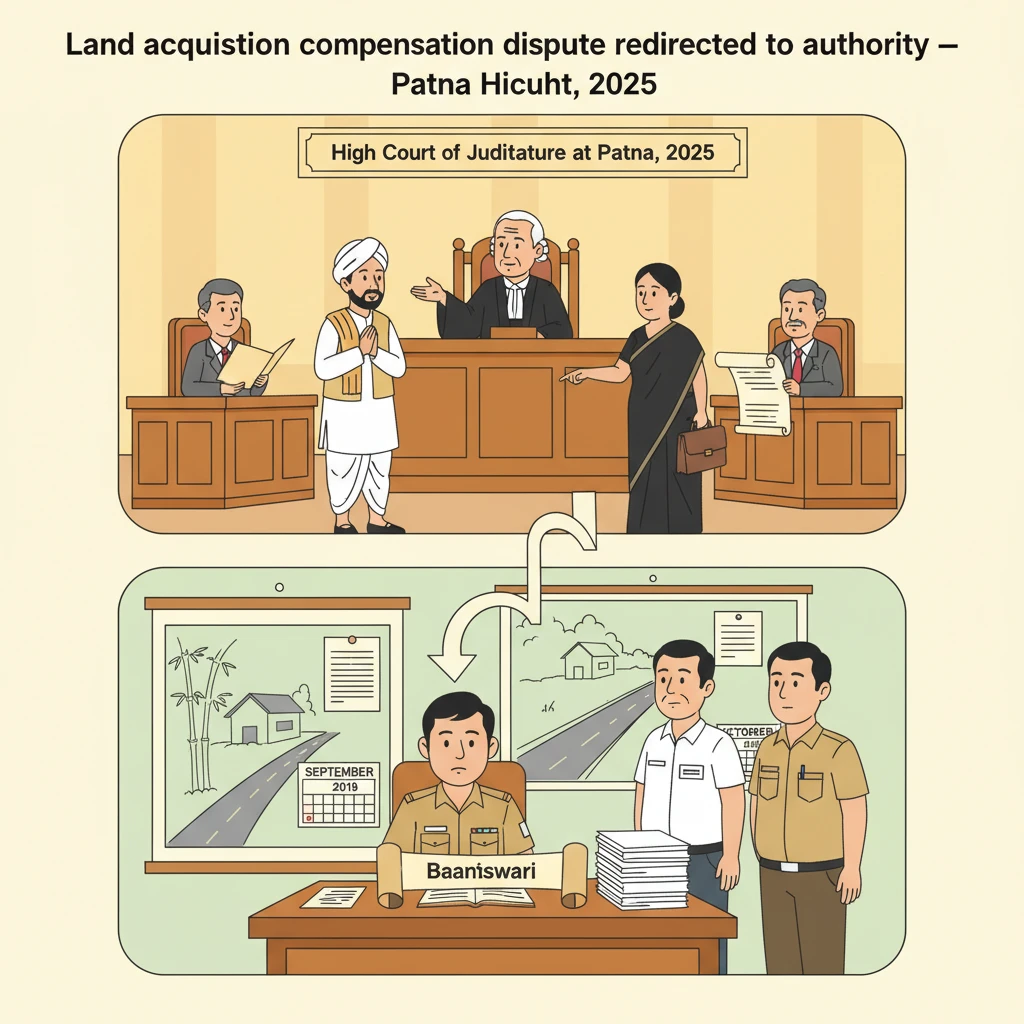
Case Background
This case arose from land acquisition for construction of the Indo-Nepal Border Road in West Champaran district, Bihar.
A notice under Section 11(1) of the Right to Fair Compensation and Transparency in Land Acquisition, Rehabilitation and Resettlement Act, 2013 (the 2013 Act) was issued on 19 September 2019 for acquisition of land for this project.
The petitioner, a resident of Village Inarwa, did not object to the acquisition of his land for the public project. Subsequently, a notice under Section 21(2) of the 2013 Act was issued in Land Acquisition Case No. 104/2015-16 on 17 October 2016.
Under this land acquisition case, 22 decimals of land owned by the petitioner in Khata No. 144, Khesra No. 107(1), Mauza Inarwa, were acquired.
An award determining compensation was then prepared by the Land Acquisition Officer, West Champaran (respondent no. 6). The petitioner’s main grievance was about the nature and classification of his land and the compensation calculated on that basis.
Feeling that the compensation was inadequate and that his land had been wrongly treated as agricultural, the petitioner approached the Patna High Court by filing Civil Writ Jurisdiction Case No. 16235 of 2021.
He sought various directions against the State authorities under the 2013 Act, mainly for setting aside the award, preparing a fresh award, and paying interest on the compensation amount.
What the Court Examined and Decided
The petitioner’s core complaint was that the Land Acquisition Officer had wrongly categorised his land as agricultural, although the land was situated near his dwelling house and, according to him, should have been treated as residential land.
The land was recorded in the revenue records as “Baanswari” (bamboo grove). However, the petitioner argued that due to its location near his house, it ought to be valued as residential land, which would attract a higher market value and therefore higher compensation.
Based on this grievance, the petitioner asked the Patna High Court for several specific reliefs:
First, he requested that the Court set aside the existing award (Annexure-2) prepared by the Land Acquisition Officer, on the ground that it was contrary to the provisions of the 2013 Act.
Second, he sought a direction to the authorities to prepare a fresh award strictly in accordance with the 2013 Act.
Third, he asked the Court to order that the market value of the land and the government-fixed price of land for that locality be properly considered for calculating compensation.
Fourth, he prayed for a writ of mandamus directing the authorities to pay 18% interest on the award amount from the date of acquisition till actual payment.
Lastly, he sought any other reliefs deemed fit by the Court in the facts and circumstances of the case.
The Court, presided over by Hon’ble Mr. Justice Bibek Chaudhuri, examined the statutory scheme under the 2013 Act, particularly Section 64, which deals with “Reference to Authority.”
The Court reproduced Section 64 in detail. Under this provision, any person interested, who has not accepted the award, may apply in writing to the Collector requiring that the matter be referred to the Authority for determination.
The objections that can be raised before the Authority include:
- objection to the measurement of the land,
- objection to the amount of compensation,
- objection as to the person to whom compensation is payable,
- objection regarding rights of rehabilitation and resettlement under Chapters V and VI of the 2013 Act, and
- objection to the apportionment of compensation among persons interested.
Section 64 further provides that the Collector shall, within thirty days of receiving such application, make a reference to the appropriate Authority.
If the Collector fails to make such reference within the specified period, the applicant may approach the Authority directly, seeking a direction to the Collector to make the reference within a further period of thirty days.
The section also prescribes time limits for making such an application:
- If the person was present or represented before the Collector when the award was made, the application must be filed within six weeks from the date of the award.
- In other cases, it must be filed within six weeks of receipt of notice under Section 21, or within six months from the date of the award, whichever comes first.
There is also a further proviso empowering the Collector to entertain an application beyond this period, within an additional one year, if sufficient cause is shown for the delay.
After setting out this legal framework, the Court noted that the real dispute raised by the petitioner concerned the adequacy and correctness of the compensation awarded and the classification/nature of the land.
The Court held that, in such a situation, the proper and efficacious remedy for the petitioner is not to file a writ petition directly before the High Court, but to seek a reference under Section 64 of the 2013 Act to the competent Authority (jurisdictional Collector).
The Court clearly stated that assessment of compensation, and related questions of classification of land and associated rights of rehabilitation and resettlement, are matters that must be examined by the statutory authority designated under the 2013 Act.
Therefore, instead of going into the correctness of the award on merits, the Patna High Court disposed of the writ petition by directing the petitioner to make a proper reference to the concerned authority under Section 64 of the 2013 Act.
The Court further addressed the issue of limitation and delay, which could potentially arise because the award and notices in this matter dated back to 2016 and 2019, while the writ petition was being decided in 2025.
The Court observed that the petitioner had been bona fide pursuing his legal remedy before the High Court with due diligence.
In this background, the Court held that the competent authority would be at liberty to consider the petitioner’s prayer for condonation of delay in filing the reference, in accordance with the relevant provisions of the Limitation Act.
In other words, the High Court did not itself extend or condone the delay, but explicitly allowed the authority to consider such a plea, keeping in mind that the petitioner had been engaged in this writ proceeding.
No costs were imposed on either side. The writ petition was disposed of “on contest,” meaning it was heard and decided after affording opportunity to both parties, but the relief sought by the petitioner in terms of quashing the award and directing fresh compensation was not granted.
The ultimate effect of the judgment is that the petitioner must now approach the jurisdictional Collector under Section 64 of the 2013 Act if he wishes to challenge the quantum of compensation or the classification of his land and seek enhancement or other related reliefs.
Why This Judgment Matters
This judgment is important for landowners in Bihar whose land is acquired under the 2013 Act, especially for public projects like roads.
It clarifies that if a person is dissatisfied with the amount of compensation, or with how their land has been classified (for example, agricultural versus residential), the main legal route is to seek a reference under Section 64 of the 2013 Act.
The Patna High Court made it clear that the High Court will generally not directly re-assess compensation or rewrite awards through a writ petition. Instead, it will send parties back to the statutory mechanism created under the Act.
The judgment also has a practical benefit for people who may have lost time pursuing writ petitions. The Court has recognised that time spent in bona fide litigation before the High Court can be considered when deciding whether delay in filing a reference under Section 64 should be condoned.
For ordinary landowners, this means:
- If you feel the compensation is too low or your land has been wrongly treated as agricultural or non-residential, you must move the Collector under Section 64.
- If you have already gone to court and lost time, you can request the authority to condone the delay, and this judgment supports consideration of such a request.
For government officials and land acquisition authorities, the decision reinforces their responsibility to handle objections and references under Section 64 promptly and lawfully, instead of expecting the High Court to decide compensation directly.
Legal Issues and Answers
-
Issue: Can the Patna High Court in writ jurisdiction directly set aside an award of compensation under the 2013 Act and order a fresh award based on alleged misclassification of land and inadequate compensation?
Answer: No. The Court held that the proper remedy for such grievances lies in seeking a reference to the appropriate authority under Section 64 of the 2013 Act. The writ petition was disposed of with a direction to pursue that remedy. -
Issue: What happens to limitation for filing a reference under Section 64 when the landowner has been pursuing a writ petition in the High Court?
Answer: The Court clarified that since the petitioner was bona fide pursuing a legal remedy through the writ petition with due diligence, the competent authority is at liberty to consider a prayer for condonation of delay in filing the reference, in accordance with the Limitation Act.
Cases Cited by the Court
- No previous cases or precedents are cited or relied upon in this judgment. The Court’s reasoning is based directly on the text of Section 64 of the 2013 Act and the Limitation Act.
Case Details
Case Number: Civil Writ Jurisdiction Case No. 16235 of 2021
Case Title: Manif Mian v. The State of Bihar & Ors.
Coram: Hon’ble Mr. Justice Bibek Chaudhuri
Citation: 2025(4) PLJR 121
Advocates:
For the petitioner: Mr. Rajeev Ranjan
For the respondents (State): Mr. Md. Khurshid Alam, AAG 4
Nature of the case: Writ petition under Article 226 challenging the land acquisition award and seeking directions for fresh assessment of compensation and payment of interest under the Right to Fair Compensation and Transparency in Land Acquisition, Rehabilitation and Resettlement Act, 2013.
Date of Judgment: 27-08-2025
Link to the judgment: View full judgment on Patna High Court website
If you found this explanation helpful and wish to stay informed about
how legal developments may affect your rights in Bihar,
you may consider following Samvida Law Associates for more updates.







