

Case Background
This judgment of the Patna High Court decides two connected writ petitions: Civil Writ Jurisdiction Case No. 9131 of 2022 and Civil Writ Jurisdiction Case No. 5914 of 2023. Both matters relate to retired teachers of colleges under Lalit Narayan Mithila University, Darbhanga, whose services had been regularised long ago and who had already superannuated.
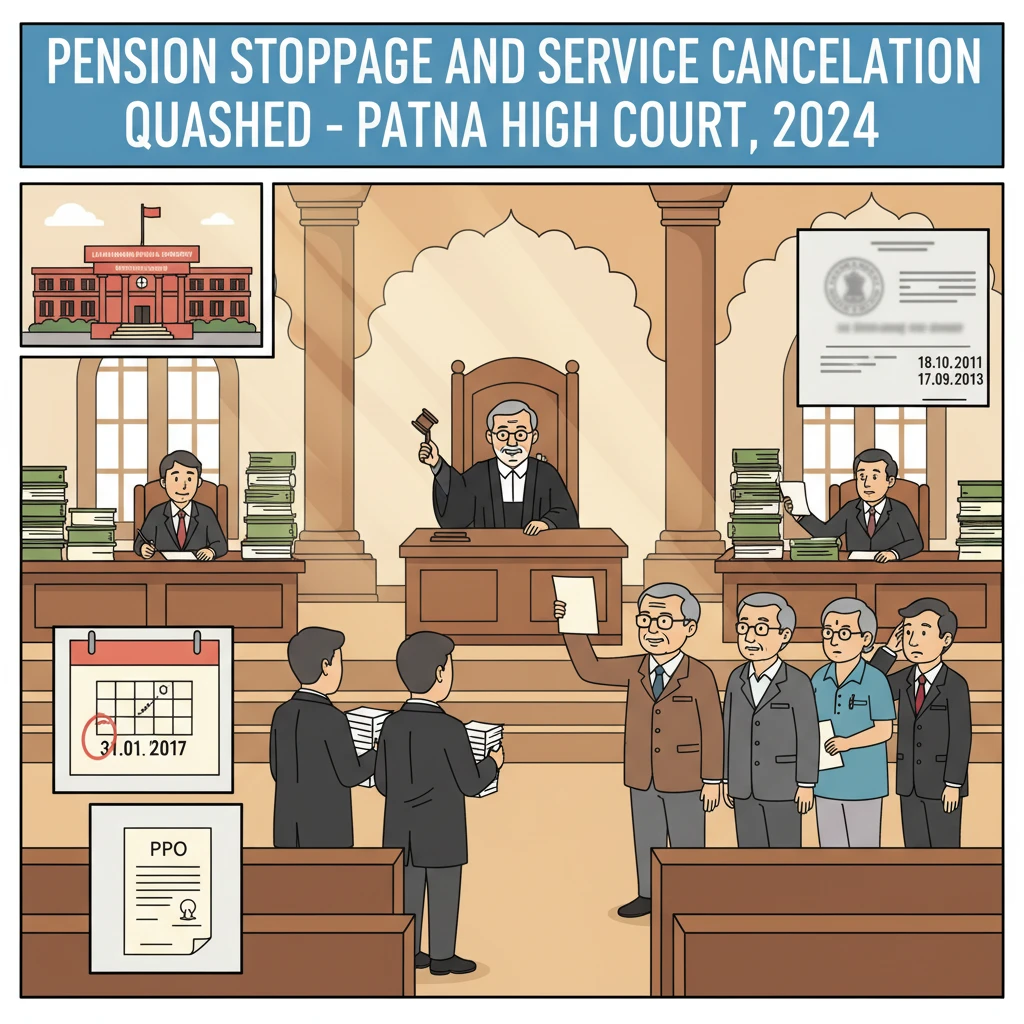
In the first case, the petitioner was a Sociology teacher of B.M.A. College, Baheri, Darbhanga. He was initially appointed on 17.11.1979 on the second post of Lecturer. The college later obtained sanction of this second post from the State Government on 05.08.1981. Over time he was absorbed under the 3rd Absorption Statute, given time-bound promotion to Reader, and his pay was fixed and revised by the Statutory Pay Fixation Committee. He retired on 31.01.2017 and started receiving pension.
In the second case, the petitioner was a Music teacher at Women’s College, Samastipur. She was appointed as Lecturer on 01.07.1977. The State Government sanctioned a second post in Music and other subjects at Mahila College, Samastipur, by letter dated 08.01.1982. She too was later regularised on the post of Assistant Professor with effect from 15.09.1982, granted time-bound promotion to Reader, and retired on 31.10.2017 with pension.
Both petitioners had worked for decades. Their services were regularised through the Post Creation, Absorption and Confirmation Committee, with approval by the University Syndicate and directions of the Chancellor. They were paid from government funds, granted promotions and other benefits, and allowed to superannuate with pensionary benefits.
Problems began only years after their retirement. The Education Department and the Pay Verification Cell questioned the legality of such regularisations and pensions, culminating in orders that stopped their pension and declared their appointments illegal. Faced with this, the petitioners approached the Patna High Court under Article 226 of the Constitution of India.
What the Court Examined and Decided
In the first writ petition (CWJC No. 9131 of 2022), the retired Sociology teacher challenged letter no. 249 dated 07.02.2022 issued by the Incharge Officer, Pay Verification Cell, Education Department, Bihar. By this letter the Cell withheld his pay slip. On that basis, the University stopped his monthly pension and other terminal dues, including salary difference.
During pendency of this writ petition, a further order was passed by the Director, Higher Education, Government of Bihar. By Memo No. 594 dated 20.02.2023, the Director declared the petitioner’s service “illegal”. This memo was also challenged by way of an interlocutory application.
In the second writ petition (CWJC No. 5914 of 2023), the retired Music teacher directly challenged the same Memo No. 594 dated 20.02.2023, by which the Director, Higher Education, held the appointments of 17 teachers, including her, as illegal and decided that no benefit would be given to them. She also questioned Memo No. SC/45/23 dated 22.02.2023 informing her that, because of the Education Department’s order dated 20.02.2023, no benefit would be given to her with immediate effect.
The petitioners’ common case was that their initial appointments may have been on non-sanctioned posts, but later those posts were duly sanctioned by the State Government in 1981 and 1982. The colleges already had affiliation in the relevant subjects. Their regularisation under the 3rd Absorption Statute was carried out pursuant to the recommendations of an Absorption Committee constituted by the Chancellor, approval of the Syndicate and directions issued by the Chancellor.
They pointed out that similar temporary teachers, such as Devendra Rai and Shashi Kant Prasad Singh, had earlier moved the Patna High Court in CWJC No. 17021 of 2008 and CWJC No. 7550 of 2009. Those writ petitions were disposed of by orders dated 16.11.2010 and 18.11.2010. In compliance with those orders, the University placed the cases of 13 teachers, including the present petitioners, before the Chancellor for absorption and eventual regularisation.
The petitioners argued that the Bihar State Litigation Policy, 2011, especially clause 4.C(1), encourages Government Departments to extend the benefit of a court decision to all similarly situated persons without forcing each person to file a separate case. The petitioners therefore claimed parity with the earlier writ petitioners. They relied on the Full Bench decision in Amresh Kumar Singh v. State of Bihar & Anr., reported in 2018 (2) PLJR 929, where clause 4.C(1) had been approved and applied.
Counsel for the petitioners further submitted that the University had fixed their pay in the admissible UGC scales, with increments and promotions, and these were paid year after year. Every year, the University prepared a budget including their names; this budget was duly approved by the State Government. By approving the budgets, the State had itself treated their services as legal.
They contended that passing Memo No. 594 dated 20.02.2023, five years after their retirement, and stopping pensions without any proceeding, notice or opportunity of hearing, was wholly without jurisdiction and violated principles of natural justice. They relied on Patna High Court decisions in Ranju Devi v. State of Bihar [1999(3) PLJR 504] and Dr. Naw Kant Thakur v. Bhupendra Narayan Mandal University, Madhepura & Ors. [CWJC No. 12868 of 2015], as well as the Supreme Court judgment in State of Jharkhand & Ors. v. Jitendra Kumar Srivastava & Anr. [(2013) 12 SCC 210] holding pension to be a constitutional right under Article 300-A.
They also referred to the Supreme Court’s decision in R. Sundaram v. The Tamil Nadu State Level Scrutiny Committee & Ors. [2023 SCC Online SC 287], to emphasise that any person whose past, present and future rights are affected must be given a fair hearing.
The State, in its counter affidavit, took a contrary stand. It said that the Pay Verification Cell, through Memo No. 1535 dated 16.06.2022, found irregularities in the regularisation of 17 teachers including the petitioners. Therefore, the Education Department constituted a three-member committee to enquire into the legality of their regularisation.
Earlier, by letter no. 190 dated 03.02.2022, the Department had directed the Pay Verification Cell to postpone the pay verification certificates issued to the petitioners. By letter no. 204 dated 04.02.2022, it sought an explanation from the Registrar of the University about irregularities in regularising the petitioner’s service after 37 years.
The State argued that the petitioners’ original appointments were on non-sanctioned posts. According to the State, their cases were not covered by the orders in Devendra Rai and Shashi Kant Prasad Singh. It claimed that their appointments could not be treated as “irregular” appointments falling within the limited exception described in paragraph 44 of the Constitution Bench judgment in Secretary, State of Karnataka & Others v. Uma Devi [(2006) 4 SCC 1], but were “void ab initio”.
The State relied on Dr. Shiv Narayan Yadav v. The State of Bihar & Ors. [2001(2) PLJR 817] to say temporary teachers cannot be regularised. It also invoked Section 35 of the governing University Act to say State permission was required but not obtained. Further reliance was placed on the Supreme Court judgments in M.P. State Co-operative Bank Ltd. v. Nanuram Yadav [(2007) 8 SCC 264] and State of Bihar v. Devendra Sharma [(2020) 15 SCC 466].
The University, while defending itself, argued that parity with Devendra Rai and Shashi Kant Prasad Singh was misplaced because the present petitioners were not parties in those cases. It pointed out that the State Government, by letter no. 15/M-05/2022-24 dated 04.02.2022, had instructed the University to enquire how the Sociology teacher’s services were regularised after 37 years despite his initial appointment on a non-sanctioned post. Following this, a three-man committee recommended that pensions of the petitioners and 16 other teachers be stopped, and their regularisation was termed illegal.
After hearing both sides and examining the records, the Patna High Court noted that the petitioners were appointed in 1977 and 1979 on posts that later became sanctioned in 1981 and 1982. Their cases were part of a larger group considered by the Chancellor and Absorption Committee under the 3rd Absorption Statute. Although some teachers were absorbed earlier and the petitioners’ cases were delayed due to technical reasons, their cases were never rejected.
The Court recalled paragraph 44 of Uma Devi, where the Constitution Bench had directed governments to take steps, as a one-time measure, to regularise services of irregularly appointed persons who had worked for ten years or more on duly sanctioned posts and were not appointed under court orders. The Court also noted that the judgment clarified that past regularisations not under challenge need not be reopened.
Applying this, the Court held that it was the duty of the authorities to consider the petitioners’ claims for regularisation, as they had worked uninterruptedly for several decades. The Court saw nothing on record from the State or the University to show that the petitioners were differently situated from other teachers whose services were regularised pursuant to Uma Devi.
The Court placed significant weight on clause 4.C(1) of the Bihar State Litigation Policy, 2011, and the Full Bench decision in Amresh Kumar Singh. The Full Bench had held that when 28 employees had been granted relief under identical facts, the remaining similarly situated employees should get the same benefit without forcing more litigation. The Court also referred to Article 14 of the Constitution, emphasising that similarly situated persons must be treated alike.
On this basis, the Patna High Court concluded that the petitioners, being identically situated to others like Devendra Rai and Shashi Kant Prasad Singh, could not be treated differently. The State and University had never objected during their service, had promoted them, paid them from government funds, and allowed them to retire with all benefits. Once they had been treated as regular employees for decades, their rights could not be taken away casually.
The Court agreed with earlier Patna High Court rulings in Ranju Devi and Dr. Naw Kant Thakur that, after an employee’s retirement, authorities cannot suddenly claim that the person worked on a non-existing post when his or her services had been regularised, promoted and paid from government funds.
The Court explained that if an employee has been given the regular pay scale, increments, promotions, regularisation and unconditional superannuation with retiral benefits, he or she is obviously a regular holder of the post. If such service is to be terminated or regularisation cancelled, the State must follow the applicable statutory rules and regulations. A vested right cannot be taken away unilaterally without notice or hearing.
The Court distinguished the reliance on Dr. Shiv Narayan Yadav and other “illegal appointment” cases. It held that here the regularisation had the support of law, including Uma Devi, and was not void. It further reiterated, following State of Jharkhand v. Jitendra Kumar Srivastava, that the right to pension is a constitutional right recognised as property under Article 300-A. Pension or gratuity cannot be taken away without statutory authority; administrative instructions are insufficient.
Finally, the Court held that the impugned orders, passed five years after retirement when the employer–employee relationship had already ended, and without any proceeding or opportunity of hearing, clearly violated principles of natural justice. No person can be condemned unheard; any order causing civil consequences must comply with natural justice.
Accordingly, the High Court set aside Memo No. 594 dated 20.02.2023 issued by the Director, Higher Education, Government of Bihar, insofar as it related to the petitioners, and also quashed letter no. 249 dated 07.02.2022 issued by the Pay Verification Cell. Both writ petitions were allowed, with no order as to costs.
Why This Judgment Matters
This Patna High Court decision is important for teachers and other employees whose services were regularised after working long years on posts that were initially non-sanctioned but later sanctioned. It makes clear that once the authorities themselves regularise such workers, grant promotions, pay them from the State budget and permit them to retire with full benefits, the State cannot later declare their appointments illegal and stop pension without following due process.
The judgment also reinforces that pension is not a government favour. It is a constitutional right and a form of property. Authorities cannot withhold or reduce pension without a clear legal basis and without giving the affected person a proper chance to be heard.
For similarly placed employees in Bihar, the ruling underlines that, under the Bihar State Litigation Policy, departments should voluntarily extend the benefit of a court decision to all identical cases. People should not be forced into repeated litigation to secure basic service and pension rights when the law is already settled.
Legal Issues and Answers
Issue: Can the State, years after retirement, declare earlier regularisation of service as illegal and stop pension and other retiral benefits without notice?
Answer: No. The Court held that once services have been regularised, promotions granted and employees allowed to superannuate with benefits, their rights cannot be taken away unilaterally and without observing principles of natural justice.
Issue: Were the petitioners entitled to parity with other similarly situated teachers who had obtained orders for regularisation earlier?
Answer: Yes. Applying Article 14, the Bihar State Litigation Policy, 2011 and the Full Bench decision in Amresh Kumar Singh, the Court held that the petitioners, being identically situated, were entitled to be treated in the same manner as those teachers.
Issue: Is pension a mere concession or a constitutional right that cannot be withdrawn except by authority of law?
Answer: Pension is a constitutional right recognised as property under Article 300-A. Following State of Jharkhand v. Jitendra Kumar Srivastava, the Court held it cannot be taken away without statutory authority and due process.
Cases Cited by the Court
- Secretary, State of Karnataka & Others v. Uma Devi [(2006) 4 SCC 1]
- Amresh Kumar Singh v. State of Bihar & Anr. [2018 (2) PLJR 929] (Full Bench, Patna High Court)
- Ranju Devi v. State of Bihar [1999(3) PLJR 504]
- Dr. Naw Kant Thakur v. Bhupendra Narayan Mandal University, Madhepura & Ors. [CWJC No. 12868 of 2015]
- State of Jharkhand & Ors. v. Jitendra Kumar Srivastava & Anr. [(2013) 12 SCC 210]
- R. Sundaram v. The Tamil Nadu State Level Scrutiny Committee & Ors. [2023 SCC Online SC 287]
- Dr. Shiv Narayan Yadav v. The State of Bihar & Ors. [2001(2) PLJR 817] (distinguished)
- M.P. State Co-operative Bank Ltd. v. Nanuram Yadav [(2007) 8 SCC 264] (relied on by State, held inapplicable)
- State of Bihar v. Devendra Sharma [(2020) 15 SCC 466] (relied on by State, held inapplicable)
- Patna University Employees Association & Ors. v. The State of Bihar & Ors. [C.W.J.C. No. 65 of 2001] (cited by petitioner in CWJC No. 9131 of 2022)
Case Details
Case Number: Civil Writ Jurisdiction Case No. 9131 of 2022 with Civil Writ Jurisdiction Case No. 5914 of 2023
Case Title: Dr. Uday Chandra Mishra v. The State of Bihar & Ors.; Sharda Sinha v. The State of Bihar & Ors.
Citation: 2024 (1) PLJR 725
Court: High Court of Judicature at Patna
Coram: Hon’ble Mr. Justice Harish Kumar
Date of Judgment: 12.01.2024
Advocates (CWJC No. 9131 of 2022): For the petitioner: Mr. Shashi Bhushan Singh, Advocate. For the State: Mr. Kameshwar Kumar, GP-17 and Mr. Amit Bhushan, AC to GP-17. For the University: Md. Nadim Siraj, Advocate.
Advocates (CWJC No. 5914 of 2023): For the petitioner: Mr. Vikas Kumar, Advocate. For the State: Mr. Madhaw Prasad Yadav, GP-23. For the University: Md. Nadim Siraj, Advocate.
Nature of the Case: Writ petitions under Article 226 of the Constitution of India challenging stoppage of pension and cancellation of regularisation of service of college teachers.
Link to Judgment: Click here to view the official judgment of the Patna High Court
If you found this explanation helpful and wish to stay informed about
how legal developments may affect your rights in Bihar,
you may consider following Samvida Law Associates for more updates.







